Naomi Sinclair stepped into the grand ballroom of the Aldercrest Charity Gala wearing a red dress that seemed to cut through the room before she said a single word. The gown was elegant and bold, fitted through the waist with a clean side slit that revealed one red heel every time she moved across the polished marble floor. Above her, a crystal chandelier hung like a crown of fire, pouring bright light over white tablecloths, champagne flutes, silver trays, and guests who smelled faintly of expensive perfume and quiet entitlement. Naomi held a cream-colored invitation card in one hand and a small clutch in the other, her face calm even though she could already feel the room measuring her.
The gala was being held inside the private ballroom of the Winthrop House, one of the oldest luxury venues in Boston. It was the kind of place where old families pretended not to notice new money, and new money tried too hard to look like it had always belonged. Naomi had attended enough rooms like this to understand their language: the quick glance at the dress, the slower glance at the skin, the polite pause before someone decided whether to call you “ma’am” or “miss.” She had not come to impress anyone, but she had come because her husband, Adrian Sinclair, had asked her to represent their foundation until he arrived from a delayed board meeting.
Adrian was the billionaire benefactor behind the entire evening, though most people in the room only knew him as a name printed in gold on the program. His donations had saved the hospital wing the gala claimed to support, funded the scholarship initiative being celebrated that night, and quietly paid off the venue debt that the board never wanted mentioned in public. Naomi did not need his money to matter, and Adrian had never treated her as a decorative extension of his wealth. Still, she knew what would happen if certain people realized too late that the woman they had dismissed was connected to the man whose signature kept the whole evening alive.
At the check-in stand, Charles Whitmore stood with an open guest ledger in his hands. He was the gala director, a tall white man in his late forties with slick dark hair, a navy formal suit, and the kind of polished expression that looked refined only from a distance. He was speaking to a couple in black tie when Naomi approached, and his smile for them was wide, warm, and automatic. When his eyes shifted to Naomi, the warmth disappeared so quickly that only someone used to being judged would have noticed.
“Good evening,” Naomi said, placing her invitation card on the stand. “Naomi Sinclair.” Charles glanced at the invitation, then back at her face. His eyes moved down to the red dress, paused on the slit, and returned to the ledger as if he had already decided what kind of mistake she represented. “I’m afraid I don’t see that name on the list,” he said.
Naomi stayed still. “Please check again.” Charles gave a small, patient smile, the kind meant to make the person receiving it feel unreasonable. “I have checked, ma’am. This is a private donor dinner, and all confirmed guests were verified this afternoon.” Naomi looked past him at the ballroom where people were being ushered in without trouble, some without even showing invitations.
“My invitation was sent directly from the gala board,” she said. “My husband confirmed our attendance with Mrs. Langford’s office.” Charles lifted the invitation again, holding it between two fingers as though it had lost value by being in her hand. “Many people receive invitations through associates,” he said. “That does not always mean they are approved for the main dinner.” Naomi’s expression did not change, but something in her eyes sharpened.
Behind Charles, two younger staff members watched uneasily. One of them, a nervous assistant named Olivia, held a tablet against her chest and kept glancing between Naomi and the check-in screen. Naomi saw the discomfort on Olivia’s face and understood it immediately. The young woman knew something was wrong, but Charles’s confidence had already filled the space where truth should have been.
“Charles, is there a problem?” asked a woman in a silver gown as she approached the stand. Charles turned instantly, and his smile returned like a switch had been flipped. “No problem at all, Mrs. Langford. We’re just sorting out a small confusion.” Naomi looked at the woman and realized this was Cynthia Langford, chair of the gala committee and one of the people who had personally asked Adrian for support.
Cynthia looked Naomi over and smiled without kindness. “This event has become very popular,” she said. “People do occasionally misunderstand the level of invitation.” Naomi felt the sentence settle over her like silk wrapped around a blade. “There is no misunderstanding,” Naomi said. “My name is Naomi Sinclair.” Cynthia’s face flickered at the surname, but not enough for fear, only enough for annoyance.
Charles lowered his voice, but not so much that the guests nearby could not hear. “Miss Sinclair, this room is for invited patrons, not for women trying to dress their way past the door.” A few heads turned. Someone near the champagne table stopped mid-laugh. Naomi let the insult hang in the air exactly as he had spoken it, because sometimes silence was the cleanest way to make cruelty show its shape.
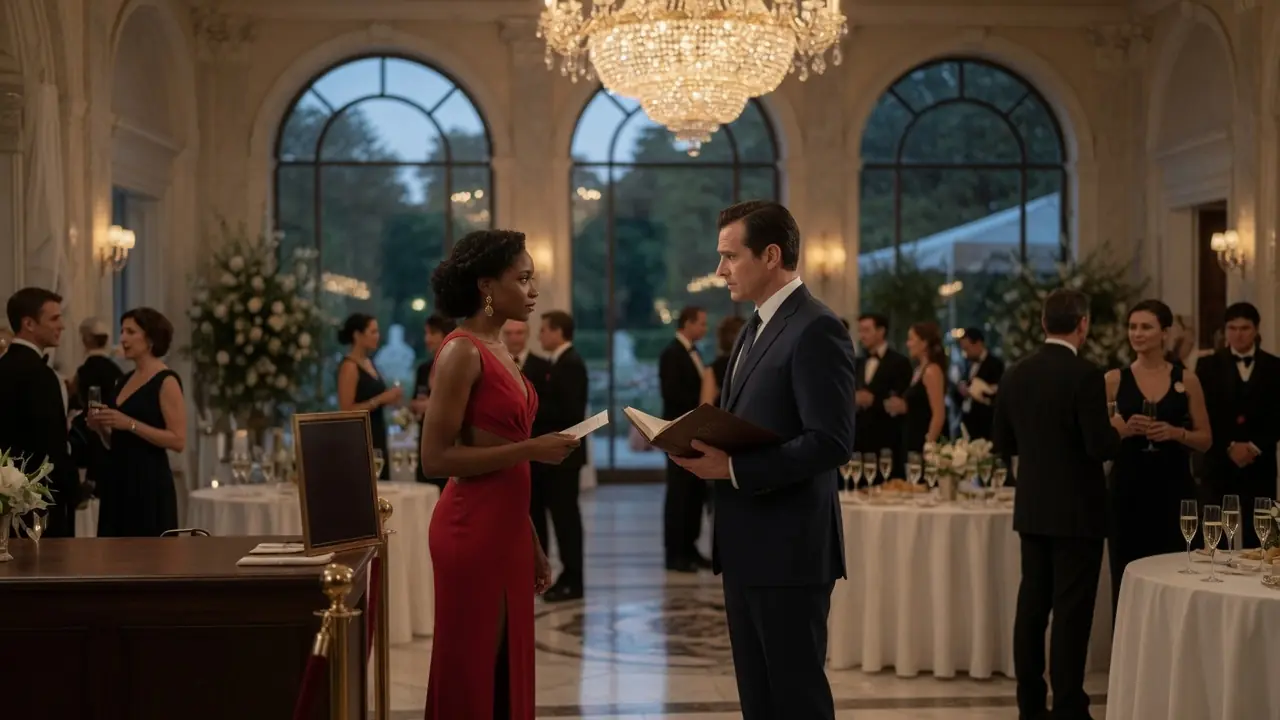
“Then check the card again,” Naomi said, her voice steady. “Because your mistake is getting expensive.” Charles’s nostrils flared. He seemed almost offended that she was not embarrassed. “No mistake, ma’am,” he said, louder now. “Names like yours do not appear on lists like mine.” Olivia’s eyes widened, and Cynthia’s mouth tightened as though Charles had said too much, but neither of them corrected him.
Naomi picked up her invitation and held it against her chest. The red of her gown looked even stronger beneath the chandelier light, and she stood with the kind of stillness that made people uncertain whether they were watching defeat or warning. “You should be very careful,” she said. Charles gave a short laugh. “Careful with what? A woman who came alone with a card anyone could have printed?”
A security guard near the doorway shifted his weight. Charles gave him a small gesture, and the guard stepped closer. The room noticed then. The conversation around the check-in stand faded into a low hush, and Naomi felt the familiar burn of being turned into a scene by people who would later call her difficult for refusing to disappear quietly. She did not look at the guard; she looked at Charles.
“If you touch me,” Naomi said, “you will regret it before dessert is served.” Charles leaned toward her, voice slick and cold. “Threats will not help your case.” Naomi answered just as quietly. “That was not a threat. It was mercy.”
Olivia finally stepped forward. “Mr. Whitmore, maybe we should check the updated donor file.” Charles turned on her with a glare so sharp she stepped back. “The ledger is final.” Olivia swallowed. “But the tablet—” “Enough,” Charles snapped. His face quickly smoothed again when he remembered the guests were watching, but Naomi had seen the crack.
Cynthia placed one hand lightly on Charles’s arm. “Perhaps we can seat her somewhere else until this is clarified.” Naomi looked at her. “Somewhere else?” Cynthia smiled with soft cruelty. “There are service tables near the back hallway. It would be more discreet.” A few guests shifted uncomfortably, but no one spoke.
Naomi felt something inside her go quiet. It was not humiliation anymore. It was record keeping. Her mind noted every witness, every exact phrase, every person who looked away, every person who smirked, and every staff member too afraid to challenge the lie. She had spent years on nonprofit boards beside billionaires, trustees, and public officials who spoke of equality while guarding their tables like inherited thrones.
Charles stepped aside and gestured toward the hallway. “You may wait there, or you may leave.” Naomi looked at the grand room behind him, at the tables Adrian had paid to fill, at the hospital banners funded by their foundation, at the guests lifting champagne glasses beneath a chandelier purchased with donor money that would not exist without her husband’s contribution. Then she looked back at Charles. “I will stand right here.”
The front doors opened behind her. At first, the sound was nothing but a small shift in the room’s attention, the subtle intake of breath that happens when someone important enters before anyone says his name. Naomi did not turn around immediately. She knew the rhythm of Adrian’s steps, the measured confidence, the calm that was never forced because he had never needed to perform power. Charles noticed him a second later, and every bit of color began draining from his face.
Adrian Sinclair crossed the marble floor in a black tailored suit, his eyes fixed on Naomi. He was tall, composed, and expressionless in a way that made the air around him feel suddenly colder. People parted without being asked. Several guests recognized him at once, and whispers began moving through the ballroom faster than the servers could carry champagne.
“Naomi,” Adrian said, stopping beside her. His hand touched the small of her back, not possessively, but with quiet solidarity. “How long have you been standing here?” Naomi did not answer directly. She looked at Charles and said, “Long enough to hear that names like mine do not appear on lists like his.” Adrian’s gaze moved slowly from Naomi to Charles.
Charles opened his mouth, but nothing came out at first. Then he forced a laugh. “Mr. Sinclair, this is an unfortunate misunderstanding.” Adrian’s voice was low. “You asked my wife to leave.” The entire ballroom seemed to stop breathing. Charles blinked as if the word wife had struck him physically.
Cynthia Langford stepped forward quickly. “Adrian, we had no idea she was—” “My wife?” Adrian finished. “That is the problem, Cynthia. You should not have needed to know.” Cynthia’s smile collapsed. Adrian looked back at Charles. “You had an invitation, a confirmed donor record, and a guest in front of you asking for basic respect. Instead, you chose to make her prove she belonged.”
Charles’s hands tightened around the guest ledger. “The name was not listed.” Adrian held out his hand without looking away from him. Olivia, trembling slightly, stepped forward and placed the tablet in Adrian’s palm. Charles’s eyes widened. “Olivia—” Adrian tapped the screen twice and turned it toward the room.
On the screen was Naomi Sinclair’s confirmed entry, highlighted under the primary benefactor table. Her name had not been missing. It had been moved into an inactive file at 5:12 p.m., twenty minutes before she arrived. The edit was tagged with Charles Whitmore’s manager credentials. A murmur traveled through the room like wind through dry leaves.
Adrian turned the tablet back toward Charles. “You erased her.” Charles shook his head. “No, that must have been an administrative error.” Adrian looked at Olivia. “Did anyone else have access to this edit?” Olivia’s voice was small but clear. “No, sir. Only Mr. Whitmore could override the benefactor table after final confirmation.” Charles looked at her like she had betrayed him, but the truth had already left her mouth.
Naomi finally turned toward the room. “He looked me in the eye and told me names like mine don’t appear on lists like his.” Her voice was calm, but it carried to every table. “Now you all know why he had to remove it first.” The guests who had watched silently began looking anywhere but at her.
Adrian stepped closer to Charles. “You removed my wife’s name from a gala funded by our foundation, then tried to send her to a service hallway.” Charles swallowed. “Mr. Sinclair, I can fix this.” Adrian’s face remained still. “No. You can explain it.”
He turned to the board members seated near the front table. “Emergency review. Now.” One of them, a silver-haired trustee named Martin Bell, stood awkwardly. “Adrian, perhaps this can wait until after the dinner.” Adrian looked at him with a calm so complete it bordered on terrifying. “This dinner exists because I wrote the check. If my wife can be erased at the door, the dinner can wait.”
The room shifted again, this time with fear. Servers stopped moving. The pianist’s hands left the keys. Naomi saw Charles glance toward the side exit, as though he could still escape into procedure. Adrian saw it too.
“Do not leave,” Adrian said. “Your access will be reviewed before you touch another guest record.” Charles’s jaw tightened. “You cannot treat me like a criminal.” Naomi answered before Adrian could. “You treated me like a fraud.” Charles looked at her then, and for the first time, there was no arrogance left in his eyes.
The board moved into a private salon beside the ballroom, but Adrian insisted the first part happen publicly. He wanted the guests to hear the facts because the insult had been public. Olivia pulled the edit log onto the large screen near the banquet stage. Naomi’s name appeared, then disappeared, then was replaced by “C. Langford Guest Allocation Hold.” Cynthia’s face turned pale.
Adrian looked at Cynthia. “You knew?” Cynthia pressed her lips together. “I asked Charles to make room for Veronica Ames. She is a major social donor.” Naomi gave a soft, humorless laugh. “So I was not misplaced. I was traded.” Cynthia’s eyes flashed with irritation, then fear when she realized how that sounded.
Charles tried to speak again. “I was following committee instructions.” Adrian shook his head. “Committee pressure did not put those words in your mouth.” He looked at the guests closest to the front. “Did anyone here hear Mr. Whitmore tell my wife that names like hers do not appear on lists like his?” No one spoke at first.
Then Olivia raised her hand. A waiter near the champagne station raised his. A woman in a green dress at the second table slowly lifted hers. Then another guest raised his hand, then another. Charles stared at the room as if he could not believe silence had abandoned him.
Naomi watched the hands rise and felt no triumph. She only felt tired. People had heard everything from the start. They had simply waited until someone more powerful asked the question. That was the part she would remember long after Charles was gone.
Adrian folded his hands in front of him. “Charles Whitmore, effective immediately, you are removed from all gala operations and venue management pending termination for cause.” Charles’s face twisted. “You’re ruining me over one mistake.” Adrian’s eyes hardened. “No. I am ending a pattern that finally reached someone you could not afford to insult.”
The security guard who had moved toward Naomi earlier now stood beside Charles, waiting for instructions. Naomi looked at him and saw embarrassment in his lowered eyes. Adrian nodded once, and the guard escorted Charles away from the check-in stand he had ruled minutes earlier. The room watched him leave, and this time no one pretended not to see.
Cynthia tried to approach Naomi after Charles disappeared. “Naomi, I am deeply sorry.” Naomi looked at her for several seconds. “You are sorry because Adrian walked in.” Cynthia opened her mouth, then closed it. Naomi continued, “Before that, you were ready to seat me by the service hallway.”
Cynthia’s face flushed. “I was trying to avoid a scene.” Naomi’s voice sharpened. “No. You were trying to avoid seeing me.” The sentence silenced everyone nearby. Adrian did not interrupt, because he knew this part belonged to her.
Naomi handed Cynthia the invitation card. “Keep it,” she said. “You seem to need proof that I was invited.” Cynthia took the card with trembling fingers. Naomi turned back toward Adrian. “I would like to sit at the table we were assigned.”
Adrian offered his arm. Together they walked through the center of the ballroom, past guests who now studied their plates, past tables that had suddenly become very interested in silence, past champagne flutes no one dared lift. Naomi did not smile. She did not look wounded. She looked like a woman reclaiming a space that had tried to swallow her name.
Their table sat beneath the chandelier, close enough to the stage that everyone could see them. Adrian pulled out Naomi’s chair, but she waited before sitting. She looked once around the room, letting every person understand that she was not being rescued into belonging. She had belonged before Adrian arrived; his entrance had only forced the room to admit it.
Dinner resumed after twenty minutes, but the room never recovered its original ease. The speeches about generosity and community sounded thinner now, almost ashamed of themselves. When Cynthia rose to address the donors, her voice shook. She thanked the Sinclair Foundation, then paused before saying Naomi’s name with visible difficulty.
Naomi listened without expression. Adrian leaned toward her and whispered, “We can leave.” Naomi looked at the untouched salad in front of her, then at the chandelier, then at the tables of people who had watched her be denied and now had to watch her remain. “No,” she said. “I want them to finish dinner with me in the room.”
The next morning, the fallout began quietly, then everywhere at once. A guest had recorded the check-in confrontation and sent it to a local journalist. By noon, the headline was spreading across business pages and social media: Black Philanthropist’s Wife Removed From Gala Guest List Funded by Her Own Family Foundation. By evening, Aldercrest’s board had suspended Cynthia Langford from all leadership duties.
Adrian did not give an angry interview. He released records: the donation agreement, the confirmed invitation, the edit log, and a short statement. “A room that requires wealth to recognize dignity does not deserve either.” The sentence was quoted so widely that the hospital board asked him to expand it into a formal ethics policy for all future fundraising events.
Charles Whitmore tried to claim the incident had been a misunderstanding. Then the edit log became public. Then three former staff members came forward with stories of other guests being moved, delayed, or “lost” depending on how they looked or who they arrived with. The misunderstanding became a pattern, and the pattern became evidence.
Two weeks later, Naomi returned to Winthrop House for a board meeting, wearing a simple cream suit and no jewelry except her wedding ring. The chandelier was still there, the marble still gleamed, and the glass doors still reflected the kind of beauty money could buy. But the check-in stand had changed. A new verification system had been installed, one that recorded every manual edit and sent donor-table changes directly to an independent oversight office.
Olivia was now the interim guest relations director. When Naomi entered, Olivia stood straighter, nervous but proud. “Good afternoon, Mrs. Sinclair,” she said. “Your seat is ready.” Naomi smiled gently. “Thank you for telling the truth.”
Olivia’s eyes softened. “I should have said something sooner.” Naomi nodded. “Most people should.” She did not say it cruelly. She said it because it was true, and truth did not become unkind simply because it arrived late.
At the meeting, Adrian announced that the Sinclair Foundation would continue funding the hospital wing, but only under new public-access and ethics guidelines. Every gala, donor dinner, and fundraising event tied to their money would require anti-discrimination audits, transparent guest-list controls, and staff reporting protections. Some board members looked uncomfortable. Naomi considered that a good beginning.
Months later, the gala became known less for the money it raised than for the moment a woman in a red dress refused to leave. People retold the story in different ways, adding details, sharpening lines, making Adrian larger than he was and Naomi quieter than she had been. But Naomi remembered the real version. She remembered standing alone at the check-in stand, watching a man erase her name and believing the room would let him.
She also remembered the moment after. Not Adrian’s entrance, not Charles’s fear, not the board’s sudden concern. She remembered choosing not to move. Before her husband entered, before the tablet exposed the truth, before anyone powerful confirmed what she already knew, Naomi Sinclair had decided the room would not remove her.
That decision mattered most. The rest was consequence.
On the anniversary of the gala, Naomi stood beside Adrian at the completed hospital wing, watching the ribbon fall cleanly to the floor. Children, doctors, nurses, donors, and reporters applauded as the doors opened behind them. This time, Naomi’s name was not hidden in a ledger or whispered as an afterthought. It was carved into the plaque at the entrance, equal in size to Adrian’s.
A young Black girl in a red dress stood near the front row with her mother, staring up at Naomi as if she were seeing a possibility she had not known how to name. Naomi noticed and smiled at her. The girl smiled back, shy at first, then with confidence. Adrian saw the exchange and squeezed Naomi’s hand.
Later, when a reporter asked Naomi what she had learned from that night at the gala, she did not mention Charles or Cynthia or the scandal. She thought carefully, then said, “I learned that erasure only works when people agree to disappear.” The reporter wrote it down immediately.
Naomi looked toward the hospital doors, toward the plaque, toward the families entering a building that existed because she and Adrian had decided power should do more than decorate itself. “I did not disappear,” she added. “And now neither will the people this wing was built to serve.”