He was already reaching for his wheels not to roll away, to disappear. The way a man disappears when the world has told him enough times and in enough ways that his presence is the problem. I was 54 years old wearing a Hells Angels cut that made people cross the street and I was standing in a strip mall parking lot in Bakersfield watching a 50-year-old man in a wheelchair get told to be invisible. He looked up at me, at the patches, at the beard, at everything the world had already decided I was. And then he whispered four words that I have never forgotten.
They told me to stay silent. I don't know what he expected me to do. I'm not sure I knew either. But what happened next in that parking lot and in the hours that followed left everyone who saw it struggling to explain what they had witnessed, including me. Michael Rourke, Beyond the Patch.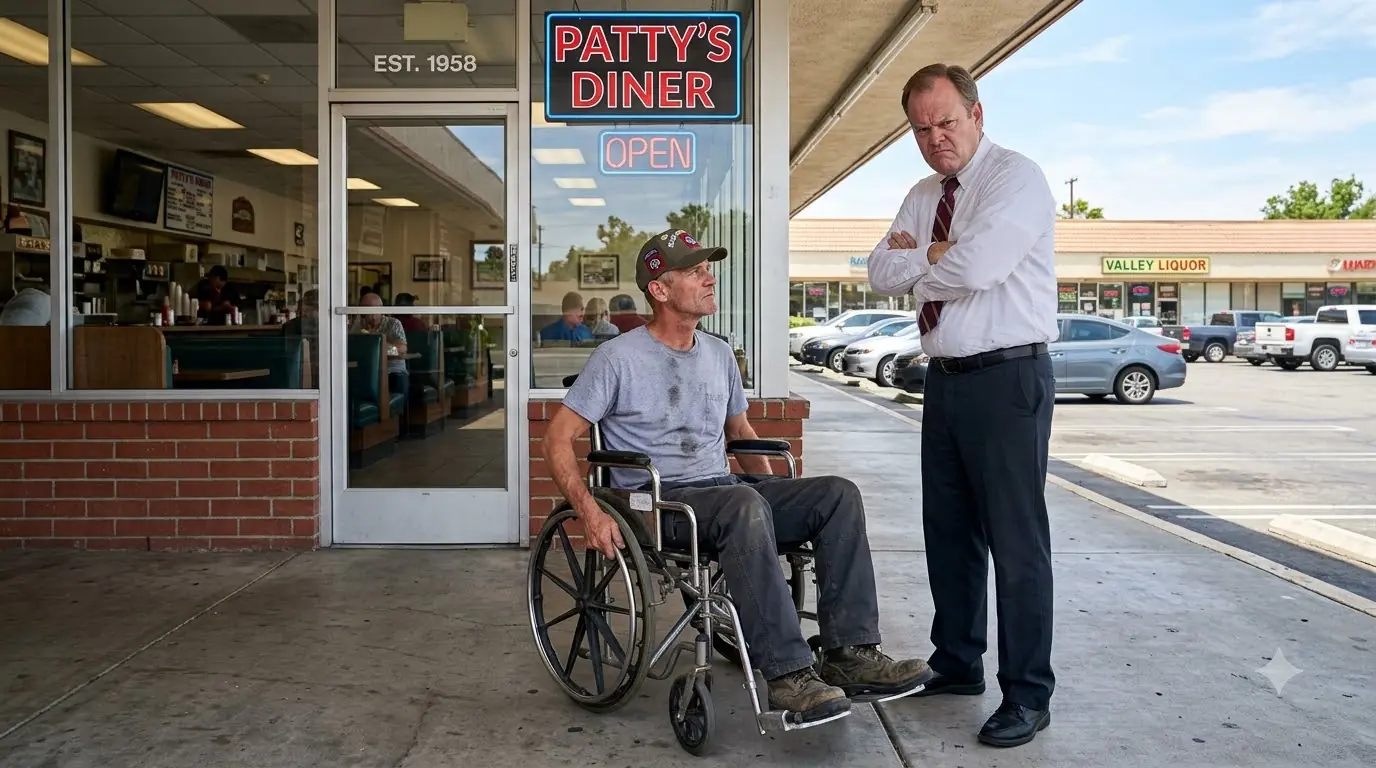
I'm 7two years old now and there are mornings when I sit on this porch with my coffee and I look out at the valley and I think about all the things I've carried through my life. Some of them I set down along the way. Some of them I still carry and some of them, the ones that matter most, I wouldn't put down for anything in this world. What I'm about to tell you happened 18 years ago when I was 54. I was a different man in some ways and in all the ways that count, exactly the same.
Bigger maybe, less patient with the ache in my knees, more certain of myself than I had any right to be. But the core of me, the thing underneath the leather and the patches and the reputation that walked into a room before I did, that was the same then as it is now. My name is Michael Rourke. I've been a member of the Hells Angels since I was 2two years old. I say that without apology and without performance.
It's what I am. It's part of what I am. And if you've already decided what that means about me, I'd ask you to hold that thought just for a while. Back in 2006, I was living on the east side of Bakersfield, the same house I'm in now, actually. Though the neighborhood has changed some since then.
The oil fields were still running strong. The almond orchards out past Rosedale Highway were in full bloom every spring. And Bakersfield had that particular energy it gets when the economy is humming. Trucks on Highway 99 at all hours. The smell of diesel and blossoms mixing in the valley air.
People working hard and spending harder on the weekends. I was 54 and I felt it. Not old, not yet, but seasoned. My hair was still mostly dark, shot through with silver at the temples and in my beard. I'd been riding since I was 19 and by that point, I had 35 years of road behind me.
My hands were rough. My knuckles had history in them. And the patch on my back, the one I'd earned more than three decades before, was as much a part of me as my own name. People had opinions about that patch. They still do.
Back then in 2006, those opinions were louder. The media had been running stories. People had ideas. I'd walk into a gas station and watch the cashier's eyes go to my cut before they went to my face. And I'd see the calculation happen in real time.
Threat assessment, they call it now. Back then, people just called it common sense. I never blamed them entirely. We weren't a book club. I knew what the club was.
I knew the weight of what I wore, but I also knew that the man wearing it, me specifically, on that specific Tuesday morning in October of 2006, was driving to a strip mall on Ming Avenue to pick up a blood pressure prescription, and maybe grab some sandpaper from the hardware store. The morning was warm, the way Bakersfield mornings are in October. Dry heat, the kind that sits on your skin politely, not the punishing summer kind. The valley sky was pale blue and wide. I drove my truck, a dark blue F-250, I'd had for a few years by then, because my left knee had been giving me grief, and I wasn't in the mood to negotiate with it on the bike.
Ming Avenue was doing its mid-morning routine. Delivery trucks, a school bus running late, old men outside the barbershop. I parked in the lot of the strip mall, pharmacy, hardware store, and at the far end, Patty's Diner, which had been there since before I moved to Bakersfield, and God willing would be there long after I was gone. I went into the pharmacy first, got my prescription from a young woman named Sandra, who always called me Mr. Rourke, and never once looked at my patches with anything other than professional indifference. I appreciated that about her more than she ever knew.
He sat in a manual wheelchair, the kind you push yourself, and his hands rested on the wheels with a practiced ease of a man who'd been living this way for some time. He wore a plain gray T-shirt, clean but faded, work boots that had seen real work, and on his head, slightly askew, a baseball cap, dark navy, with the insignia of the 82nd Airborne Division embroidered in gold above the brim. I recognized that insignia. I had brothers who'd served. I knew what that patch meant in its own way, the same way I knew what mine meant.
I was heading for the hardware store when I heard the voice. It was coming from the diner entrance, or rather from the space just outside it, where a man in a manager's uniform, short-sleeved white shirt and a clip-on tie, was standing with his arms crossed and his chin pointed down at Ray like he was addressing something considerably beneath him. "I told you already," the manager was saying, "you can't block the entrance. " Ray's voice was quiet, measured. "I'm not blocking anything.
I'm three feet from the door. You're creating an obstruction. We've had complaints. From who? That's not your concern.
I need you to move along. I slowed my walk without stopping entirely. There was a particular tone in that manager's voice. Not fear, not urgency, convenience. The man wasn't worried about an obstruction.
He was worried about optics, about a wheelchair, and a worn-out man making his diner look like a place where certain kinds of people lingered. I'm waiting for the paratransit bus, Ray said, still calm. It'll be here in 20 minutes. I'm not bothering anyone. I don't care what you're waiting for.
This is private property, and I'm asking you to leave. Ray looked up at him then, and even from 15 feet away, I could see the exhaustion in that look. Not the exhaustion of that morning, but the accumulated exhaustion of a man who'd had this conversation, or variations of it, more times than he could count. The exhaustion of someone who had learned, through long and grinding experience, that the world considered his presence an inconvenience. He reached for his wheels.
That's what got me. Not the manager's tone, not even the injustice of it, though both of those things were working in me already. What got me was the moment Ray Callaway reached for those wheels with the resigned, automatic motion of a man who had been told to disappear so many times that he'd stopped arguing about it. I changed direction. I want to be clear about something.
I'm not a hero. Never have been, never claimed to be. In 54 years of living at that point, I'd done things I'm not proud of, made choices that cost people I cared about, and moved through the world in ways that didn't always leave it better than I found it. I knew that about myself, still know it, but there are moments when something in you recognizes something in another person. Not the details, not the story, not the name or the history, just the essential thing, the human thing.
And in that moment of recognition, you either act or you don't, and the choice you make says more about who you are than anything you've ever told yourself in a mirror. I walked toward them. The manager saw me coming before Ray did. I watched the man's expression do something complicated. The professional hostility he'd been directing at Ray suddenly encountering a new variable, one he wasn't sure how to calculate.
A man my size in those days with my cut on and 18 inches of silver-streaked beard and 35 years of road worn into my face, I registered differently than Ray had. I could see it happening behind his eyes. "There a problem here? " I asked. I kept my voice level, calm.
I've learned that calm is more unsettling than loud in most situations. The manager straightened, found some professional footing. "This isn't your business, sir. I was just asking this gentleman. " "I heard what you were asking.
" I stopped next to Ray's wheelchair, looked down at him briefly. He was looking up at me with those pale blue eyes, and there was something in them I couldn't entirely read. Weariness, maybe. Curiosity. A man who'd learned not to assume that a new arrival to a conflict was necessarily on his side.
"You okay? " I asked him. He studied me for a moment. The patches, the beard, the general impression I made. Then he said quietly, "They told me to stay silent.
Said I was causing a problem just by being here. " Those words landed somewhere specific in me. "They told me to stay silent. " I turned back to the manager. "What's your name?
" The man blinked. "Excuse me? " "Your name. What is it? " "I'm the manager of this establishment and I don't see what" "Because when I call your corporate office in about 3 minutes," I said, "I'd like to be accurate about who I spoke with.
" Something shifted in the manager's posture. Not dramatically. He wasn't the kind of man who collapsed under pressure. I could see that. But there was a recalibration.
"His wheelchair's blocking customer access to the entrance," he said with slightly less certainty than before. I looked at the entrance, looked at Ray, looked at the concrete planter, the width of the walkway, the actual spatial reality of the situation. "No, it isn't," I said simply. "Sir, I'm going to have to ask you" "He's waiting for paratransit," I said. "20 minutes.
He's got a legal right to be on this public walkway and his chair is not blocking anything. " I pulled out my phone, a Nokia brick of a thing. This was 2006. Nobody had smartphones yet. And made a show of looking at it.
"What's the name of this franchise? Patty's is locally owned, or is it a chain? The manager stared at me. A couple coming out of the diner had stopped to watch. A woman with a stroller had paused on the walkway, pretending to check something in her bag while clearly listening.
"Locally owned," the manager said, quieter now. "Then I'll be speaking with the owner directly. " I looked at the sign above the door. Patricia Harmon, the name on the business license in the window. Another pause, longer this time.
The manager's jaw worked slightly. He was doing the math. A man in a Hells Angels cut, who clearly knew enough to ask about business licenses, an audience that was quietly forming, a situation that had moved well past the easy resolution he'd expected when he'd walked out to dismiss one man in a wheelchair. "He can stay for 20 minutes," the manager said finally. His voice had the particular flat quality of a man who has decided that retreat is the better part of valor, but refuses to frame it that way.
He went back inside. I looked down at Ray Callaway. He was watching me with an expression I still think about 18 years later, like a man who had prepared himself for one kind of outcome and found himself in the middle of a completely different one. He didn't look relieved exactly. He looked careful, like a man who'd learned that unexpected interventions sometimes came with their own costs.
"You didn't have to do that," he said. "I know. " I looked around for a moment, then back at him. ""Mind if I wait with you? "" He looked at me for a long moment, those pale blue eyes doing their own calculation.
"You're Hells Angels," he said, not accusing, just stating. "Have been since '74," I said. He nodded slowly. Something in him seemed to settle, though I couldn't tell you exactly why. Maybe because I hadn't denied it.
Maybe because a man who states what he is plainly is easier to trust than one who performs something else. "Ray Callaway," he said, and extended his hand. I shook it. His grip was firm, direct, the handshake of a man who'd learned to make certain things count. "Michael Rourke," I said.
We stood. He sat. I stood in the October warmth, and neither of us said anything for a moment. A delivery truck rumbled past on Ming Avenue. Somewhere down the strip mall, a car alarm chirped and went silent.
"82nd Airborne," I said, nodding at his cap. Something moved across his face, pride and grief in the same motion, the way it always is with men who've served. "Three tours," he said. "Last one was '85. Mogadishu was later, but" he stopped, shook his head slightly, "different life.
" "The chair," I said carefully. I didn't finish the sentence. Some things you don't finish. You leave space and let the other person decide what to put there. "Accident," he said, "not combat.
That's the joke of it. " A brief, humorless smile. "Made it through three tours, and then a drunk driver on the Highway 99 took my legs in 1987. " He said it the way men say things they've said a thousand times, not without weight, but with the weight distributed evenly, not concentrated in any one place. I was 29 years old.
I thought about myself at 29, what I'd been doing, who I'd been, the world that had been available to me, the way I could walk into any room and occupy it on my own terms. "Where are you headed? " I asked. "Medical appointment, Kaiser on Stockdale. " He glanced down the street in the direction the paratransit bus would come from.
"Bus was supposed to be here at 10:15. It's 10:38. " "They're often late. " A look that answered that question without words. I thought for a moment, then I said, "I've got my truck.
I can drive you. " Ray looked at me, the careful look again. "You don't know me. " "You don't know me, either. " I said.
"Here we both are. " He seemed to consider this. Then slowly, something in his expression shifted. Not the trust, exactly, but to a kind of provisional openness, the kind that a man arrives at when he's weighed his options and decided that the risk of accepting help is lower than the cost of refusing it one more time. "I've got a folding chair.
" he said. "It fits in most trucks. " "Then let's go. " I said. It was while I was loading Ray's folded wheelchair into the bed of my F-250 that I became aware we had an audience.
The woman with the stroller had drifted closer. Two men who'd been sitting on a bench outside the hardware store were watching. And in the window of Patty's Diner, visible through the glass, the manager stood watching with an expression I couldn't fully read from that distance. "Let them watch," I thought. "Let them see what they're seeing and figure out what to do with it.
" I helped Ray into the passenger seat. He moved with practiced efficiency, his arms doing the work his legs couldn't, pulling himself up with a strength that was matter-of-fact and quietly impressive. He settled in, pulled the door shut, and looked straight ahead through the windshield. I got in, started the engine, and we pulled out of the Ming Avenue strip mall into the mid-morning Bakersfield traffic. "Thank you," Ray said after a moment.
Just those two words, but the weight in them was considerable. "Don't mention it," I said. We drove in a comfortable silence for a minute, then Ray said something that I've thought about many times since. "I've been invisible for a long time," he said. "You get used to it.
And then when someone actually sees you, it's almost" He paused, looked out the window at the valley moving past. "It's almost harder than the invisible days because you remember that it doesn't have to be like this. " I kept my eyes on the road. The San Joaquin Valley stretched around us, flat and vast and golden in the October light. "It does," I agreed.
The drive to Kaiser on Stockdale Highway wasn't long, maybe 12 minutes in mid-morning traffic, but sometimes 12 minutes is enough to change the shape of a day. And occasionally, if you're paying attention, the shape of something larger. Ray told me, in pieces, the way men tell things when they're not sure how much to say, about the accident, about the years of rehabilitation, about the particular bureaucratic maze of being a disabled veteran in the late 1980s and through the 1990s. The VA system that moved like cold honey, the disability applications that took two years and three appeals, the apartment he lost while he was in the hospital because nobody had thought to help him maintain the lease. "I had people who helped," he said, and I noticed he was careful to say this, careful to acknowledge it as if the alternative was ingratitude.
"My sister Annie came out from Fresno for six months. Couple of army buddies showed up when they could. " He paused. "But you find out real fast who stays and who goes, and most people go. " I understood something about that, not from disability, from the club, from the way people's loyalties reveal themselves under pressure, from funerals and courtrooms and moments of crisis that separated the real thing from the performance of it.
"Where you living now? " I asked. "Apartment on Beale Avenue, Section 8. " He said it without apology or embarrassment, the way you state a fact about weather. "It's a good place, quiet neighbors, accessible bathroom.
" A brief pause. "The elevator breaks down twice a month. How do you manage when it does? " "I wait. " A pause.
"Or I go down the stairs on my hands if I need to badly enough. " I thought about that image, a man lowering himself down a staircase on his arms, his useless legs trailing behind him because a machine had broken down and nobody had fixed it fast enough. And I felt something in my chest that wasn't quite anger and wasn't quite grief, but lived somewhere between the two. You work? I asked.
I do some bookkeeping. Couple of small businesses let me do their accounts from home. It's not He glanced at me. It keeps me useful. That matters.
It does, I said. We were on Stockdale Highway now, the Kaiser campus coming up on the left. I put on my signal and Ray turned slightly in his seat to look at me. Really look at me, the way people do when they're deciding to say something they weren't planning to say. Why did you come over?
He asked. Back there. You didn't have to. I thought about that for a moment. I could have given him a simple answer.
I could have said something general about fairness or decency. Instead I found myself saying something closer to the truth. I know what it's like, I said, to have people decide who you are before you said a single word. To have them look at you and think they already know the whole story. I glanced at him briefly, then back at the road.
I'm not comparing my situation to yours. I know the difference, but I know that feeling of having someone look right through you, like you're not worth the space you're standing in. I paused. It makes me tired when I see it happening to somebody else. It makes me angry.
Ray was quiet for a moment. Then he said, most people who came to help me over the years felt sorry for me. I could always tell, the way they'd look at the chair first, and then try to pretend they hadn't. I noticed the cap first, I said honestly. He absorbed that.
Something in him seemed to relax by a fraction. You know the 82nd had a brother in the club who served with the 101st, Korea, not Vietnam. He used to say the airborne boys were I smiled slightly. Well, he used the kind of language I won't repeat, but it was complimentary in his way. Ray made a sound that was almost a laugh, almost.
I pulled into the Kaiser parking lot and found a spot in the accessible zone near the entrance. I got out, retrieved his chair from the bed of the truck, and brought it around to his door. He watched me unfold it and set it up with the practiced attention of a man who has had people do this wrong for him many times. I must have done it right because he nodded slightly and moved himself from the seat into the chair with that same efficient, no wasted motion grace I'd noticed before. Once settled, he gripped his wheels and looked up at me.
You don't have to wait, he said. I know, I said. How long's the appointment? Probably an hour, maybe more. These things He made a small gesture that encompassed the inefficiency of large medical institutions.
I'll be in the waiting room, I said. He looked at me for a long moment. There was something happening in his face that I recognized from other context, the difficult work of accepting help from a source you hadn't expected it from, without letting the surprise of it make you suspicious, without letting the relief of it make you weak. The careful navigation of genuine need and genuine pride meeting in the same moment. "All right," he said finally.
The waiting room at Kaiser Stockdale was the particular beige purgatory that all medical waiting rooms aspire to. Plastic chairs, a television mounted too high showing a talk show with the sound low. Magazines from three months ago, the smell of recycled air and hand sanitizer. I sat in a chair by the window and watched the parking lot and thought about the morning. Around me people came and went.
A young woman with a crying baby, an elderly man who'd come alone and seemed uncertain about the check-in process. I watched the receptionist help him patiently and felt an uncomplicated gratitude for that small act. A teenager with his arm in a fresh cast, phone in his good hand, texting rapidly. Regular life, the vast and unglamorous machinery of regular life grinding forward. I thought about what Ray had said, "I've been invisible for a long time and then when someone actually sees you, it's almost harder than the invisible days.
" I understood that more than I'd let on in the car. There's a particular loneliness that comes with being categorized, with being filed away in a mental folder the moment you walk through a door. It doesn't matter what the folder says, dangerous, pitiful, inconvenient, irrelevant. The common element is that you stop being a specific person and become an instance of a type. And you can either rage against it or you can accept it.
And either way, you're still in the folder and the person doing the filing has moved on with their day. I was 54 years old and I had been filed away in people's mental folders since I was 22. I was used to it, but used to it and at peace with it are different things. What I hadn't been prepared for, sitting in that Kaiser waiting room watching the talk show on the silent television, was the way Ray's simple acknowledgement of being seen had hit me. It's almost harder than the invisible days because you remember that it doesn't have to be like this.
That cut both ways. My phone rang. It was a club brother named Dennis. I'd been supposed to meet him at the shop on Union Avenue at noon to look at a carburetor situation. I'd forgotten entirely.
"Yeah, I got held up. " I said. "Something came up. Give me a couple hours. " Dennis, who had known me for 15 years, asked no further questions.
That's the thing about people who actually know you. They trust the shape of you even when they don't have the details. Ray came out after an hour and 20 minutes. He wheeled himself into the waiting area and found me by the window. And again, I saw that flash of something in his expression.
Recalibration. The update to his working model of what had happened today and what it meant. "Blood pressure. " he said by way of summary. "Same as me.
" I said. He looked at that for a moment, then made the sound that was closer to a laugh this time, more complete. "I'll take you home," I said. The apartment building on Beale Avenue was a three-story block from the early 1970s, the kind of utilitarian construction that got put up fast and without elegance when housing was needed and aesthetics were secondary concern. It had been maintained adequately.
The accessible ramp from the parking area was in reasonable repair. The landscaping was minimal, a strip of drought-tolerant plants along the front that got watered by a timer and survived without flourishing. The elevator was in fact broken. There was a hand-lettered sign on the door, "Out of service, repair scheduled, no date given. " Ray looked at it with the expression of a man who had seen this particular sign before.
"Third time this month," he said. I looked at the staircase, three flights. Ray in a manual wheelchair. "Where's your apartment? " I asked.
"Third floor. " He said it the way you say something you've made your peace with, even though you haven't really. "I can manage. I've done it. " "I know you have," I said.
"You don't have to today. " He turned slightly in his chair to look at me. "You going to carry me up three flights of stairs? " "Chair and all if you'll let me. " A long pause.
The afternoon light coming through the lobby windows was warm and golden, the kind of Bakersfield afternoon that looks like it was designed by someone who wanted to make hard things look bearable. "The chair folds," he said finally. It took us three careful trips. Ray first, moving himself up the stairs with his hands and his arms in that lowered to the ground method he described, which was as hard to watch as I'd imagined and harder. Then his folded chair, then his bag from the medical appointment.
By the time we reached the third floor landing, I was breathing harder than I like to admit, and Ray had already settled himself back into his chair with the efficient speed of long practice. He led me down the hallway to apartment 312. The door was standard, not widened, and he navigated through it with the millimeter precision of a man who knew exactly how much space his chair needed and exactly how much the door gave him. The apartment was small and precise. Everything had been arranged to be reachable.
Counters at the right height, furniture positioned to leave clear paths. A kitchen modified with lower shelves and pull-out drawers. It was the apartment of a man who had made decisions about every square foot based on function and who had found within those functional constraints a space that was genuinely his. On the wall above a small desk, there were photographs. Military.
A younger Ray, barely recognizable. All energy and certainty. The wheelchair version of himself decades away. With other men in uniform. Below those, a few civilian photographs.
A woman I took to be a sister. The family resemblance strong. A landscape that looked like it might be somewhere in Virginia or the Carolinas. Mountains. Early fall color.
And in a simple frame, a citation. I didn't read it, but I saw the formal typography, the official seals. "You want coffee? " Ray asked. He'd already moved to the kitchen with the ease of a man in his own domain.
"Sure," I said. He made coffee with a drip machine positioned at the edge of the counter, his movements economical and unhurried. I sat in the living room. There was one armchair positioned at an angle that made conversation easy with someone at wheelchair height, and I recognized that this was intentional, and looked at the photographs. I thought about what had happened that morning, the manager and his manufactured obstruction, Ray's hands reaching for his wheels with that resigned automatic motion, the drive, the waiting room, the broken elevator.
None of it was dramatic, exactly. There was no single moment of crisis, no obvious villain twirling a mustache, just the accumulated friction of a world that had been designed without Ray Callaway in mind, and maintained that design with the casual indifference of systems that don't think of themselves as making choices. Ray came out with two mugs and set mine on the small table beside the armchair with the quiet competence of a good host working within unconventional logistics. "Can I ask you something? " I said.
"Go ahead. " "This morning, before I came over, you were going to move. You'd already decided to go. " He wrapped both hands around his mug, looked at it. Yeah, why?
A long pause. He wasn't avoiding the question. He was finding the honest answer, which sometimes takes a moment. Because the fight cost something, he said, every time. Even when you're right, even when you win, and mostly you don't win.
It cost. And sometimes you look at what's in front of you and you think, is this the one I spend that on? He looked up at me. I've got a fixed amount of energy. Every day, that's what I have.
Fighting some diner manager about whether my chair is 3 in over some imaginary line. He shook his head. Some days it doesn't make the list. I heard that, really heard it. But it should make someone's list, I said.
Something shifted in his face. Yeah, he said quietly, it should. We drank coffee in a silence that had settled into something comfortable. The silence between two people who have moved past the initial uncertainty and arrived somewhere more honest. Outside the window, a Bakersfield afternoon was doing what Bakersfield afternoons do, deepening toward the amber hour when the light gets thick and the valley fills with it like a bowl.
You've been carrying that a long time, I said. The invisible thing. "Nineteen years," he said, since the accident. He paused long enough that it became normal. And then you stop fighting it because normal is what you navigate, not what you fight.
But you didn't go fully invisible, I said. I nodded at the photographs. The bookkeeping, the apartment, the way you run this place. A small genuine smile this time. I'm stubborn, he said.
My sister Annie would tell you that's the defining feature. Ask her about Thanksgiving 1991 sometime. What happened in 1991? I'll tell you if you come back. He said it matter-of-factly, not as an invitation weighted with anything except the simple extension of one.
The way you extend an invitation to someone you decided is worth knowing. I thought about that, about the strangeness of the morning, a blood pressure prescription, an errand to a hardware store I never made it to, and now this, sitting in a third-floor apartment on Beale Avenue with a 50-year-old disabled veteran drinking coffee and talking about Thanksgiving. I might take you up on that, I said. He nodded as if it were settled. It was on my way out.
Ray had insisted on seeing me to the door in the way that men who value courtesy maintain it regardless of logistics. That I passed the desk with the photographs again, and this time I caught one I'd missed earlier. A small photo, the older square format of the early 1980s showing a younger Ray, mid-20s, pre-accident, standing straight and easy in civilian clothes outside what looked like a diner not unlike Pattie's with his arm around a woman who was laughing at something outside the frame. Something about it stopped me. The casual ease of it.
The weight his body carried then, not burden, just mass, just the uncomplicated physical presence of a man who moved through a world that had been designed for him. I didn't say anything. I didn't need to. Ray had seen me notice it, and we both understood what was in that photograph, and what was in this room 18 years later, and neither of us needed to put language around it. "Tomorrow morning," I said at the door, ""that elevator is going to be fixed.
"" He looked at me, the careful look, one more time. ""You know people? "" "I know enough people," I said, "and I know how to talk to the ones I don't know yet. " A long pause. Outside in the hallway, somewhere a door opened and closed.
The muffled sound of a television, the ordinary sounds of people living in proximity to each other. "Michael," Ray said, "I stopped. " "Thank you. " He held my eyes when he said it. Not the earlier thank you, not the reflexive one that closes a transaction.
This one was different. This was a kind of thank you that has weight and history and admission in it. The kind that acknowledges not just the thing done, but the seeing that preceded it. Not just for the ride, for he paused, found the word, "for the full thing. " I nodded.
I didn't have a speech. I just nodded and went out into the hallway and walked back down the three flights of stairs to the afternoon. I made two phone calls on the way back to my truck. The first was to Dennis to tell him I'd be at the shop by 4:00 and apologize for the wasted afternoon. Dennis told me not to worry about it.
The carburetor wasn't going anywhere and asked if everything was all right. "Yeah," I said, "actually, yeah. Everything's all right. " The second call was to a man named Gary Webb, no relation to the journalist, who was on the board of Ray's apartment buildings management company. I knew Gary because Gary had bought a bike from me 3 years prior and we'd stayed in cordial contact.
He was the kind of man who responds well to direct conversation and I was in the mood for direct conversation. I told Gary about the elevator. I told him it had been broken three times that month. I told him there was a disabled veteran on the third floor who was navigating stairwells on his hands because the building's accessible infrastructure was maintained with the urgency of something nobody important cared about. I told him that I found this to be a problem worth solving and that I was happy to follow up to confirm it had been solved.
Gary thanked me for bringing it to his attention and told me someone would be there the next day. "Today," I said, not unkindly. A pause. "Today," Gary confirmed. I drove back down Beale Avenue toward the highway.
The afternoon had gone full amber now, the San Joaquin Valley doing its evening trick of turning everything honey-colored and heavy. I drove with the window down and the warm air moving through the cab and I thought about the day and what it had been. Nothing dramatic by the standards of the life I'd lived. No violence, no confrontation beyond the bloodless standoff with a diner manager, no revelation delivered in lightning and thunder, just a man in a wheelchair who needed someone to be in his corner for 20 minutes and then for a few hours after that, and who had gone so long without that specific thing that it's arrival had cracked something open in him that it broke my heart a little to see. I thought about what Ray had said, it's almost harder than the invisible days because you remember that it doesn't have to be like this.
I thought about what I'd said in return, it doesn't. And I thought about how many times I'd said some version of that to myself in different contexts over the years. Usually in the middle of the night in the particular silence of a man who has made many choices and is not always sure which ones he stands behind. It doesn't have to be like this. The biker's creed and the veteran's creed and maybe the basic creed of any person who has been shaped by hard experience but has not let it make them hard all the way through.
The shop on Union Avenue was cool and smelled of motor oil and metal. The smell I'd associated with satisfaction for most of my adult life. Dennis was there as expected with a carburetor disassembled on a clean towel on the workbench. He looked up when I came in, read something in my face that he didn't comment on, and handed me a cold can of Coke from the small fridge by the door. Carburetor, he said.
Carburetor, I agreed. We worked for two hours in the comfortable company of men who know each other well enough not to perform anything. I thought about what I was going to do next, not about the carburetor, but about Ray, about the morning, about the shape of what had happened and whether there was more of it available. I went back to Beale Avenue Three days later, not for any particular reason, just to check in the way you check in on people who have moved from the category of stranger to something else. The elevator was working.
Gary had been as good as his word, or my persuasion had been sufficient, or both. Ray answered the door and looked at me with those careful blue eyes, and then after a moment, pulled the door wider. "I was going to make lunch," he said. "You know how to make anything useful in a kitchen? " "I make a decent grilled cheese," I said.
"That'll do. " I went in. The apartment was exactly as I remembered it. The photographs on the wall, the modified kitchen, the armchair positioned at the right height for conversation, the October light coming through the windows, different from 3 days ago, a little softer, a little more like the light that comes just before the season fully turns. We made lunch, grilled cheese, tomato soup from a can, the kind of meal that has no pretense in it.
We ate at the small kitchen table, and Ray told me about Thanksgiving 1991, which turned out to involve a disagreement about whether a turkey could be adequately cooked in a modified roasting pan at a rehabilitation facility, and which his sister Annie maintained to this day he had been wrong about, and which he maintained with equal firmness he had been right about. It was a good story, funny in the way that only stories told from a safe distance from their own pain can be funny. I laughed, a real laugh, the kind that comes from somewhere genuine and uncomplicated. I want to tell you that what happened next was simple, that Ray and I became friends, that things got easier for him, that the world adjusted in small ways to acknowledge what it owed a 50-year-old disabled veteran who did his bookkeeping from a third floor apartment on Beale Avenue. Some of that happened.
The elevator got maintained better after my conversation with Gary. I'm not certain there's a direct line there, but the timing was suggestive. I gave Ray my number and told him to call me if the paratransit was late again and he needed a ride, and he called three times over the following months. And I drove him each time without making anything of it. We didn't become inseparable.
We weren't that kind of story, but we became something, a reliable thing, a mutual acknowledgement. The club brother who had no interest in his patches and the veteran who'd stopped expecting anyone to see past the chair. Two men who had been categorized by the world in ways that didn't fully account for them finding in each other a space where the categories mattered less. I think about that morning a lot now that I'm 72 and the world has gotten quieter around me. I think about the specific moment, Ray's hands reaching for those wheels, the automatic resignation of it, that made me change direction in a Ming Avenue parking lot.
I've asked myself over the years what I would say if someone asked me why I did it. The real why, not the simple version. And the honest answer is this, because I knew that feeling. The feeling of being looked at and not seen. Of being processed as a type rather than a person.
Of having your presence assessed as a problem before you'd said a word. I had that feeling my whole adult life and I'd made a kind of peace with it. Built walls, built reputation, built the particular armor of a man who has decided that the world's opinion of him is not his problem to manage. But armor is not the same as wholeness and walls keep things out in both directions. What Ray Callaway gave me that morning by whispering those words, they told me to stay silent, was a reminder of something I'd been keeping at a certain distance.
That the invisibility I'd made my peace with was not something to be at peace with. That the world's decision about who I was, based on my cut and my patches and my face, was no more true of me than its decision about Ray was true of him. And that the only response to that, the only one that cost you something real and means something real, is to see the person in front of you clearly and act on what you see. I drove home from the shop that Tuesday evening as the sky over Bakersfield went from amber to orange to the deep purple blue that comes just before dark. Highway 99 hummed under my tires.
The valley smelled like earth and diesel and faintly the blossoms from somewhere out past Rosedale. 18 years ago. I'm 72 now. Ray will be 68 this spring. I still know this because we still talk a few times a year, the way two people talk when the connection between them has been made of something solid enough not to require constant maintenance. His sister Annie moved to Bakersfield eventually, which Ray describes as both the best and most exhausting development in recent memory.
The elevator on Beale Avenue still breaks sometimes, though less. He called me last month just to talk, he said. Told me about a book he'd read, a documentary he'd watched about veterans and the VA system, something that had moved him and made him angry. And then he said, made him think about that Tuesday morning in 2006, about being told to stay silent and choosing for once not to. You didn't tell me to do anything differently, he said.
You just showed up and didn't leave. That's all it was, I said. That's everything, he said. I've thought about that a lot, whether showing up and not leaving is enough, whether it counts as anything against the scale of everything that goes unseen, unheard, unmended. Whether one morning on Ming Avenue, one elevator call to Gary, one grilled cheese sandwich on a Wednesday afternoon in October adds up to anything worth the telling.
I think it does. Not because any of it was large, but because the things that change people, the things that actually move the shape of a life, even slightly, are almost never large. They are almost always small. A shift in direction across a parking lot, a question asked instead of a silence maintained, a hand extended and taken. The world decided long ago what I was, a biker, a threat, an inconvenience, a man to be moved away from in line, assessed at gas stations, given wide berth on sidewalks.
Ray Callaway had been decided, too, an obstacle, an awkward presence, a man to be moved along. We were both of us more than what the world had decided. We both knew it.
And on a warm October morning in Bakersfield, California, we happened to be in the same parking lot at the same time, and neither of us looked away. That's the whole story. That's all of it.