“Service staff uses the side entrance.”
The words were delivered with the kind of bored confidence that made them worse. Simone Caldwell stopped beside the reception desk at Teterboro Airport, one hand still wrapped around the worn leather handle of a duffel bag she had carried since her first year in business. She looked behind herself once, just to make certain there was not actually a catering crew standing there.
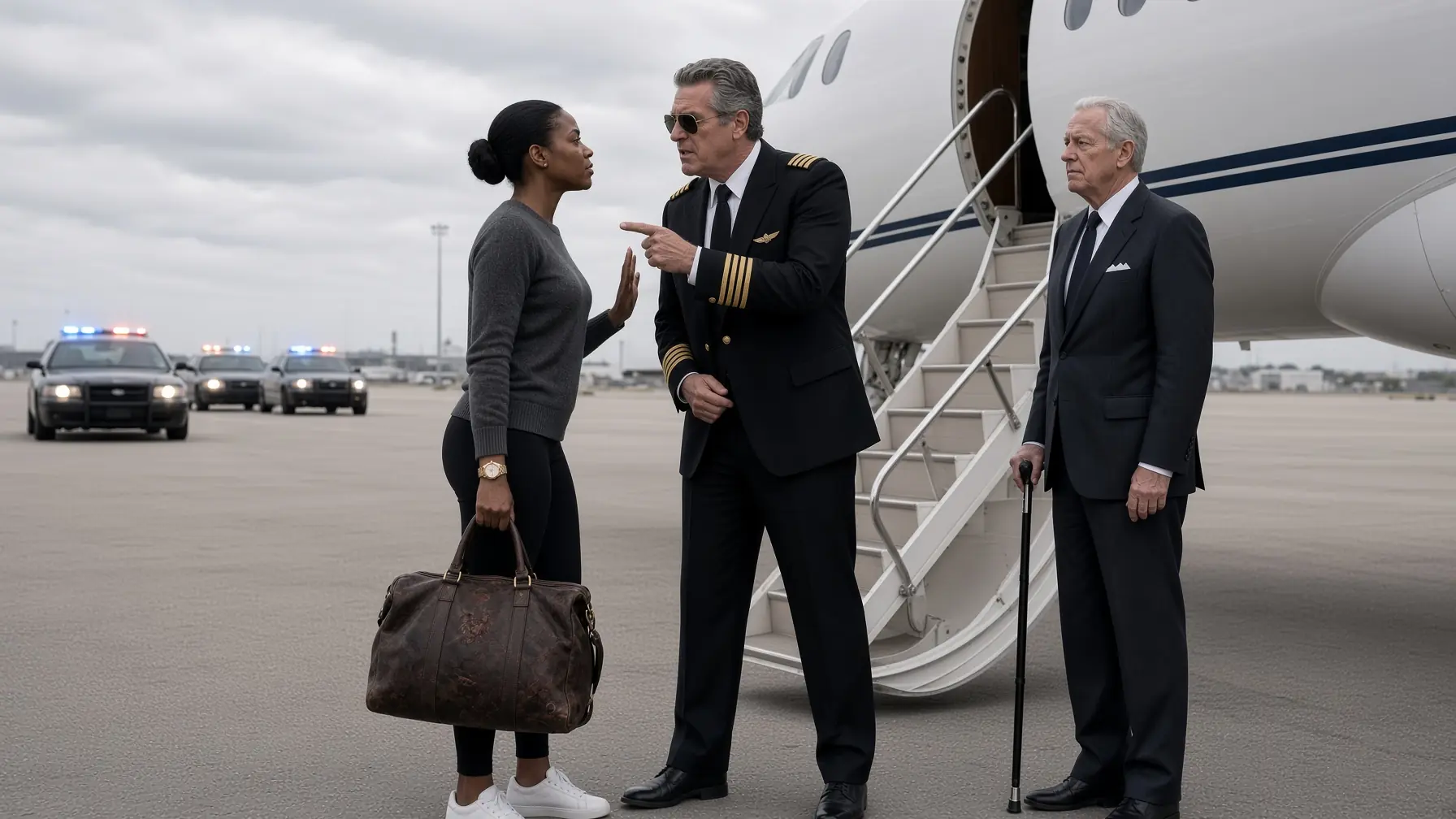
There wasn’t. The lobby was nearly empty except for a businessman reading financial news, two pilots drinking coffee near the windows, and Miles Broderick behind the FBO desk. Miles had looked at Simone’s white sneakers, black travel pants, charcoal cashmere sweater, and battered bag before apparently deciding everything else about her.
“I’m not service staff,” Simone said. “I’m here for Northstar Seven.”
Miles barely glanced at his screen. “Catering for Northstar uses the loading corridor around the east side.” He pointed toward a set of doors without looking at her again. “You’ll need a ramp vest before anyone lets you near the aircraft.”
Simone rested both hands on the desk. “Tail number N781NC. Bombardier Global 7500. Departure filed for Geneva at fourteen hundred.” She waited until Miles finally looked at her. “I’m the passenger.”
His expression changed, but not in the direction she expected. Amusement appeared first, followed by the faint irritation of a man who believed someone beneath him had told a joke at his expense. “That aircraft is privately managed for Northstar Freight Systems.”
“Yes.”
“The principal passenger is Simone Caldwell.”
“Yes.”
Miles leaned back. “And you’re telling me you’re Simone Caldwell.”
“I am.”
For several seconds, he simply stared. Simone had seen that look before in banks, conference centers, executive clubs, even inside buildings her company leased. There was always a moment when someone had to reconcile the person standing in front of them with the image they had unconsciously built around money, power, race, age, or status.
Simone was thirty-nine years old and Black. She had founded Northstar Freight Systems at twenty-six with a leased warehouse outside Detroit, three secondhand delivery vans, and a line of credit her mother had begged her not to take. Thirteen years later, Northstar coordinated logistics across North America and Europe, employed more than twenty thousand people, and moved everything from medical equipment to industrial components.
She did not dress like the magazine photographs when she traveled. No structured blazer, no heels, no executive entourage walking five steps behind her. Long flights were uncomfortable enough without turning clothing into another board meeting.
Miles looked toward her duffel again. “Do you have authorization from Northstar flight operations?”
“I am Northstar flight operations’ principal traveler today.”
“That isn’t what I asked.”
Simone took out her phone. “Would you like the trip authorization number?”
Miles gave a short laugh. “Ma’am, I deal with assistants trying to ride empty legs all the time. I’m trying to save you some embarrassment before the actual passenger arrives.”
Simone stopped smiling. “You could also look at the passenger manifest.”
Miles’s fingers rested on the keyboard. He did not type. “You could also sit down until we sort this out.”
Before Simone answered, the tarmac doors opened and a pilot walked into the lobby carrying a paper coffee cup. Captain Peter Lang was fifty-seven, silver-haired, broad through the chest, and wore four gold stripes with the practiced confidence of a man who had spent decades being addressed as Captain before anyone knew his first name. Behind him came Lauren Beck, the cabin attendant assigned to Northstar Seven, already dressed for an overnight crossing.
Peter saw Simone near the desk and held his half-empty cup toward her. “Could you toss this for me?”
Simone looked at the cup. Then at him.
Peter moved it closer. “Trash is right there.”
“I can see it.”
He frowned. “Then?”
“You can throw it away.”
Lauren covered a smile with one hand.
Peter lowered the cup slowly. “Excuse me?”
Miles turned toward him. “She says she’s Ms. Caldwell.”
Peter’s face changed instantly into open disbelief. “Our Ms. Caldwell?”
Simone said, “Your passenger, yes.”
Lauren laughed once before apparently realizing Simone was serious. “Oh.”
Peter looked her over again. “I’ve never met Ms. Caldwell personally.”
“That makes two of us,” Simone said. “I’ve never met you personally either.”
Peter’s mouth tightened. “I’ve been assigned to Northstar Seven for three months.”
“And I’ve owned it for four years.”
The businessman reading financial news lowered his tablet. Simone noticed but ignored him.
Peter turned to Miles. “Did you verify her?”
“I’m trying.”
“No,” Simone said. “You’re avoiding verification because verification might contradict your assumption.”
Lauren crossed her arms. “You have to understand how this looks.”
Simone turned toward her. “Explain it.”
Lauren hesitated.
“How does it look?”
Nobody answered.
That silence lasted only a few seconds before the main doors opened again and brought in enough noise to rescue all three of them from the question.
Charles Wexler entered with two assistants and the mood of a man accustomed to rooms reorganizing themselves around his inconvenience. He was in his early sixties, red-faced from anger, carrying a walking stick he did not appear to need so much as enjoy pointing. One assistant dragged a garment bag while the other spoke urgently into a phone.
“Miles,” Charles called. “Tell me you found something.”
Miles’s posture changed immediately. His shoulders straightened. His irritation disappeared beneath professional concern.
“Mr. Wexler, we’re still checking options.”
“I have a board dinner in London tonight. My Gulfstream is grounded because someone at maintenance apparently forgot how hydraulic systems work.” Charles slammed one palm onto the reception counter. “I do not care what it costs. Find me a plane.”
Miles looked toward the windows.
Beyond them, several business jets sat on the apron. Among them was the long, white Global 7500 with NORTHSTAR painted discreetly near the tail.
Then Miles looked at Simone.
The idea arrived visibly.
Peter saw it too.
Miles lowered his voice. “Northstar Seven is fueled.”
Peter frowned. “That aircraft isn’t in charter service.”
“I know.”
“Then it isn’t available.”
Miles leaned closer. “Northstar’s principal still hasn’t checked in.”
Simone stared at him.
Miles continued as if she were not standing six feet away. “Corporate flights get amended all the time. Wexler pays a premium. We clear the passenger change through the management desk, Northstar gets compensated, everybody wins.”
Peter looked toward Simone.
“She says she’s the principal.”
Miles waved one hand. “She says a lot of things.”
Simone felt something colder than anger settle inside her. Up to that moment, this had been insult, arrogance, and lazy bias. Now the men were discussing putting another passenger aboard a privately operated aircraft without confirmation from the owner or the owner’s authorized operations team.
Peter knew enough to hesitate. That mattered.
He also knew enough to stop the conversation completely. He did not.
“If flight management authorizes it,” Peter said slowly, “I’d need a new manifest.”
Miles smiled. “Exactly.”
That sentence told Simone almost everything she needed to know.
Charles followed the exchange only partially. “What are we talking about?”
Miles turned toward him. “A Global 7500 is available.”
Charles looked through the glass. “That one?”
“Yes.”
“Whose?”
“A corporate account.”
Simone stepped forward. “Mine.”
Charles finally looked directly at her.
His eyes moved over her sweater, sneakers, duffel, and face.
Then he looked at Miles.
“Who is she?”
Miles replied, “There’s some confusion.”
“There is no confusion,” Simone said. “That aircraft belongs to an LLC controlled by Northstar Freight Systems. I am Northstar’s chief executive and the authorized passenger for today’s flight.”
Charles stared at her for two seconds.
Then dismissed her.
“Miles, deal with this.”
Simone almost admired the efficiency of it.
He had heard the statement.
He simply decided it did not deserve investigation.
Charles pointed toward the tarmac. “Can we leave?”
Miles nodded. “Give me ten minutes.”
“Make it five.”
Peter looked uncomfortable.
Lauren did not.
She said, “I’ll get the cabin ready.”
Simone turned to her. “For whom?”
Lauren gave her a thin smile. “For the confirmed passenger.”
“I am the confirmed passenger.”
“Then I’m sure it’ll all get sorted out.”
She walked toward the tarmac doors.
Simone watched her go.
Then looked at Miles.
“Do not authorize anyone to board N781NC.”
His expression hardened. “You don’t give me operational instructions.”
“I am giving you notice as the beneficial owner’s authorized representative.”
“That’s enough.”
“No,” Simone said. “It isn’t.”
Charles was already walking toward the doors.
Miles followed him.
Peter hesitated again.
Then followed too.
That decision would matter later.
Simone did not chase them immediately.
Instead, she took out her phone and opened Northstar’s aviation portal. The trip page showed her name, passport information, destination, aircraft, assigned crew, fuel release, catering confirmation, and the management company responsible for the flight.
Everything was correct.
No substitute passenger had been approved.
No charter release existed.
No operational amendment was pending.
Simone took screenshots.
Then she called Northstar’s director of aviation, Rebecca Sloan.
Rebecca answered on the first ring. “You should be boarding.”
“I’m not.”
“Mechanical?”
“Personnel.”
Silence.
Simone continued. “I need you to place N781NC on owner hold immediately. No passenger movement, no amended manifest, no release without my direct approval.”
Rebecca’s voice sharpened. “Done.”
Keyboard sounds followed.
“Hold is in the system.”
“Notify Meridian Flight Management that we may have an unauthorized boarding attempt.”
“Crew?”
“Assigned captain is involved.”
Another pause.
“I’ll call their operations director.”
“Preserve every communication.”
“Understood.”
Simone ended the call.
Only then did she walk toward the tarmac doors.
A young ramp employee stopped her immediately.
“Ma’am, you can’t enter the apron without escort and high-visibility gear.”
He looked nervous but professional.
His name patch read JORDAN ELLIS.
Simone stopped.
“Thank you.”
Jordan blinked.
She opened the Northstar operations page on her phone. “I’m the passenger for N781NC. The FBO manager just escorted an unauthorized party toward the aircraft. Can you contact your ramp supervisor and ask them to hold movement at the plane?”
Jordan examined the screen without touching the phone. He looked toward the Global 7500, where Charles Wexler and his assistants were approaching the stairs.
“Yes, ma’am.”
He raised his radio.
Unlike everyone inside, Jordan did not decide who Simone was from her clothes.
He verified what mattered.
Within thirty seconds, a ramp supervisor responded.
The aircraft was placed on ground hold locally too.
Nobody would taxi.
Nobody would close the cabin door.
Nobody would move luggage.
Simone accepted a safety vest from Jordan before stepping onto the apron.
That small exchange stayed with her.
Later, reporters would turn the story into a morality play about bad employees and a billionaire owner.
Simone remembered the twenty-four-year-old ramp worker who did his job correctly before knowing anything about her net worth.
People rarely became one thing.
Systems mattered because systems made the correct response easier for ordinary people.
By the time Simone reached the aircraft, Charles had one foot on the first stair.
Lauren stood inside the doorway.
Peter was speaking with someone on his phone.
Miles had a radio in one hand.
“Mr. Wexler,” Simone called.
Charles turned impatiently.
“Do not board that aircraft.”
He looked at Miles.
“I thought this was handled.”
Miles moved toward Simone.
“You cannot just walk onto an active ramp.”
“I was escorted.”
“You’re interfering with operations.”
“The aircraft is on owner hold.”
Peter looked at his phone.
“What?”
Simone glanced at him. “Check your flight-management portal.”
Peter did.
His expression changed.
Across the screen was an immediate notice:
AIRCRAFT HOLD — OWNER AUTHORIZATION REQUIRED — DO NOT DEPART OR EMBARK SUBSTITUTE PASSENGERS.
Peter lowered the phone.
Miles said, “That can be cleared.”
“Not by you,” Simone replied.
Charles stepped down from the first stair.
“Who exactly are you?”
Simone looked at him.
“I already told you.”
Charles’s anger returned. “Then prove it.”
That was a reasonable request.
The contempt behind it was not.
Simone took out her passport and company identification. She also opened the aircraft registration record and management portal showing Northstar Aviation Holdings LLC as the registered entity and her executive authorization for the flight.
Peter looked first.
His face went pale.
Not because one document magically revealed everything.
Because the information now aligned with the name he had seen hundreds of times on flight schedules.
CALDWELL, SIMONE.
He stared at her.
“Ms. Caldwell.”
Simone said nothing.
Miles took the passport.
He read.
Looked at her.
Read again.
Charles’s assistants had gone completely silent.
Lauren remained at the top of the stairs.
The smile had disappeared.
Miles handed the passport back.
“I…”
Simone waited.
He began again.
“This is obviously a serious misunderstanding.”
“No.”
Her voice remained calm.
“A misunderstanding would have ended when I gave you the tail number and asked you to check the manifest.”
Miles glanced toward Charles.
Simone continued. “You chose not to check.”
She looked at Peter.
“You had the authority to verify the passenger manifest.”
Peter lowered his eyes.
“You chose to discuss putting another passenger aboard instead.”
Then Lauren.
“You laughed when I identified myself and proceeded to prepare my cabin for someone who had no authorization to enter it.”
Lauren came down two steps.
“Ms. Caldwell, I was following the captain and FBO manager.”
“That may matter in your employment review.”
Lauren flinched.
“It does not make your conduct disappear.”
A Port Authority patrol vehicle approached slowly across the apron.
Miles exhaled in relief.
“I called security because she entered a restricted area,” he said quickly.
The irony was so complete that even Peter looked uncomfortable.
Sergeant Colin Barrett stepped out with another officer.
“What’s the issue?”
Miles began immediately. “We have a passenger identity dispute and unauthorized ramp access.”
Simone waited.
Barrett held up one hand.
“One at a time.”
He looked at Simone.
“Ma’am, identification?”
She handed over her passport.
Then her trip authorization.
Then the aircraft information.
Barrett reviewed the documents before speaking again.
He contacted airport operations.
Then Meridian Flight Management.
Then the local ramp supervisor.
Nobody shouted.
Nobody was arrested.
Nobody needed to be.
After several minutes, Barrett returned Simone’s documents.
“You are listed as the authorized principal passenger.”
“Yes.”
“The aircraft is under an owner hold.”
“Yes.”
He turned toward Miles.
“Who authorized Mr. Wexler to board?”
Miles hesitated.
“We were working on an accommodation.”
“That wasn’t my question.”
“No authorization had been completed.”
Barrett looked toward the aircraft stairs.
“Then nobody boards until your respective companies resolve this.”
That ended the tarmac argument.
Not wealth.
Not threats.
Verification.
Simone called Meridian Flight Management next.
The chief operating officer, Evan Langford, joined by video because the company managed both the aircraft and assigned crew.
“Simone, Rebecca briefed us.”
“Good.”
“We’re grounding Captain Lang and Ms. Beck from this trip pending an incident review.”
Peter closed his eyes briefly.
Evan continued. “A relief crew is being dispatched from White Plains. Your departure will be delayed.”
“Fine.”
“We are also preserving crew messages, scheduling records, and the dispatch log.”
“Good.”
“Anything else?”
Simone looked at Peter.
Then Lauren.
“No personnel decisions based solely on what I tell you.”
Peter looked up.
Evan paused.
Simone continued. “Review the evidence. Interview them. Interview the ramp staff. Check the FBO cameras. Determine whether they violated policy.”
Peter’s expression changed again.
He had probably expected revenge.
Simone had every reason to want it.
She wanted something more useful.
A process nobody could later dismiss as an angry billionaire firing people for offending her.
Evan said, “Understood.”
Simone looked toward Miles.
“He is not your employee.”
“No.”
“I’ll handle that contract separately.”
Miles’s employer arrived twenty minutes later.
Hudson Executive Aviation operated the FBO.
Its regional director, Miriam Cole, entered the tarmac with legal counsel.
Miles immediately began explaining.
Catering confusion.
Identity uncertainty.
Time pressure.
A demanding client with a disabled Gulfstream.
A possible revenue opportunity.
The story grew more complicated every time he told it.
Miriam listened.
Then asked one question.
“At what point did you check the Northstar manifest?”
Miles stopped.
“I was about to.”
“When?”
No answer.
“Before or after escorting Mr. Wexler toward the aircraft?”
Miles swallowed.
“After.”
Miriam looked toward Simone.
Then toward Charles.
Then back at Miles.
“You are being removed from duty pending investigation.”
Miles’s face reddened.
“You’re suspending me because she complained?”
“I’m removing you because you facilitated an attempted unauthorized boarding of a privately managed aircraft before confirming ownership authorization.”
He tried another angle.
“I was trying to save a client relationship.”
Miriam’s voice remained flat.
“You nearly destroyed two.”
Charles Wexler had remained quiet through most of this.
Now he approached Simone.
His anger had been replaced by something more careful.
“Ms. Caldwell.”
She looked at him.
“I owe you an apology.”
“Yes.”
That answer seemed to surprise him.
Charles continued. “Miles misrepresented the situation.”
“He did.”
“I was told the aircraft could be substituted.”
“Yes.”
Charles paused.
Simone waited.
Then he said the sentence she had expected.
“I had no idea who you were.”
She looked at him.
“That is not helping you either.”
Charles frowned.
“I mean I obviously would never have spoken to you that way if I understood—”
“If you understood I was useful to you?”
He stopped.
Charles Wexler’s real-estate company owned several warehouses Northstar leased in Newark, Atlanta, and Charlotte.
He knew it.
Simone knew it.
Now both of them knew the other knew it.
Charles lowered his voice. “Our companies have a strong relationship.”
“Correct.”
“I would hate to see an airport misunderstanding interfere with that.”
Simone looked toward the Global 7500.
“It won’t.”
Relief appeared too early.
She continued. “Our leases will be evaluated by our real-estate committee on their ordinary commercial merits.”
Charles’s relief disappeared.
“I am recusing myself from the renewal recommendation because after today I cannot claim to be neutral about you personally.”
That was not the revenge he feared.
In some ways, it frightened him more.
Simone continued. “If your properties are the best option, Northstar can renew.”
“And if they aren’t?”
“We won’t.”
Charles nodded slowly.
For the first time that morning, someone who was used to purchasing outcomes had been handed a process instead.
Simone departed for Geneva nearly three hours late.
The relief captain was a woman named Dana Collins.
Before boarding, Dana asked for Simone’s passport and matched it to the manifest.
No hesitation.
No excessive apology.
No performance.
Just verification.
Simone liked her immediately.
Jordan Ellis, the ramp employee, loaded the duffel himself.
Simone stopped him.
“You handled the situation correctly.”
Jordan looked confused.
“I just checked the trip record.”
“Exactly.”
She handed him nothing.
No enormous tip.
No dramatic promotion.
Doing ordinary professional work should not require a billionaire reward.
Instead, she emailed Miriam Cole later and specifically documented that Jordan had followed access and verification procedures when others did not.
That belonged in his record.
The investigation took five weeks.
FBO video showed Miles repeatedly refusing to verify Simone’s identity despite having immediate access to the passenger manifest.
Audio captured him referring to her as an assistant and telling Charles that Northstar’s “actual CEO” had not arrived.
More serious was his attempt to begin a substitute-flight arrangement without confirmed authorization from the owner or management company.
Hudson Executive Aviation terminated him for multiple policy and security violations.
Not for failing to recognize a billionaire.
For failing to verify before acting.
Meridian’s investigation into Peter Lang was more complicated.
Peter had not tried to steal an aircraft.
He had not completed an illegal charter.
The plane never moved.
No unauthorized passenger actually entered the cabin.
But Peter was the pilot in command assigned to a privately operated aircraft, and he understood that the owner’s authorization and passenger manifest mattered.
He admitted he knew Miles could not simply substitute Charles Wexler without management approval.
He also admitted that Simone identified herself repeatedly.
Investigators asked why he did not verify her immediately.
Peter sat silent for nearly a minute.
Then answered:
“Because she didn’t look like the woman I imagined owned the plane.”
The investigator asked:
“What did you imagine?”
Peter looked down.
“Older.”
“White?”
Another silence.
“Yes.”
That answer entered the final report.
Peter’s contract was terminated.
His pilot certificate was not magically revoked.
There had been no unauthorized flight and no finding that he was unsafe at the controls.
But Meridian concluded his judgment during a security and ownership dispute was incompatible with continued assignment to managed private aircraft.
he was unsafe at the controls.
But Meridian concluded his judgment during aPrivate aviation was a small world.
Peter eventually found flying work again.
Not immediately.
Not at the level he had before.
That was consequence, not annihilation.
Lauren Beck’s review produced a different result.
She admitted mocking Simone.
Admitted she laughed.
Admitted she followed Peter toward the aircraft without personally verifying the manifest.
Unlike Peter, she had little operational authority over ownership approval.
Her greatest failure was professional conduct.
Meridian suspended her for several weeks, required retraining, and removed her from VIP assignments during a probation period.
Simone received angry emails demanding Lauren be fired.
She ignored them.
People loved symmetrical punishment.
One cruel laugh deserved permanent ruin.
One insult deserved unemployment.
Simone did not want a company run that way.
If Lauren could learn, correct the behavior, and meet standards afterward, that outcome mattered more than satisfying strangers online.
The most uncomfortable report came from Hudson Executive Aviation.
Miles had not treated all passengers badly.
Quite the opposite.
Employees described him as exceptional with famous people.
Patient with billionaire families.
Meticulous with celebrity entourages.
Generous with repeat clients.
His conduct problems appeared mostly with drivers, caterers, cleaners, junior assistants, and people he assumed lacked influence.
That distinction became the center of the reform.
Hudson rewrote its FBO training around a simple rule:
Verify role. Do not infer status.
Employees were trained to ask names.
Check manifests.
Check credentials.
Follow security procedures.
Not clothing.
Not luggage.
Not age.
Not race.
Not accent.
Not whether someone arrived in a limousine.
Charles Wexler’s business relationship with Northstar did not collapse overnight either.
Three warehouse leases came up for renewal eight months later.
Simone recused herself as promised.
Northstar’s real-estate committee evaluated rent, transportation access, labor availability, expansion capacity, taxes, building condition, and alternatives.
One Wexler property in Newark remained Northstar’s best option.
They renewed it.
The Atlanta location did not.
Northstar moved to a newer distribution building with better highway access.
Charlotte remained unresolved for months before Northstar negotiated a shorter extension.
Charles later told one of Simone’s executives he had expected her to destroy him.
The executive answered:
“She wasn’t interested in destroying you.”
“She was interested in not becoming you.”
That quote eventually reached Simone.
She wished she had said it herself.
The story reached the media anyway.
At first, the headlines focused on the irresistible twist.
BLACK BILLIONAIRE MISTAKEN FOR AIRPORT STAFF AT HER OWN PRIVATE JET.
CREW TRIES TO BOARD WRONG BILLIONAIRE ON CEO’S GLOBAL 7500.
TETERBORO INCIDENT TRIGGERS MANAGEMENT SHAKEUP.
Simone declined television interviews.
She issued one written statement.
It was shorter than her communications team wanted.
“The problem was never that several people failed to recognize me. The problem was that once they decided I was unimportant, they stopped verifying facts and started treating me as though respect was optional.”
Then:
“Good procedures exist partly because assumptions are unreliable.”
That became the line quoted everywhere.
Six months later, Simone returned to Teterboro.
Same FBO.
Same duffel.
Same preference for comfortable clothing.
Different morning.
She entered the lobby.
A new operations manager looked up.
“Good afternoon.”
“Good afternoon.”
“Name?”
“Simone Caldwell.”
The manager checked the manifest.
“N781NC to London?”
“Yes.”
“May I see your passport?”
Simone handed it over.
The manager matched the photograph.
Returned it.
“Thank you, Ms. Caldwell. Your aircraft is fueled. Crew is completing the exterior inspection. We can escort you whenever you’re ready.”
That was all.
No recognition speech.
No panic.
No one mentioning the viral story.
No one acting as though asking for identification would insult her now that she was famous.
Simone appreciated that more than special treatment.
The system had verified her the same way it should verify anyone.
Jordan Ellis was still working the ramp.
He had been promoted to lead dispatcher.
When Simone saw him, she smiled.
“Jordan.”
He grinned.
“You remembered.”
“You were the first person that day who checked facts before deciding who I was.”
He shrugged.
“That was the job.”
“Yes.”
Simone looked toward the aircraft.
“It still is.”
Years later, business writers continued turning the incident into a story about power.
A billionaire humiliated.
A private jet nearly stolen.
Employees fired.
Rich man exposed.
Corporate consequences.
Those elements made satisfying headlines.
Simone disliked the phrase wrong woman most of all.
People would say Miles insulted the wrong woman.
Peter gave his coffee cup to the wrong woman.
Lauren laughed at the wrong woman.
Charles dismissed the wrong woman.
Simone corrected them whenever she could.
They had not chosen the wrong billionaire.
They had chosen the wrong behavior.
If Simone had actually been a catering employee, Peter still could have thrown away his own coffee.
If she had been an assistant, Miles still could have spoken respectfully.
If she had been a cleaner, Lauren’s laughter would not have become acceptable.
If she had possessed no plane, no company, no Rolex, and no authority at all, Charles still would not have been entitled to speak about her as though she were invisible.
That was what the revenge version always missed.
It suggested the insult became wrong only when wealth was revealed.
Simone believed the exact opposite.
The reveal merely exposed what had already been wrong.
Northstar eventually sold the Global 7500.
Not because of the incident.
The company restructured its aviation needs and moved toward a mixed model of corporate ownership and long-range charter.
When the aircraft left the fleet, Rebecca Sloan asked Simone whether she wanted the old tail plate for her office.
Simone laughed.
“Absolutely not.”
“Sentimental value?”
“It’s an airplane, Rebecca.”
“You spent seventy million dollars on it.”
“Northstar spent considerably less than the internet thinks.”
“Still.”
Simone shook her head.
“Sell everything that belongs with the aircraft.”
She kept only one thing from that day.
The worn leather duffel.
She had owned it before Northstar had employees.
Before private aviation.
Before magazine covers.
Before anyone called her chief executive.
The leather was cracked around one handle now.
Her assistant had tried replacing it twice.
Simone refused.
Not because she romanticized humble beginnings.
Because the bag reminded her how little appearance revealed.
At Northstar’s annual leadership meeting two years later, a regional vice president complained about a new workplace-respect policy.
He called it unnecessary.
“People know how to behave.”
Simone looked at him.
“Do they?”
He hesitated.
She told the Teterboro story.
Not the viral version.
The operational version.
A manager had access to a manifest.
A pilot had access to flight data.
A cabin attendant had access to the same trip information.
All three had verification tools.
They relied on appearance instead.
That turned bias into operational risk.
The executive stopped treating the policy as an HR slogan.
That was Simone’s larger point.
Respect was moral.
Verification was operational.
Good organizations needed both.
She ended the meeting with a question.
“What happens in your division when someone believes a warehouse worker less than a manager?”
Nobody answered.
“When a receptionist sees a safety issue and an executive dismisses her?”
Silence.
“When a driver says a route is dangerous and the spreadsheet says it should be fine?”
People began taking notes.
Simone looked around the room.
“Teterboro was embarrassing.”
“It could also have become expensive.”
“Those employees nearly created a security incident because they trusted hierarchy more than information.”
She paused.
“If your culture teaches people that low-status voices can be ignored, eventually someone will ignore the person who sees the fire first.”
That line stayed inside Northstar longer than any story about instant karma.
Peter Lang wrote Simone once.
Three years after the incident.
No request for his job back.
No lawsuit.
No public-relations strategy.
Just a letter.
He told her he had spent months angry.
At Miles.
At Meridian.
At Simone.
At the passengers who had discussed the story online without knowing him.
Eventually, he replayed the FBO footage.
He noticed something he hated.
When Charles Wexler entered the room, Peter immediately became more attentive.
Shoulders straighter.
Tone warmer.
Coffee cup suddenly his own responsibility.
He wrote:
I told myself I respected clients because that was my profession. The video showed me I respected the people I believed could affect me. Those are not the same thing.
Simone read the sentence twice.
Peter had taken a corporate flying position for a manufacturing company in the Midwest.
Smaller aircraft.
Less prestige.
He said he now made a point of introducing himself to fuelers, caterers, cleaners, schedulers, mechanics, and drivers by name.
Not because any of them might secretly own the airplane.
Because they were colleagues.
Simone did not answer immediately.
Eventually she sent three lines.
Thank you for writing.
What happened that day was serious.
What you do after understanding it matters too.
Nothing more was required.
She never heard from Miles Broderick.
That was fine.
Lauren eventually completed her probation and returned to cabin service.
Two years later, Meridian promoted her to training coordinator after supervisors documented a dramatic improvement in professionalism and mentoring.
That surprised Simone.
She liked surprises that complicated old judgments.
Lauren occasionally used the incident during training.
She never named Simone.
She described only herself.
“I laughed at someone because I thought she was pretending to belong.”
Then she would tell new cabin attendants:
“The most embarrassing thing wasn’t learning she owned the airplane.”
“It was realizing I had decided she deserved less respect before I knew anything about her.”
That was better than unemployment forever.
Growth was more useful than ruin when growth was real.
Charles Wexler changed less.
He remained wealthy.
Remained impatient.
Remained convinced many inconveniences were personal attacks.
But people around him said he stopped asking service workers, “Do you know who I am?”
Maybe the lesson had entered somewhere.
Maybe not.
Simone did not need to know.
His character was no longer her project.
On an October afternoon four years after the incident, Simone again walked through Teterboro carrying the same old leather duffel.
The Global 7500 was gone.
That day she was boarding a chartered Gulfstream managed by a company Northstar had begun using regularly.
At reception sat a young woman Simone had never met.
“Good afternoon.”
“Good afternoon.”
“Name, please?”
“Simone Caldwell.”
The woman checked her computer.
“Passport?”
Simone handed it over.
The receptionist matched it carefully.
Then smiled.
“Thank you.”
“Your aircraft is running about twelve minutes late because maintenance is completing a tire inspection.”
“Would you prefer to wait here or in the quieter lounge?”
“Here is fine.”
“No problem.”
She returned to her screen.
Simone sat with her duffel beside her.
Nobody panicked.
Nobody whispered.
Nobody called a regional director.
Nobody recognized the famous Teterboro story.
And for twelve quiet minutes, Simone Caldwell was simply a passenger waiting for an aircraft.
She opened her laptop.
Answered emails.
Drank mediocre airport coffee.
Watched ramp workers move luggage outside.
It was completely ordinary.
She loved it.
Because the best outcome of that ugly afternoon years earlier had never been three people losing positions.
It had never been watching an arrogant manager surrender his access badge.
Never been seeing a powerful real-estate investor suddenly remember manners.
Never even been proving she owned the airplane.
The best outcome was that a person could now walk into the same building dressed however she wanted, give a name, present identification, and be verified by facts rather than judged by appearance.
That was what professionalism looked like when nobody needed a dramatic reveal.
People still told the story as though Simone Caldwell had taught Teterboro not to underestimate billionaires.
She always corrected them.
“That would be a terrible lesson.”
Then she would explain.
A billionaire could defend herself.
A billionaire had lawyers.
Executives.
Contracts.
Phones full of people who answered immediately.
The people most endangered by arrogance were usually the ones without any of those things.
The caterer Miles thought he was dismissing.
The cleaner Peter thought should take his coffee.
The junior assistant Lauren thought she could laugh at.
The ramp worker everyone expected to become invisible.
Those were the people for whom standards mattered most.
Simone’s ownership of the aircraft had made the mistake expensive.
It had not made the behavior wrong.
The behavior had already been wrong before anyone checked her name.
That was the part she wanted remembered.
Not that the woman in sneakers turned out to own the jet.
That nobody should have needed her to.