“You need to leave now.”
The words cut through Lumiere’s dining room like a knife drawn across silk.
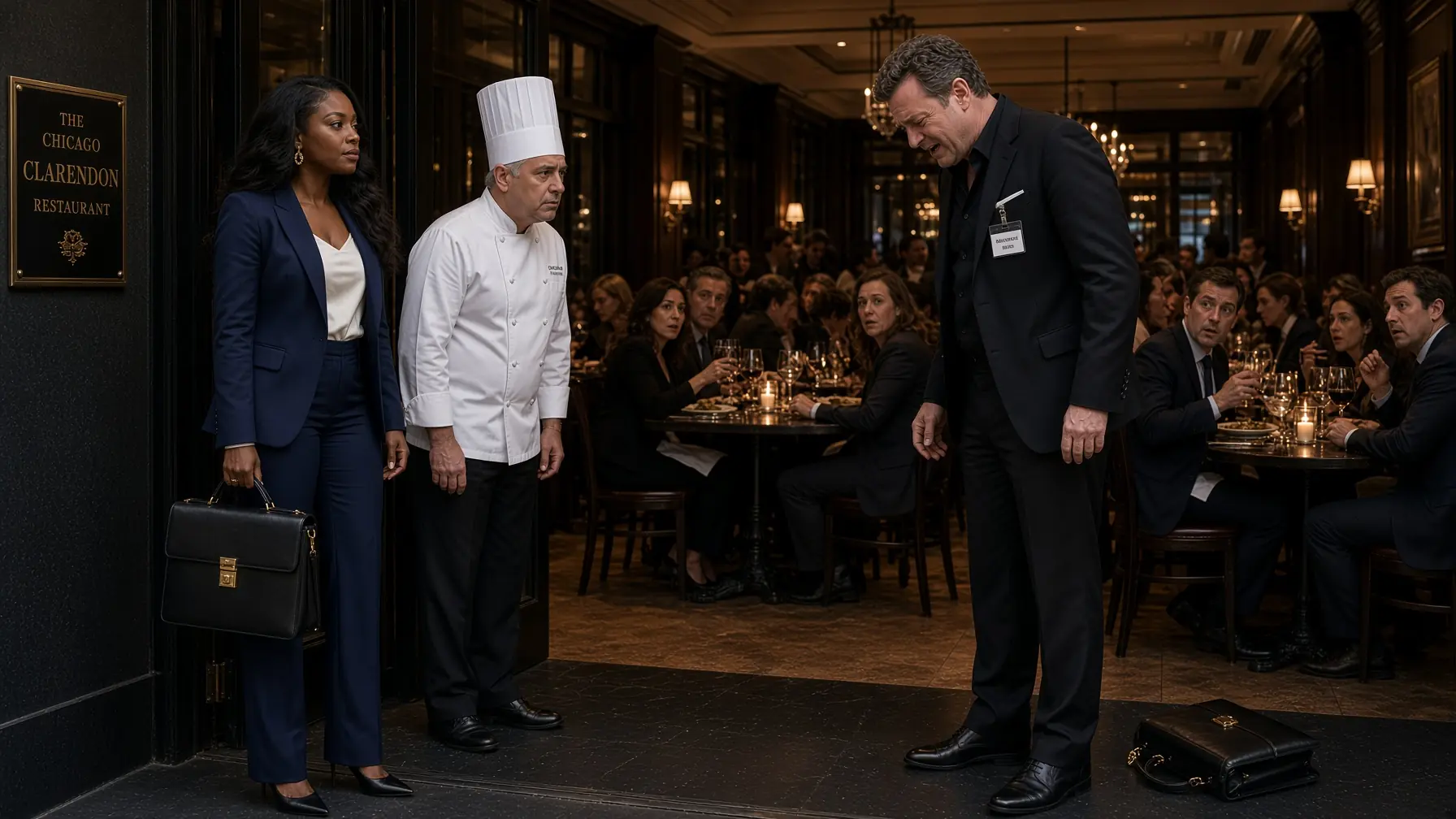
Wine glasses paused halfway to lips.
Conversations softened.
Thirty diners turned toward the hostess station, where Brad Thompson stood over a Black woman holding a leather briefcase.
Brad wore a tailored black suit, silver tie, and the expression of a man who believed everyone in the room already agreed with him.
The woman did not.
Amara Williams stood perfectly still.
Forty-one years old.
Deep-brown skin.
Dark eyes.
Navy blazer.
Ivory blouse.
Sensible black heels.
Nothing flashy.
Nothing remotely inappropriate for one of Chicago’s most expensive restaurants.
Yet Brad looked her over with theatrical disapproval.
“Ma’am,” he continued, raising his voice just enough for nearby tables to hear, “Lumiere has a strict dress code and certain clientele expectations.”
Amara glanced once at a man twenty feet away wearing an open-collar golf shirt beneath a sport coat.
Then at another guest in designer sneakers.
Then back to Brad.
“What part of my clothing violates your dress code?”
Brad’s lips tightened.
“That isn’t the point.”
“Then what is?”
Behind the hostess podium, twenty-four-year-old Maria Alvarez lowered her eyes.
She already knew the answer.
So did Amara.
Brad stepped closer.
“I’m trying to avoid making this unpleasant.”
Amara almost smiled.
“You’re doing a remarkable job.”
A few diners heard that.
One man coughed to hide a laugh.
Brad’s face hardened.
“I’m going to ask you one final time to leave before you make our guests uncomfortable.”
Amara’s fingers tightened once around the briefcase handle.
Not from fear.
Control.
She had experienced this expression before.
In banks.
Boardrooms.
Luxury hotels.
Investor meetings.
Places where people sometimes mistook expensive surroundings for proof that their prejudices had become sophisticated.
But never here.
Never inside something she had built.
Amara looked past Brad.
At the marble bar imported from Italy.
At the brass light fixtures she had personally selected.
At the velvet banquette that had taken three manufacturers to get right.
At the kitchen doors swinging beneath the gold Lumiere emblem.
Her restaurant.
Brad Thompson had worked there for eleven months.
He apparently still had no idea who owned it.
“I just wanted to—” Amara began.
“No.”
Brad cut her off.
“No exceptions.”
Then, with a small smile:
“If necessary, security can escort you.”
Maria shifted behind the podium.
“Brad…”
He snapped his head toward her.
“Did I ask you something?”
Maria froze.
“No.”
“Then stay out of it.”
Amara watched that too.
Her expression changed slightly.
Brad turned back.
“Now.”
Amara placed her briefcase on the hostess podium.
Brad sighed dramatically.
“Ma’am—”
She opened it.
“If you’re about to show me some membership card or fake reservation confirmation, save us both the trouble.”
Amara removed a black leather folder.
Embossed in silver on the front were two words:
WILLIAMS HOSPITALITY
Brad’s smile disappeared.
Only for a second.
Then returned.
He clearly did not recognize the name.
Amara opened the folder.
Brad looked down.
His eyes moved across the first page.
Then stopped.
A corporate seal.
Lumiere Restaurant Holdings LLC.
Majority Member:
Amara N. Williams — 82% ownership interest.
Brad read the line again.
Color began draining from his face.
Amara closed the folder.
Then looked directly into his eyes.
“Before you call security, Brad…”
Her voice lowered.
“…you should probably call payroll.”
The room went silent.
Completely silent.
Maria slowly looked up.
Brad’s mouth opened.
Nothing came out.
And for the first time that evening, Amara Williams saw fear replace contempt.
Thirty minutes earlier, Amara had stepped out of an Uber on East Bellevue Place in Chicago’s Gold Coast.
No Bentley.
No driver.
No assistant.
No public relations staff.
Just Amara and a leather briefcase.
That was intentional.
Two years earlier, she had invested $3.2 million of her own money into opening Lumiere.
The restaurant was supposed to be more than another luxury dining room with tiny portions and enormous wine lists.
Amara had spent fifteen years building Williams Hospitality Group from a three-location catering company into a collection of boutique hotels, private-event spaces, and restaurants.
Lumiere was her most personal project.
Her father had been a hotel banquet cook for thirty-two years.
Her mother cleaned offices at night.
Amara grew up entering beautiful buildings through service entrances.
She remembered watching wealthy guests pass through lobbies while employees who looked like her family disappeared through doors marked STAFF ONLY.
When she finally had the money to build a luxury restaurant herself, she wrote one principle into the original operating plan:
Elegance without exclusion.
She did not want lower standards.
She wanted better ones.
Professional service.
Exceptional food.
Attention to detail.
But no employee was supposed to confuse luxury with deciding which kinds of people deserved dignity.
For the first year, Lumiere performed well.
Strong reviews.
Reservations booked weeks ahead.
Private events.
Corporate dinners.
Then, about five months earlier, small complaints began appearing.
Not public ones at first.
Internal.
A hostess mentioned that Brad had instructed staff to tell certain walk-ins the restaurant was fully booked even when bar seating was open.
A server wrote anonymously that Brad used phrases like:
“Not our crowd.”
Another employee claimed Brad selectively enforced the dress code depending on “how the guest presented.”
One complaint described a Black couple being turned away for the husband’s clean designer sneakers.
Forty minutes later, a white guest wearing similar sneakers had been seated.
Brad explained each incident individually.
Miscommunication.
Reservation pressure.
Different footwear.
Private event hold.
Nothing conclusive.
Then Amara’s operations director, Claire Donovan, discovered something stranger.
Three guest complaints submitted through Lumiere’s online contact form had never reached corporate review.
Brad had marked them resolved locally.
All three involved allegations of discriminatory treatment.
That was why Amara came to Lumiere unannounced.
She had not planned to pretend she was anyone else.
She simply did not announce that she was coming.
Brad had been hired through Claire while Amara was opening another property in Boston.
They had spoken once on a large video call.
Brad had apparently forgotten her face.
Or never bothered remembering it.
Amara stood across the street from Lumiere for several minutes before entering.
She watched the front door.
A couple emerged laughing.
A valet retrieved a Mercedes.
Inside, chandeliers glowed warmly above white tablecloths.
From the sidewalk, Lumiere looked exactly like the restaurant she had imagined.
Then she stepped inside and discovered what it had become when she wasn’t standing there.
Maria Alvarez greeted her first.
“Good evening.”
“Good evening. I’d like to speak with the manager.”
Maria smiled politely.
“Of course. May I ask who—”
Brad appeared before she finished.
He had been standing near the bar.
“Excuse me.”
He looked at Amara.
Then at Maria.
“I have this.”
Maria immediately became quieter.
Amara noticed.
“Are you the manager?” she asked.
“General manager.”
“Brad Thompson?”
His expression shifted.
“How do you know my name?”
“It’s on the website.”
That explanation satisfied him.
“What can I help you with?”
“I’d like to discuss restaurant operations.”
Brad gave a short laugh.
“Operations?”
“Yes.”
“With me?”
“That was the idea.”