My name is Oliver Montgomery, and I was twenty-seven when I learned that the only person in my family who had ever truly believed in me had left almost everything he owned in my hands. The estate was worth roughly three and a half million dollars when the investments, house, rental properties, and cash accounts were added together, which was more money than I had ever imagined being responsible for. Yet the number itself was not what made my hands shake in the lawyer’s office that afternoon. It was seeing my parents and my older sister sitting across from me as though the previous nine years had never happened.
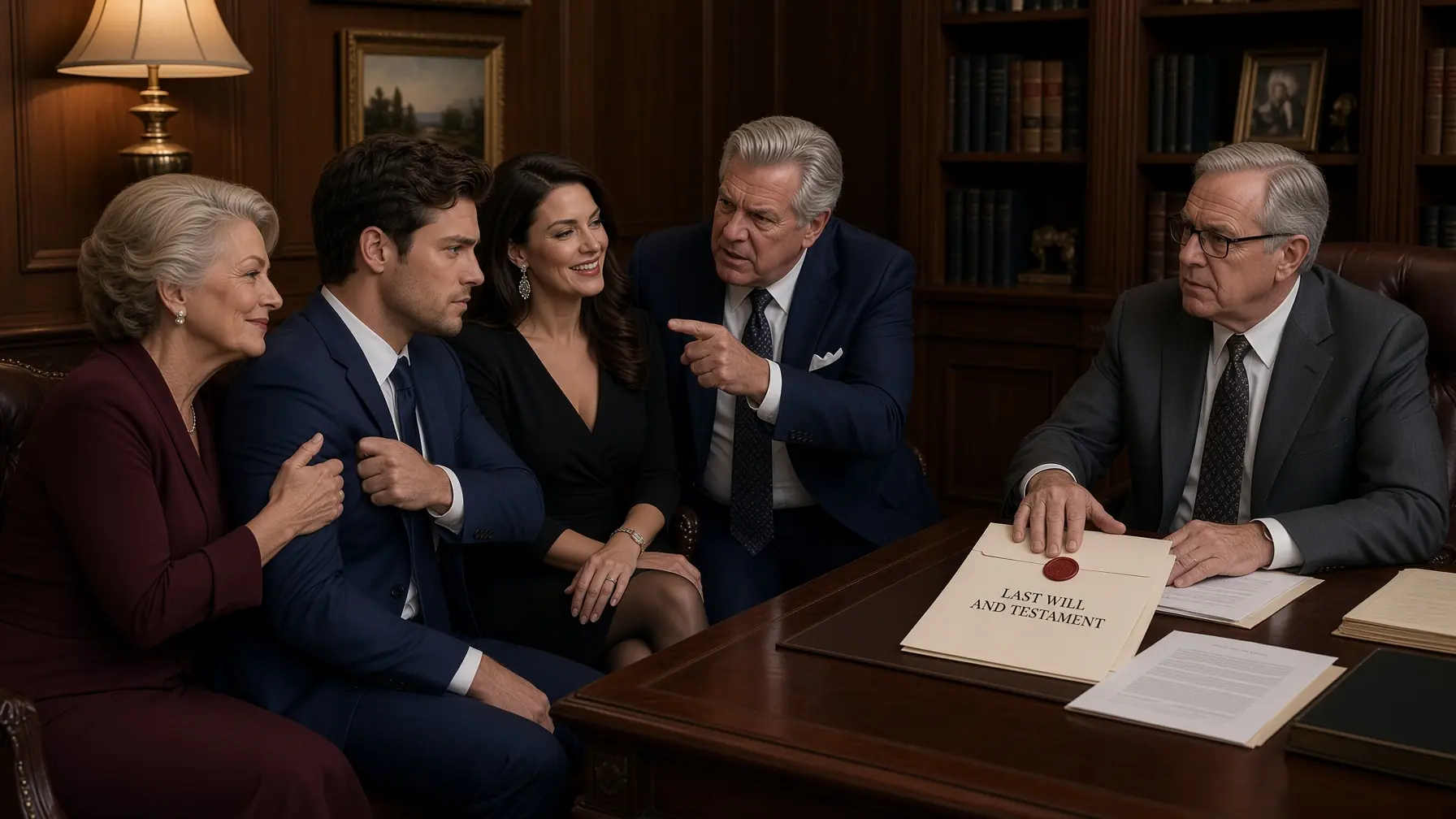
My father, Thomas Montgomery, wore the dark blue suit he saved for weddings, funerals, and situations where he wanted strangers to assume he was important. My mother, Diane, had chosen pearls, a cream jacket, and the sympathetic expression she usually wore when telling someone something insulting “for their own good.” My sister Claire sat beside them with her leather handbag resting neatly against one ankle, checking her phone with the relaxed confidence of a woman certain the day would end in her favor. Nobody looked like the family who had watched me walk out of their house at eighteen carrying nearly everything I owned in one backpack.
We had not gathered for a theatrical “reading of the will” in the way movies show families sitting around while a lawyer announces surprises. My grandfather’s estate attorney, James Thompson, had asked the immediate family to attend a meeting because Harold Montgomery had used both a will and a revocable living trust, and James wanted to explain what would enter probate, what would pass through the trust, and what responsibilities followed. Claire knew that because she was an attorney herself, though corporate contracts were her specialty rather than estate law. Still, she kept calling it “the reading” because I think she enjoyed the drama of the phrase.
I assumed I had been invited because Grandpa had left me something sentimental. Maybe his watch, his collection of first-edition mystery novels, or the battered chess set that had sat beside his fireplace for as long as I could remember. He had never discussed his finances with me beyond saying he had “enough,” and I had never asked because our relationship was not built around what he owned. I would have been happy with a letter.
My parents clearly expected more. Dad rested one hand on his knee and looked around James’s oak-paneled office with the satisfied patience of a man waiting for a transaction to be completed. Mom had already whispered, “Whatever happens today, Oliver, we’ll make sure everything is handled properly,” before James even entered the room. Claire gave me a quick glance afterward and smiled as though we had all agreed on something.
That smile brought back a memory I had spent years trying not to visit. I was eighteen again, standing inside my childhood bedroom while Mom placed empty cardboard boxes beside the door and Dad reminded me that adults paid their own way. Claire was home from college that weekend, sitting downstairs with a new laptop our parents had bought her before the semester began. By midnight, I would be sleeping in the backseat of a car with thirty-seven dollars in my checking account.
The strange thing was that I had not been a particularly difficult teenager. I did not drink, get arrested, disappear for days, steal from them, or set the garage on fire, though the way my parents told the story later you might have assumed I had done all five. My actual offense was failing to resemble the son they had imagined before I was born. I liked drawing, history books, photography, and quiet weekends, while Dad wanted football, business clubs, and a child who agreed with him quickly.
Claire fit them much better. She earned straight A’s, became captain of the cheerleading team, planned college visits two years in advance, and understood instinctively how much our parents valued visible achievement. When she won an academic award, Mom posted photographs around the neighborhood before social media made that sort of thing effortless. When I won a statewide student art competition at sixteen, Dad asked whether there was prize money.
There was not. He shrugged and said, “Then make sure you keep your grades up.” I remember standing in the kitchen holding the certificate and feeling embarrassed for having expected a different reaction. Grandpa Harold later framed the certificate and hung it above the desk in his study.
Money made the difference between Claire and me impossible to ignore. On her seventeenth birthday, our parents bought her a new Honda because she needed “something safe for college.” When I turned seventeen, Dad handed me the keys to his ten-year-old Ford after buying himself a replacement and told me I should be grateful because plenty of kids got nothing. I was grateful, but I also noticed that Claire’s gratitude was never tested in the same way.
College followed the same pattern. My parents promised to cover Claire’s tuition, housing, books, and basic expenses as long as her grades remained strong. When I asked whether they planned to help me, Dad told me, “You’ve always wanted independence, so here’s your chance.” I reminded him that I had been accepted into a state university and qualified for partial aid, but he said paying the rest would teach me the wrong lesson.
Mom told me I was too sensitive when I objected. She said, “You expect everything to be equal because you don’t understand that life rewards effort differently.” I asked what effort Claire had made at seventeen that I had not, and the conversation ended with Dad telling me to watch my tone. After that, I stopped asking questions I already knew they would punish me for asking.
Grandpa noticed. He was Dad’s father, which always confused me because the two men seemed to operate from completely different definitions of strength. Dad thought strength meant never needing anyone, while Grandpa thought strength meant knowing when another person needed you. He rarely criticized my parents openly, but he had a way of saying, “Come over Saturday, Oliver,” whenever our house felt particularly unbearable.
At Grandpa’s place, nobody cared whether I liked football. He kept a shelf of old National Geographic magazines because I liked the photography, bought used art books whenever the library held sales, and let me leave sketch pads all over his dining room table. When I apologized for taking up space, he would say, “That is what tables are for.”
He called me Ol. Almost nobody else did. “Ol, you think before you speak,” he told me once after Dad complained that I was too quiet around guests, and I remember how strange it felt to hear a trait my parents disliked described as something valuable. Grandpa did that constantly without making a performance of it.
The sentence from Dad that stayed with me longest came when I was seventeen. We were eating meatloaf at the kitchen table when he leaned toward me and said, “If you are still under this roof after eighteen, you have failed.” Claire laughed because she assumed he was joking. Dad did not.
I laughed too. It was easier than showing him the sentence had landed exactly where he intended. That night I started calculating what a room might cost if I moved out after graduation. The numbers did not work.
My eighteenth birthday fell on a Tuesday. I came home from my shift at a bookstore and found Mom, Dad, and Claire waiting in the living room. Mom said, “We need to discuss your future,” and I knew before sitting down that the discussion had already ended without me.
Dad said they were cutting off financial support. I pointed out that they were paying my phone bill and car insurance but little else, and he said that was precisely the problem because even those expenses were encouraging dependence. Mom told me, “It’s time for you to understand how hard the world really is.”
I asked when they expected me to leave. Dad looked toward the clock and said, “You’re eighteen.” The answer was so cold that for several seconds I thought I had misunderstood him. Claire stared at the floor.
Mom said they were not being cruel. “Lots of young men need a push,” she explained, as though forcing me out with no savings, no housing, and a part-time job were a motivational seminar. Dad added, “If we keep rescuing you, you’ll never become anything.”
They gave me until the end of the evening. I packed two changes of clothes, toiletries, my sketchbook, a paperback Grandpa had given me, and the laptop I bought used with bookstore wages. Everything else stayed because there was no room in the backpack.
I remember standing at the door and waiting. Some part of me thought Dad would stop me once the performance had gone far enough. Another part thought Mom would slip me cash when he turned away. Neither happened.
Claire hugged me. She whispered, “You’ll figure it out,” which was kinder than anything my parents said but still sounded like she was watching an experiment. Then I walked outside.
That first night I slept in the backseat of the Ford. The car was parked behind the bookstore because my manager, Luis, had once mentioned that the security camera covered the lot until morning. I reclined as far as the seat allowed, used my backpack as a pillow, and listened to trucks move along the highway two blocks away. I did not sleep more than an hour.
The next morning I went to work without telling anyone. Luis looked at me and asked, “You sick?” I said no. He stared a little longer, then told me to take ten minutes and eat something from the café.
Grandpa found out three days later. I never learned whether Claire told him or whether he drove past my parents’ house and noticed my car was gone. He called at six in the morning and said, “Where are you sleeping, Ol?”
I lied. “Friend’s place.”
“Whose?”
I had no answer.
Grandpa said, “Come here.” I told him I had work.
“After work.”
“I’m fine.”
His voice hardened in a way I rarely heard. “Oliver.”
I went.
He had made stew. There were clean sheets on the couch and a spare key on the table. Grandpa did not interrogate me.
He only asked, “How long?”
“Until I find somewhere.”
He nodded. “Good.”
I stared. “Good?”
“Because that means you have a plan.”
That was how he helped me. Not by taking control. By giving me somewhere safe enough to make decisions.
I stayed on his couch for six weeks. I paid him what I could, which was almost nothing, and he placed every dollar in an envelope without telling me. When I finally rented a room with two other guys near the community college, he handed the envelope back and said, “Security deposit.”
I tried to refuse. He said, “This is not rescue.” I asked what the difference was.
“Rescue carries you where you do not want to go.” He pushed the envelope into my hand.
“Help lets you keep walking.”
I never forgot that.
I enrolled in community college part-time because the bookstore offered tuition assistance after a year. I studied graphic design and business communications, not because either field guaranteed anything, but because I liked making ideas clearer. School took almost four years because I worked full-time.
Grandpa attended the graduation. My parents did not.
Mom said they already had a weekend trip planned. Dad said, “Community college ceremonies are mostly symbolic anyway.” Claire sent a gift card.
Grandpa wore a tie. He took seventeen photographs.
After graduation, I found work at a regional printing and packaging company called Mercer & Vale. I began as a production coordinator, which meant keeping designers, customers, printers, and shipping schedules from destroying one another. The job paid modestly but consistently.
I was good at it. Years spent carefully reading my parents’ moods turned out to have useful professional applications when three departments were arguing over a missed deadline. I learned how to listen for what people actually needed beneath what they were loudly demanding.
By twenty-five, I was supervising a small team. I still rented a one-bedroom apartment because rent was manageable and I was terrified of debt. I drove the old Ford until the transmission died.
Then I bought a used Toyota. Claire mocked it the first time she saw me at a family funeral. “Oliver, you are twenty-six,” she said. “You can finance something that doesn’t look like a rental.”
I told her I liked the car. She smiled.
“You’ve always been easy to please.”
That was the family version of my adulthood. Claire became a corporate attorney at a respected firm, married briefly, divorced quietly, bought a townhouse, traveled internationally, and posted photographs that made every hotel balcony look like a magazine advertisement. Mom forwarded those photographs to relatives with captions about how proud they were.
My accomplishments remained difficult for them to recognize because they were smaller and quieter. A promotion. Paying off student debt. Building an emergency fund.
Helping Grandpa after cataract surgery. Learning how to cook something besides pasta. Creating a life stable enough that nobody could make me leave it before sunset.
My parents contacted me mostly when something practical was needed. Dad called if his printer stopped working. Mom called when she wanted help carrying boxes from the attic. Neither asked many questions about my job.
One Christmas, Dad asked, “Still at the printing place?” I told him yes.
He nodded toward Claire. “You should talk to your sister about professional options.”
Claire smiled. “He’d hate corporate.”
I said, “I’m doing fine.”
Mom answered, “Fine isn’t the same as building a future.”
Grandpa, sitting at the end of the table, looked toward me. He did not defend me. He knew I hated when people turned me into a debate.
Instead, after dinner, he slipped a folded note into my coat pocket. I opened it at home.
Fine is underrated. Keep building.
That note stayed inside my desk for years.
Grandpa began slowing down when I was twenty-six. First it was small things. He stopped driving at night, started leaving grocery bags on the floor because lifting them hurt his shoulder, and occasionally forgot where he put his glasses even when they were on the desk in front of him. Doctors eventually diagnosed congestive heart failure and chronic kidney disease.
He hated being treated like a patient. I became the person who accompanied him to appointments because Dad always seemed busy and Claire lived forty minutes away. Mom offered occasionally but Grandpa said, “Oliver already knows the doctors.”
I never considered it a burden. Sitting with him in medical offices felt like repayment for six weeks on his couch, though he would have hated that framing. We played chess in waiting rooms using a phone app because carrying his wooden set became impractical.
He still beat me most of the time. Even at eighty-one, he could see three moves ahead while pretending not to understand how to change the television input. I accused him once of selective aging.
He laughed so hard the nurse came in.
Grandpa never discussed inheritance. Once, after a hospital admission, he asked whether I knew where his attorney’s card was. I found it in his desk and assumed he was updating medical directives.
A month later he said, “If people start telling you what I wanted after I’m dead, check what I actually wrote.”
I stared at him. “That’s cheerful.”
“Death is administrative.”
“You are impossible.”
He smiled. “That’s genetic.”
I did not understand the warning.
Grandpa died the following spring. His heart simply became too tired to keep doing what it had done for more than eight decades. I was sitting beside him in the hospital when his breathing changed.
Dad stood by the window. Mom and Claire arrived twenty minutes later.
Grandpa was conscious long enough to look at me and say, “Ol.”
I leaned closer.
“Don’t shrink.”
Those were the last words he said clearly.
He died before sunrise.
Grief made the next week unreal. There were flowers, casseroles, phone calls, paperwork, people telling stories, and relatives asking questions about medical details I did not want to repeat. Dad handled the funeral arrangements.
Claire prepared the obituary. Mom selected photographs.
I stood through all of it feeling like somebody had removed the one person who knew my private language. At the cemetery, I watched dirt fall onto Grandpa’s casket and wondered whether I had ever clearly told him what he had meant to me. I hoped years of showing up had said enough.
James Thompson called six days later. I recognized the name from Grandpa’s desk. He asked whether I could attend an estate meeting the following Tuesday.
“Do my parents know?” I asked.
“Yes.”
I almost declined. Then I remembered Grandpa saying to check what he actually wrote.
So I went.
That was how I ended up sitting across from my family while James explained the estate structure. He began with debts, final expenses, tax filings, the pour-over will, and the revocable trust Grandpa had created nine years earlier. I barely understood half the terminology.
Claire appeared comfortable. Dad appeared impatient.
Then James turned to the dispositive provisions. “Harold amended the trust approximately fourteen months ago after completing an updated estate-planning review.”
Dad leaned forward.
James continued. “Specific charitable gifts and several small personal bequests are listed separately.”
Mom nodded as though expecting her name.
James read them. A local library foundation received fifty thousand dollars. Grandpa’s church received twenty-five thousand.
A veterans’ assistance organization received another fifty thousand. His longtime housekeeper received twenty thousand.
The chess club received his books and sets.
Then James paused.
Dad frowned. “And the remainder?”
James looked toward me.
“The remaining trust estate passes outright to Oliver Montgomery.”
Nobody moved.
I thought I had misunderstood.
James continued. “Based on current valuations, the residual estate is approximately three point five million dollars before final administration expenses and market changes.”
The room disappeared around the number.
I stared at him. “Me?”
“Yes.”
“All of it?”
“The residue, yes.”
My mother’s expression froze.
Dad’s hand stopped moving on his knee. Claire lowered her phone.
For one ridiculous second, I remembered Grandpa grinning after trapping my queen on a chessboard. I could almost hear him saying, You were looking at the wrong piece, Ol.
Mom recovered first. “Well.”
She laughed too brightly. “That makes sense.”
Nobody answered.
She continued, “Oliver and Harold were very close.”
Dad cleared his throat. “Obviously Harold intended Oliver to be looked after.”
James looked at him.
“That is not how the trust is written.”
Dad’s eyes narrowed.
“What does that mean?”
“It means Oliver is not receiving an allowance or managed trust.”
James folded his hands.
“Once administration is complete, the residue belongs to him outright.”
Mom reached toward me. “Naturally we’ll help.”
I moved my arm before she touched it.
She pretended not to notice.
Dad leaned back and studied me. “Three and a half million is substantial.”
I said nothing.
“You have no experience managing assets of that size.”
Claire finally spoke. “That’s true.”
I looked toward her.
She offered a sympathetic smile.
“Oliver, don’t take that personally.”
I almost laughed.
She continued. “Grandpa loved you, but love doesn’t turn someone into an investment professional.”
James cleared his throat.
“Oliver does not need to become an investment professional.”
Claire glanced at him.
“He can hire one.”
Mom nodded quickly. “Exactly, and Thomas has experience with financial planning.”
Dad was a regional manager at a logistics company. His work involved budgets, contracts, and operational planning. It did not make him a private wealth manager.
Nobody said that.
Dad said, “What Harold probably expected was that the family would help Oliver make responsible decisions.”
James opened another document.
“Harold anticipated that interpretation.”
The room went still.
I looked toward him.
James continued, “He left a written memorandum regarding the reasons for his estate plan.”
Dad’s face changed.
“Is that part of the trust?”
“No.”
“Then why is it relevant?”
James answered calmly. “Because your father wanted his intentions documented in case anyone later alleged confusion, incapacity, coercion, or misunderstanding.”
Claire stopped smiling.
James looked toward me.
“Oliver, there is also a personal letter for you, which I will give you privately.”
My throat tightened.
Mom leaned forward.
“What does the memorandum say?”
James looked toward her.
“That Harold understood he was leaving the bulk of his property to Oliver.”
Dad’s jaw moved.
“And?”
“That he did so intentionally.”
Silence.
James continued. “He specifically stated that Oliver had provided companionship and assistance without asking for financial benefit.”
My eyes dropped.
“He also stated that previous financial assistance given during Oliver’s early adulthood did not create an expectation of repayment.”
Dad looked confused.
“What financial assistance?”
I almost smiled.
The couch.
The groceries.
The security deposit.
Help I had never discussed with them.
James said, “Harold documented his own relationship with Oliver.”
Dad leaned forward.
“That still doesn’t mean he wanted the rest of the family excluded.”
James turned a page.
“Thomas, he named you as a contingent beneficiary only if Oliver predeceased him.”
Dad stared.
“He subsequently removed that provision in the final amendment and designated several charities as contingent beneficiaries instead.”
That landed harder than the inheritance itself.
Dad’s face lost color.
Mom whispered, “Why?”
James did not answer.
I knew.
Grandpa wanted no ambiguity.
Claire crossed her arms.
“This is unusual.”
James nodded. “It is specific.”
Dad looked at me.
For the first time that afternoon, his expression contained something other than confidence. It was calculation.
“Oliver.”
I waited.
“We should review this as a family before you make any decisions.”