For thirty years, the people of Bellweather, Missouri, knew Samuel Carter as the man who could make dead tractors breathe again.
His repair shop stood at the edge of town in a converted feed barn with a faded red roof, two sagging doors, and a hand-painted sign that had not been straight since 1997.
CARTER FARM EQUIPMENT — REPAIRS, WELDING, HONEST WORK
Sam rarely corrected anyone who assumed he was barely getting by.
He wore patched denim overalls, drove a twenty-three-year-old Ford pickup, and packed the same lunch most days: a ham sandwich, an apple, and coffee from a dented green thermos.
He charged less than the dealership in Jefferson City.
Sometimes, when a farmer was short on money, he accepted eggs, firewood, or a promise to settle the bill after harvest.
To most people, Sam was simply part of the landscape.
Dependable.
Quiet.
Easy to overlook.
That changed on a Monday morning in March, when six black SUVs rolled into Bellweather behind a polished silver sedan bearing Illinois plates.
They passed the grain elevator, the high school, and the courthouse square before turning toward the old Miller farm east of town.
By noon, everyone knew why they had come.
Meridian Global Logistics intended to build a three-hundred-million-dollar distribution hub in Bellweather County.
The project would include four warehouses, a rail terminal, a regional trucking center, and enough paved storage to cover more than three hundred football fields.
Company representatives promised two thousand construction jobs and six hundred permanent positions.
They also promised tax revenue, new roads, and “a future beyond agriculture.”
The words appeared on banners hung inside the county courthouse that same week.
Some residents called it salvation.
Others called it a takeover.
Sam Carter said nothing.
He stood beneath the raised hood of a 1974 John Deere 4430, listening to its engine knock, while three farmers argued about the project near his workbench.
“It’ll save the town,” said Dale Mercer, whose family had grown soybeans outside Bellweather for four generations. “My grandson won’t have to move to St. Louis for work.”
“It’ll destroy the water table,” replied Howard Finch. “You pave that much ground, every storm floods the bottom farms.”
“They’re putting in drainage.”
“They’re putting in whatever gets them a permit.”
Sam adjusted a fuel line.
Neither man asked what he thought.
People rarely did unless the question involved machinery.
When the tractor’s engine settled into a smooth idle, Sam wiped his hands on a rag.
“Your second injector was sticking,” he told Dale. “I cleaned it, but it’ll need replacing before planting.”
“How much?”
“Two hundred for today.”
Dale frowned.
“The dealership wanted nine.”
“The dealership has nicer chairs.”
Howard laughed.
Dale paid in cash.
As the farmers left, Sam walked to the office behind the parts room.
The office was small and windowless. An ancient adding machine sat beside stacks of invoices, repair manuals, and coffee-stained calendars.
Sam locked the door.
Then he moved a filing cabinet away from the wall.
Behind it was a steel safe.
Inside were no guns, gold bars, or bundles of cash.
There were deeds.
Hundreds of them.
Some covered ten acres.
Some covered half an acre.
Several described strips of land no wider than a county road.
Others concerned old drainage channels, abandoned rail spurs, utility corridors, mineral rights, or forgotten access easements recorded before most people in Bellweather were born.
At the center of the stack was a hand-drawn map.
Sam spread it across his desk.
Colored lines crossed the eastern side of the county.
Blue for drainage.
Red for roads.
Black for rail.
Yellow for electrical transmission and underground utilities.
The proposed Meridian site sat in the middle.
Almost every line leading toward it crossed land owned by Samuel Carter.
He studied the map for a long time.
Then he folded it and returned it to the safe.
The first Meridian public meeting took place Friday night in the high school gymnasium.
More than four hundred people attended.
The company brought architects, economists, employment consultants, and a public-relations team from Chicago.
At the center of the group stood Grant Whitmore, Meridian’s vice president of development.
Whitmore was forty-five, silver at the temples, and smooth in the practiced way of a man who had spent years making difficult projects sound inevitable.
He stood beneath a projection of the proposed complex.
“This facility will place Bellweather at the center of a growing national supply network,” he said. “Meridian is prepared to invest more than three hundred million dollars in this community.”
Applause rose from half the gym.
The image changed.
Warehouse roofs appeared where farms now stood.
A four-lane access road connected the site to the interstate.
A rail extension curved toward the main freight line.
New drainage basins and utility routes crossed parcels shown only as clean geometric shapes.
“We estimate six hundred permanent jobs,” Whitmore continued. “Average wages will exceed the county median by thirty percent.”
More applause.
Sam sat in the rear bleachers wearing his work clothes.
No one noticed him.
Whitmore introduced County Commissioner Raymond Pike, who praised the company for recognizing Bellweather’s potential.
Pike owned a construction business.
His brother-in-law operated the county’s largest gravel quarry.
Neither fact appeared in the presentation.
“We have spent too long watching our young people leave,” Pike said. “This is our chance to bring opportunity home.”
An elderly farmer raised his hand.
“What happens to the families who don’t want to sell?”
Whitmore smiled.
“We are committed to voluntary, fair-market negotiations.”
“And if they refuse?”
“We believe mutually beneficial agreements can be reached.”
The answer satisfied no one, but it sounded polite enough to prevent an argument.
Then a woman named Sarah Cole stood.
She taught biology at the high school and lived near the proposed site.
“The plan shows a drainage basin emptying into Miller Creek,” she said. “That creek feeds two cattle ponds and reaches the elementary school’s well field.”
One of Meridian’s engineers approached the microphone.
“Our preliminary environmental modeling indicates no significant impact.”
“Preliminary?”
“The final study is ongoing.”
“You are asking the county to approve tax incentives before completing it.”
Commissioner Pike intervened.
“This is not the time for technical debate.”
Sarah looked toward him.
“When is the time?”
The room became restless.
Whitmore raised both hands.
“We welcome every question. Meridian has completed projects in communities across the country. We know change creates uncertainty.”
Sam watched him carefully.
Change.
Companies used that word when they wanted old people to feel ashamed of remembering what a place had been.
After the meeting, Meridian representatives surrounded landowners near the gym entrance.
They handed out glossy folders and business cards.
A young associate approached Sam.
“Do you own property near the proposed development?”
“A little.”
“How much?”
“Depends on where you’re looking.”
She handed him a card.
“We’re offering very competitive prices.”
Sam studied the name.
EMILY VALE — LAND ACQUISITION SPECIALIST
“What do you consider competitive?”
“In many cases, three times current agricultural value.”
“That sounds generous.”
“It is.”
“Why?”
Emily seemed surprised.
“Because Meridian wants landowners to benefit.”
“No company pays three times what something is worth unless it believes it is worth more.”
She gave him a professional smile.
“We consider the entire community’s future.”
Sam returned the card.
“Then you should finish the water study.”
He walked away.
The first offer arrived at his shop four days later.
Meridian wanted to purchase thirty-seven acres north of Miller Creek.
The letter valued the land at $555,000.
Sam had purchased the parcel for $12,000 in 1998.
At the time, everyone called it useless.
The soil remained wet through spring, the access road ended half a mile away, and county maps showed an abandoned drainage trench cutting across the middle.
Sam declined the offer without making a counterproposal.
A second letter arrived.
$700,000.
He declined.
Then Meridian requested a meeting.
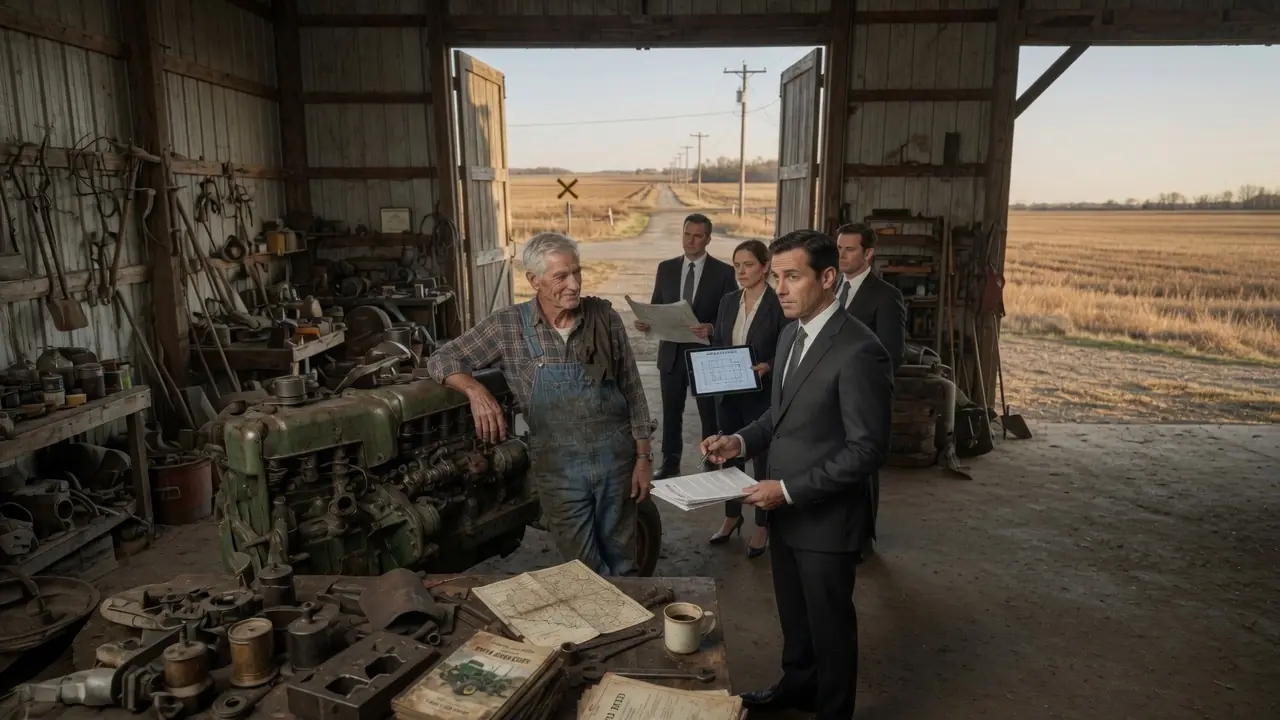
Grant Whitmore arrived at Carter Farm Equipment on a rainy Thursday afternoon.
He wore a navy suit and shoes too polished for the muddy gravel outside.
His driver remained in the car.
Whitmore entered the shop while Sam was replacing a hydraulic hose on a Massey Ferguson.
“Mr. Carter?”
Sam looked up.
“Depends who’s asking.”
“Grant Whitmore. Meridian Global Logistics.”
“I know.”
Whitmore waited for Sam to offer his hand.
Sam’s hands were covered in hydraulic fluid, so he nodded instead.
“I appreciate you making time.”
“You came without an appointment.”
Whitmore glanced around the shop.
Old pistons, chains, tractor seats, and rusted signs hung from the walls. A radio played quietly near the welding station.
“I hoped we could discuss your property.”
“You sent a letter.”
“We sent two.”
“I answered both.”
Whitmore smiled.
“I admire directness.”
“Most men say that until they hear no.”
Sam returned to the hose connection.
Whitmore moved closer.
“Your parcel is important to our stormwater plan.”
“Then your engineer drew a poor plan.”
“It is the most efficient route.”
“Efficient for whom?”
“The county as a whole.”
Sam tightened the fitting.
“You’re not the county.”
“No. But we are investing in it.”
“That doesn’t make you own it.”
Whitmore’s smile weakened.
“Our latest offer is nine hundred thousand dollars.”
Sam wiped his hands.
“For swamp ground?”
“You know its strategic value.”
“I know you need it.”
“We have alternatives.”
“Then use one.”
Whitmore studied him.
“You appear to be a practical man.”
“I repair tractors.”
“Exactly. You understand that machines work because every part serves a larger purpose.”
Sam looked at him.
“And you understand what happens when one small part fails.”
A silence passed between them.
Whitmore removed a folder from his briefcase.
“The county is considering a development authority. If created, it may possess condemnation powers for roads and utilities.”
The warning was carefully delivered.
Sam did not appear impressed.
“You’re threatening eminent domain.”
“I am explaining the legal environment.”
“For private warehouses.”
“For public infrastructure supporting economic development.”
Sam leaned against the workbench.
“Roads, perhaps. Drainage, maybe. Your loading docks are another matter.”
“You have an attorney?”
“Yes.”
“Who?”
“Me, until I need someone better.”
Whitmore looked at the patched knees of Sam’s overalls.
“I don’t believe you understand the scale of what is happening.”
Sam gave him a faint smile.
“That’s probably because you don’t know what I own.”
Whitmore’s expression shifted.
“What does that mean?”
“It means you should go back to Chicago and ask your title company to finish its work.”
The rain struck the metal roof.
Whitmore closed his briefcase.
“We will speak again.”
“I expect so.”
Three weeks later, Meridian’s attorneys discovered the first problem.
The proposed four-lane access road crossed seven separate parcels that appeared on modern county maps as portions of neighboring farms.
The legal descriptions told a different story.
Narrow strips running beneath the old county lane had been separated from those farms during a failed railroad expansion in 1956.
Samuel Carter owned six.
A Carter family trust owned the seventh.
Meridian adjusted the road west.
The alternative route crossed a bridge approach controlled by an easement Sam purchased from the estate of a bankrupt milling company.
The engineers moved it again.
That path required access across a half-mile frontage parcel Sam owned beside the interstate.
Grant Whitmore ordered a full title review.
The report required eleven days.
When it arrived, it was 642 pages long.
The rail extension crossed two parcels held by Carter Agricultural Holdings.
The power substation required an underground utility corridor subject to a ninety-nine-year easement controlled by the Carter Land Trust.
The main drainage basin emptied into a channel whose water rights belonged to Samuel J. Carter.
The emergency access road crossed an abandoned county right-of-way that had reverted to Sam’s ownership twenty-seven years earlier.
Even the fiber-optic connection from the western boundary required permission to cross a six-foot strip surrounding an old telegraph route Sam had purchased at a tax auction.
Whitmore spread the documents across a conference table in Meridian’s temporary field office.
“This cannot be right.”
The title attorney adjusted her glasses.
“The records are valid.”
“One man owns all of this?”
“Not all of it. He owns the pieces connecting everything else.”
“How?”
“Gradually.”
“Why would a tractor mechanic buy abandoned drainage rights?”
The attorney turned another page.
“He purchased his first parcel in 1989.”
“What happened in 1989?”
“No idea.”
Whitmore found out from Commissioner Pike.
Samuel Carter’s father had lost the family farm in 1988.
The bank divided the property, sold the productive acreage, and ignored several difficult parcels.
A year later, twenty-three-year-old Sam purchased a six-acre strip containing the family cemetery and the spring where his mother once drew water.
He paid for it by working nights at a truck-repair depot.
That purchase began a habit.
Whenever forgotten land went to tax sale, Sam examined it.
He studied old plats, railroad maps, drainage records, and utility plans.
He bought parcels that no one wanted because they flooded, lacked road access, contained abandoned structures, or were too narrow to farm.
He purchased land from widows who needed cash but wanted the family name preserved.
He accepted deeds from farmers who could not afford repairs.
He acquired options, easements, and rights-of-way.
Sam never bought the best field.
He bought the strip beside it.
He never wanted the building.
He wanted the alley, the culvert, or the old road underneath it.
For thirty years, people laughed at his collection of useless ground.
Now Meridian needed nearly all of it.
Whitmore returned to the repair shop with two attorneys.
Sam was eating lunch on an overturned bucket.
“You were right,” Whitmore said.
“About what?”
“We underestimated your holdings.”
Sam bit into his apple.
“That happens.”
Whitmore placed a map on the workbench.
Every parcel controlled by Sam was marked in red.
Together, the red lines formed a web around the proposed site.
“You intentionally assembled this position.”
Sam looked at the map.
“I bought land.”
“You bought leverage.”
“At the time, most of it wasn’t leverage. It was mud, weeds, and unpaid taxes.”
Whitmore opened another folder.
“Meridian is prepared to offer twelve million dollars for all rights and parcels affecting the project.”
One attorney slid the proposal forward.
Sam continued eating.
Whitmore waited.
Finally, Sam folded the paper without reading beyond the first page.
“No.”
The attorneys exchanged looks.
Whitmore remained composed.
“Fifteen million.”
“No.”
“Twenty.”
“No.”
“You have not reviewed the terms.”
“I heard the important part.”
“Twenty million dollars would make you one of the wealthiest men in the county.”
Sam looked around his shop.
“I already have everything I need.”
Whitmore’s patience thinned.
“You live in an old farmhouse and repair equipment six days a week.”
“Yes.”
“You drive a truck worth less than my watch.”
“Then you paid too much for your watch.”
One attorney looked down to hide a smile.
Whitmore leaned forward.
“What do you want?”
“I told you. I’m not selling.”
“Not one parcel?”
“Not one acre.”
“You cannot stop regional development because of sentiment.”
Sam placed the apple core inside his lunch bag.
“Watch me.”
Whitmore’s voice hardened.
“Meridian can pursue condemnation.”
“You can try.”
“We have county support.”
“You have Pike.”
“We have jobs, tax revenue, and state-level interest.”
“And I have deeds.”
Whitmore pointed toward the map.
“This project will happen.”
“Maybe.”
“You think people will thank you for stopping it?”
Sam’s expression changed.
“I’m not trying to stop jobs.”
“Then what are you doing?”
“Waiting for you to tell the truth.”
“About what?”
“The water. The trucks. The tax deal. The number of local hires. The automated warehouse systems you left out of the presentation.”
Whitmore’s face became still.
Sam continued.
“You promised six hundred permanent jobs. Your internal filing with the state says two hundred eighty within five years.”
“How did you obtain that?”
“It’s public if you know where to look.”
“You said you repair tractors.”
“I also read.”
Sam pointed toward the eastern edge of the map.
“Your traffic model sends nine hundred trucks a day through County Road Twelve. The bridge there was built in 1952.”
“We will replace it.”
“With county bonds.”
“The development will generate revenue.”
“After twelve years of tax abatement.”
Whitmore said nothing.
Sam tapped the blue lines.
“And your drainage plan increases peak flow into Miller Creek by forty percent during a hundred-year storm.”
“Our engineers dispute that interpretation.”
“Sarah Cole’s hydrologist doesn’t.”
“You hired a hydrologist?”
“I paid for an independent study.”
Whitmore stared at him.
“How long have you been preparing for this?”
Sam folded the map.
“Since your surveyors appeared last fall.”
The company had not publicly announced the project until March.
Whitmore understood then that Sam had known months earlier.
“You could have approached us.”
“You could have approached the town honestly.”
The meeting ended without an agreement.
By summer, the battle divided Bellweather.
Meridian funded advertisements warning that delays might send the project to another state.
Commissioner Pike accused “a small number of selfish land speculators” of holding the county hostage.
He did not mention Sam by name.
He did not need to.
People began visiting the repair shop.
Some came politely.
Others did not.
Dale Mercer entered one afternoon carrying the injector Sam had told him to replace.
“My grandson applied for one of those jobs.”
“The jobs don’t exist yet.”
“They might if you quit blocking everything.”
Sam placed the injector on the bench.
“I’m not blocking jobs.”
“That’s not what Pike says.”
“Pike also said the county would not borrow money.”
Dale frowned.
“What money?”
“Read the development agreement.”
“I don’t have time to read three hundred pages.”
“Then don’t let a man who did tell you what’s in it.”
Dale slammed one hand against the bench.
“You could sell one road and be rich.”
“I could.”
“Then why won’t you?”
Sam looked toward the open bay door.
Across the road stood an empty field where Dale’s grandson once played baseball.
“Because Meridian can leave in ten years. The roads, debt, and flooded farms will remain.”
Dale shook his head.
“You always thought you were smarter than everybody.”
“No.”
Sam met his eyes.
“I just learned what happens when people sign papers they don’t understand.”
Dale left without the injector.
That night, someone painted GREEDY OLD FOOL across the repair-shop door.
Sam arrived before sunrise.
He stared at the words for several seconds.
Then he spent an hour removing the paint.
He did not report it.
At nine, a teenage boy named Lucas Reed brought in a broken lawn tractor.
“My dad says you’re ruining the town.”
Sam looked at the boy.
“What do you say?”
Lucas shrugged.
“I think this belt snapped.”
Sam smiled.
“That we can fix.”
The pressure increased.
Meridian filed a petition asking the county to create a transportation development district. If approved, the district could condemn certain road and utility corridors.
Commissioner Pike scheduled the vote for a Tuesday morning when most farmers would be working.
Sam’s attorney, Elizabeth Harper, urged him to negotiate.
Elizabeth had grown up in Bellweather and practiced property law in Kansas City. Sam once repaired her father’s combine during harvest and refused payment after the family nearly lost the farm.
Now she sat inside his small office surrounded by thirty years of deeds.
“You could lose some corridors through eminent domain,” she said.
“I know.”
“You could also spend years in court.”
“I know.”
“Meridian raised its offer to twenty-eight million.”
“I know.”
Elizabeth removed her glasses.
“Sam, I need you to answer one question as a client rather than a stubborn mechanic.”
“All right.”
“What outcome do you actually want?”
He looked toward the safe.
“For the land to keep belonging to the people who live here.”
“It belongs to you.”
“For now.”
Elizabeth waited.
Sam removed a second map.
This one showed smaller parcels divided among more than a hundred farms, homes, and businesses.
“I’ve spent thirty years putting it together,” he said. “Not to own the county. To keep anyone else from owning its throat.”
Elizabeth studied him.
“What are you planning?”
“A trust.”
“What kind?”
“A community land and infrastructure trust.”
Her eyes moved across the map.
“You want to transfer the corridors?”
“Most of them.”
“To whom?”
“Bellweather.”
“The county government?”
“No.”
Sam almost laughed.
“A nonprofit trust with local landowners, residents, and independent trustees. Roads, drainage, rail access, and utilities stay under community control.”
Elizabeth leaned back.
“That is complicated.”
“So is a transmission.”
“You have been thinking about this for years.”
“My father lost the farm because one bank controlled the note, the grain contract, and the road access. When he fell behind, they took everything that mattered.”
Sam looked toward an old photograph on the wall.
It showed his parents beside a white farmhouse.
“I began buying the pieces nobody valued because I learned that the pieces connecting land can matter more than the land itself.”
Elizabeth returned to the map.
“What terms would you offer Meridian?”
“A long-term lease. No sale.”
“For all necessary corridors?”
“If they meet the conditions.”
“What conditions?”
Sam handed her a handwritten list.
Meridian would complete an independent environmental review.
The company would fund the bridge and road improvements without placing debt on county residents.
At least sixty percent of permanent employees would be hired locally or from surrounding counties.
Tax incentives would decrease if promised employment levels were not reached.
The company would establish a workforce-training program at the community college.
Drainage systems would be monitored by an independent board.
Neighboring farms would receive compensation for measurable flood or traffic damage.
And the infrastructure lease would return a portion of annual revenue to the community trust.
Elizabeth finished reading.
“They will never agree.”
“Then they don’t need the land badly enough.”
The county meeting drew more than a thousand people.
Residents filled the courthouse, the lawn, and both sides of Main Street. Local television crews parked near the square.
Commissioner Pike opened the hearing by describing the condemnation petition as “essential to economic survival.”
Grant Whitmore sat in the front row beside Meridian’s attorneys.
Sam entered alone in clean overalls and a white work shirt.
People whispered when they saw him.
Some cursed.
A woman near the door called him a thief.
Sam took a seat beside Sarah Cole.
“You ready?” she asked.
“No.”
“Good. People who feel ready for this are usually dangerous.”
Commissioner Pike invited Meridian to speak first.
Whitmore described months of delay, increased costs, and the risk of losing the project.
“We respect private property,” he said. “But individual control cannot be permitted to obstruct infrastructure serving the greater public good.”
Applause rose.
Then Elizabeth Harper approached the microphone.
She introduced herself as counsel for Samuel Carter and several related trusts.
Pike looked irritated.
“We are aware of Mr. Carter’s objections.”
“You are not aware of his proposal.”
A projector displayed Sam’s map.
The crowd became quiet as the red, blue, black, and yellow corridors appeared.
Elizabeth explained the land history.
Gasps moved through the room when she identified the number of parcels and easements Sam controlled.
Whitmore’s attorneys leaned toward one another.
Commissioner Pike interrupted.
“This only confirms the need for condemnation.”
Elizabeth changed the slide.
Meridian’s development agreement appeared.
Highlighted sections showed the county’s proposed debt obligations, twelve-year tax abatement, and employment targets.
The crowd’s mood shifted.
Dale Mercer stood near the back, reading the figures for the first time.
Elizabeth continued.
“Mr. Carter is not refusing all development. He is offering Meridian a ninety-nine-year infrastructure lease through a community-controlled nonprofit trust.”
The room became completely silent.
She listed the conditions.
Local hiring.
Environmental safeguards.
No county-backed construction debt.
Independent flood monitoring.
Revenue sharing.
Automatic penalties for missed employment promises.
Commissioner Pike’s face reddened.
“This is extortion.”
Sam stood.
Every camera turned toward him.
He approached the microphone slowly.
“No, Commissioner. Extortion is telling people they must surrender control of their land before they can learn what the company promised behind closed doors.”
Pike struck the table with his gavel.
“You will address the chair respectfully.”
“I am.”
Sam looked toward the residents.
“For thirty years, many of you thought I was foolish for buying wet ground, abandoned roads, and pieces of property too narrow to plant.”
A few people shifted uncomfortably.
“You were not entirely wrong. Some years, I could barely pay the taxes. I repaired tractors at night to keep parcels I could not use.”
He looked toward Dale.
“I did not buy them because I knew Meridian was coming. I bought them because I watched my family lose everything when one institution controlled every road leading in and every contract leading out.”
Sam rested both hands on the podium.
“Land is not only soil. It is access. Water. Power. The path a truck uses to reach a highway. The ditch that keeps a house from flooding.”
He looked toward Whitmore.
“Meridian understands that. That is why they offered me twenty-eight million dollars.”
The crowd erupted.
Pike struck the gavel repeatedly.
Sam waited.
When the room quieted, he continued.
“I refused.”
Someone shouted, “Why?”
Sam looked toward the voice.
“Because once I sell, Bellweather never gets those pieces back.”
He unfolded the map.
“I am transferring the controlling corridors into the Bellweather Community Land Trust. I will not own them personally after the transfer is complete.”
The room went still again.
Dale stared at him.
“You’re giving them away?”
“Not away. Protecting them.”
Whitmore stood.
“This is a publicity stunt.”
Sam turned.
“You can sign the lease and build.”
“Under terms no responsible company would accept.”
“Then explain which term is irresponsible.”
Whitmore’s jaw tightened.
“Sixty percent local hiring is unrealistic.”
“You advertised jobs for local families.”
“Specialized operations require experience.”
“Then fund the training program.”
“The revenue share is excessive.”
“It is less than the annual tax reduction you requested.”
“The environmental oversight is redundant.”
“Then it should not trouble you.”
A murmur of approval moved through the room.
For the first time, Whitmore looked uncertain.
Commissioner Pike called for order.
But control had shifted.
The county board postponed the condemnation vote.
Two weeks later, a state newspaper published an investigation into the Meridian agreement. It revealed private emails between Commissioner Pike and contractors connected to his family.
The state ethics commission opened an inquiry.
Pike resigned before the end of summer.
Meridian threatened to abandon Bellweather.
Sam did not move.
Neither did the community trust.
Then something unexpected happened.
Three competing logistics companies contacted Elizabeth Harper.
All were interested in Bellweather’s rail and highway access.
All understood that any project would require the trust’s approval.
Meridian returned to negotiations.
This time, the company sent its chief executive rather than Grant Whitmore.
Negotiations lasted four months.
The final agreement did not give Sam everything he requested.
The local hiring threshold began at forty-five percent and rose with the training program.
Meridian received limited tax incentives, but they depended on verified employment.
The company funded a new bridge and contributed to county emergency services.
The community trust retained ownership of every key corridor.
Meridian received long-term access through renewable leases.
Most importantly, the drainage system was redesigned.
Instead of sending stormwater directly into Miller Creek, the company purchased additional land for retention wetlands and funded downstream monitoring.
Construction began the following spring.
Some farms disappeared.
Others benefited from new markets and better roads.
The project did not save every family or destroy the county.
Real life rarely followed either promise.
It created jobs.
It caused traffic.
It increased rent.
It gave young people new choices and older residents new complaints.
But Bellweather kept control of the systems beneath it.
Each year, lease revenue entered the community trust.
Part funded scholarships at the community college.
Part repaired rural bridges and drainage ditches.
Part created a low-interest emergency fund for farms facing foreclosure.
Sam remained at his repair shop.
Reporters arrived during the first year.
They asked how a small-town mechanic had assembled a real-estate position worth tens of millions of dollars.
Sam usually answered while working.
“I paid attention.”
One television host asked why he continued repairing tractors after transferring most of the land into the trust.
Sam looked confused.
“They still break.”
His old Ford pickup remained in the gravel lot.
His lunch still came from the green thermos.
He never purchased a larger house.
But a few things changed.
Carter Farm Equipment hired two young apprentices.
One was Dale Mercer’s grandson, who decided warehouse work was not for him.
Dale returned to the shop with the injector he had taken months earlier.
He placed it on Sam’s bench.
“You were right,” he said.
“About the injector?”
“About reading the agreement.”
Sam nodded.
Dale looked around.
“I called you greedy.”
“I remember.”
“I’m sorry.”
Sam picked up the injector.
“This can still be rebuilt.”
“I wasn’t talking about the injector.”
“I know.”
They stood in silence.
Dale cleared his throat.
“Why didn’t you tell us what you were doing?”
Sam looked toward the open doors.
“Would you have believed me?”
Dale considered that.
“No.”
“Then I saved us both time.”
Years later, the Meridian hub became one of the region’s largest employers.
A sign near the entrance identified the land beneath its access road.
LEASED FROM THE BELLWEATHER COMMUNITY LAND TRUST
Most drivers passed without noticing.
Sam noticed every time.
At seventy-one, he began reducing his hours at the shop.
His hands had grown stiff, and climbing beneath tractors took longer than it once had.
One autumn afternoon, a young Meridian executive arrived in a new electric sedan.
He found Sam repairing a 1968 International Harvester.
“Mr. Carter?”
Sam remained beneath the tractor.
“What broke?”
“Nothing. I’m here about the eastern utility corridor.”
“Then something broke.”
The executive crouched awkwardly.
“We need to expand the automated sorting facility.”
“And?”
“The existing power easement is too narrow.”
“You need six more feet.”
The executive blinked.
“How did you know?”
“I read the plan last month.”
“We are prepared to offer the trust a substantial amount.”
“That depends on the trustees.”
“We hoped you might influence them.”
Sam rolled out from beneath the tractor.
His overalls were stained with grease.
“Why?”
“You founded it.”
“That is why I don’t control it.”
The executive looked frustrated.
“Surely you understand the importance of expansion.”
Sam sat up slowly.
“I understand importance. That is why one man should not own the decision.”
The executive left with an application for the trust’s public review process.
Sam returned to the tractor.
That evening, he locked the shop and walked toward the field behind his house.
His father’s original farm had long since been divided.
The white farmhouse was gone.
The productive acreage belonged to three different families.
But Sam still owned the six-acre strip he purchased in 1989.
At the top of the hill stood the Carter family cemetery.
His parents rested beneath a maple tree.
Sam sat beside his father’s stone.
For years, he had carried anger toward the bank, the auction, and the people who watched the farm disappear.
Age had softened the anger without erasing the lesson.
“They thought I was buying scraps,” he said.
Wind moved through the dry grass.
“Maybe I was.”
He looked toward the distant lights of the logistics hub.
Trucks moved along roads built under the trust agreement. Red signals marked the rail crossing. Beyond them, retention ponds reflected the evening sky.
“I couldn’t bring the farm back.”
Sam touched the top of the stone.
“But nobody gets to take the whole town the same way.”
He remained until the air grew cold.
The following year, Samuel Carter retired from daily repair work.
The shop continued under the ownership of his two apprentices.
They kept the original sign.
They also kept Sam’s rules.
Never charge for a problem you did not fix.
Never replace a part before testing it.
Never mistake an old machine for a useless one.
And never assume the quiet man in patched overalls owns only what you can see.
Sam’s story became part of Bellweather history.
People exaggerated it, as people always do.
Some claimed he bought the entire county one acre at a time.
Others said he predicted Meridian’s arrival thirty years before it happened.
Neither was true.
Sam possessed no secret vision.
He did not become wealthy by outsmarting everyone in a single brilliant move.
He worked.
He saved.
He studied records that other people ignored.
He bought land nobody valued and held it through years when taxes hurt more than the property seemed worth.
What looked like genius from a distance had often felt like uncertainty while he lived it.
There were winters when he nearly sold.
Medical bills after his wife’s illness had forced him to mortgage several parcels.
A drought once reduced his repair business so badly that he slept in the shop to save heating oil at home.
He had not known whether the pieces would ever form anything useful.
But he understood one principle.
The most powerful part of a system was not always the largest.
A tractor could weigh ten thousand pounds and still stop because of one broken fuel line.
A corporation could possess three hundred million dollars and still wait because it lacked six feet of legal access.
A town could appear powerless until someone remembered who owned the road beneath the wheels.
For thirty years, people saw Samuel Carter bent over old engines and assumed he was repairing machines because he had no better option.
They never understood that the work financed something larger.
Every carburetor rebuilt, every hydraulic pump resealed, and every midnight field repair helped him purchase another forgotten strip of Bellweather.
He never wanted to become the richest man in town.
He wanted to make sure no outsider could purchase the town’s future without speaking to the people who had to live inside it.
Meridian offered him millions because it believed every man had a price.
Sam refused because the land was never the thing he intended to sell.
It was the one tool he had spent his life building.
And like every good mechanic, he knew that once the right tool was in your hands, you did not throw it away simply because someone wealthy wanted to borrow it.