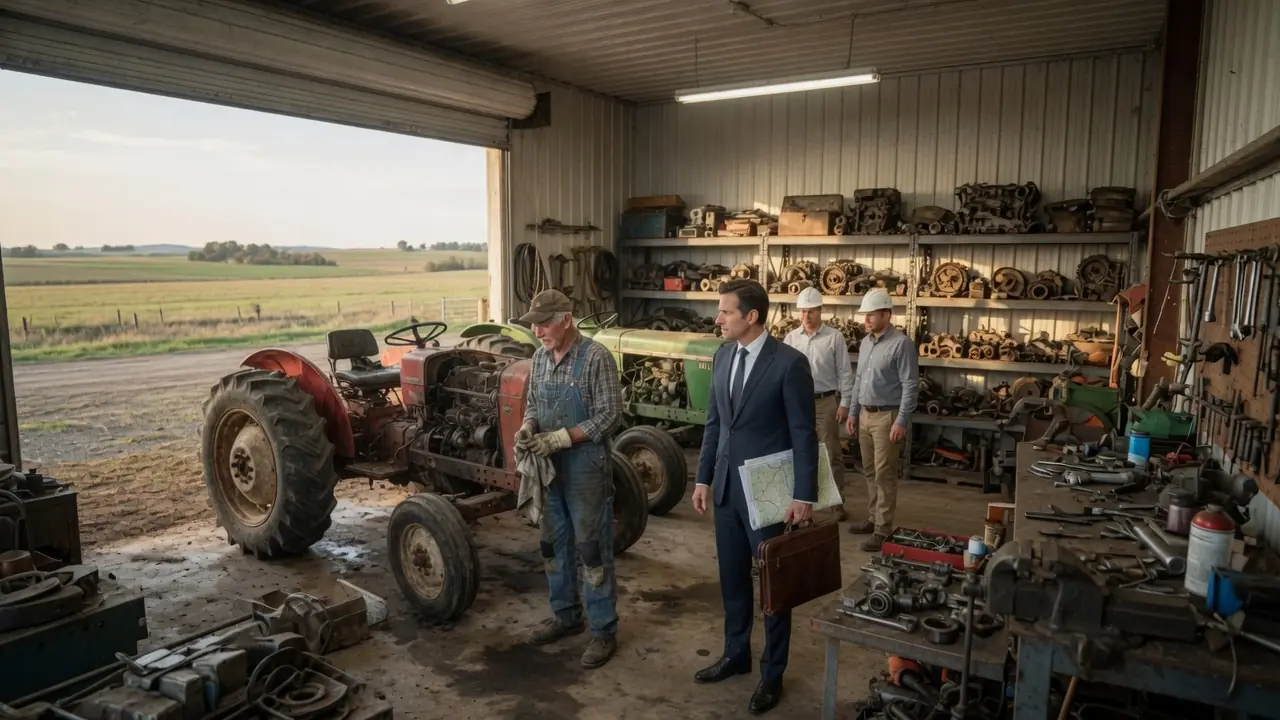
For thirty years, Samuel Carter had repaired old tractors in a cluttered workshop on the edge of Mercer Creek while the town slept through its own slow fade. Mornings began the same way: the heavy latch on the shop door, the smell of solvent and wet sawdust mixing with valley fog, and the first cough of a diesel engine he was coaxing back to life. He wore patched overalls, kept his gray hair cropped short, and spoke in sentences so spare that people filled the silence with assumptions. Everyone assumed he was just a small-town mechanic getting by on modest jobs and the occasional sale of spare parts pulled from rusted implements behind the building.
What nobody knew was that he had spent decades carefully buying forgotten pieces of land no one else wanted. He acquired overgrown fields, rocky hillsides, narrow strips along abandoned rail spurs, and easements that lawyers called nuisance parcels and bankers called unsellable. He bought them with cash from slow weeks in the shop, with small loans he paid off early, and with quiet persistence that never showed up in the county newsletter. Each deed went into a locked drawer behind his desk, beside a notebook where he recorded spring runoff, fence lines, and which corners of which parcels held the real shape of the valley—not on any developer’s slideshow, but in the ground itself.
The first piece had come young, after his father died. The old man had left the shop, a modest debt, and a folded right-of-way across a wet meadow where a creek fed the Mercer River. His father had once said that water routes mattered more than truck routes, that whoever held the seams where streams met could hold more than acreage suggested. Sam had nodded without understanding. Ten years later, he bought the meadow for five hundred dollars from a widow who laughed as she signed. “What are you going to do with a weedy corner?” she asked. He said he wanted to remember the sound of trains that no longer stopped. What he meant was the sound of water under the weeds.
From there it became a private rhythm. When a hillside slipped, when heirs squabbled over a strip too small to farm, when a rail line was retired and the county forgot who maintained the gravel beside it, Sam appeared—not at auction, but at kitchen tables with apple pie and coffee in a dented thermos. He did not compete with speculators. He wrote letters in a steady hand and said he was not trying to beat anyone; he only wanted the land to stay still. People sold cheap because he seemed harmless, a bachelor mechanic with dirt under his nails and no appetite for headlines.
He spent summers mending fences, clearing invasive brush without sterilizing the ground, letting some fields stay ragged so the soil could breathe. He built nothing flashy. He walked the parcels with a notebook and measured what mattered after rain: where the ground softened, where deer crossed, where the old easements still implied a path the county maps had erased. Thirty years of notes lived in that drawer, not for sale, for understanding.
Then Meridian Logistics arrived with ambitious plans for a three-hundred-million-dollar hub. They did not love Mercer Creek. They loved geometry. On their maps, the main rail corridor, the proposed I-41 extension, and the Mercer River formed a triangle made for containers, overnight freight, and eighteen-wheelers threading between regions. Their pitch promised jobs, a “green” catalyst, a future that would finally pull the town into the twenty-first century. Drone teams celebrated the topography until legal opened the title work and the celebration stopped.
Every critical pinch point—the creek crossing, the spur connection, the drainage that kept the floodplain honest, the utility corridor that could not bend without drowning someone’s basement—resolved to the same owner. Not a shell company. Not a hedge fund. Samuel Carter, mechanic, holder of patched overalls and a reputation for fair prices on hydraulic hoses.
Executives flew in from Chicago and Dallas. They met him in the modest office behind the repair shop, where a fan clicked on a windowsill and a cat slept on a stack of parts catalogs. They spread glossy maps across a scarred table and talked in millions. Sam listened without interrupting. He traced the proposed berms and retention ponds with a calloused finger, not to admire them, but to see where they assumed the land would cooperate. When they finished, he folded the map along its creases, aligned the corners, and smiled in a way that did not promise agreement.
“I’m not selling,” he said. “Not one acre.”
The room went quiet in the particular way corporate rooms go quiet when spreadsheets have not budgeted for a word like never.
They came back with escalators in the offer: cash premiums, profit participation, naming rights on a training center, a story in their annual report about partnership with local stewardship. Sam heard them out. He poured coffee from the thermos, the same one he took to widow’s kitchens years before. He said the land was not a sudden windfall to him. It was a lifetime assembled in fragments, each piece chosen because it was the kind of place people drove past without seeing. He had restored what he could, maintained fences not because he feared trespass but because boundaries reminded him what he was protecting, and kept the natural flow of water across those parcels because once you break that flow for a berm, you do not get it back when the lawsuits end.
Word of the standoff moved through Mercer Creek faster than Meridian’s press release. The waitress at the diner stopped calling him “Sammy” and started calling him “Mr. Carter” until he told her to stop. Teenagers who had only known him as the man who fixed the baler began to hear stories from their grandparents: the night he helped sandbag the creek, the year he bought the Henderson strip so two feuding cousins would stop poisoning each other in court, the easement he refused to fence because it was the last path deer used before winter. Foresight, people said, as if foresight were a virtue you could discover in a man the day he cost a corporation money.
Meridian faced delays that compound the way interest compounds. Survey crews needed access he would not grant without terms he would not discuss. Environmental consultants required seasonal flow data he had been recording when their executives were in middle school. Attorneys discovered that “nuisance parcels” become leverage when they sit between everything a hub needs and everything a hub promises. Costs climbed. Local officials who had smiled in groundbreaking photos began to sweat through interviews. Editorial writers asked whether one stubborn mechanic should hold a region hostage.
Sam kept opening the shop at dawn. He rebuilt carburetors, replaced clutch plates, and told a farmer with a leaking gasket that he could pay half now and half after harvest without signing anything. He walked his land on Sundays, not as a protest march, but as maintenance—the same way he maintained engines: not for drama, for function. He did not give speeches. When a reporter thrust a microphone toward his face, he said, “Talk to the creek if you want a quote,” and went back under a tractor.
Inside Meridian, factions hardened. Development directors called him irrational. Land acquisition teams called him a holdout to be broken by eminent domain. Their own counsel, reading the easements and the hydrology notes implied by decades of quiet use, used a different word: exposure. The valley was not empty land waiting to be improved. It was a stitched quilt of old decisions, and Sam held the stitches.
The company tried pressure without naming it pressure: hints about code enforcement on the shop, whispers about back taxes on obscure lots, outreach to relatives who did not exist. Sam had no wife, no children, no partner waiting for a payout. He had a brother in Spokane who sent a text that said, “Don’t let them make you the villain in their brochure.” He had neighbors who began leaving casseroles on his porch, not because they understood every deed, but because they understood what it felt like when outsiders drew a future on a map and called it inevitable.
A town hall turned ugly in the polite Midwestern way—voices raised, then lowered, then raised again. Someone shouted jobs. Someone shouted flooding. An old science teacher unfolded a hand-drawn map of the watershed and said the hub’s retention plan moved the problem downstream, which meant somebody else’s basement. Meridian’s regional VP promised mitigation until the questions got specific, and then promised studies. Sam sat in the back row and listened. He did not stand. Afterward, a young mother walked to him and said her husband drove truck and they needed work. He looked at her for a long moment and said, “I need the valley to still be here when your kids are grown. Work that washes away with the first bad season isn’t work. It’s a loan.”
Offers rose again. The number on the table made the diner go silent when it leaked. People calculated what Sam could buy: land elsewhere, a new life, security. He did not display the offer. He did not negotiate in public. Privately, he told Meridian’s lead counsel the same thing he told the first team: not one acre. When the counsel asked why, Sam opened the drawer—not to show deeds like playing cards, but to show the notebook. Dates, rainfall, sketches of where the ground sighed after storms. “You want to move earth,” he said. “I’ve been listening to this place move on its own for thirty years. You’re not buying dirt. You’re asking me to sign away a way of paying attention.”
Eminent domain entered the conversation like a door finally kicked open. Lawyers for the county and the company explored blight designations, public purpose arguments, the machinery by which private land becomes a photograph in a ribbon-cutting ceremony. Sam hired a lawyer too—not a flashy one from the city, but a woman from two counties over who still ate in diners and knew how juries felt about men in overalls who fixed things. She did not promise victory. She promised delay with teeth.
Seasons turned. Meridian’s investors received revised timelines. The hub that was going to break ground in eighteen months pushed to thirty-six, then to “under strategic review.” Rail partners who had priced capacity began to price uncertainty. Competitors in neighboring states sent fruit baskets to Sam’s shop—joke gifts, but the jokes had teeth. Mercer Creek became a case study in land-use blogs, then a footnote, then, when the next news cycle arrived, almost a memory.
Almost.
Because Sam’s refusal had changed the map in ways money could not directly buy. Without the clean corridor, Meridian had to rethink routes, shrink footprints, downgrade berms, and accept a design that no longer dominated the triangle—one that fit awkwardly, expensively, like a man trying to wear shoes two sizes too small. They could still build something. They could not build the thing they had sold to investors and politicians. The grand project stalled not with a single cinematic explosion, but with the accumulation of small impossibilities: a crossing that could not be permitted without access he would not sell, a drainage pattern their models had assumed was empty, a community that had learned to see the mechanic as something other than an obstacle.
In the end, the developers had no choice but to rethink their entire route and scale back their ambitions. They announced a “phased approach” that sounded like wisdom and felt like retreat. Ground broke eventually on a smaller pad miles from the original seam, where the geometry worked without Samuel Carter’s stitches. Jobs still came, fewer than promised. Trucks still rolled, on roads that had to be widened elsewhere at greater cost. The press release spoke of partnership with the community. Sam was not named. He would not have wanted to be.
He continued his daily work in the shop, fixing engines and tending his holdings with the same steady hands. Spring came. He planted willows where the creek bent. A teenager apprenticed with him, learning to listen for the knock in a rod bearing and, without knowing it, learning that some problems are solved by patience more than torque. The cat on the parts catalogs grew old and was replaced by another stray that chose the shop as its territory.
Locals who had long seen him only as the tractor repairman now nodded differently when he walked into the hardware store. Some were grateful. Some were bitter about lost wages. Most lived in the complicated middle where real towns live. Sam did not court gratitude. His satisfaction came from knowing he had protected something more valuable than any offer on the table—not because land is sacred in the abstract, but because attention is: the long, unglamorous work of noticing a place before someone with a glossy map names it obsolete.
On a Thursday evening, when the sun hit the birches at the angle that made the valley look like a photograph he had carried in his head since childhood, Sam locked the shop, pocketed the notebook, and walked the old rail spur strip. Weeds brushed his knees. Somewhere, a train horn sounded far away—not stopping here, never stopping here, but reminding the night that movement and stillness share a border. He had spent thirty years buying the borderlands nobody valued, and when the world finally showed up with three hundred million reasons to let go, he discovered what he had maybe known all along: the future of a region is not only built by those who arrive with cranes. It is also shaped by those who were already there, quietly keeping the seams together, one forgotten acre at a time.
He went home to a small house behind the shop, heated soup, and read a page of his notebook by lamplight. Tomorrow there would be a Fordson with a stuck injector and a farmer who would complain about the price of gaskets. Tomorrow, too, the land would still be his to tend—not as a trophy, not as leverage, but as a responsibility he had chosen in increments so small that no one had noticed until noticing became impossible to avoid.
Samuel Carter’s quiet accumulation had reshaped what could be built and what would have to be built elsewhere. He never sought attention or public praise for what he had assembled. In Mercer Creek, people would tell the story for years—in diners, in church basements, in the kind of exaggerated versions that make a man into a myth. He let them tell it. He had tractors to fix. He had fences that needed mending before the first hard frost. He had a creek that would rise again when the rains came, and a valley that, because he had refused to sell not one acre, still had a say in its own weather.