Brianna Freeman noticed the patrol car before either officer stepped onto the sidewalk, but for several seconds she gave it no more attention than the buses rolling through downtown Atlanta or the black sedans idling outside restaurants along the block. She had spent nearly forty minutes inside Bellamy & Rowe choosing a handbag and silk wrap for an anniversary dinner, something she almost never allowed herself to enjoy because she usually shopped while answering emails or calculating how quickly she could get home. Now she stood beneath the boutique’s black awning wearing an ivory fitted dress, a quilted beige purse over one shoulder, and a cream shopping bag hanging from her right hand, letting the afternoon sun touch her face before her husband arrived. Then the driver’s door of the cruiser opened.
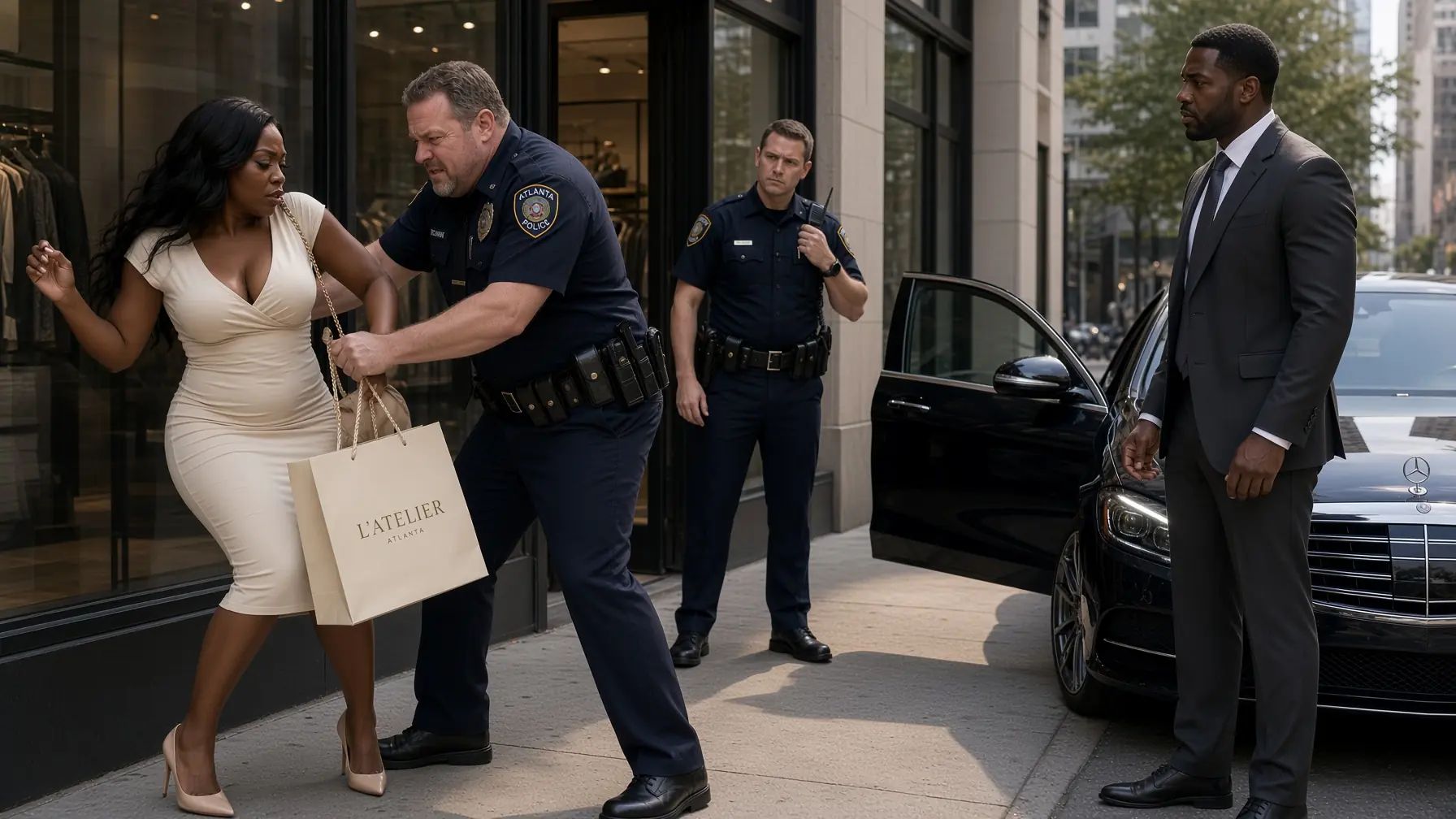
The first officer was a broad white man in his late forties whose uniform identified him as Sergeant Thomas Rickman, and the younger officer following several steps behind wore the name Mills. Rickman approached with the carefully relaxed expression of someone who wanted the encounter to appear casual while his eyes moved from Brianna’s face to the Bellamy & Rowe bag and then down the ivory dress she had bought earlier that afternoon. “Beautiful day,” he said, and Brianna answered, “It is,” before looking at her phone and noticing that Jaylen was now four minutes late. She started walking toward the corner, but Rickman shifted sideways and placed himself directly in her path.
“You shop around here often?” Rickman asked, and Brianna immediately disliked the question because nothing about the way he asked it sounded like small talk. She answered, “Sometimes,” while his gaze returned to the boutique bag and he remarked that Bellamy & Rowe was not exactly cheap, as though she might have wandered inside without noticing the prices printed on every display. Brianna replied, “I’m aware,” and tried to step around him again, but Rickman moved with her and added, “That dress certainly gets attention.” Officer Mills glanced toward his supervisor but said nothing.
Brianna stopped walking. “You followed me out of a store, commented on what I’m wearing, and stepped in front of me, so if you have an official reason to speak with me, say it,” she told him, keeping her voice low enough that nobody could reasonably describe it as shouting. Rickman’s smile disappeared almost instantly, and he answered, “Defensive, aren’t you?” as though her objection itself had supplied the first evidence he had been waiting for. Brianna looked directly at him and said, “No, Sergeant, I’m being clear.”
Rickman folded his arms and looked toward the boutique window. “Stores like this lose merchandise every week,” he said, leaving the accusation hanging in the space between them without saying the actual word theft. Brianna lowered the shopping bag carefully and asked, “Are you accusing me of stealing?” but Rickman replied, “I didn’t say that,” before suggesting they verify what she had purchased. She told him he had no reason to search her belongings, and he answered, “Walking out dressed like that with a full bag, you really expect me not to stop you?”
The words landed harder than Brianna expected because he had finally connected the dress, the bag, and his suspicion in a way that no polite explanation could disguise. She felt the urge to demand that Mills tell his supervisor how ridiculous he sounded, but the younger officer had already lowered his eyes toward the pavement with the expression of someone who understood something was wrong and had not yet decided whether understanding required action. Rickman stepped closer and said, “That mouth, that dress, and that attitude are giving me plenty of reasons to hold you here.” Brianna smiled once and replied, “Then you should probably make sure you’re very certain about what happens next.”
A black Mercedes pulled against the curb before Rickman could answer, and Jaylen Freeman stepped out wearing charcoal trousers and a pale blue dress shirt with the sleeves rolled once. He was forty, tall, athletic, and possessed the kind of calm expression that made strangers assume very little could irritate him, though Brianna knew the slight change around his eyes that appeared whenever something was wrong. From twenty feet away he saw the two officers, Brianna’s rigid shoulders, and the shopping bag sitting at her feet, then walked toward them and asked, “Everything okay?” Rickman turned immediately and ordered, “Stay back.”
Jaylen stopped without argument and looked at his wife. “Did he touch you?” he asked, and Brianna said no before adding that Rickman had not yet decided whether she was actually detained. Rickman told Jaylen the situation did not concern him, and Jaylen replied, “My wife is standing on a sidewalk surrounded by two police officers, so it concerns me,” while keeping his hands visible beside his body. Mills shifted his weight again, and Brianna noticed that he had started watching Rickman more closely than he was watching either of them.
Rickman pointed toward the Mercedes and told Jaylen to wait inside his vehicle. “Am I legally required to?” Jaylen asked, and the question changed something in Rickman’s face because he seemed to dislike precise questions almost as much as Brianna’s refusal to produce her receipt. He threatened to “join” Jaylen with his wife if he kept interfering, which caused Jaylen to ask, “Join her for what?” before Rickman finally announced that police had received a report of suspicious activity involving possible theft. Brianna turned toward him and said, “You never mentioned a report until my husband arrived.”
Jaylen asked who made the report and whether it specifically identified Brianna, but Rickman answered only that the details were police business. When Jaylen asked what time the complaint had been received, the sergeant stepped closer and said, “You conducting the investigation now?” while Jaylen glanced briefly at the body camera fixed to Rickman’s chest. “No,” he answered, “I’m just trying to understand the timeline.” It was a simple sentence, but Mills looked toward him as though something about the word timeline had suddenly made the encounter more serious.
Rickman reached for Brianna’s shopping bag and said, “Let me see the receipt.” Brianna pulled it away before he touched it and answered, “No, but you can ask the store directly,” then turned toward Bellamy & Rowe before Rickman could accuse her of refusing to cooperate. “Fine,” he said, apparently surprised by her willingness to return inside, and the four of them walked through the glass doors beneath the stares of two customers entering from the opposite direction. Brianna hated the walk more than she had hated anything outside because it transformed her from a woman leaving a store into a woman being escorted back inside by police.
The saleswoman who had helped Brianna looked up from the register and smiled automatically. “Mrs. Freeman, did you forget something?” Caroline asked, until she noticed Rickman behind her and the smile disappeared. The sergeant stepped forward, identified himself as police, and pointed toward Brianna’s shopping bag before asking whether “this woman” had purchased merchandise there. Caroline looked confused and answered, “Yes, of course.”
“What did she buy?” Rickman asked, and Caroline explained that Brianna had purchased a handbag and a silk evening wrap. When he asked whether she had actually paid, Caroline said yes, and when he asked how, the saleswoman hesitated before answering that Brianna used a credit card. Rickman followed with, “Whose card?” and Brianna’s patience finally cracked enough that her voice sharpened. “Sergeant, she just told you I made the purchase, so my financial arrangements are none of your business.”
Caroline stepped around the counter and said she had personally checked Brianna’s identification because the purchase exceeded the boutique’s verification threshold. Rickman asked how much the transaction was, and after Brianna nodded permission, Caroline answered, “Forty-eight hundred dollars.” Mills looked toward his supervisor, then at the boutique bag, as if expecting the obvious next step to be returning Brianna’s afternoon to her. Instead, Rickman asked whether any alarms had sounded, whether merchandise was missing, and whether Caroline was absolutely certain Brianna had paid.
Caroline answered no, no, and yes. Jaylen finally said, “So there was no theft,” but Rickman replied that the investigation was still active without identifying what remained to be investigated. Brianna watched his eyes move toward the back office and realized he was no longer trying to discover what happened; he was trying to locate something that would keep his original assumption alive. She had seen the same expression in executives who refused to abandon a failing proposal because admitting error felt worse than wasting another million dollars.
Rickman asked whether anyone at Bellamy & Rowe had called police about Brianna. Caroline’s eyes moved involuntarily toward a closed office door near the rear of the store, and the tiny motion was enough for everyone to notice. “I didn’t,” she said, and when Rickman asked who had, she reluctantly answered, “Our assistant manager, Marcus Ellison.” Brianna stared toward the office and said, “He followed me for nearly twenty minutes.”
Jaylen looked at his wife. She explained that Ellison had appeared in nearly every section she entered, pretended to straighten merchandise whenever she stopped, and once stood so close while she examined a handbag that she finally asked whether she was doing something wrong. He had smiled and said he was merely providing attentive service, then disappeared after Caroline carried Brianna’s purchases to the register. Rickman seemed encouraged rather than concerned and said, “Maybe he saw something you didn’t.” Caroline immediately shook her head.
“No,” she said, and the word came out more firmly than anything she had said since the officers entered. When Rickman asked how she could know that, Caroline took a breath and admitted Ellison had never claimed he witnessed theft. “He said she looked suspicious and that people sometimes come in dressed to look wealthy, buy one thing, then distract staff while somebody else steals,” Caroline explained, looking increasingly uncomfortable as she heard the logic aloud. Jaylen asked whether Brianna had entered with anyone else, and Caroline said no.
Rickman insisted the information was still enough to justify investigation. Jaylen replied that it might justify asking the store what happened, but the store had now confirmed a valid purchase, no missing merchandise, no alarm, no suspicious companion, and no theft. Rickman turned on him and asked, “You a lawyer?” while Jaylen answered simply, “No.” The sergeant smirked and said, “You sure talk like one.”
“I work with policies and records,” Jaylen replied, offering nothing else about himself. Rickman dismissed the answer with a laugh and told Brianna they would take the discussion back outside, but she refused. “I’m not standing on a sidewalk where you can describe this later however you want when this store has cameras and witnesses,” she said, then asked Caroline whether Bellamy & Rowe objected to her remaining inside. Caroline said, “No, Mrs. Freeman, you can stay.”
Rickman’s face reddened. “You’re not in charge here,” he said, but Brianna answered, “Neither are you inside a private business that has just told you I’m welcome.” Jaylen looked toward Mills and asked whether he could verify the original dispatch notes while they waited. Rickman turned so quickly that even Caroline flinched and said, “Don’t.”
Mills froze. Jaylen did not smile, threaten, or challenge the order; he simply looked at the younger officer and said, “That answer should concern you more than anything my wife has done today.” Rickman stepped toward him, asking whether he thought he was clever, but Jaylen replied, “No, Sergeant, I think your partner should protect himself by knowing what call he is standing inside.” For several seconds, Mills said nothing.
The office door opened before he could decide. Marcus Ellison emerged wearing a fitted black suit, white shirt, narrow tie, and the silver Bellamy & Rowe management pin fixed perfectly to his lapel. He stopped when he saw Brianna still inside with two officers and immediately looked toward Caroline as if she had violated some instruction by allowing the conversation to continue. Brianna said, “You called them,” and Ellison answered, “I was following store policy.”
“What policy?” she asked. Ellison referred vaguely to suspicious-customer procedures, so Jaylen asked what Brianna had actually done. The assistant manager said she looked around frequently, remained in the store a long time, asked about expensive items, and appeared “overly interested” in where cameras were positioned. Brianna stared at him and said, “I looked at the ceiling once because the lighting above the handbag display was reflecting in the mirror.”
Ellison continued anyway. He said high-end retailers had to recognize behavior patterns, and Brianna’s clothing, confidence, extended browsing, and interest in several expensive items had created concern. Caroline looked horrified and reminded him that Brianna had actually bought the expensive items. “That doesn’t automatically eliminate the possibility of distraction theft,” Ellison said, and Rickman nodded as though he had finally been given the explanation he needed. Mills did not nod.
Jaylen asked Ellison whether anything had been stolen while Brianna was inside. The manager said no, and when asked whether Brianna concealed merchandise, switched tags, entered employee areas, tampered with sensors, distracted staff while another person stole, or attempted to leave without paying, he answered no every time. “Then the behavior you’re describing is shopping,” Jaylen said. Ellison looked toward Rickman instead of responding.
That was when Rickman told Brianna he wanted to search her personal purse as well as the Bellamy bag. The request stunned even Ellison, and Brianna asked what specific stolen item he believed might be inside. Rickman said officers were permitted to investigate reasonable possibilities, so she answered, “Then reasonably identify one item that is missing.” When he could not, she refused consent.
“You keep making this harder,” Rickman said. Brianna looked at him and replied, “No, Sergeant, the facts keep making it harder for you.” His jaw tightened, and for the first time he touched the handcuffs at the back of his belt without removing them. Jaylen noticed the movement and asked, “Is she detained now?”
Rickman answered yes. Brianna asked for what suspected offense, and he said possible theft while the store employee standing three feet away repeated that no merchandise was missing. Caroline whispered, “This is insane,” under her breath, but Rickman heard her and ordered her to remain out of police business. Ellison did not object.
Nearly twenty minutes passed inside the boutique. Customers entered, noticed the officers, and either moved quietly to the opposite side or left without shopping. Brianna remained near the register with her purchased bag placed on the floor beside her, while Rickman repeatedly asked versions of the same questions about where she worked, whether the Mercedes belonged to her husband, how they paid for expensive purchases, and why someone would spend nearly five thousand dollars on accessories. Brianna answered none of the financial questions.
Jaylen remained calmer than she felt. Every few minutes he checked the time, looked toward the cameras, and asked Rickman to clarify whether new evidence had appeared. He never raised his voice, but the questions seemed to irritate the sergeant because each one forced him to confront the same problem: every objective fact pointed toward an ordinary purchase. Mills eventually moved several feet away from Rickman and began studying the display on his department phone.
Rickman noticed and snapped, “What are you doing?” Mills answered that he was checking the call notes, and the sergeant ordered him to stop. This time Mills did not. He looked at the screen for several seconds before saying, “Sergeant, the call only says suspicious customer, possible shoplifting, no confirmed loss.”
Rickman told him that was exactly what they were investigating. Mills quietly added, “It says complainant is Marcus Ellison,” and looked toward the assistant manager. Ellison crossed his arms, but something about the way he avoided looking at Brianna made Jaylen glance toward the shopping bag again. “What time?” Jaylen asked.
Rickman immediately said the timestamp was irrelevant. Mills hesitated, then read it anyway. “Three forty-seven.”
Brianna felt Jaylen become very still beside her. He did not look at Rickman or Ellison; instead, he bent slowly, picked up the Bellamy & Rowe bag, and asked his wife where the receipt was. Brianna reached into the inner pocket and handed it to him, confused by the change in his expression. Jaylen unfolded the paper and looked at the transaction line.
3:42 p.m.
He said nothing.
Brianna read it over his shoulder and understood. The police call had been made five minutes after the store completed her purchase. Caroline walked closer, read the receipt, and whispered, “Marcus watched me ring everything up.”
Ellison’s face changed. “I was still concerned,” he said quickly, but Brianna asked whether he had watched Caroline verify her identification and process the payment. He admitted yes. She asked whether the handbag and wrap had been placed into the cream store bag before he called police. Ellison hesitated before admitting that they had.
Rickman stepped between the conversation and announced that the timeline did not necessarily eliminate possible theft. Jaylen finally looked at him and asked, “Possible theft of what?” The sergeant gestured vaguely around the boutique and said expensive merchandise could disappear without immediate detection. Caroline replied that inventory alerts would have notified staff and no such alert existed.
Brianna asked Rickman to end the detention. He said he wanted several more questions answered first, and when she asked what answers could change the evidence already in front of him, he told her to stop “playing victim.” That phrase caused a woman browsing scarves nearby to lower the item in her hands and begin recording with her phone. Mills saw her but said nothing.
Jaylen asked his wife quietly whether she wanted to leave once the officers released her. Brianna looked toward Rickman and said, “No, I want his name and badge number first.” The sergeant pointed toward his uniform and told her to read it, but she answered, “I want you to say it while your camera is running.” After several seconds of silence he said, “Sergeant Thomas Rickman, badge 4172.”
Brianna repeated the number once. Jaylen repeated it too. Mills looked toward both of them and then at his supervisor.
Rickman finally said they were free to go. Brianna picked up her bag but did not move toward the door. “Cleared?” she asked, and Rickman answered, “Yes.”
“That’s not what I asked,” she said. “You’re saying I was cleared as if there was ever evidence against me, but the store verified I paid before you even arrived.” Rickman gave a tired laugh and asked whether she wanted an apology.
“I want the record to say what actually happened,” Brianna answered. Rickman told her police reports were not written by citizens. Jaylen looked at him and said, “That might be the first accurate thing you’ve said all afternoon.”