They Spent Four Hours Staring at Screens — An Old Farmer Looked at the Ground for Thirty Seconds
The combine stopped at 2:17 on a Wednesday afternoon.
One moment, the enormous machine was swallowing row after row of corn beneath a clear Nebraska sky.
The next, its engine dropped to idle, warning lights flashed across the display, and every harvesting system shut down at once.
Daniel Mercer pulled back the hydrostatic lever.
Nothing happened.
He pressed the header switch.
No response.
The machine sat motionless in the middle of the field while dry corn leaves scraped against the cab.
Daniel stared at the screen.
Three fault codes appeared.
HEADER DRIVE OVERLOAD.
FEED SYSTEM INTERRUPTION.
ENGINE PROTECTION ACTIVE.
He read them twice.
Then a fourth warning appeared.
SERVICE REQUIRED.
Daniel closed his eyes.
More than three hundred acres of corn remained standing.
A line of storms was expected Friday evening.
The weather service had already warned of heavy rain, strong wind, and possible hail.
If the crop went down before harvest, losses could reach tens of thousands of dollars.
He tried restarting the combine.
The engine fired normally.
For seven seconds, every display appeared clear.
Then the header engaged.
A metallic vibration traveled through the machine.
The warning lights returned.
Everything shut down again.
Daniel reached for the radio.
“Caleb.”
His younger brother answered from the grain truck at the edge of the field.
“What happened?”
“It quit.”
“Engine?”
“Running.”
“Header?”
“Dead.”
“Belts?”
“Can’t see from here.”
“I’m coming.”
Caleb arrived in the pickup five minutes later.
The brothers climbed beneath the header and checked everything they could reach safely.
No broken chain.
No snapped belt.
No obvious bearing failure.
No corn stalk wrapped tightly around an auger.
No smoke.
No leaking oil.
Nothing explained why the machine refused to work.
Daniel called Plains Agricultural Service in Hastings.
The service manager listened to the fault codes.
“Could be an electronic controller.”
“What controller?”
“Header module. Feedhouse sensor. Main harness. Hard to say from codes alone.”
“How soon can somebody come?”
“We’ve got technicians thirty miles away.”
“How long?”
“Maybe an hour.”
Daniel looked toward the horizon.
The sky remained clear.
That offered little comfort.
Storms did not need to be visible to be expensive.
The combine was only four years old.
It had cost more than the farmhouse, barn, and original eighty acres combined.
Daniel purchased it because newer equipment was supposed to reduce uncertainty.
It monitored grain loss.
Adjusted threshing settings.
Mapped yield.
Detected overloads.
And communicated problems through an electronic diagnostic network.
Now it had stopped in the middle of the best corn crop the Mercers had grown in a decade.
The machine knew something was wrong.
It simply refused to explain it clearly.
Two technicians arrived shortly after three.
The older one was named Trevor Lane.
He had worked on modern harvesting equipment for eleven years and carried a rugged laptop inside a black case.
His partner, Cody Jensen, was twenty-six and had recently completed factory certification on the exact combine model.
They parked the service truck beside the machine.
Trevor climbed into the cab and connected the laptop to the diagnostic port.
Cody began inspecting the header.
Daniel watched the laptop fill with data.
Colored graphs.
System pressures.
Sensor readings.
Communication errors.
Stored events.
The screen displayed hundreds of lines he could not interpret.
Trevor opened one menu, then another.
“Your header controller lost communication six times.”
“So that’s the problem?”
“Maybe.”
Cody called from below.
Trevor looked toward Daniel.
“Did you hit anything?”
“No.”
“Rock?”
“Not that I felt.”
“Tree limb?”
“This field doesn’t have trees.”
“Did the header plug?”
“No. It was feeding clean.”
Trevor cleared the codes.
Daniel started the combine again.
The technicians watched live data.
The header engaged.
The machine vibrated.
Then shut down.
Trevor frowned at the screen.
“That shouldn’t have happened.”
Daniel leaned closer.
“What did it show?”
“Torque spike at the feeder drive. Then the speed sensor dropped to zero.”
“So something is jammed.”
“Not necessarily.”
Cody entered the cab.
“The feeder chain is clear.”
“Gearbox?”
“Oil level good. No heat.”
Trevor scrolled through more information.
“Could be false sensor data.”
Daniel looked from one technician to the other.
“What does that mean?”
“The controller may think the machine is overloaded when it isn’t.”
“Can you bypass it?”
“No.”
“Can you replace the sensor?”
“We need to identify which one.”
“How long?”
Trevor did not answer immediately.
That worried Daniel more than a bad estimate would have.
The technicians began testing components one by one.
Header-speed sensor.
Feederhouse-position sensor.
Drive-pressure switch.
CAN communication harness.
Ground connections.
Controller voltage.
They removed covers.
Disconnected plugs.
Checked resistance.
Reconnected everything.
The combine started.
Stopped.
Started again.
Stopped again.
Each test produced slightly different codes.
By five o’clock, the cab looked like a portable office.
Trevor’s laptop rested on the passenger seat.
Cody held a tablet showing electrical diagrams.
Daniel stood outside beside Caleb, watching the technicians move between screens and components.
“How bad?” Caleb asked.
“They don’t know.”
“That is not the same as bad.”
“It usually becomes expensive before it becomes different.”
Caleb looked toward the standing corn.
“We could bring in Mason’s old combine.”
“It hasn’t run in two years.”
“It might.”
“It has a cracked unloading auger.”
“It still harvests.”
“At half the rate.”
“Half is more than zero.”
Daniel knew that.
He also knew the old machine sat fifteen miles away behind Mason Wheeler’s shed, covered in weeds and bird droppings.
By the time they serviced it, repaired tires, and found a battery, another day could disappear.
At 6:20, Trevor called the dealership.
He spoke quietly near the service truck.
Daniel heard only fragments.
Multiple communication faults.
Possible control module.
Need overnight shipment.
Harness unavailable locally.
When Trevor returned, his expression had become careful.
“We may have two issues.”
Daniel stared.
“It stopped once.”
“The event may have caused a secondary fault.”
“What event?”
“That’s what we’re trying to determine.”
Cody pointed toward the display.
“The header-control module is dropping offline.”
“Replace it.”
“We can order one.”
“When?”
“If the warehouse has it, tomorrow afternoon.”
“And if it doesn’t fix it?”
Trevor looked toward the feederhouse.
“Then we may need to replace the main harness.”
“How long?”
“Five to seven days.”
Daniel laughed once.
Not because anything was funny.
“You’re telling me this machine may sit here for a week?”
“We’re telling you what the diagnostics indicate.”
“What do they actually prove?”
Trevor’s face tightened slightly.
“They prove the system is losing communication.”
“Why?”
“We don’t know yet.”
Daniel looked toward the cab.
Four hours of data, graphs, and electronic diagrams had produced no explanation.
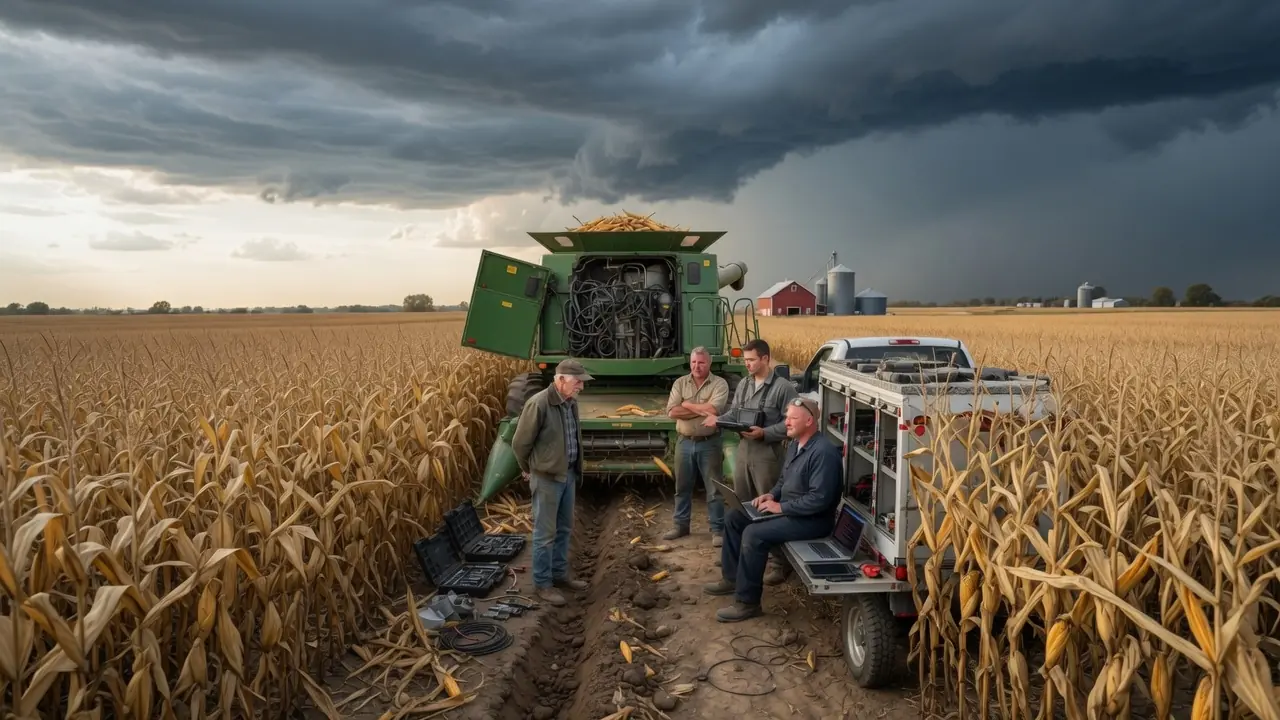
The technicians continued working until dusk.
They replaced one sensor using a spare from the service truck.
Nothing changed.
They cleaned electrical connectors.
No improvement.
They ran a software update.
The combine failed again.
At 7:11, Trevor shut the laptop.
“We need the controller.”
Daniel looked toward the west.
The setting sun had turned the field copper.
A breeze moved through the corn.
Standing stalks whispered against one another.
“If the controller arrives tomorrow, can we run tomorrow night?”
“If that’s the only problem.”
“And if it isn’t?”
Trevor lowered his voice.
“It could take a week.”
Caleb cursed softly.
Daniel said nothing.
The farm had borrowed heavily that spring.
Seed.
Fertilizer.
Fuel.
Equipment payments.
The crop represented more than profit.
It represented survival until the following harvest.
A week of delay could allow the storm to flatten entire sections.
Trevor packed the diagnostic equipment.
“We’ll be back as soon as the part arrives.”
Daniel nodded without looking at him.
The technicians left.
Their service truck disappeared down the county road, leaving the combine in the growing dark.
Caleb leaned against the pickup.
“Call Mason.”
Daniel took out his phone.
Before he could dial, headlights appeared at the far end of the field.
An old green Ford pickup turned through the gate.
It moved slowly along the stubble.
Caleb squinted.
“Who is that?”
Daniel recognized the truck.
“Walter Briggs.”
Caleb looked surprised.
“He still drives?”
“Apparently.”
The pickup stopped near the combine.
Walter stepped out.
At seventy-three, he was tall but thin, with shoulders slightly rounded by age. He wore faded overalls beneath a brown canvas jacket and a seed-company cap so old the lettering had nearly disappeared.
He had farmed for forty-six years before turning his land over to his daughter.
Before farming full-time, Walter spent fifteen years repairing combines and forage harvesters.
He belonged to the generation that learned machinery through sound, vibration, smell, and the consequences of guessing wrong without a computer to correct them.
Daniel walked toward him.
“What brings you out?”
“Mason called.”
“I haven’t called Mason yet.”
“He heard the service truck on the radio.”
Caleb smiled.
“Nothing travels faster than machinery trouble.”
Walter looked toward the combine.
“What did it do?”
Daniel explained.
One sudden shutdown.
Header overload.
Feed interruption.
Communication faults.
Two technicians.
Four hours.
Possible controller.
Possible wiring harness.
Walter listened without interrupting.
When Daniel finished, the old man asked, “What were you harvesting?”
“Corn.”
Walter looked at the field.
“I can see that.”
Daniel waited.
“What condition?”
“Dry. Seventeen percent moisture.”
“Yield?”
“Around two hundred ten.”
“Any down corn?”
“Very little.”
“Ground dry?”
“Yes.”
“What row were you in when it stopped?”
Daniel pointed.
“About two hundred yards in.”
Walter looked toward the stationary machine.
“Did it stop immediately?”
“The systems did.”
“The combine?”
“I pulled the lever back.”
“Before or after the warning?”
“After.”
“What did you feel?”
Daniel thought.
“A vibration.”
“Where?”
“Under the cab. Maybe feederhouse.”
“Before the warning?”
“Yes.”
“One vibration or repeated?”
“Repeated for two or three seconds.”
Walter nodded.
“What did the technicians inspect?”
“Everything.”
The old farmer looked toward him.
“That means nothing.”
“Header. Feeder chain. sensors. Wiring. Gearbox.”
“Did they run it?”
“Several times.”
“Did it move?”
“No.”
Walter looked down at the ground beside the combine.
Then he began walking.
Not toward the engine.
Not toward the cab.
Not toward the exposed electrical connections.
He walked around the front tire.
Then along the left side of the machine.
His eyes remained on the soil.
Daniel and Caleb followed.
“What are you looking for?” Caleb asked.
Walter did not answer.
He stopped near the rear axle.
Stared at the ground for several seconds.
Then walked toward the header.
The field was covered with chopped stalks, husks, and dry leaves.
Tire tracks pressed deeply into the soil.
Walter crouched near the left side of the feederhouse.
He touched the dirt.
Rubbed something between two fingers.
Then stood.
Daniel glanced toward Caleb.
Neither understood.
Walter moved ten feet backward along the combine’s path.
Stopped again.
The last sunlight was nearly gone.
He pointed toward the ground.
“There.”
Daniel saw nothing.
“What?”
Walter used his boot to push aside dry corn leaves.
Beneath them lay a thin dark line in the soil.
Not oil.
A shallow groove.
It began near the left tire track and continued toward the combine.
Walter followed it.
The mark grew deeper closer to the machine.
He reached beneath the feederhouse and pulled out a short length of black rubber.
Cody and Trevor had inspected belts.
This was not a drive belt.
It was part of a hydraulic hose’s protective outer covering.
Walter held it toward Daniel.
“Something has been dragging.”
Daniel crouched.
“Where?”
Walter pointed beneath the feederhouse.
A bundle of hydraulic lines and electrical cables ran along a steel support.
Nothing looked disconnected.
Walter asked for a flashlight.
Caleb brought one from the pickup.
The old farmer lay on the ground and directed the beam upward.
For nearly thirty seconds, he said nothing.
Then he pointed.
“Your problem isn’t the controller.”
Daniel lowered himself beside him.
“What is it?”
“That bracket.”
A steel clamp held the hydraulic and wiring bundle above the left feederhouse pivot.
One mounting bolt remained.
The second was missing.
The clamp had rotated downward.
On level ground, it appeared secure.
When the header was raised, the bundle shifted slightly.
The edge of the loose bracket pressed against a hydraulic hose and the main electrical harness.
The hose’s outer covering had been cut.
More importantly, the harness insulation had rubbed through against the metal edge.
The copper wires inside remained mostly intact.
Until the combine entered a shallow depression.
Then the feederhouse angle changed.
The cable bundle pulled tight.
The exposed communication wire touched the bracket.
The electronic network shorted momentarily.
Controllers lost communication.
Safety systems shut down the header, feederhouse, and engine load functions.
Once stopped on level ground, the wire moved away from the bracket.
The system appeared normal again.
Trevor’s diagnostic screen accurately showed communication failure.
But it could not explain what physically caused it.
Daniel stared upward.
“Why didn’t it fail during their tests?”
“They didn’t move the machine.”
“They raised the header.”
“Not while the left front tire sat lower than the right.”
Walter pointed toward the soil.
The combine had stopped with its left tire inside a shallow washout hidden beneath chopped stalks.
The machine leaned less than two degrees.
Barely visible.
Enough to change the feederhouse geometry.
Enough to pull the harness against the bracket.
Caleb looked toward the groove behind the machine.
“And the mark?”
“The loose cable bundle dragged against residue before the final insulation cut.”
Walter held up the rubber strip.
“It’s been warning you for several rows.”
Daniel looked toward him.
“You saw all that from the ground?”
“I saw the mark.”
“How did you know what made it?”
“I didn’t.”
Walter slid from beneath the machine.
“I followed it.”
Caleb shined the flashlight into the washout.
The left tire had compressed the loose soil.
“Could this really cause every code?”
Walter nodded.
“One short on the communication line can make half the machine accuse the other half.”
Daniel thought of the four hours spent replacing sensors, updating software, and discussing controllers.
“How do we fix it?”
Walter looked toward the exposed harness.
“Properly tomorrow.”
“And tonight?”
“You have electrical tape?”
“Yes.”
“Rubber hose?”
“Probably.”
“Bolt?”
Daniel smiled for the first time that afternoon.
“We have bolts.”
They disconnected the battery.
Walter cleaned the damaged section.
One wire had a small cut in the insulation but no broken strands.
He wrapped it with self-fusing electrical tape.
Then split a short piece of fuel hose lengthwise and placed it around the repaired harness for protection.
Caleb found a grade-eight bolt inside the service compartment.
Walter returned the clamp to its original position and secured it with a locking nut.
They tied the bundle farther back from the pivot.
The temporary repair took twenty-two minutes.
Walter insisted they lower the header completely before reconnecting power.
Daniel climbed into the cab.
The displays started.
No fault codes.
He engaged the header.
It ran.
Then the feederhouse.
No shutdown.
Walter raised one hand.
“Drive it into the depression.”
Daniel hesitated.
“What if it shorts again?”
“Then we know I’m wrong.”
The combine rolled forward slowly.
The left tire entered the washout.
The cab leaned slightly.
The header continued running.
Daniel increased engine speed.
The machine remained steady.
He drove into the unharvested corn.
The header pulled in the first rows.
Stalks disappeared beneath the snouts.
Corn entered the feederhouse.
Grain began collecting in the tank.
No warning lights appeared.
Daniel harvested fifty yards.
Then one hundred.
The machine ran exactly as it had before the failure.
Caleb followed in the pickup.
Walter stood beside the field, hands inside his jacket pockets.
Daniel stopped and climbed down.
“You fixed it.”
Walter shook his head.
“I moved a wire.”
“You found what two factory technicians missed.”
“They were looking at what the machine reported.”
“And you weren’t?”
“I looked at what the machine left behind.”
Daniel held out his hand.
Walter shook it.
“What do I owe you?”
“Nothing.”
“That repair may have saved the crop.”
“Then finish the crop.”
The old farmer walked toward his pickup.
Daniel followed.
“How did you think to look at the ground?”
Walter opened the driver’s door.
“Because the machine stopped moving.”
Daniel waited.
Walter looked toward the dark line beneath the residue.
“Something happened before it stopped.”
“The vibration.”
“Yes.”
“The codes appeared after.”
“Yes.”
“So?”
Walter leaned against the truck.
“Screens tell you what the system noticed.”
He pointed toward the field.
“The ground tells you what the machine did.”
Daniel looked back at the combine.
Walter continued.
“Your technicians began with the fault codes.”
“What would you have begun with?”
“The last place it worked.”
That night, the Mercers harvested until two in the morning.
The combine never failed again.
By sunrise Thursday, another eighty acres were finished.
Trevor Lane returned shortly before noon carrying a new header-control module.
He found Daniel unloading grain at the farm.
“We got the part earlier than expected.”
“Don’t need it.”
Trevor looked toward the combine running beyond the bins.
“You got it working?”
“Yes.”
“What was wrong?”
“Loose harness clamp.”
The technician frowned.
“Where?”
“Feederhouse pivot.”
“We checked that harness.”
“On level ground.”
Daniel explained the washout.
The bracket.
The damaged insulation.
The intermittent communication short.
Trevor listened carefully.
Then looked toward the combine.
“Who found it?”
“Walter Briggs.”
“The retired mechanic?”
“Yes.”
Trevor remained silent for several seconds.
Then he opened the laptop.
“I want to see the damaged section.”
They stopped the combine during the next unload.
Trevor crawled beneath the feederhouse.
He examined the temporary repair.
When he emerged, dirt covered one shoulder of his clean work shirt.
“That would do it.”
Cody arrived in the second service truck.
He looked at the bracket.
“We were right about the communication fault.”
Trevor nodded.
“We were wrong about the cause.”
Cody pointed toward the laptop.
“The data never showed a continuous short.”
“Because it wasn’t continuous.”
Daniel folded his arms.
“You recommended a controller.”
Trevor looked embarrassed.
“The controller was disappearing from the network.”
“Because its wire touched metal.”
“Yes.”
“Would replacing the controller have fixed anything?”
“No.”
“What about the harness?”
“Eventually, yes.”
“After a week.”
Trevor closed the laptop.
“Yes.”
He did not defend himself.
That mattered to Daniel.
“You spent four hours here,” Daniel said.
“We did.”
“Walter spent thirty seconds looking at the ground.”
Cody’s face tightened.
Trevor glanced toward him.
“Don’t.”
“What?”
“Make this about old versus young.”
Daniel looked surprised.
Trevor continued.
“We knew how to read the system. He knew where to begin the investigation.”
Cody looked toward the groove in the soil.
“We should have asked where the vibration started.”
“Yes.”
“We did ask if he hit anything.”
Trevor shook his head.
“That is not the same question.”
Walter returned that afternoon after Daniel called him.
The technicians were still present.
Cody appeared uncomfortable.
Trevor approached the old farmer.
“Would you show us exactly what you saw?”
Walter looked toward Daniel.
“Didn’t he explain?”
“He did.”
Trevor nodded toward the field.
“I want to see it the way you saw it.”
Walter agreed.
They walked to the original stopping point.
The groove remained visible beneath scattered residue.
Walter showed them the first faint mark.
Then the torn rubber.
Then the difference in tire height.
Trevor took photographs.
Cody crouched near the washout.
“This drop is barely an inch and a half.”
“Enough,” Walter said.
“To change the harness tension?”
“Apparently.”
Cody looked toward him.
“You knew that before inspecting the bracket?”
“No.”
“What did you know?”
“Something dragged.”
“Then?”
“I looked for what could drag.”
“That’s all?”
Walter smiled.
“That’s usually enough for the next question.”
Trevor looked toward the combine.
“The system recorded thirty-seven communication errors in less than two seconds.”
Walter nodded.
“That sounds impressive.”
“It is.”
“Did it tell you about the missing bolt?”
“No.”
“Then the machine knew less than it sounded like.”
Cody almost laughed.
Trevor did.
The tension eased.
They repaired the harness properly.
The damaged wire section was replaced.
Protective loom installed.
The clamp received two new bolts with locking nuts.
Trevor inspected similar brackets across the combine.
One other bolt was loose.
He tightened it.
Then he created a service note for the dealership’s technicians.
INSPECT PHYSICAL HARNESS SUPPORTS UNDER OPERATING GEOMETRY BEFORE REPLACING COMMUNICATION MODULES.
Daniel read it.
“Operating geometry?”
Trevor shrugged.
“Engineers like longer words.”
Walter looked toward the field.
“Means check it where it works.”
The storm arrived Friday night.
By then, only thirty-two acres remained.
Daniel and Caleb worked beneath a darkening sky.
Lightning flashed to the west.
Wind bent the corn.
The final grain cart left the field at 9:46 p.m.
Rain began eleven minutes later.
It struck the combine roof while Daniel parked inside the machinery shed.
He shut down the engine.
For a moment, he remained in the cab listening.
Water hammered the metal building.
Across the fields, unharvested corn on neighboring farms bent beneath the storm.
The Mercers’ grain was already inside the bins.
Daniel looked toward the diagnostic display.
No codes.
No warnings.
The screen glowed quietly.
Then he looked down at his muddy boots.
The machine had not been saved by ignoring technology.
It had been saved by placing technology inside a larger investigation.
The screen identified where the system lost communication.
The ground revealed why.
On Saturday morning, Daniel drove to Walter’s farm.
The old man was repairing a gate hinge.
“You finished?”
“Before the rain.”
“Good.”
Daniel handed him an envelope.
Walter looked at it.
“What’s this?”
“Payment.”
“No.”
“You saved us more than the amount inside.”
“No.”
Walter returned it.
Daniel refused to take it.
“You drove out after dark. Found the problem. Helped repair it.”
“I was curious.”
“Curiosity still has value.”
Walter looked toward the envelope.
“How much?”
“Five hundred.”
The old farmer frowned.
“For twenty minutes?”
“For seventy-three years.”
Walter stared at him.
Then smiled faintly.
“That sounds like something a salesman would say.”
“Take it.”
Walter opened the envelope.
Removed one hundred dollars.
Then returned the rest.
“That covers fuel.”
“You drove six miles.”
“Old truck.”
Daniel accepted the remaining money reluctantly.
“What can I do instead?”
Walter pointed toward an abandoned combine parked behind his shed.
A faded red machine from the early 1970s sat beneath a torn canvas cover.
“Mason wants that running.”
Daniel looked toward it.
“That thing?”
“Yes.”
“Why?”
“He says it belongs in the harvest parade.”
“Does it run?”
“No.”
“What’s wrong?”
Walter smiled.
“That’s what we’ll find out.”
For the next three Saturdays, Daniel and Caleb helped restore the old combine.
Trevor and Cody joined during their time off.
At first, the project became an informal competition.
The younger technicians brought gauges, manuals, and electronic test equipment.
Walter brought his notebook and a flashlight.
The old combine lacked computers.
That did not make diagnosis simple.
Its fuel system contained air.
A clutch linkage was bent.
Mice had destroyed sections of wiring.
The engine’s oil-pressure gauge stuck at zero despite normal pressure.
Each problem required different methods.
Trevor discovered the fuel leak using a vacuum tester.
Cody rewired the starter circuit correctly.
Walter noticed the clutch problem by studying uneven wear on one pedal.
Daniel found the stuck gauge by tapping it too hard.
Nobody solved everything alone.
By October, the combine ran.
Mason drove it in the county harvest parade.
Children waved as the old machine crawled down Main Street.
A sign attached to the side read:
IT STILL WORKS BECAUSE PEOPLE KEPT LOOKING.
Trevor visited Walter often after that.
Not to ask for secret solutions.
To learn how the old mechanic organized observations.
Walter used no formal system.
At first, that frustrated Trevor.
“You must have a process.”
“I do.”
“What is it?”
“Describe the failure without naming the broken part.”
Trevor wrote that down.
“What next?”
“Ask what changed immediately before it.”
“Then?”
“Find what evidence the machine left.”
“What if there is none?”
“There is always something.”
“That can’t be true.”
Walter looked toward a tractor near the shop.
“Heat. Wear. Smell. Marks. Timing. Conditions. Something worked before and doesn’t now.”
“And if the evidence is electronic?”
“Then read it.”
Trevor waited.
Walter continued.
“Just don’t let the screen become the entire machine.”
The dealership eventually asked Walter to teach a diagnostic workshop.
He refused twice.
On the third request, they offered lunch.
He accepted.
Twenty-six technicians attended.
Most expected stories about old equipment.
Walter began with a photograph of Daniel’s modern combine.
Then another image showing the barely visible groove in the soil.
“What failed?” he asked.
A technician answered.
“CAN communication harness.”
Walter shook his head.
“Too late in the story.”
“Loose mounting bracket?”
“Still too late.”
Nobody answered.
Walter pointed toward the groove.
“The first failure was a missing bolt.”
He changed the slide.
A close photograph showed the exposed wire.
“The second was contact between wire and steel.”
Another slide.
The washout beneath the tire.
“The third was geometry.”
The technicians looked puzzled.
Walter explained.
“The machine leaned. The harness tightened. The wire touched.”
He looked across the room.
“The code described the final consequence.”
A young technician raised his hand.
“Isn’t that what codes are supposed to do?”
“Yes.”
“Then the system worked.”
“Yes.”
“So why criticize it?”
“I’m not.”
Walter leaned against the table.
“I’m criticizing people who ask the final consequence to explain the entire chain.”
The room became quiet.
Trevor watched from the back.
Walter continued.
“A fault code is a witness.”
He pointed toward the screen.
“It saw one part of the event.”
Then toward the photograph of the field.
“The ground was another witness.”
He held up the missing bolt.
“This was another.”
His final slide contained one sentence.
DO NOT ASK WHICH WITNESS IS SMARTEST.
ASK WHAT EACH ONE SAW.
The workshop changed how Plains Agricultural Service approached difficult failures.
Technicians still used laptops.
They still read codes.
Still updated controllers and tested sensors.
But every field call began with additional questions.
Where did the failure occur?
What load?
What slope?
What crop?
What weather?
What sound came first?
What marks were left behind?
Could the problem be reproduced under the same physical conditions?
Repeat visits declined.
Unnecessary controller replacements dropped.
Trevor was promoted to service manager three years later.
Inside the training room, he framed the torn piece of protective hose Walter found beneath the combine.
Below it hung a small plaque.
THE SCREEN WAS RIGHT.
IT JUST DIDN’T KNOW THE WHOLE STORY.
Walter disliked the wording.
“Screens don’t know anything.”
Trevor refused to change it.
Daniel kept the combine for another eleven years.
Each preseason inspection included the feederhouse harness brackets.
He never found another missing bolt.
That did not stop him from checking.
Caleb sometimes teased him.
“You going to inspect the ground before starting?”
“Yes.”
“You’re serious?”
“Very.”
Daniel’s son, Luke, learned to operate the combine at sixteen.
On his first day, Daniel explained the failure.
Luke listened impatiently.
“So an old guy found a loose wire.”
“No.”
“That’s what happened.”
“An old man noticed evidence everyone else stepped over.”
Luke looked toward the cab display.
“This machine has self-diagnostics.”
“So did the last one.”
“That was eleven years ago.”
“Gravity is older.”
Luke rolled his eyes.
Years later, he repeated the story almost word for word to his own daughter.
That amused Daniel.
Walter Briggs died at eighty-four.
His funeral took place inside the same Lutheran church where he had married his wife sixty years earlier.
Farmers filled every pew.
Technicians from three dealerships attended.
Trevor delivered the eulogy.
He held no piece of machinery.
No missing bolt.
No diagnostic screen.
He brought Walter’s small notebook.
Most pages contained brief entries.
Machine.
Symptom.
Condition.
Evidence.
Question.
Not answers.
Questions.
Trevor opened to one page written after the combine repair.
Modern combine.
Shutdown under load.
Codes many.
Cause small.
Look down sooner.
The congregation laughed softly.
Trevor closed the notebook.
“Walter was not against technology.”
He looked toward the young technicians seated together.
“He was against allowing tools to narrow curiosity.”
After the funeral, Daniel drove past the field where the combine had stopped years earlier.
The washout had long since been filled.
Corn stood there again.
Nothing marked the exact location.
He stopped beside the road anyway.
For four hours, trained technicians had searched through electronic systems.
They were intelligent.
Capable.
And largely correct about what the combine experienced.
Walter arrived after dark.
Walked once around the machine.
Looked at the ground.
Then followed a faint mark to the physical event that caused everything else.
The difference was not age.
Not old knowledge defeating new knowledge.
It was sequence.
The technicians began with the machine’s explanation.
Walter began with the machine’s experience.
One method read the consequence.
The other reconstructed the event.
Together, they produced the full truth.
That lesson remained long after the combine was traded.
Long after the repaired harness disappeared inside another machine owned by another farm.
Long after the diagnostic software became obsolete.
During harvest, when machinery stopped unexpectedly, Daniel still resisted the urge to reach first for a phone.
He shut down safely.
Stepped from the cab.
Then stood quietly for a moment.
He listened.
Smelled the air.
Studied the residue.
Looked beneath the machine.
And finally, looked back along the path it had traveled.
Because the most important evidence was not always hidden inside a computer.
Sometimes it lay in the dirt behind the tire.
A shallow groove.
A torn strip of rubber.
A single missing bolt.
Waiting for someone to stop asking what the screen had said long enough to notice what the ground had already answered.