On an unusually cold morning in April, twenty-nine-year-old Evelyn Mercer stepped out of a dusty pickup truck carrying a cashier’s check for $5,500.
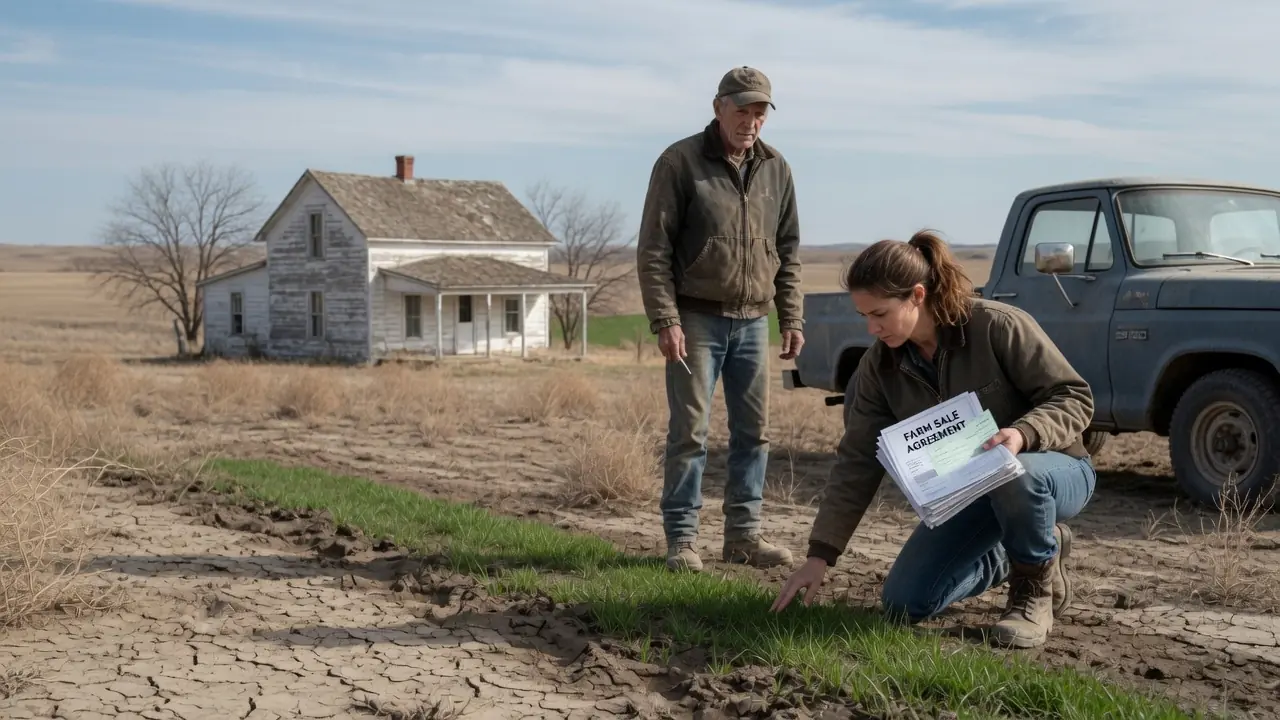
The wind came hard across the western Kansas prairie, lifting pale soil from the abandoned fields and pushing it against her boots. The farmhouse behind her leaned slightly toward the south, its porch sagging beneath years of wind and snow. Several windows had been covered with plywood. A section of gutter hung loose from the roof, tapping against the siding.
Nothing about the property suggested a new beginning.
The seller, Amos Caldwell, stood beside Evelyn near the entrance to the county records office. At sixty-seven, he looked older than his age. His shoulders had taken on the permanent bend of a man who had spent decades working beneath open skies.
He barely examined the cashier’s check.
He signed his half of the papers before Evelyn finished reading hers.
The county clerk looked from Amos to Evelyn.
“You’re certain about the price?”
Amos nodded.
“That’s what we agreed.”
The clerk turned toward Evelyn.
“You understand the property is being sold as-is?”
“I understand.”
“The house needs structural work. Two of the wells have been declared unreliable. There are back taxes, though the sale amount will cover those. Most of the north acreage hasn’t produced a full crop in nearly a decade.”
“I read the records.”
The clerk studied her for another moment, perhaps wondering whether Evelyn was naive, desperate, or both.
Then she stamped the papers.
No one congratulated her.
Everyone in the county already knew what she had purchased.
The Caldwell place had been failing for nearly forty years.
Wheat seedlings emerged in spring and died before forming proper roots. Shallow wells weakened by July and often stopped producing altogether in August. The soil across much of the property carried a white alkaline crust that cracked beneath the summer heat like old pottery.
Even weeds struggled there.
Amos folded his copy of the sale agreement and placed it inside his coat.
“I left the keys on the kitchen counter,” he said.
“Thank you.”
“The north well’s no good.”
“So I’ve heard.”
“The south one runs after rain, but I wouldn’t depend on it.”
Evelyn nodded.
Amos looked toward the distant farmhouse.
For a brief moment, the exhaustion left his face and something more painful appeared.
“I loved that place,” he said quietly. “I suppose that’s why it took me so long to let it go.”
Evelyn did not offer one of the empty comforts people gave when they did not know what else to say.
She simply stood beside him.
After a moment, Amos looked down at the papers.
“My father bought that ground after Korea. Swore there was enough land there to feed three generations.”
“He believed in it.”
“We all did.”
Amos placed his hat firmly on his head.
“I hope it treats you better.”
He walked toward his truck without looking back.
Evelyn remained in the parking lot until the vehicle disappeared.
Then she drove to her new farm.
The property lay nine miles outside the small town of Marlow, where the road narrowed from pavement to hard-packed dirt. Rusted fence posts leaned at uneven angles along the boundary. The old barn had lost several sections of roof. A windmill stood near one of the dry wells, its blades frozen in place.
Evelyn stopped near the farmhouse but did not immediately get out.
For several minutes, she studied the land through the windshield.
Most of it looked exactly as the county reports described.
Pale.
Exhausted.
Forgotten.
Then she noticed the hillside.
It rose gently along the eastern edge of the property, beyond an area of exposed stone and scattered cottonwood trees. A narrow ribbon of green grass curved across its lower slope.
The line was not wide.
From the road, most people would have mistaken it for shadow.
But the rest of the hillside was brown.
The green ribbon passed through the dry landscape like a vein beneath thin skin.
Evelyn stepped out of the truck.
The wind pulled at her coat as she walked toward it.
She stopped where the grass changed color.
The soil beneath her boots was darker than the ground several feet away.
She crouched and pressed two fingers into it.
Cool.
Not wet.
But cooler than it should have been after weeks without meaningful rain.
Evelyn looked uphill.
A shallow depression cut across the slope, almost erased by erosion and years of plowing.
She followed the line for nearly two hundred yards before it vanished beneath thorny brush.
Nothing there proved the existence of water.
A small difference in grass color could have a dozen explanations.
Yet Evelyn remained on the hillside for a long time.
The farm looked abandoned.
The hillside did not.
Something in her settled.
Not excitement.
Not certainty.
A quiet refusal to dismiss what she had seen.
That evening, she moved into the farmhouse with a mattress, two boxes of dishes, several changes of clothes, and a weathered brown field journal she had carried through six years of conservation work.
She placed the journal on the kitchen table.
The electricity had not yet been connected, so she lit a kerosene lamp and opened to a blank page.
At the top, she wrote one question.
What is this land trying to tell me?
Evelyn had grown up two counties east on her grandparents’ wheat farm.
Her grandfather taught her to read approaching weather by the shape of clouds and the movement of cattle. Her grandmother showed her how soil moisture changed its color, weight, and smell.
As a child, Evelyn preferred walking fence lines to attending school dances. She could spend an entire afternoon watching rainwater carve tiny channels through a field.
After college, she worked as a soil-conservation technician.
For six years, she walked other people’s land carrying test equipment, maps, and government forms. She wrote recommendations on erosion, crop rotation, groundwater protection, and soil recovery.
Some families followed the advice.
Others placed the reports in drawers and returned to the methods they had always used.
Evelyn watched good farmers lose land they loved.
Sometimes they lacked money.
Sometimes the weather defeated every reasonable plan.
Sometimes they had worked the same ground for so long that they could no longer see it clearly.
The Caldwell farm had always interested her.
Its failures seemed too complete.
Forty years of poor harvests suggested not one problem, but several interacting problems no one had fully understood.
Amos Caldwell inherited the property from his father and spent most of his adult life trying to make it productive.
He drilled wells.
He applied soil amendments.
He changed crops.
He tried deeper tillage, shallow tillage, crop residue, and fallow seasons.
Some efforts produced temporary improvement.
None lasted.
“I loved that land,” Amos told a neighbor after the sale. “I just never understood it.”
Evelyn did not plant anything during her first spring.
That decision confused almost everyone.
A farmer was supposed to plant.
Even on poor land, an empty field looked like surrender.
Instead, Evelyn walked.
Every morning, she left the farmhouse carrying her field journal, a soil probe, a compass, and several colored flags.
She followed the property boundary one day.
The next day, she crossed from north to south.
Then east to west.
She walked after rain and during heat.
She studied the ground at sunrise, noon, and dusk.
She learned the farm the way a person learns a face—slowly, through repeated attention.
The obvious problems appeared first.
The upper fields had severe wind erosion.
The lower sections carried alkaline deposits.
Several drainage channels had been redirected over the years, allowing water to rush from the property rather than soaking into it.
Then Evelyn began noticing the things that did not make sense.
The narrow line of grass on the eastern hillside never fully dried.
By July, the surrounding prairie had turned pale and brittle, but that strip remained green.
A small cluster of cottonwoods grew near the rocky depression.
Cottonwoods could survive dry weather once established, but they usually indicated water somewhere below.
On the hottest afternoons, the soil around the depression remained cooler beneath Evelyn’s boots.
Birds gathered there.
Not constantly.
Often enough to form a pattern.
She recorded each visit.
June 12, 6:40 a.m. Meadowlarks near the eastern draw. No recent rain.
June 18, 4:10 p.m. Surface temperature noticeably lower within green strip.
June 26. Wildflowers still blooming beside exposed limestone.
Ordinary prairie flowers that had wilted elsewhere remained alive weeks longer in that narrow section.
None of the signs proved anything alone.
Evelyn knew better than to confuse hope with evidence.
But a single observation was an anecdote.
Repeated observations became data.
Her nearest neighbor, sixty-four-year-old Martin Bell, watched her from across the fence.
Martin had farmed nearby his entire life. His father had known Amos’s father. He had seen the Caldwell family drill wells, deepen wells, and abandon wells.
One evening, he drove over in an old green pickup.
Evelyn was kneeling near the cottonwoods with a soil thermometer.
Martin rested both arms on the fence.
“You planning to farm that thermometer?”
“Not this year.”
“You going to plant anything?”
“Eventually.”
He looked toward the hillside.
“Amos spent forty years trying to find water.”
“I know.”
“His father tried before him.”
“I know that too.”
Martin removed his cap and scratched his head.
“You’re chasing ghosts, Evelyn.”
She stood and brushed dirt from her knees.
“Maybe.”
“That ground has been dead longer than you’ve been alive.”
Evelyn looked at the green grass.
“Maybe it isn’t dead.”
“What is it, then?”
“Misunderstood.”
Martin gave a tired laugh.
“Land doesn’t care whether we understand it.”
“No.”
Evelyn closed her journal.
“But understanding it might change what we ask it to do.”
By early summer, she had enough observations to form a theory.
Water was moving beneath the eastern slope.
Not a deep regional aquifer—the failed wells had reached the expected depth without finding dependable supply.
This appeared shallower.
Local.
Perhaps seasonal.
She contacted a drilling company and marked a test site near the lower cottonwoods.
The crew arrived in June.
Martin watched from his fence.
Amos heard about the drilling and drove past once without stopping.
The bit went down.
Thirty feet.
Fifty.
Seventy.
The ground produced damp material, then dry stone.
At ninety feet, the crew found only a weak seep that would not support a household, much less a farm.
The foreman removed his gloves.
“That’s all she’s got here.”
Evelyn stared into the borehole.
The drill had cost more than she could comfortably afford.
“How much flow?”
“Not worth completing.”
The equipment was packed before sunset.
Martin did not say anything when the trucks left.
His silence was almost worse than being told he had been right.
Evelyn marked a second test location one hundred yards uphill.
The grass was greener there. Surface temperatures were slightly lower. Exposed rock suggested fractured limestone.
The second well produced even less.
Dr. Laura Bennett, the county extension hydrologist, came to review the results.
Laura had spent twenty-eight years studying groundwater across western Kansas. She had listened to hundreds of hopeful theories from landowners convinced that water existed beneath a particular tree, stone, dream, or family story.
Most theories ended with an expensive dry hole.
She stood at Evelyn’s kitchen table turning through the field journal.
“You’ve documented this carefully.”
“But?”
Laura pointed toward several entries.
“Cottonwoods, birds, cooler soil—these are observations. They are not proof of a spring.”
“I know.”
“Vegetation patterns can be caused by soil variation. Cooler ground may come from shade or rock structure.”
“I know that too.”
Laura closed the journal.
“Two failed wells are stronger evidence than wildflowers.”
Evelyn met her eyes.
“A failed well proves there wasn’t enough water where we drilled.”
“It also costs money.”
“That part I’ve noticed.”
Laura almost smiled.
“Be careful. Land can make intelligent people see what they want to see.”
Evelyn looked toward the hillside through the kitchen window.
“I don’t want to see water.”
“What do you want?”
“To understand why that part of the farm behaves differently.”
Laura left without endorsing another test.
That night, Evelyn sat beneath the kitchen lamp with the field journal open.
Two dry boreholes lay beyond the dark window.
Her savings were shrinking.
The roof still needed repair.
The south well required a new pump.
She had not planted a crop, and local people had begun referring to the property as the farm bought by the woman who walked around taking notes.
For the first time, Evelyn wondered whether she had mistaken stubbornness for insight.
She closed the journal.
Then opened it again.
If the evidence did not support her theory, the theory had to change.
She started with the first entry and read every page.
Rainfall.
Soil temperatures.
Bird activity.
Plant species.
Elevation estimates.
Sketches of the hillside.
Nothing new appeared.
Near midnight, she opened an old cardboard box of county documents she had collected before the sale.
Inside were soil surveys, well records, tax maps, and aerial photographs dating back nearly sixty years.
Evelyn spread the photographs across the table.
The earliest image had been taken in 1962.
The Caldwell farm appeared in black and white, divided by old fence lines that no longer existed.
She placed a recent satellite image beside it.
The property had changed through erosion, field expansion, and road construction.
Then she noticed a faint curved line in the older photograph.
It crossed the eastern slope almost exactly where the green grass grew now.
Evelyn leaned closer.
The line continued toward the rocky depression and cottonwoods.
In the 1962 photograph, it appeared to be a shallow seasonal drainage channel.
She examined the next photograph from 1978.
The channel remained visible but weaker.
A new fence and field grading had changed part of its course.
By 1991, the visible drainage had nearly vanished beneath soil movement and repeated plowing.
Evelyn placed transparent paper over the photographs and traced the line.
It matched the modern vegetation pattern.
The green grass.
The cooler soil.
The wildflowers.
The cottonwoods.
They were not random clues.
They were the remaining surface signature of an old water path.
The channel aboveground had disappeared.
Something below it had not.
Evelyn sat back.
The failed wells had been drilled beside the old drainage line.
Perhaps the mistake was assuming the water rested directly beneath the visible signs.
If the underground rock dipped or fractured at an angle, water could be traveling sideways before rising elsewhere.
She telephoned Laura Bennett the next morning.
“I found something.”
Laura arrived that afternoon.
Evelyn laid the aerial photographs and field notes across the table.
At first, the hydrologist’s expression remained skeptical.
Then she began aligning the maps herself.
She studied the elevation changes.
She compared well locations.
She looked at the exposed limestone near the depression.
“What do you think?” Evelyn asked.
Laura did not answer immediately.
Finally, she tapped the old drainage line.
“I think the previous wells may have missed a perched system.”
“Shallow groundwater?”
“Possibly. Water entering fractured limestone at a higher elevation, then stopping above a denser layer.”
“Pressurized?”
“Not necessarily strongly. But enough to move toward the surface.”
Evelyn waited.
Laura gathered the photographs.
“All right.”
“All right what?”
“Let’s actually look.”
A university team arrived two weeks later with electrical-resistivity equipment and ground-penetrating radar.
They surveyed the hillside for three days.
Cables crossed the fields.
Small flags marked changes in subsurface structure.
Martin Bell watched from his truck.
Amos returned and stood near the road without approaching.
The first results showed fractured limestone beneath the old drainage route.
The fractures continued deeper, angling toward a dense rock layer several hundred yards from the failed wells.
Water from higher elevations entered the limestone miles away. Over centuries, it traveled slowly through cracks and underground channels.
Where the fractured layer met the dense rock barrier, the water could no longer continue downward.
It collected above the barrier.
A perched aquifer.
Closer to the surface than the deep wells had been designed to detect.
The water then moved toward the eastern depression, where pressure forced part of it upward through smaller fractures.
Laura stood beside Evelyn studying the readings.
“This explains the vegetation.”
“And the cooler ground.”
“And why the shallow wells failed. They were placed outside the productive fracture zone.”
Evelyn looked across the pale farm.
“How long has it been here?”
“Centuries, perhaps longer.”
“Under every failed crop?”
Laura nodded.
“Under every dry well.”
The third test borehole was placed between two limestone outcrops, uphill from the cottonwoods but downhill from the invisible recharge path.
The drill reached twenty-seven feet.
The soil became damp.
At thirty-four feet, water entered the hole.
At thirty-eight, it rose without pumping.
The crew stopped working.
Everyone stared.
Clear water climbed inside the casing.
It continued rising until it stood several feet below the surface.
The foreman lowered a measuring device.
“You have natural pressure.”
Evelyn crouched beside the well.
For months, she had imagined this moment.
She expected triumph.
Instead, she felt the weight of responsibility.
The farm had not been empty.
It had been holding something valuable while generations struggled above it.
The problem was never that water did not exist.
No one had understood its path.
News traveled quickly.
Within two weeks, Amos Caldwell returned.
He parked near the farmhouse and walked toward the eastern slope carrying his hat in both hands.
Survey stakes marked the underground channel. A temporary pipe carried spring water into a storage tank for testing.
Amos stood beside the first flowing outlet.
He watched the clear stream fill a metal bucket.
“Forty years,” he said.
Evelyn remained beside him.
“I walked this ground every day for forty years.”
He looked toward the cottonwoods.
“I thought the farm had failed me.”
“It didn’t.”
Amos laughed bitterly.
“What would you call four decades of dead crops?”
“A system no one had mapped correctly.”
“I drilled wells.”
“In the places everyone expected water to be.”
He stared at the stream.
“My father died thinking the land was cursed.”
Evelyn spoke gently.
“He worked with the knowledge he had.”
Amos lowered his head.
“Five thousand five hundred dollars.”
“If you want to discuss the sale—”
“No.”
He shook his head.
“A deal is a deal. You saw something I didn’t.”
“I saw a green line.”
“You stopped long enough to wonder why it was there.”
For several minutes, they listened to the water entering the tank.
Then Amos placed his hat back on his head.
“I’m glad someone finally understood it.”
County officials visited.
So did agricultural investors.
The first offer came from a company interested in purchasing the land and drilling production wells.
The amount was more money than Evelyn had ever possessed.
Another company proposed leasing the spring rights for commercial bottling.
A third wanted to irrigate thousands of acres beyond the farm.
Every proposal emphasized opportunity.
Profit.
Expansion.
The spring had existed quietly for centuries. Within weeks of being documented, people were discussing how quickly it could be extracted.
Laura Bennett cautioned Evelyn.
“We don’t know the recharge rate yet.”
“They say the flow tests are strong.”
“Strong today does not mean unlimited.”
“What happens if we pump too much?”
“The pressure drops. Nearby vegetation changes. The perched zone could collapse or become contaminated.”
Evelyn looked at the offers spread across her kitchen table.
Selling would be easy.
She could repair the farmhouse, pay every debt, and leave with enough money to begin somewhere else.
Protecting the spring would be slower and far less profitable.
She opened her field journal.
Near the front was the first question she had written.
What is this land trying to tell me?
The answer was not simply that water existed.
The land was telling her how carefully that water had survived.
Evelyn rejected the offers.
Over the following year, she worked with Laura, the university, and state conservation officials.
They identified the recharge zone miles uphill, where rainfall first entered the fractured limestone.
Evelyn negotiated agreements with neighboring landowners to limit chemical use and development near the most sensitive areas.
She placed part of the farm under a conservation easement.
The spring’s withdrawal rate was limited to a fraction of its estimated recharge.
She restored the wetland around the rocky depression, removing compacted soil and planting native grasses whose roots held water and prevented erosion.
The first spring-fed irrigation system was simple.
Water flowed into a protected storage basin and moved downhill through pipes using natural pressure. No diesel pump was required.
Evelyn divided the land into small sections rather than attempting to irrigate everything.
She planted native forage grasses first.
Their roots improved the soil and reduced alkaline damage.
The following year, she added sorghum, alfalfa, and a small test field of wheat.
The farm did not transform overnight.
Some crops still failed.
Sections of soil required years of recovery.
The spring solved the water shortage but could not erase four decades of damage in one season.
Evelyn treated every improvement as part of a longer conversation.
Martin Bell visited often.
At first, he came to inspect.
Later, he came to help.
One evening, while they repaired a gravity line, he glanced toward the flowing spring.
“I told you that you were chasing ghosts.”
“You did.”
“You going to make me apologize every time I come over?”
“I haven’t made you apologize once.”
“That somehow makes it worse.”
Evelyn smiled.
Two summers later, one of the worst droughts in recent memory settled over western Kansas.
Rain disappeared from the forecast.
Pastures burned brown.
Wells weakened.
Martin’s livestock pond dropped several feet in one month.
Three nearby family farms faced losing crops and cattle.
Evelyn’s spring continued flowing.
The conservation limits allowed her enough water to protect her own fields.
No agreement required her to share it.
She opened the valves anyway.
Temporary lines ran across property boundaries.
A portable tank supplied water to Martin’s cattle.
Two neighboring farms received enough irrigation to preserve seed crops.
Another family used the spring to keep a small orchard alive.
Evelyn monitored every gallon to avoid damaging the aquifer.
They did not have unlimited water.
They had enough because she had refused to treat the spring as unlimited.
Martin stood in his surviving sorghum field near the end of August.
“This should all be dead.”
Evelyn checked the soil beside a drip line.
“It’s stressed.”
“But alive.”
“Yes.”
He looked toward her farm.
“You could have kept the water.”
“I could have.”
“You didn’t owe us anything.”
“No.”
“Then why?”
Evelyn stood.
“Because water does not understand property lines.”
Martin shook his head.
“You saved half the county.”
“No.”
She closed the valve slightly.
“We used what was available carefully.”
The distinction mattered to her.
She did not want to become a legend.
Legends often encouraged people to forget the work, measurements, failures, and limits behind a result.
The Caldwell farm gradually became a demonstration site for sustainable water management.
Agricultural students arrived from across the state.
Young farmers studied the gravity-fed irrigation system, the restored wetland, and the protected recharge zone.
Evelyn showed them the failed well locations before showing them the successful spring.
“The dry holes are part of the system,” she explained.
One student looked confused.
“How?”
“They taught us where the water was not.”
Amos visited occasionally.
He usually came in the evenings when the light turned gold across the hillside.
At first, he stood apart from the tours.
Over time, Evelyn began inviting him to speak.
He told students about the decades before the spring was mapped.
The wells.
The failed wheat.
The debt.
The things his family tried.
“I thought we had done everything,” he said during one visit. “What I did not understand was that doing everything you know is different from knowing everything there is.”
He looked toward Evelyn.
“She asked a question none of us were asking.”
Amos never asked for the farm back.
Evelyn never treated his failure as foolishness.
They both understood that the discovery belonged partly to every person who had worked the ground before her.
Their mistakes had created records.
Their wells had eliminated possibilities.
Their endurance had preserved the property long enough for someone else to examine it.
Years later, the old farmhouse stood repaired.
The porch no longer sagged.
Native grasses surrounded the eastern wetland.
Cottonwoods grew taller beside the spring, their leaves flickering in the prairie wind.
Evelyn continued carrying the same brown field journal.
Its cover had cracked.
The pages had softened from use.
Rainfall totals filled one section. Water-flow measurements filled another. Sketches showed changing vegetation and soil recovery across the property.
Near the beginning remained the question she had written on her first night.
What is this land trying to tell me?
She never crossed it out.
A visiting student once asked why.
“You found the answer,” he said.
“I found one answer.”
“What else is there?”
Evelyn looked across the hillside.
“That depends on what changes.”
The land was never finished speaking.
A wet season could alter erosion.
A new plant could reveal a soil problem.
Birds might gather where insects had increased.
A patch of grass might remain green several days longer than everything around it.
The clues were rarely dramatic.
Most required patience.
That was why most people missed them.
On a cold April evening, exactly ten years after purchasing the farm, Evelyn stood beside Amos near the original green strip.
The spring flowed below them through the restored wetland.
Amos carried a cane now.
His walking had slowed, but his eyes remained clear.
“Do you remember closing day?” he asked.
“Yes.”
“I thought you were making the worst mistake of your life.”
“So did the county clerk.”
“She was probably right to wonder.”
Evelyn smiled.
Amos pointed his cane toward the hill.
“You noticed that grass before you even had the keys.”
“Yes.”
“What made you stop?”
“I’m not sure.”
“Instinct?”
“Maybe.”
He considered that.
“I used to think instinct meant knowing something without evidence.”
“What do you think now?”
“Maybe it means noticing evidence before you understand it.”
Evelyn looked at him.
“That sounds right.”
The two stood quietly as evening settled across the farm.
Water moved beneath the ground and emerged among limestone stones.
It had traveled through darkness for miles before reaching the surface.
For decades, families worked above it without knowing it was there.
Crops failed.
Wells dried.
People blamed the weather, the soil, themselves, and sometimes the land.
The spring had not suddenly appeared after Evelyn purchased the property.
It had not been created by good fortune.
It had always been there.
Hidden beneath erosion, forgotten drainage paths, and assumptions repeated so often they became accepted as truth.
Evelyn had done one thing differently.
She stopped.
She looked closely.
And when the first two answers proved wrong, she asked the question again.
The farm that sold for $5,500 never became valuable merely because water was discovered beneath it.
Its true value came from the choice not to destroy what had been found.
Evelyn could have pumped the spring dry for quick profit.
Instead, she protected the source.
She could have kept every gallon within her fence.
Instead, she shared enough to help her neighbors survive.
She could have treated Amos’s forty years as proof that she was wiser.
Instead, she understood that knowledge grows from the labor, failures, and observations of those who came before.
The dead farm had never truly been dead.
It had been waiting beneath the Kansas wind, holding its secret close until someone arrived who was willing to listen longer than everyone else.