Marcus Carter stepped into the lobby of the Sterling Meridian Tower just after noon, wearing a plain gray T-shirt, dark jeans, worn sneakers, and a black backpack over one shoulder. The building rose sixty-eight stories above downtown Chicago, all glass, marble, polished steel, and quiet wealth. Executives crossed the lobby with security badges clipped to tailored suits, while assistants moved quickly between elevators with tablets in their hands. Marcus looked like he had wandered into the wrong building, and that was exactly what everyone assumed.
He had not slept properly in nearly two days. The night before, the acquisition of his software company had officially closed after months of negotiations, audits, investor calls, and legal reviews. Financial reporters were calling him a genius, business magazines were calling him the youngest tech founder in the state to sell a company for an eight-figure fortune, and venture firms were already begging for meetings. But inside that luxury high-rise, all anyone saw was a tired Black man with a backpack and no visible sign of power.
Marcus approached the security desk calmly and gave his name. The guard looked him over once, then frowned as if the name and the appearance did not match. Before Marcus could explain further, a group of executives came out of the private elevator corridor, led by Richard Hale, the senior managing director of Sterling Meridian Capital. Richard was silver-haired, expensive-looking, and used to rooms adjusting themselves around him.
Richard stopped when he saw Marcus near the desk. His eyes moved from Marcus’s sneakers to his backpack, then to the plain T-shirt, and his mouth tightened with immediate judgment. “Can I help you?” he asked, though his tone made it clear he had no intention of helping. Marcus turned toward him and said, “I’m here for the Carter acquisition meeting.”
A few employees nearby glanced up. Richard stared at Marcus for a long second, then gave a cold laugh. “The Carter acquisition meeting is on the fifty-ninth floor,” he said. “That floor is restricted.” Marcus kept his voice even. “I know. That’s why I gave my name.”
Richard stepped closer, lowering his voice but not enough to hide it from the lobby. “People don’t walk into this building dressed like that and claim access to private board meetings.” Marcus looked at the security desk, where the guard now seemed uncertain. “You should check the visitor list,” Marcus said. “My name is Marcus Carter.”
Richard’s face hardened at the name, but arrogance moved faster than recognition. “Marcus Carter is expected upstairs with legal counsel, not standing in my lobby looking like he needs directions to a bus station.” The words made the nearby employees freeze. A young assistant lowered her eyes, but nobody spoke. Marcus felt the old familiar weight of being judged before being known settle across his shoulders.
“I don’t need directions,” Marcus said quietly. “I need access to the elevator.” Richard folded his arms. “No, what you need is to stop embarrassing yourself.” Marcus looked directly into his eyes. “Be careful, Mr. Hale. The next thing you say may cost you more than you understand.”
Richard laughed in disbelief. The laugh carried across the marble lobby, drawing attention from investors, assistants, and security staff. “You hear that?” Richard said, turning slightly toward the room. “He’s threatening me now.” Marcus’s jaw tightened, but he did not raise his voice.
“I’m not threatening you,” Marcus said. “I’m giving you a chance to correct yourself.” Richard stepped so close that Marcus could smell his expensive cologne. “You don’t belong in this building,” he said. “And I am tired of people like you walking into places like this pretending the world owes you a seat at the table.”
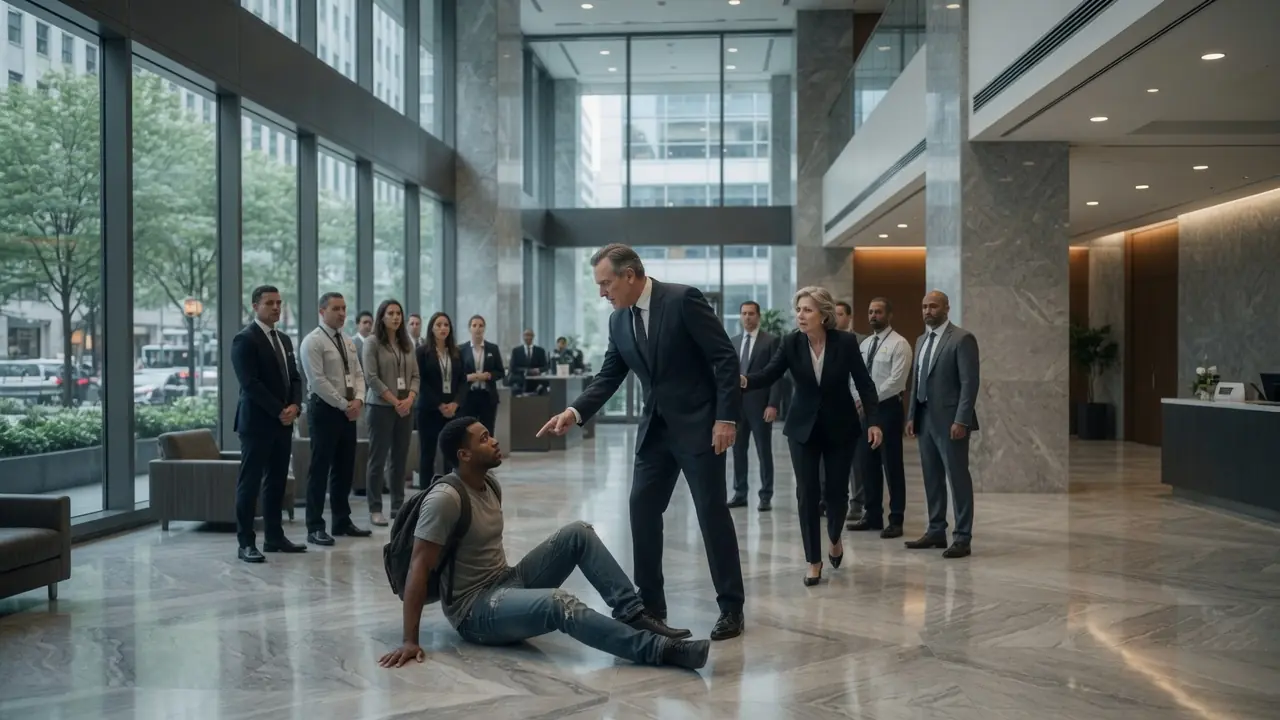
The lobby went silent. Marcus stared at him, and for the first time his exhaustion showed through his calm. He had built a company from nothing, slept on office floors, coded through sickness, carried payroll on credit cards, and survived investors who smiled while trying to steal control. Yet one man in a suit could still look at him and decide his whole life did not fit the room.
“People like me built the table,” Marcus said. Richard’s face flushed. “Security,” he snapped. “Remove him.” The guard hesitated, glancing at the system. Marcus reached slowly into his backpack for his executive access folder, but Richard misread the movement and grabbed his arm.
“Don’t reach for anything,” Richard barked. Marcus pulled his arm back and said, “Take your hand off me.” Richard’s pride had already crossed the point of reason. In front of investors, staff, and guests, he shoved Marcus hard enough that Marcus lost his balance on the polished marble floor.
Marcus fell backward, his backpack sliding off his shoulder and papers scattering across the lobby. A sharp gasp moved through the room. His palm hit the floor first, then his hip, and for one humiliating second he sat there under the lights while everyone stared. Nobody moved to help him.
Richard stood over him, breathing hard, pointing toward the exit. “Now get out before I make this worse,” he said. Marcus looked up slowly, not with fear, but with something deeper and colder than anger. His voice came out low and steady. “You already made it worse.”
Then the private elevator doors opened.
Eleanor Grant stepped out first, followed by two board members and the company’s legal counsel. Eleanor was the chair of Sterling Meridian’s board, a woman known for ending careers with fewer words than most people used to order coffee. She saw Marcus on the floor, saw Richard standing over him, and stopped so suddenly that everyone behind her nearly collided. Her face changed in an instant.
“Stop everything,” Eleanor said. The entire lobby froze. Richard turned, suddenly pale around the mouth. Eleanor walked straight toward Marcus, ignoring Richard completely, and extended her hand. “Mr. Carter,” she said, her voice shaking with controlled shock. “Are you hurt?”
The words hit the lobby like thunder. Employees looked at one another. The security guard’s face drained of color. Richard’s mouth opened slightly, but no sound came out.
Marcus accepted Eleanor’s hand and stood slowly. “I’m fine,” he said, though his wrist ached and his pride had been publicly bruised. Eleanor looked down at the scattered documents, then at the backpack on the floor. One of the lawyers quickly gathered the papers and saw the signed acquisition folder bearing Marcus Carter’s name, the same name attached to the deal worth more than anything else happening in the building that day.
Eleanor turned toward Richard. “Tell me I did not just see you put your hands on the CEO we have been waiting for.” Richard swallowed. “Eleanor, there was confusion. He refused to identify himself properly.” Marcus gave a tired laugh that held no humor. “I gave my name three times.”
A young assistant finally spoke from near the desk. Her voice trembled, but she forced the words out. “He did. I heard him.” The security guard nodded quickly. “He gave the name Marcus Carter. I was checking the system.” More employees lowered their eyes as truth began finding witnesses.
Richard tried to recover. “With respect, he did not present himself in a professional manner.” Eleanor’s eyes narrowed. “You mean he did not look rich enough for you.” The sentence cut through every excuse Richard had prepared. Marcus looked away for a moment, because hearing the truth spoken plainly in that lobby hurt more than he expected.
Eleanor turned back to Marcus. “Mr. Carter, on behalf of this company, I apologize.” Marcus picked up his backpack from the floor and brushed dust from the strap. “I don’t need an apology that protects the deal,” he said. “I need to know if this is how your company treats people when it thinks they have no power.”
Nobody answered. The lobby’s silence became heavier than the fall itself. Richard stared at the floor, and the executives who had followed him moments earlier suddenly wanted distance from him. Marcus looked around at all of them, every face exposed under the bright lobby lights.
“I came alone for a reason,” Marcus said. “I wanted to see the building before the meeting. I wanted to understand the culture I was about to attach my name to.” He looked at Richard. “Thank you for showing me faster than any presentation could.”
The legal counsel stepped forward carefully. “Mr. Carter, perhaps we should continue this conversation upstairs.” Marcus shook his head. “No. It started here, in front of everyone. It should be answered here, too.” Eleanor did not interrupt him.
Marcus walked to the center of the lobby, still holding the backpack strap in one hand. The same employees who had watched him fall now watched him stand with a different kind of attention. “Three weeks ago,” he said, “people called me a visionary because I sold software for more money than my mother ever imagined seeing in one lifetime.” His voice softened. “But twenty minutes ago, in this building, I was just a man who didn’t belong.”
That touched something in the room. An older janitor near the far wall looked down, blinking hard. The young assistant covered her mouth. Even one of the investors looked ashamed. Marcus continued, not loudly, but with enough force that no one moved.
“I built my company because my mother cleaned offices in buildings like this,” he said. “She used to tell me that the floors did not care who polished them, only that someone did the work.” He looked at Richard again. “Men like you walk across those floors and think ownership is something stitched into a suit.”
Richard’s face tightened, but he said nothing. Eleanor’s expression remained still, but her eyes had sharpened. Marcus took the acquisition folder from the lawyer’s hands and opened it. The final signature page waited inside, the page Sterling Meridian needed before the deal could fully proceed.
“This signature gives your firm control over technology my team spent six years building,” Marcus said. “It gives you access to patents, infrastructure, client networks, and the people who trusted me to protect what we made.” He paused, and the silence stretched until it hurt. “I was ready to sign upstairs.”
Richard finally looked up, fear breaking through his pride. “Mr. Carter, please. This was a misunderstanding.” Marcus stared at him. “No. A misunderstanding is when you get a name wrong. This was character revealing itself before money could hide it.”
Eleanor turned to security. “Deactivate Mr. Hale’s executive access immediately.” Richard’s head snapped toward her. “Eleanor, you cannot be serious.” She did not blink. “I am completely serious.” The security guard moved to the system with shaking hands.
Richard stepped closer to Eleanor. “You are making a mistake over one incident.” Marcus looked at him and said softly, “One incident for you. A lifetime pattern for people who keep getting told they don’t belong.” The words struck harder because he did not shout them.
Eleanor faced Richard fully. “You touched a guest, humiliated him publicly, ignored procedure, and nearly destroyed a billion-dollar relationship because you trusted your prejudice more than our system.” Richard had no answer. The badge on his jacket gave a soft electronic beep as his access was revoked. Somehow that tiny sound felt louder than the shove.
Marcus looked at the signature page again. Then he closed the folder. “I’ll still meet with the board,” he said. “But the deal is paused until I see a written plan for leadership accountability, hiring review, anti-bias training, and an independent investigation into complaints under Richard Hale.” Eleanor nodded immediately. “You’ll have it.”
A murmur moved through the lobby. The investors looked stunned, but nobody dared object. Marcus’s signature had become more than paperwork; it had become judgment. For the first time that day, the people in the tower understood that power did not always arrive escorted, polished, and announced.
Eleanor turned to the room. “Let everyone here remember what happened today,” she said. “Not because Mr. Carter is important now that you know his title, but because he was important before you knew anything.” The young assistant began crying quietly. Marcus glanced at her, and she whispered, “I’m sorry I didn’t speak sooner.”
Marcus’s expression softened. “Speak sooner next time,” he said. She nodded, wiping her face quickly. That simple exchange carried more weight than any corporate statement could have. It was not enough, but it was a beginning.
Richard was escorted away without ceremony. No one laughed now. The same executives who had smirked earlier stood stiff and silent as he crossed the lobby he once ruled. He looked smaller without authority protecting him.
Eleanor led Marcus toward the private elevators, but Marcus stopped before entering. He turned back toward the lobby one last time. “My mother used to clean a building downtown at four in the morning,” he said. “She wore sneakers cheaper than mine and carried lunch in a plastic bag. If she walked in here today, I want to know she would be treated like a person before anyone asked who her son was.”
No one spoke. They did not need to. The truth had already taken possession of the room.
The elevator doors closed behind Marcus and Eleanor, leaving the lobby changed in a way no renovation could show. By evening, Richard Hale was suspended pending investigation, three prior complaints were reopened, and Sterling Meridian announced a full review of executive conduct. But the official memo did not capture what really happened. It could not describe the moment a man was shoved down and stood up with the power to change the whole building.
Weeks later, Marcus returned to Sterling Meridian Tower for the final signing. This time, cameras waited outside, executives lined up in formal welcome, and security knew his name before he reached the door. Marcus still wore a simple shirt, though this one was black instead of gray. His backpack remained on his shoulder.
Eleanor met him at the entrance herself. “You did not have to come back,” she said. Marcus looked up at the shining tower. “Yes, I did.” She waited. He added, “My team deserves the deal. Your company deserves the chance to become better. And I deserve to walk through this lobby without proving I belong.”
Inside, employees stood with quiet respect, not the empty politeness of fear, but something closer to accountability. The young assistant who had spoken up now worked directly with the board’s culture review committee. The janitor near the far wall nodded at Marcus, and Marcus nodded back first. That mattered to both of them.
At the boardroom table on the fifty-ninth floor, Marcus signed the agreement. But before handing over the folder, he added one final condition: every employee, from executives to contractors, would be included in the new equity-funded education and advancement program created from part of the acquisition budget. “Talent gets ignored when people only recognize it in expensive packaging,” he said. “We are going to change that.”
The board approved it unanimously. Some did it from conscience, some from fear, and some because Marcus had made refusal impossible. He did not care which reason came first. Systems often changed before hearts caught up.
Months later, Sterling Meridian Tower looked the same from the street. The glass still reflected the skyline, the marble still shone, and expensive shoes still crossed the lobby every morning. But employees remembered what happened there. They remembered Marcus Carter on the floor, Richard Hale standing over him, and Eleanor Grant saying his name like the room had just realized its own shame.
Marcus remembered too. Not because he wanted to hold the humiliation forever, but because forgetting would make it easier for others to repeat. He carried the moment like a warning and a promise. A warning about what power reveals, and a promise that he would never build rooms where dignity depended on appearance.
Success still did not look the way people imagined. Sometimes it looked like a tired Black man with a backpack walking into a tower that underestimated him. Sometimes it looked like falling to the floor and standing up with enough restraint not to destroy everyone watching. And sometimes it looked like refusing to sign until the people at the top finally understood that respect is not a luxury feature.
It is the foundation.