The first thing anyone noticed along the tree line above Pruitt County that August was the sound. It was not silence but a dry, restless rustling that seemed to move across the fields even when the wind stopped, the sound of thousands upon thousands of small mouths feeding at once. Cotton leaves that had been green three days earlier were reduced to lace, soybean plants stood stripped along entire rows, and tractors idled uselessly while men crouched beside damaged crops they had spent months trying to protect. Farmers who had worked the same ground for thirty years picked larvae from ruined leaves, stared at them in their palms, and discovered there was nothing useful left to say.
Word traveled faster through pickup windows and phone calls than through the county extension office. Armyworms had arrived on warm, humid weather moving north from the Gulf, and conditions had lined up badly enough that what began as scattered reports became a countywide emergency within days. Feed stores ran short of several insecticides, custom applicators filled their schedules before breakfast, and farmers who waited for certainty sometimes discovered that certainty had eaten another twenty acres while they were thinking. By the time Pruitt County organized anything resembling a coordinated response, nobody was talking about containment anymore because the conversation had become triage.
That was why so many people eventually stopped beside Nora Kessler’s farm. Her 120 acres should have suffered at least as badly as everybody else’s, especially according to the men who had spent spring explaining why her planting plan was foolish. Instead, motorists slowing along the county road saw something difficult to understand because her farm looked damaged without looking defeated. A low collard block near the creek had been shredded, several patches of turnip greens showed unmistakable feeding, yet broad stretches of cabbage, onions, garlic, squash, and other vegetables remained marketable while flowering borders still hummed with insect life.
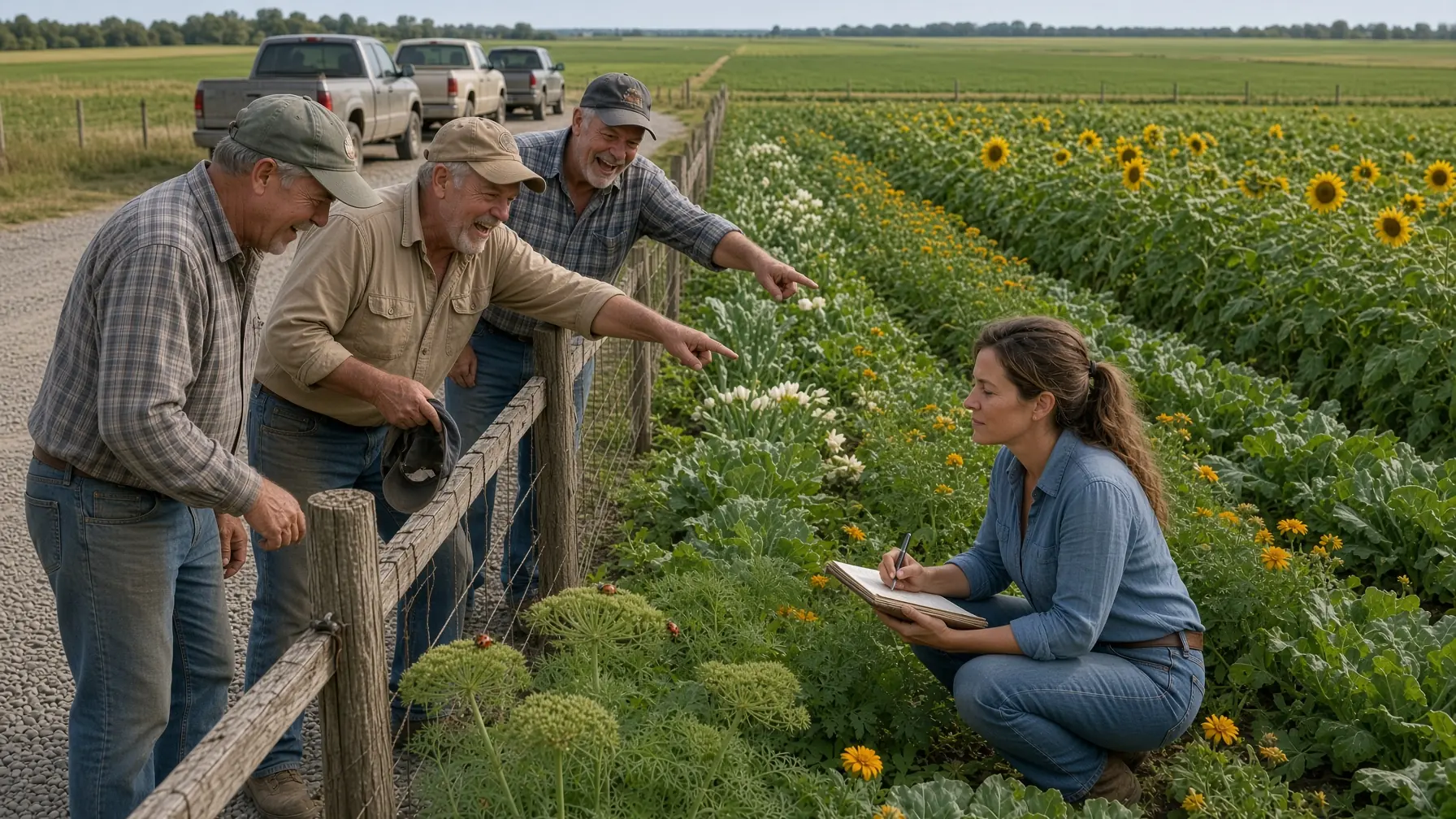
Ed Toliver stood at Nora’s fence one afternoon holding his cap against his thigh. In April he had told her directly that she was turning good agricultural ground into a garden-club demonstration, and through June he had joked that somebody ought to photograph the farm before her experiment bankrupted her. Now he looked across a strip of collards chewed almost down to stems and then toward cabbage growing forty feet away with only scattered edge damage. Nora noticed him from the field, but she did not walk over because Ed had spent enough months coming to conclusions without her help.
From the road, her farm had always looked wrong by local standards. Instead of broad rectangles containing one crop planted cleanly from one boundary to the next, Nora had divided acreage into long strips and blocks interrupted by onions, garlic, herbs, flowering plants, access lanes, and patches of habitat that some neighbors considered wasted space. Dill and cilantro were allowed to flower instead of being harvested at the moment they looked most marketable, while sunflower and marigold borders crossed places where another farmer might have squeezed in three additional production rows. Nobody could deny that machinery moved through Nora’s farm less efficiently, and nobody could deny that her layout required more planning than simply planting forty acres of the same thing.
What her neighbors could not see from the road was the notebook Nora carried every morning. Every block had a number, every crop had planting dates and varieties recorded, and every scouting walk produced counts showing aphids, caterpillars, beetles, beneficial insects, disease symptoms, moisture conditions, and anything else that seemed worth remembering. She had no belief that a complicated field arrangement made insects disappear, and she still kept conventional controls available when pest numbers crossed thresholds she considered economically dangerous. Her goal had never been purity because her goal was survival.
Nora Kessler was forty-three that season and had been responsible for the family farm for eleven years. She had grown up there but never imagined herself returning permanently, which disappointed her father more than he admitted when she left for college to study biology. Nora preferred microscopes to machinery, worked several years testing soil and water samples for a county environmental laboratory, and assumed farming would remain something she visited during holidays rather than something carrying her mortgage. Then her father’s knees failed badly enough that climbing into a tractor became painful, commodity prices turned against him at the same time, and selling land that had survived four generations became a serious conversation.
Her father, Samuel Kessler, did not ask Nora to come home. He sent her an email containing three numbers, the farm debt, the annual property tax, and the price a neighboring operator had offered to lease most of the acreage. Nora called him and asked what the numbers meant, and Samuel answered, “They mean I’m getting old enough to stop lying about what I can do.” Three months later she left the laboratory, moved back into the small house near the equipment shed, and began discovering that knowing soil chemistry was not remotely the same thing as making a farm pay.
The first years humbled her quickly. Nora could explain nutrient cycling and identify fungal structures under magnification, but that knowledge did not teach her how to negotiate with vegetable buyers who changed volume requirements two days before delivery. She knew integrated pest management in theory yet underestimated labor, equipment breakdowns, fuel prices, packing costs, refrigeration, and how much damage one poorly timed rain could do to a crop that looked perfect on Monday. Samuel helped where his body allowed, but he refused to rescue her from every mistake because he understood that eventually the farm would either become Nora’s operation or remain his burden.
The worst lesson arrived two seasons before the armyworm outbreak. Nora had planted almost thirty-five acres of collards in one large block because a regional distributor offered attractive pricing for consistent weekly volume, and on paper the arrangement looked safer than juggling five smaller markets. Warm wet weather settled over Pruitt County just as the crop reached its most valuable stage, disease appeared in one corner, and within days symptoms had spread far enough that every walk through the field felt like receiving another invoice from something invisible. Nora lost nearly a third of her expected annual income because a third of that income had been standing in one place waiting for one problem to find it.
She remembered the afternoon she finally stopped pretending the crop could be saved. Samuel sat beside her in the pickup while Nora worked figures on a legal pad because doing the arithmetic in her head made the loss feel infinite. When she finished, she said, “The fungus ruined us,” and Samuel answered, “No, it hurt us.” Nora looked at him, and he tapped the legal pad before adding, “What ruined you was making one bad week important enough to decide the year.”
The sentence annoyed her because it sounded like the kind of wisdom people offered only after they already knew what had happened. For several weeks Nora treated it as criticism, then gradually began treating it as a research question instead. She asked herself what a farm would look like if its primary design goal were not maximizing the efficiency of one crop but reducing the number of ways one event could destroy everything at once. That question became more important than the blight itself.
Nora returned to university extension publications she had once skimmed as a student. She read about intercropping, trap crops, insectary strips, rotations, disease breaks, conservation biological control, cover crops, soil structure, and how landscape diversity could sometimes alter the movement and survival of pests. None of the research promised immunity, and results varied by crop, climate, scale, pest, and management quality, which reassured Nora because she distrusted agricultural claims that offered one answer for every farm. The more she read, the less interested she became in miracle techniques and the more interested she became in stacking modest advantages.
She called Doctor Raymond Delgado, one of her former instructors who had moved into extension work. Ray remembered Nora as the student who argued with laboratory procedures until somebody explained why each step existed, and he laughed when she told him she wanted to redesign 120 acres around biological diversity. “You finally came home from college?” he asked, and Nora told him she had been home eleven years. Ray answered, “No, I mean your brain finally caught up with the farm.”
They spent an entire winter discussing what could work without pretending Nora had unlimited labor or money. A farm could be ecologically elegant and financially dead, Ray warned, so every strip needed either direct market value or a clear enough management function to justify the acreage and labor it consumed. Nora mapped equipment widths, irrigation access, harvest routes, buyer requirements, crop families, planting windows, disease histories, wind direction, low ground, drainage, and how quickly workers could move from one block to another. By February the drawing on her kitchen wall looked more like a transportation plan than a garden.
The main vegetable acreage would be divided into strips and blocks rather than broad uninterrupted fields. Brassicas would no longer dominate one large section, and members of the same crop family would be separated where practical by other crops, access lanes, and flowering areas rather than sitting side by side across almost half the farm. Onions and garlic would occupy several strips because Nora already had buyers for them, while dill, cilantro, buckwheat, sunflowers, and selected flowering plants would be allowed to bloom where their ecological value justified the space. Cover crops and rotations would address soil problems while reducing the chance that the same pest or disease encountered identical conditions in the same location year after year.
Nora was careful with companion-planting claims because she had read enough nonsense online to last a lifetime. She did not believe marigolds created an invisible force field around cabbage or that one fragrant herb could confuse every moth arriving from another state. What she did believe, based on research and experience, was that flowering resources could support certain predators and parasitoids, diversified vegetation could sometimes complicate host finding, rotations could interrupt some pest and disease cycles, and small separated blocks could make targeted intervention more practical. None of those mechanisms had to work perfectly if several worked a little.
The financial plan was harder. Crop diversity meant smaller purchase quantities, more planting dates, more harvest schedules, additional labor training, and reduced compatibility with machinery designed around uninterrupted rows. Nora needed buyers willing to accept mixed production across the season instead of one enormous delivery window, and the first three wholesalers she contacted were unimpressed. One told her directly, “I buy vegetables, not ecological philosophy.”
Nora eventually built a sales network from smaller pieces. A regional grocery cooperative agreed to take cabbage, onions, greens, and squash on staggered schedules, two restaurants committed to herbs and specialty produce, a school district expressed interest in seasonal vegetables, and her existing distributor kept part of the collard contract at a reduced volume. None of those buyers alone replaced the simplicity of one large agreement. Together they made it harder for one cancelled contract to ruin her year.
Samuel watched Nora tape the final field map to the wall. “Looks complicated,” he said. Nora told him that was the point.
He stared at it longer. “Complicated things break too.”
“I know.”
“Good.”
Samuel smiled. “Then maybe you’re learning.”
Planting began in early April under a sky that could not decide between winter and spring. Nora’s hired crew consisted of four regular workers, including sisters Elena and Marisol Perez, who had been returning seasonally for seven years and understood the farm better than some consultants. Elena studied the field plan and asked Nora who would remember where everything went. Nora handed her a laminated copy, and Elena said, “So nobody.”
The first week was slow. Equipment needed more turning, seed changes happened more often, and planting crews lost time moving between small blocks instead of working one uninterrupted field. Ed Toliver drove past twice during the process before finally pulling in because curiosity had overcome politeness. He climbed from his pickup, looked over the field, and asked, “You planning to farm it or quilt it?”
“Both if the market is good,” Nora answered. Ed walked toward a newly planted onion strip and asked why it divided two sections he believed should have been collards. Nora explained that she wanted more separation between large blocks of closely related crops and had a buyer for the onions anyway.
Ed shook his head. “You’re wasting passes.”
“Yes.”
“You know fuel costs money.”
“Yes.”
“Labor costs money.”
“Yes.”
He looked at her. “Then why are you agreeing with me?”
“Because those costs are real.”
Ed seemed disappointed that she would not fight. “You’ll wish you planted it normally by harvest,” he said.
Nora nodded. “Maybe.”
That answer followed Ed back to his truck because certainty was harder to argue with when the other person refused to provide it.
At the feed store, the jokes became broader. One older farmer called Nora’s layout “Pinterest agriculture,” while another asked whether she planned to release butterflies during harvest for tourists. A man she barely knew told her that universities had filled her head with ideas nobody who actually depended on crops would try. Nora bought seed, fertilizer, drip-line fittings, and coffee without defending herself.
She had spent enough time in laboratories to recognize another kind of experiment happening. Her neighbors expected failure because the farm looked inefficient according to the rules that had worked for them, while Nora expected only that different management might alter the pattern of risk. Both conclusions would eventually encounter evidence. Until then, arguing served no useful purpose.
May brought the first indications that Nora’s farm was behaving differently in ways she could measure. Sections bordered by flowering dill and early buckwheat consistently showed more lady beetles, hoverflies, lacewings, and tiny parasitoid wasps during scouting than comparable blocks farther away. Aphid numbers fluctuated but remained lower in some of the diversified areas than Nora remembered from prior seasons, though weather and planting dates made clean comparisons difficult. She wrote everything down without writing the word success.
Ray visited twice. He reminded Nora that beneficial insects were not employees who could be ordered to arrive on schedule, and that creating habitat did not guarantee enough natural control when pest pressure became severe. Nora agreed because she had already budgeted for targeted sprays and would use them if scouting crossed thresholds. “Good,” Ray told her, “because the fastest way to ruin integrated pest management is turning it into a religion.”
Soil conditions produced another encouraging result. Blocks that had received winter cover crops and reduced disturbance retained moisture better during a dry spell than neighboring sections where Nora had fewer residues. She could feel the difference under her boots before soil probes confirmed it. That mattered when June arrived hot.
Not everything improved. The low field beside the creek held water after a heavy rain because drainage there remained poor, and Nora found collards beginning to yellow despite adequate nutrients. She pulled one plant and cut the stem, then dug into the root zone and found tissue already discolored by rot. Biology had not negotiated with her field plan.
Nora destroyed the worst plants and abandoned part of the section early. The decision cost marketable acreage before harvest and irritated her because the loss occurred in a block where she had already invested extra labor. Ray visited afterward and said, “Your biodiversity didn’t fix drainage.” Nora answered, “I noticed.”
They walked the muddy section together. Ray recommended changing the rotation, improving drainage before planting another susceptible crop there, and considering whether the lowest portion should stay in production at all. Nora wrote the suggestions down.
Ed Toliver heard about the failed collards by that afternoon. He did not gloat directly, but somebody told Nora he had said the creek block proved plants could still die in a field full of flowers. Nora laughed because on that point Ed was completely correct. Resilience was not the absence of failure.
By July, the farm had settled into a rhythm that felt less experimental. Workers knew each block, harvest routes had been adjusted, buyers had become accustomed to mixed shipments, and Nora’s field notebook filled with enough observations that the system no longer existed only as theory. The farm still demanded more coordination than a uniform planting would have. It also gave Nora more opportunities to change one section without changing everything.
That difference became important when market prices moved unexpectedly. A regional cabbage shortage raised prices, while a restaurant group reduced herb purchases after losing two locations. In prior years such changes might have forced Nora to watch one dominant crop determine whether she felt fortunate or desperate. Now gains in one part partly absorbed disappointment in another.
One evening Samuel sat beside her on the porch while Nora entered receipts. His knees had worsened, but he still visited enough to criticize anything inefficient. “Making money?” he asked.
“A little.”
“That good?”
“Depends on August.”
Samuel looked toward the fields. “Everything depends on August.”
For once Nora could not argue.
The weather changed during the final week of July. Hot humid air moved through Pruitt County in waves, nights stayed warm, and extension bulletins began mentioning increased moth activity across the region. Nora saw the first notice on her phone and added armyworm scouting to the next morning’s list. The warning seemed important but not yet exceptional.
Reports multiplied three days later. A cotton grower south of town found unexpectedly high larval numbers in several sections, a soybean farmer called the extension office after seeing feeding that had not been present two days earlier, and lights around barns filled with moths at night. Ray sent Nora a message saying pressure was building quickly. She increased scouting frequency.
Ed Toliver discovered larvae in his cotton the following morning. He walked fifty yards counting damaged plants, reached eleven in one short section, and stopped because the exact number no longer mattered. His custom applicator could not reach the farm until late the next day because half the county was already calling. Ed spent those hours driving field edges and watching fresh feeding appear where healthy plants had been.
The outbreak accelerated with a speed that made older farmers uncomfortable. Some fields went from scattered feeding to visible economic damage between scouting intervals, especially where populations concentrated and treatment timing lagged. Farmers discovered that having insecticide in a shed was not the same as having enough labor, equipment, weather, and time to apply it across hundreds of acres simultaneously. Pruitt County began measuring the outbreak less in insects than in acres lost between phone calls.
Nora found the first serious damage on August third. She entered the creek-side collard block shortly after five in the morning with a flashlight and notebook, saw ragged leaves before reaching the first marker flag, and felt her stomach tighten. Larvae were feeding throughout the low section, with enough small caterpillars present that waiting another day would be irresponsible. She counted until the threshold she used was clearly exceeded.
For several minutes Nora stood beneath a sky just beginning to lighten and imagined Ed’s prediction becoming true. The crop diversity, flowers, rotations, careful scouting, and extra labor might have been nothing more than an expensive arrangement awaiting the same outbreak everyone else faced. She pictured the larvae moving from block to block until the entire farm looked exactly like Ed’s cotton. Then she forced herself to stop imagining and started walking.
Thirty yards beyond the collards, the next cabbage strip looked different. Feeding existed along several outer rows, but damage was scattered rather than overwhelming and larval counts were much lower. Flowering dill beside the block carried tiny wasps, hoverflies, and other insects moving between blooms while spiders occupied webs near the ground. Nora did not assume the beneficial insects explained everything, but the contrast was strong enough to record.
The onion strip beyond the cabbage showed virtually no relevant feeding because onions were not providing the same kind of host resource. Another brassica block farther away contained some larvae yet remained below treatment threshold. A patch near the eastern boundary looked worse, while the western blocks were cleaner. The outbreak had reached her farm, but it was not moving through it as one uninterrupted wave.
Nora called Ray before six. “It’s here,” she said.
“How bad?”
“Bad in the low collards, mixed everywhere else.”
“Define mixed.”
Nora began reading counts. Ray interrupted and said he would arrive by noon.
Before he came, Nora treated the worst block. She used the selective control already planned for caterpillar outbreaks rather than blanketing every acre automatically, and she followed label requirements, timing, and buffers carefully. The decision cost money but far less than treating 120 acres indiscriminately.
Elena asked whether they should spray every susceptible block before numbers increased. Nora wanted to say yes because fear favors action over waiting. Instead she said they would rescout the highest-risk sections that evening and again the next morning. If counts crossed thresholds, they would treat them.
That restraint terrified her more than the spray bill. Every untreated acre represented the possibility that she was being too cautious while neighbors watched crops disappear. Yet spraying everything would also kill or disrupt some of the beneficial insects she had spent months supporting, increase cost, and erase the opportunity to learn whether the system was contributing anything. Integrated pest management became hardest exactly when panic made integration feel irresponsible.
Ray arrived shortly after noon carrying sweep nets, sample bags, a hand lens, and no miracle answer. He and Nora spent almost four hours walking transects across damaged and undamaged sections. They counted larvae by size, looked for egg masses, examined feeding patterns, noted crop boundaries, and collected several caterpillars showing signs that parasitoids might already be affecting them. The pattern stayed complicated.
The low collard block was unquestionably bad. Two additional brassica sections showed increasing pressure and would need close monitoring, while cabbage near flowering borders remained notably cleaner in the counts they collected that afternoon. Areas separated by nonhost strips often showed discontinuities in damage, though Ray repeatedly warned Nora that correlation in one outbreak could not establish exactly how much each factor contributed. Nora appreciated the warning because certainty would have made her careless.
They stopped beside a cabbage row late in the afternoon. Ray turned over one leaf and found only minor chewing, then walked twenty yards toward collards where damage was obvious. “You want the magazine answer or the honest answer?” he asked.
“The honest one.”
“You probably have five things helping at once, and none of them is a force field.”
Nora leaned against a crate and waited.
Ray counted on his fingers. Crop diversity likely reduced the size of continuous host patches, which could slow or complicate movement compared with a large uninterrupted block. Flowering borders provided food and habitat for predators and parasitoids that might reduce some eggs and young larvae, although nobody should pretend natural enemies could stop an extreme outbreak alone.
Rotation and varied planting dates had changed the background pest environment. Nora’s scouting meant damaging populations were discovered while treatment could still remain localized, and separating blocks allowed her to intervene in one place without automatically treating the entire farm. Soil health and crop vigor might also influence how well plants tolerated moderate feeding, though Ray warned that healthy cabbage was still cabbage to a hungry caterpillar.
Nora looked over the field. “So which thing saved it?”
Ray frowned. “Nothing has saved anything yet.”
She smiled faintly.
“That was the correct answer.”
Ray nodded toward the damaged collards. “Your farm got hit.”
“I know.”
“You may lose more.”
“I know.”
“But you didn’t give one problem a straight highway through 120 acres of the same host.”
That sentence stayed with her.
Ed Toliver arrived the next afternoon. Nora saw his pickup beside the road and initially assumed he had come to inspect whether her experiment had failed. Instead he climbed down carrying no coffee, no jokes, and no expression Nora recognized from spring.
“How bad are you?” he asked.
“Depends where you stand.”
He followed her into the creek block. Ed bent beside damaged collards and said, “Looks like mine.”
“Here it does.”
Then she walked him into the next cabbage strip.
Ed stopped. “You sprayed this?”
“No.”
“You sure?”
“Yes.”
He inspected several leaves. “Why isn’t this section hit harder?”
“If I knew exactly, I’d charge you for the answer.”
Ed looked toward the flowering dill. “You think it’s all this?”
“No.”
The answer surprised him. “Then what?”
Nora repeated Ray’s explanation as carefully as she could. She described block size, host separation, beneficial insects, rotation, scouting, targeted treatment, and the possibility that chance or local moth distribution still accounted for some of what they were seeing. Ed listened without interrupting.
When she finished, he said, “So you don’t actually know.”
“I know some things.”
“Not why this cabbage looks good.”
“I know several likely reasons.”