Victor Harland slammed the gavel before Eleanor Mercer had finished wiping the tears from her face. “Seven children,” he announced from the raised platform in the center of Dry Creek, his voice carrying across the frozen Montana square. “Seven mouths Mrs. Mercer cannot feed, clothe, or properly shelter, and an estate whose assets cover less than half the obligations left by her late husband.” Then he looked past Eleanor toward the families gathered below him and declared that the county would begin placing the Mercer children into separate working households before noon.
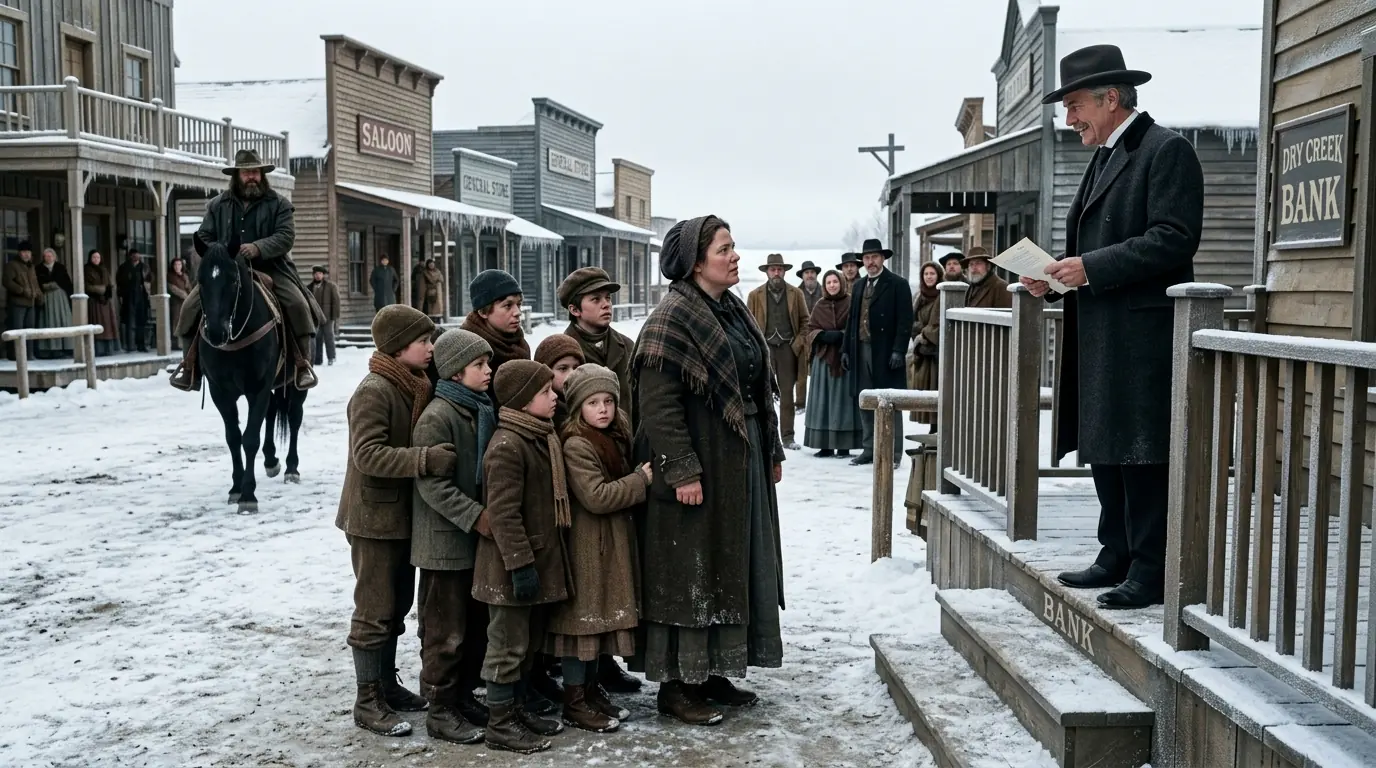
Eleanor stood beneath him with all seven children clustered close enough that their coats touched. Fourteen-year-old James was on her left, twelve-year-old Robert and eleven-year-old Daniel behind him, eight-year-old twins Clara and Samuel pressed against her skirts, six-year-old Hannah holding baby Thomas because Eleanor’s hands were full of legal notices, unanswered letters, and the one copy of the family deed Harland’s bank had not managed to take from her. She was a large woman, tall and broad through the shoulders and hips, and Dry Creek had spent eleven years making certain she knew that fact as though her body were a public announcement. Franklin Mercer had been one of the few men who never treated her size as either entertainment or apology.
Now Franklin had been dead eight weeks.
And Victor Harland wanted her children.
Harland owned Dry Creek Merchant Bank, sat on the town council, financed half the businesses along Main Street, and possessed the quiet talent of making personal ambitions sound like civic responsibility. At Franklin’s funeral he had placed one hand over his heart and spoken about “community,” “loss,” and “honoring a hardworking man.” Eleanor remembered standing beside the grave wondering why his voice sounded less like grief than completion. She understood the feeling now.
“James Mercer,” Harland announced. “Age fourteen. Strong, literate, experienced with farm equipment. The county will entertain applications from established ranch or trade households willing to assume responsibility for his maintenance.”
“No.”
The word escaped Eleanor before fear could stop it.
Harland looked down.
Eleanor stepped closer to the platform. “You do not call my son like cattle at a sale.”
“Mrs. Mercer, this is a lawful dependency proceeding.”
“He has a name.”
“I just said it.”
“You said enough to describe what labor someone gets for feeding him.”
Murmurs moved through the crowd.
James came beside her.
Eleanor continued. “His name is James Franklin Mercer. He learned to read at four. He can add three columns in his head faster than some men in this square can do it with a pencil. He knows when a cow is going off feed before she stops eating, and he stays awake with his baby brother when I am too tired to hear him cry.”
Harland’s mouth tightened.
“He is not standing on that platform.”
A few faces in the crowd lowered.
Nobody stepped forward.
That hurt almost as much as Harland.
These were people Eleanor knew. Mrs. Hix from the general store had delivered soup after Thomas was born. Old Pete Kalen at the assay office had attended every Christmas pageant since James first forgot his lines. Constable Nathan Briggs had once borrowed Franklin’s wagon when his own broke an axle.
Now every one of them was watching.
Harland descended one step. “The estate is insolvent.”
“Show me the loans.”
“We have discussed this.”
“No, you have refused this.”
Eleanor held up one of the notices. “You say Franklin borrowed against our house, our fields, and income from crops we never planted. I asked your bank for the original notes three times.”
“Those documents are with the county assessor.”
“The assessor says they are with you.”
Harland’s eyes hardened.
Eleanor saw it.
A very small thing.
But Eleanor had spent eight weeks surviving on small things.
“Every time I ask to see my husband’s signature,” she continued, “someone sends me to another building.”
“This is not the venue.”
“Then what is?”
Silence.
Baby Thomas began fussing in Hannah’s arms.
Without looking, six-year-old Hannah bounced him gently against her shoulder.
The motion almost broke Eleanor.
Her daughter had learned to care for a baby because her mother had spent two months fighting bankers.
Harland climbed back onto the platform.
“Constable.”
Briggs looked miserable.
“Sir?”
“Move Mrs. Mercer aside so we can proceed.”
James stepped in front of Eleanor.
Robert joined him.
Daniel moved beside Robert.
Hannah took Clara’s hand.
Samuel pressed against Eleanor’s back.
Seven children became one small wall.
Briggs stopped.
“Constable,” Harland repeated.
Briggs looked at James.
Then at Eleanor.
Then at the frozen ground.
“Sir, perhaps we could postpone until—”
Hoofbeats struck the road beyond the square.
Not the easy rhythm of somebody riding into town for flour.
Fast.
Heavy.
Deliberate.
Every head turned.
The horse came around the livery building at a pace that sent frozen mud cracking beneath its hooves. It was enormous, dark, and built for mountain trails rather than appearance, and the man on its back seemed nearly too large for any ordinary saddle. He wore an oiled canvas coat, fur-lined boots, a battered hat, and a beard that had apparently stopped negotiating with scissors years earlier.
Thorne Blackidge.
People in Dry Creek knew the name the way they knew avalanche gullies and winter rivers: mostly by warning.
He trapped high country, traded furs two or three times each year, and spoke so little that every story about him contained more speculation than fact.
Thorne stopped at the edge of the crowd.
His gray eyes moved across Harland.
The county clerks.
Briggs.
Eleanor.
Then the children.
He dismounted.
People moved out of his path without being asked.
Harland forced a smile. “Blackidge. This is county business.”
“I heard.”
Thorne’s voice was quiet.
That somehow carried farther.
Harland folded his hands. “Then you understand—”
“How much?”
Harland blinked.
“What?”
“How much is owed?”
“That is not—”
“I didn’t ask what it is.”
Thorne looked at the clerk holding the ledger.
“I asked the number.”
The clerk shuffled papers.
Harland gave him a warning glance.
Too late.
The clerk named the amount.
Thorne reached inside his coat and removed a leather pouch.
When it struck the platform, the sound of coin inside made three people in the front row straighten.
“That covers it,” Thorne said.
The county clerk opened the pouch.
Counted.
Then counted again.
Harland’s face did not change enough for most people to notice.
Eleanor did.
“This may cover certain outstanding obligations,” Harland said carefully, “but the Mercer property has already transferred to the bank under default.”
“Then sell it back.”
“It isn’t for sale.”
Too fast.
Thorne’s gray eyes remained on him.
“Everything you own has a price.”
Harland’s jaw tightened.
“The bank has plans for that property.”
“What plans?”
“That is private bank business.”
Thorne glanced toward Eleanor.
Then back.
“Interesting.”
Harland looked irritated. “What is?”
“Farm’s worth maybe a quarter of what you’re protecting it like.”
The square became quieter.
Eleanor felt something cold move through her that had nothing to do with January.
She had asked herself the same question.
Why did Harland want the Mercer property so badly?
Their farm was good land.
Not extraordinary.
The creek kept the eastern meadow green in dry summers, but half the county had water somewhere.
Harland finally named a price.
Several people laughed in disbelief.
Four times the assessed value.
Thorne looked at him for a long moment.
Then said, “No.”
Harland smiled slightly.
Thorne continued.
“Here’s what happens instead.”
He pointed toward the children.
“The debt money stays with the county pending review.”
Then toward Eleanor.
“They stay together.”
Harland’s eyes narrowed.
“You have no authority to—”
“And the estate goes before a territorial judge.”
Harland stopped.
Thorne took one step closer to the platform.
“Or I ride to Helena today and tell them Pete Kalen says the assessor’s records don’t match the papers your bank filed.”
Eleanor turned toward Pete.
He went pale.
Harland did too.
Only slightly.
Enough.
Thorne waited.
“You have three seconds.”
“You cannot threaten a bank officer—”
“One.”
Harland stared.
“Blackidge.”
“Two.”
“Fine.”
The word came through clenched teeth.
“The placements will be suspended pending review.”
“No.”
Harland’s nostrils flared.
Thorne said, “Canceled.”
The county clerk looked toward Harland.
Then at the coin pouch.
Then at Constable Briggs.
Briggs suddenly became very interested in supporting proper procedure.
“I believe,” the constable said slowly, “that suspension of the dependency order until territorial review would be advisable.”
Harland looked ready to kill him.
Thorne picked up his pouch.
Then walked toward Eleanor.
Up close, he was even larger.
Eleanor was not accustomed to looking up at men.
She had to look considerably upward at Thorne.
“Mrs. Mercer.”
“Mr. Blackidge.”
“I have a cabin eight miles north.”
“That is not reassuring.”
One corner of his beard moved.
Perhaps a smile.
“Solid roof. Food through February. Three rooms.”
Eleanor glanced toward her children.
“You are asking me to take seven children into a mountain cabin with a stranger.”
“I’m asking you to take seven children somewhere Harland can’t separate them before a judge sees those papers.”
She studied him.
“Why?”
Thorne looked past her toward the platform.
Then back.
“I knew Franklin.”
That was all.
Eleanor hated partial answers.
For eight weeks, partial answers had nearly destroyed her family.
But one fact mattered more.
Harland wanted them in Dry Creek.
Thorne wanted them out.
“All right.”
James immediately said, “Mama.”
Eleanor raised a hand.
Her son stopped.
“We go together.”
Thorne nodded.
“Together.”
They left before noon.
Dry Creek watched.
Nobody apologized.
Not yet.
The first mile up the mountain was easy enough that Eleanor refused the saddle on Thorne’s pack mule when he offered it.
The second mile made that decision irritating.
The third made it stupid.
She continued walking anyway.
Thorne did not offer again.
Eleanor appreciated that.
The children rearranged themselves naturally. James stayed near the front, suspicious enough to watch Thorne without pretending otherwise. Robert and Daniel helped Hannah over frozen ruts. Clara and Samuel asked questions until even grief became briefly distracted by animal tracks.
“Those wolves?” Samuel asked.
“Elk.”
“Are there wolves?”
“Yes.”
“Have you fought one?”
“Samuel,” Eleanor warned.
“It’s a real question.”
Thorne made a sound that might have been laughter.
“More than once.”
Samuel looked delighted.
James looked less impressed.
Eleanor watched Thorne.
He answered children directly.
No baby voice.
No false cheer.
No attempt to become likable.