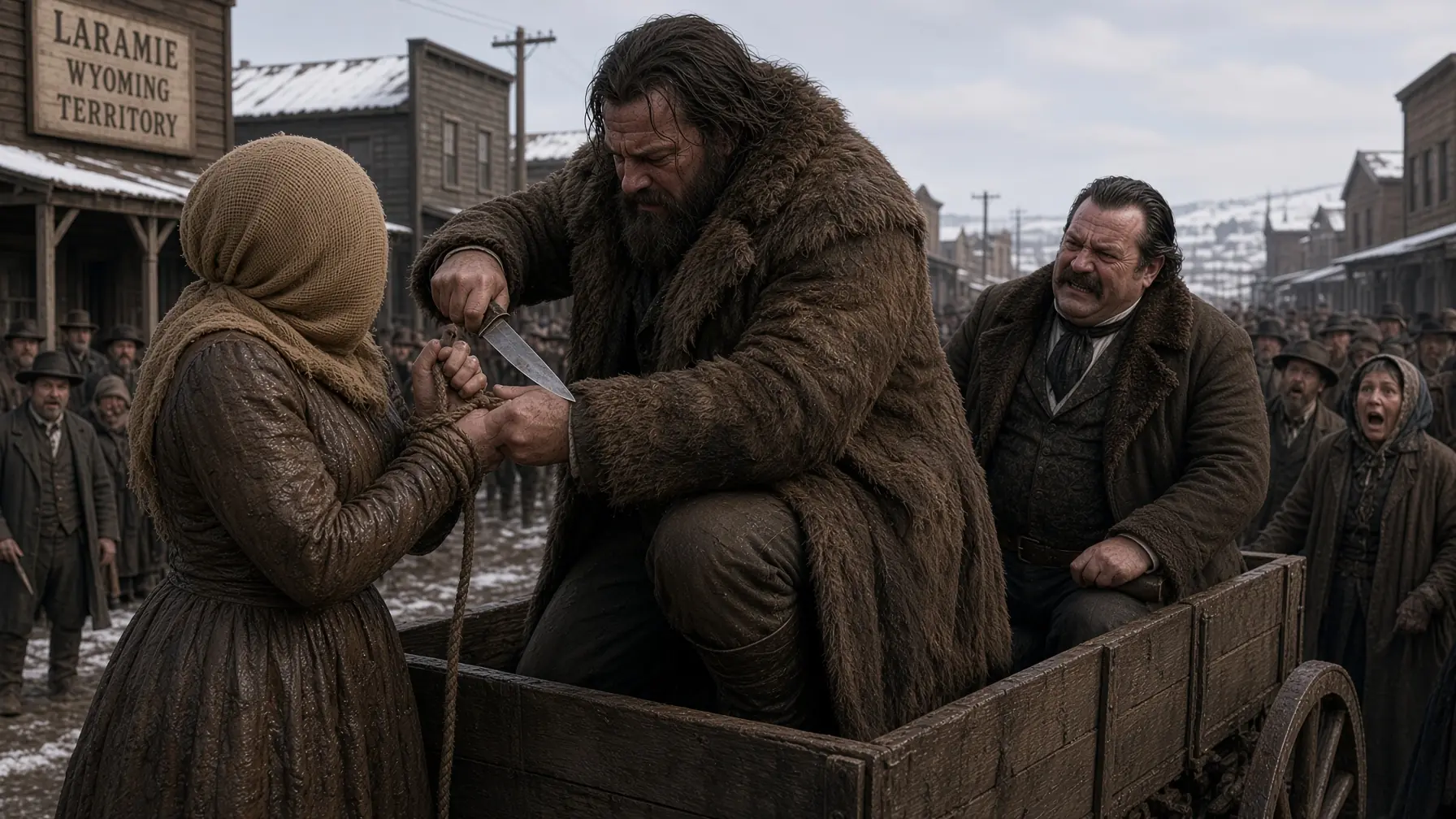
They covered the woman’s face with a burlap sack before dragging her into the center of Laramie.
That was the part Elias Boone would remember years later.
Not the shouting. Not the price. Not even the laughter.
The sack.
Someone had decided it was not enough to bind her wrists, force her onto the bed of an old freight wagon, and humiliate her in front of half the town. They had needed to take away her face too.
Winter hung low over Wyoming Territory, turning Laramie’s main street into a trench of black mud, frozen ruts, and dirty snow. Smoke crawled from chimneys beneath a gray afternoon sky. Horses stood at hitching rails with their heads lowered against the wind, and men crowded beneath the wooden awnings outside the mercantile, saloon, and livery.
Nobody stepped forward.
Not the ranchers.
Not the merchants.
Not even Reverend Samuel Pike, who stood beneath the eaves of the church mission clutching his Bible while apparently finding nothing useful inside it.
Clyde Mercer stood on the wagon beside the bound woman.
He was thirty-eight, broad around the waist, narrow around the eyes, and dressed more expensively than any honest work he was known to perform could reasonably explain. His brown wool coat had a velvet collar. A silver watch chain crossed his vest. His boots were polished despite the mud.
In one hand he held a sheet of paper.
In the other, a riding crop.
“Listen up!” Clyde called.
Conversation faded.
The woman stood beside him.
Her dress was soaked to the knees. The hem was torn. Mud covered one sleeve where someone had apparently dragged her after she fell. Rope was wrapped around both wrists, cutting deep enough to redden the skin.
The burlap sack covered her entire head and tied loosely beneath her chin.
She did not beg.
That bothered Elias more than begging would have.
She stood straight.
Even when laughter came.
Clyde raised the paper.
“Forty-two dollars and seventy cents owed for lodging, food, medical expenses, burial charges, and debts transferred from the late Matthew Vale.”
A man near the saloon shouted, “Nobody’s paying forty dollars for that curse.”
Laughter.
Clyde grinned.
“I didn’t say forty.”
He tapped the document.
“Under the service pledge signed by her father, the remaining obligation can be transferred to any man willing to assume the debt.”
That was a lie.
Elias knew it almost immediately.
Not necessarily that the signature was forged. He had not seen the paper.
But a debt did not make a woman livestock.
Wyoming Territory had labor contracts, apprenticeship agreements, debt suits, liens, warrants, judgments, and all the same ways people with money had invented for making life difficult for people without it.
It did not have a lawful public auction where a grown woman became property because some loud fool waved a sheet of paper.
Yet nobody challenged Clyde.
That told Elias almost as much as the document did.
The town was afraid of him.
Or indebted to him.
Probably both.
Clyde pulled the sack slightly forward so the woman’s face remained completely hidden.
“Strong back. Twenty-seven years old. Knows cooking, washing, sewing, accounts, and enough medicine to be useful when somebody gets kicked by a horse.”
A drunk ranch hand called:
“What’s wrong with her face?”
Clyde smiled.
“There’s the question.”
The woman’s bound hands tightened.
Clyde continued.
“Some of you already know the stories.”
Whispers moved through the crowd.
Elias had heard versions of them that morning while buying flour.
The Vale woman.
The cursed woman.
Men who looked directly at her suffered bad luck.
A stage driver broke his neck two days after insulting her.
A rancher lost forty cattle after trying to court her.
Her father died in a fire.
Someone claimed even her fiancé had vanished.
The details changed depending on who told the story.
That should have been enough to make sensible people suspicious.
Instead, repetition had turned nonsense into local knowledge.
Clyde shouted:
“Her own father tried for years to send her away.”
The woman moved.
Only slightly.
A tremor through her shoulders.
That lie hurt.
Elias saw it.
Clyde continued.
“Can’t say I blame him.”
A few people laughed.
One woman near the mercantile did not. She looked down instead.
Clyde pointed toward the covered face.
“Unfortunate-looking thing.”
More laughter.
“Take her home and keep the sack on if you like.”
That earned the loudest reaction yet.
Elias stood at the far edge of the crowd in a buffalo coat darkened by snow.
At forty-three, he was larger than most men without being bulky. Years in the Bighorn country had taken softness from him. Thick brown hair touched his collar. His beard was streaked with early gray, and a pale scar ran from his left temple across his cheek toward the corner of his jaw.
Children stared at it.
Adults pretended not to.
People in Laramie called him a mountain man because they needed a simple word for someone who trapped occasionally, guided survey parties, hunted for army posts, traded hides, cut timber, carried freight, and sometimes disappeared into country other men avoided.
A few simply called him Boone.
Most left him alone.
That suited Elias.
He had come down from the mountains for flour, salt, lamp oil, cartridges, coffee, two new traps, and a replacement drawknife.
He had no intention of becoming involved in anybody else’s misery.
Then Clyde raised the riding crop and used it to lift the woman’s chin beneath the sack.
“Five dollars!” someone shouted.
Clyde laughed.
“Come now.”
“Seven.”
“She cook?”
“She can.”
“Eight.”
A man near the back called:
“I’ll give ten if Mercer throws in the sack.”
The crowd laughed again.
The woman’s fingers curled into fists.
Elias felt something inside him become very cold.
He had heard crowds laugh like this before.
During the war.
Outside prison wagons.
Around frightened deserters.
Near a farmhouse after men with uniforms decided the people inside belonged to the wrong side.
Cruel men became braver when enough cowards surrounded them.
Elias could have climbed onto the wagon and broken Clyde Mercer’s jaw.
For several seconds he wanted to.
Then he noticed the paper.
Clyde kept holding it up.
Proudly.
Evidence.
Elias had survived long enough to know there were times when striking a man gave him exactly what he needed: a new story in which he became the victim.
So Elias kept his hands still.
“Twenty.”
The laughter stopped.
Clyde turned.
People moved aside.
Elias raised his head.
Clyde stared.
“Boone?”
“Twenty.”
A few men whispered.
Clyde recovered quickly.
“You haven’t even seen what’s underneath.”
Elias looked at the woman’s wrists.
“I’m buying the contract.”
Clyde grinned.
“That means you get what comes with it.”
“No.”
The grin weakened.
Elias stepped closer.
“It means I get the paper you claim gives you authority over her.”
Clyde’s eyes narrowed.
“You interested or not?”
“Twenty-five.”
Someone whistled.
Clyde looked toward the crowd.
He liked spectacle too much to stop now.
“Anybody give thirty?”
Nobody answered.
Elias reached inside his coat.
“Thirty.”
He tossed a leather pouch onto the wagon.
Coins struck the boards with a heavy clink.
Clyde’s grin returned.
“Sold.”
A cheer began somewhere near the saloon.
It died quickly when Elias climbed onto the wagon.
He was taller up close than Clyde remembered.
Elias ignored him.
He stopped in front of the woman.
She flinched when his hand rose.
He did not touch the sack.
He reached for the rope instead.
Clyde’s expression changed.
“What are you doing?”
Elias loosened the first knot.
“Taking delivery.”
“That rope stays until you get her out of town.”
Elias pulled the second knot free.
“No.”
The rope dropped into the mud.
The woman’s hands remained together for several seconds as though they had forgotten they were free.
Elias leaned close enough that only she could hear him.
“You don’t belong to me.”
She stopped breathing.
“I bought his piece of paper.”
Her fingers began trembling.
“Not you.”
The burlap shifted as she looked toward him.
“You’re free.”
For several heartbeats she said nothing.
Then Elias stepped back.
He intended to take the document, walk her somewhere warm, and determine exactly what kind of fraud had just occurred.
He had already turned toward Clyde when the woman whispered:
“Caleb Boone.”
Elias stopped.
Everything inside him went still.
He slowly looked back.
The woman beneath the sack repeated it.
“Caleb Boone.”
Elias had not heard his brother’s name spoken aloud in thirteen years.
Clyde glanced between them.
“What did she say?”
Elias ignored him.
He faced the woman again.
“Who told you that name?”
Her voice shook.
“My father.”
“Matthew Vale?”
“Yes.”
Elias stared through burlap he suddenly wanted to tear away and feared to touch.
“How did he know Caleb?”
The woman whispered:
“He buried him.”
For the first time in years, Elias Boone forgot how to breathe.
Clyde reached for the woman.
“Enough.”
Elias caught his wrist.
Not violently.
He simply stopped it.
Clyde looked down at Elias’s hand.
Then up.
“Let go.”
Elias did.
Clyde rubbed his wrist.
“You bought the contract. Take her and get out of my street.”
“Your street?”
Clyde smiled thinly.
“You know what I mean.”
Elias picked up the paper.
At the bottom was a signature:
Matthew A. Vale
Below that:
Witnessed: J. Horace Bell, Notary
Elias folded it once.
“Where are her belongings?”
Clyde’s face tightened.
“She doesn’t have any.”
The woman said:
“He took them.”
Clyde snapped toward her.
“You want that sack tightened?”
Elias took one step forward.
Clyde reconsidered the next sentence.
Elias spoke quietly.
“Where?”
Clyde laughed.
“You paid thirty dollars for a labor debt. You didn’t buy an inventory.”
Elias looked toward the crowd.
Many had stopped enjoying themselves.
Good.
“Who saw Mercer take her property?”
Nobody moved.
Then an older woman standing outside the bakery raised her hand halfway.
“I did.”
Clyde turned.
“Mind your own business, Mrs. Bell.”
The woman flinched.
Elias memorized that too.
Clyde had influence.
Fear.
But not silence everywhere.
Elias looked at the covered woman.
“What’s your name?”
“Anna Vale.”
“Do you want the sack removed?”
The question seemed to surprise her.
Not May I?
Not Why is it there?
Do you want it removed?
“Yes.”
Elias untied the cord beneath her chin.
He lifted the burlap slowly.
Cold air touched Anna Vale’s face.
The crowd leaned forward.
Somebody gasped.
Not because she was monstrous.
Because she was ordinary.
Anna had dark hair cut unevenly at the shoulders, probably because someone had hacked through part of it. Her eyes were green-gray. One fading bruise darkened her left cheek.
A pale burn scar crossed the right side of her face from temple to jaw.
It was visible.
It was also far less dramatic than rumor had promised.
A man near the saloon muttered:
“That’s it?”
Anna heard him.
Her mouth tightened.
Elias looked at the scar.
Then at his own reflection in the mercantile window.
His was worse.
Anna noticed.
For the first time, something almost like humor touched her face.
Clyde seemed disappointed that the reveal had failed.
“Don’t let appearances fool you,” he called. “That woman brings death.”
Elias looked at him.
“Then you should be relieved she’s leaving.”
A few people laughed.
Not with Clyde this time.
His face hardened.
Elias climbed down from the wagon.
He offered Anna his hand.
She looked at it.
Then stepped down without taking it.
Pride.
Good.
Her knees nearly buckled when her boots reached the ground.
Elias caught her elbow.
She pulled away immediately.
“I can walk.”
“All right.”
He released her.
They crossed toward the livery.
Behind them, Clyde shouted:
“Boone!”
Elias stopped.
“You got until sundown tomorrow to get her out of Laramie.”
Elias turned.
“Why?”
“Because I’m telling you.”
“That isn’t a reason.”
“It’s enough.”
Elias looked at the paper in his hand.
“We’ll see.”
Then he walked away.
Anna did not speak again until they reached the back room of Abigail Hart’s boardinghouse.
Abigail was a widow in her sixties who had once stitched a bullet wound in Elias’s shoulder after he made the poor decision to argue with two drunken prospectors outside Rawlins.
She took one look at Anna’s wrists and stopped asking questions.
“Kitchen.”
Anna hesitated.
Abigail pointed.
“Woman comes into my house half-frozen, she eats first and explains trouble second.”
“I’m not hungry.”
“Then you can be not hungry over stew.”
Anna looked toward Elias.
He shrugged.
“Arguing with her takes longer.”
Abigail slapped the back of his coat as he passed.
“Still does.”
Anna sat at a small table near the stove.
Abigail brought hot water, clean cloth, salve, bread, and venison stew.
Elias remained near the doorway.
Anna looked at him.
“You can sit.”
“I’m fine.”
“You’re making me nervous standing there.”
He sat.
Better.
Abigail cleaned Anna’s wrists.
The rope had broken skin in two places.
“Who tied these?”
“Mercer’s men.”
“Names?”
“Wade Crowley and Nathan Fitch.”
Abigail’s mouth tightened.
Everyone apparently knew them.
Anna ate three spoonfuls of stew before hunger defeated caution.
Elias waited.
When the bowl was nearly empty, he placed the folded contract on the table.
“Tell me about Caleb.”
Anna stopped eating.
Her fingers tightened around the spoon.
“You’re his brother.”
It was not a question.
“Yes.”
“My father said you would have that.”
She pointed toward Elias’s chest.
He looked down.
A silver compass hung from a leather cord inside his shirt.
Only its edge was visible.
Elias pulled it free.
The case was scratched and dented.
A small B had been carved near the hinge.
Anna stared.
“Caleb described it.”
“When?”
“Thirteen years ago.”
Elias’s throat tightened.
“He was alive?”
“For two days after my father found him.”
The room became quiet.
Abigail stopped cleaning.
Elias leaned forward.
“Start at the beginning.”
Anna lowered the spoon.
“My father was a doctor before we came west. Not a proper city doctor by the time I was old enough to remember. He treated ranch hands, freighters, women in childbirth, whoever could pay and most people who couldn’t.”
Elias nodded.
“He lived near Dale Creek then?”
“Yes.”
“He found Caleb?”
“Near an old survey camp north of Crow Creek.”
“What condition?”
Anna hesitated.
“Shot.”
Elias’s face changed.
Not lost.
Not frozen.
Not drowned.
Shot.
“Where?”
“Below the ribs. My father wrote that the bullet had passed through, but there was internal bleeding. He knew Caleb would die.”
“Who shot him?”
“He didn’t know.”
“Caleb did.”
Anna looked at him.
“Yes.”
Elias’s hands tightened.
“Who?”
“My father never wrote the full name.”
“Why?”
“Because Caleb asked him not to.”
Elias stared.
“That makes no sense.”
“It will.”
Anna stood carefully.
“Can we go somewhere private?”
Abigail crossed her arms.
“My kitchen has heard worse than murder.”
Anna almost smiled.
Then shook her head.
“What I’m going to tell him is why Clyde Mercer put a sack over my head.”
That ended the humor.
Abigail walked toward the hall.
“I’ll keep people out.”
Anna waited until the door closed.
Then she looked at Elias.
“My father kept Caleb’s field notebook.”
Elias stopped moving.
“He had been working as a surveyor?”
“Deputy contract surveyor.”
Elias nodded.
Caleb had written about taking government work.
Then the letters stopped.
“We thought he disappeared in a snowstorm.”
“That’s what the report said.”
“Who wrote it?”
“Sheriff William Mercer.”
Elias looked toward the window.
“Clyde’s father.”
“Yes.”
There it was.
The first connection.
Anna continued.
“Caleb had discovered something while checking old land claims west of Laramie.”
“What?”
“Boundary markers had been moved.”
Elias frowned.
“For what?”
“Water.”
Of course.
Land in Wyoming looked endless to people who did not understand it.
The valuable pieces were often the ones with water.
Anna continued.
“Three springs and a creek corridor were supposed to sit partly inside public grazing land and partly on smaller homestead parcels. According to Caleb’s measurements, older markers had been moved by hundreds of yards. The new lines placed nearly every reliable water source inside property controlled by Mercer interests.”
“How much land?”
“Not much.”
“Then the water.”
“Yes.”
Elias leaned back.
“Cattle.”
“Thousands.”
A man could control enormous grazing acreage if he controlled where livestock drank.
Anna continued.
“Caleb recorded the original bearings and found two surviving government corner markers. He also wrote down the names of men who had helped move the others.”
“William Mercer?”
“Yes.”
“Who else?”
“My father’s journal only names one.”
“Clyde?”
“He would’ve been twenty-five.”
“Old enough.”
Anna nodded.
“Caleb went toward Laramie to file a correction.”
“He never arrived.”
“My father found him the next morning.”
Elias stared at the table.
For thirteen years he had imagined Caleb freezing alone somewhere in the hills.
Then drowning.
Then leaving deliberately.
The worst possibility had been the simplest.
That his younger brother had decided he no longer wanted to be found.
Their last conversation had been an argument.
Caleb wanted Elias to join the survey work.
Elias had refused.
Caleb called him a coward for hiding in the mountains after the war.
Elias told him to go to hell.
Caleb rode away.
Then vanished.
Elias asked:
“Did he say anything about me?”
Anna’s face softened.
“Yes.”
“What?”
“My father wrote it down.”
Elias looked up sharply.
“Where?”
“That’s what Clyde wants.”
Anna lowered her voice.
“The notebook. My father’s journal. And Caleb’s letter.”
“Letter?”
“To you.”
Elias stopped breathing.
Anna’s eyes remained on him.
“He wrote it before he died.”
“Where is it?”
“Safe.”
“Where?”
“I’m not telling you yet.”
Elias’s expression hardened.
Anna did not retreat.
“Why?”
“Because I met you forty minutes ago.”
“My brother wrote that letter.”
“Yes.”
“And you just told me it exists.”
“Because my father told me Elias Boone was the only person I should trust with it.”
“Then trust me.”
“No.”
Elias stared.
Anna stared back.
Then something unexpected happened.
He smiled.
Barely.
“You’re smarter than the crowd thought.”
“I’d hope so.”
“Keep it safe.”
Her shoulders relaxed.
The first test had passed.
The story of Anna’s “curse” had begun three months earlier.
Her father died when fire destroyed the rear room of their small clinic and boardinghouse outside Laramie.
Anna survived.
The burn on her face came from crossing the burning room to reach him.
She failed.
Matthew Vale died from smoke and burns before dawn.
Clyde Mercer arrived the following afternoon.
He produced a ledger claiming Matthew owed him thirty-six dollars for livestock feed, medicine shipments, and loans.
Anna had never seen those debts.
Then came burial costs.
Then storage fees.
Then “property protection.”
The total became forty-two dollars and seventy cents.
Clyde offered a solution.
Anna could work in his household until the amount was repaid.
She refused.
Three days later, rumors began.
Matthew Vale had died because Anna brought misfortune.
A ranch hand who insulted her was thrown from his horse.
A shopkeeper who refused her credit lost a barn in a lightning fire.
A man who once proposed marriage to Anna had disappeared while prospecting in Colorado.
Events separated by years suddenly became part of one story.
The cursed woman.
People started crossing the street.
Then Clyde produced the alleged service pledge.
Anna went to the local justice.
The justice told her debt matters should be settled privately.
She went to Town Marshal Orin Pike.
Pike said Clyde’s paper appeared valid.
When she tried reaching the territorial court through an attorney in Cheyenne, Clyde’s men intercepted her stage ticket.
Two nights later they broke into Abigail Hart’s old clinic storehouse, where Anna had hidden several boxes belonging to her father.
They did not find what they wanted.
The next morning Anna was seized.
Clyde decided public humiliation would accomplish what threats had not.
If everybody believed she was cursed, indebted, and undesirable, nobody would object when she disappeared into somebody’s ranch household.
Nobody did.
Until Elias.
He listened without interruption.
Then asked:
“Why auction you instead of simply keeping you working for him?”
Anna looked toward the fire.
“Because he had already searched his own property.”
“You hid the papers somewhere else.”
“Yes.”
“He thought whoever took you would eventually learn where.”
“Or I’d surrender them before being hauled hundreds of miles away.”
Elias nodded.
“Then I was useful.”
Anna looked at him.
“Probably.”
“He let me buy the paper because he thought I’d take you into the Bighorns.”
“Yes.”
“And sooner or later, you’d tell me where the notebook was.”
“Yes.”
Elias stood.
Anna looked alarmed.
“Where are you going?”
“To make sure he keeps thinking that.”
Clyde Mercer watched from the upstairs window of his office as Elias Boone loaded supplies onto a packhorse the following morning.
Anna stood beside him wearing a borrowed wool coat from Abigail Hart.
Her face was uncovered.
That alone had begun weakening the curse.
Children stared.
Adults stared too.
Then eventually people discovered staring at Anna did not cause lightning to strike them.
Clyde came outside.
“Leaving?”
Elias tightened a saddle strap.
“Soon.”
Clyde looked at Anna.
“You tell him yet?”
Anna said nothing.
Clyde smiled.
“Careful, Boone. She lies.”
Elias looked toward him.
“So do you.”
Clyde’s expression tightened.
“You got what you paid for.”
Elias pulled the folded contract from his coat.
“That what you mean?”
Clyde’s eyes followed it.
“Yes.”
Elias unfolded the page.
“Interesting witness.”
“What?”
“J. Horace Bell.”
Clyde said nothing.
“Notary.”
“Yes.”
“When’d he witness Matthew Vale signing?”
Clyde’s smile disappeared.
“When the debt was taken.”
“Date says September seventh.”
“So?”
“Horace Bell died in June.”
Clyde stared.
Elias had spent sunrise at the county clerk’s office.
A death register was useful that way.
Clyde recovered.
“Clerical error.”
“Probably.”
Elias folded the document again.
“Territorial judge can decide.”
Clyde stepped closer.
“You don’t want to play lawyer.”
“No.”
Elias placed the paper inside his coat.
“I want a lawyer to play lawyer.”
Clyde’s eyes hardened.
“You think anybody in this town cares?”
Elias looked around Main Street.
Several people were watching.
“Yesterday?”
He shrugged.
“Maybe not.”
“Today?”
Elias pointed toward Anna.
“She still got her face.”
Clyde glanced around.
Nobody laughed.
That frightened him more than Elias expected.
Good.
Elias did not take Anna into the mountains.
Instead, they rode six miles south to a ranch belonging to Amos Garrett, a former army scout Elias trusted.
Clyde’s men followed.
Elias expected them.
He left visible tracks toward the ranch, then doubled back after dark with Anna and crossed into a narrow stand of cottonwoods near the river.
Anna looked at him.
“You do this often?”
“Get followed?”
“Yes.”
“Enough.”
“You live a suspicious life.”
“Useful life.”
They waited.
Two riders passed toward Garrett’s ranch.
Elias watched until they disappeared.
“Now.”
They rode back toward town by another route.
Anna frowned.
“I thought we were hiding.”
“We are.”
“In Laramie?”
“Last place they’ll search if they think we left.”
Abigail Hart opened the back door after midnight.
“You two look terrible.”
Elias nodded.
“Need the attic.”
“You planning murder?”
“No.”
“Good. I just washed the floor.”
Anna laughed before she could stop herself.
The sound surprised all three of them.
It was the first time Elias heard it.
For a moment Anna covered her mouth, almost ashamed.
Abigail pointed upstairs.
“Keep doing that. Town needs to hear it.”
They slept until dawn.
Then Anna finally decided to trust Elias.
The papers had never left Laramie.
Matthew Vale had hidden them inside a place Clyde Mercer would never willingly search.
The church.
Not inside the sanctuary.
Inside the old stone foundation beneath the mission schoolhouse, behind a loose block beside the stove chimney.
Reverend Pike had not known.
Matthew had once repaired the foundation and created the cavity himself.
Elias and Anna entered before morning service.
Anna removed the stone.
Inside lay an oilcloth package.
Her hands shook.
She placed it on a school desk.
Elias did not touch it.
Anna unwrapped the cloth.
Three items.
A leather notebook.
A thicker journal.
And an envelope yellowed with age.
Elias recognized the handwriting before Anna handed it to him.
Elias Boone
Caleb.
His knees suddenly felt weak.
Anna turned away.
That kindness mattered.
Elias opened the envelope.
The letter contained less than one page.
He read slowly.
Eli,
If this reaches you, then I was wrong about having more time. I found what I came looking for and should have turned back sooner. That part is mine.
You were right about one thing and wrong about another. You were right that a man can get himself killed believing every wrong needs him personally. You were wrong that hiding from people keeps them from mattering.
I’m sorry our last words were angry ones.
Don’t make a life out of them.
Your brother,
Caleb
Elias read it twice.
Then a third time.
He did not cry.
Not immediately.
He sat at the small school desk while thirteen winters inside him changed shape.
Anna remained near the window.
After a long while Elias asked:
“Did your father read it?”
“No.”
“How do you know?”
“He told me sealed letters belonged to the dead and the person named on them.”
Elias folded the page carefully.
“He was a good man.”
“Yes.”
“What happened in the fire?”
Anna’s face changed.
“I don’t know.”
Elias looked toward her.
“You think Clyde did it.”
“I think the back window was broken.”
“Anything missing?”
“One box.”
“What was inside?”
“Old property files.”
“Not these.”
“No.”
Elias looked at Matthew’s journal.
“We prove what we can.”
Anna nodded.
Not every suspicious death needed to become murder to make the rest of the story ugly enough.
They opened Caleb’s field notebook.
Measurements filled the pages.
Bearings.
Distances.
Sketches of rock formations.
Corner markers.
Water sources.
Parcel numbers.
Then names.
W. Mercer present at relocated marker. C. Mercer with team.
Elias stopped.
Clyde had been there.
Twenty-five years old.
Old enough.
The final page was stained dark brown.
Not enough to determine whether it was blood.
Elias did not need to know.
The notebook ended with one line.
Take copy to land office. Original marker at split granite above Black Willow Spring.
Anna opened her father’s journal.
Matthew had documented finding Caleb.
Date.
Location.
Wounds.
What Caleb said.
One passage mattered most.
Patient states William Mercer confronted him with two men after he refused payment to amend survey notes. Patient identifies younger Mercer son Clyde as present. Shot fired after altercation. Patient escaped on horse approximately three miles before collapse.
Elias read it.
His face became empty.
Anna watched him carefully.
“Elias.”
He closed the journal.
“Where’s Clyde right now?”
Anna’s voice sharpened.
“No.”
“What?”
“My father kept those papers thirteen years so they could reach a court.”
“I know.”
“Not so you could shoot somebody.”
Elias looked toward her.
“You think that’s what I’m doing?”
“I saw your face.”
“You see too much.”
“My face got covered with a sack because people didn’t like seeing mine. I learned to use my eyes.”
That stopped him.
Elias looked at Caleb’s letter.
Don’t make a life out of them.
He exhaled.
“All right.”
Anna did not relax.
“What does all right mean?”
“It means we find someone Clyde doesn’t own.”
That person arrived by train the following afternoon.
Deputy United States Marshal Thomas Kersey was not impressive to look at.
He was fifty-four, short, thin, balding, and wore spectacles he constantly pushed back up his nose.
Clyde Mercer laughed when he saw him.
That was his first mistake.
Kersey had spent sixteen years investigating land fraud, mail fraud, cattle theft, forged federal claims, and men who assumed a quiet federal marshal was less dangerous than a loud local one.
Elias knew him from an old timber-theft case in the mountains.
Kersey read everything.
Then he asked Anna to tell the story again from the beginning.
He interrupted constantly.
“Did you see Clyde sign the contract?”
“No.”
“Then we don’t say he forged it.”
“Did he tell you your father signed?”
“Yes.”
“Write that.”
“Did you see who set the clinic fire?”
“No.”
“Then leave it out for now.”
“Did Clyde order the men to bind you?”
“Yes. He was standing there.”
“Witnesses?”
“Mrs. Bell. Maybe the blacksmith’s apprentice.”
“Good.”
Elias listened.
This was what he wanted.
Not revenge.
Separation between what they suspected and what they could prove.
Kersey examined the contract.
“Horace Bell?”
“Dead three months before the claimed notarization,” Elias said.
Kersey nodded.
“Useful.”
He studied Matthew Vale’s journal.
“Not perfect evidence by itself.”
Elias frowned.
“Why?”
“Dead man writing what another dead man told him. Defense attorney will have plenty to say.”
He lifted Caleb’s field notebook.
“This is better for the land question if the original markers still exist.”
“The split granite marker,” Anna said.
Kersey nodded.
“Need a surveyor.”
“What about Clyde?”
“Clyde isn’t going anywhere.”
“You sure?”
Kersey smiled.
“I had the stationmaster quietly told not to sell him a ticket.”
“That legal?”
“No.”
Elias stared.
Kersey smiled again.
“Which is why I didn’t actually do that.”
Anna laughed.
Even Elias did.
Then Kersey became serious.
“What I did do was wire Cheyenne requesting a territorial land examiner and warrant authority related to the forged contract and unlawful restraint.”
“How long?”
“Tomorrow morning if the judge signs.”
Elias looked toward the window.
“Clyde will know.”
“Yes.”
“He’ll come for the notebook.”
Kersey looked at him.
“Probably.”
Anna asked:
“So what do we do?”
The deputy marshal closed the notebook.
“Let him.”
Clyde came after midnight.
Not personally.
That was another useful decision.
Wade Crowley and Nathan Fitch entered Abigail Hart’s boardinghouse through the rear kitchen window.
They expected Anna upstairs.
Instead, they found Deputy Marshal Kersey sitting in the dark with a shotgun across his knees.
“Evening.”
Crowley froze.
Fitch turned.
Elias stood behind him.
“Door’s that way.”
Fitch reached toward his revolver.
Kersey cocked the shotgun.
“Son, I’m fifty-four years old, tired, and deeply uninterested in writing the paperwork that follows you making that choice.”
Fitch slowly raised his hands.
Both men were arrested.
Crowley lasted twenty-three minutes before deciding Clyde Mercer was not worth federal charges.
He told Kersey Clyde had ordered them to retrieve “the Vale papers.”
“Which papers?” Kersey asked.
“Survey book.”
“How’d Clyde know it existed?”
“His father told him.”
“Why want it?”
Crowley looked toward Elias.
“Because of Boone.”
Elias’s jaw tightened.
“Caleb?”
Crowley nodded.
“Old Mercer used to get drunk and talk.”
“What did he say?”
“That Boone was supposed to disappear with the notebook.”
The room went quiet.
“Who shot him?”
Crowley shook his head.
“Never said.”
“Was Clyde there?”
“Old Mercer said both boys were there.”
Both.
Clyde had an older brother, Henry, dead twelve years from pneumonia.
Kersey wrote everything down.
Then asked:
“Did Clyde order Matthew Vale’s clinic burned?”
Crowley’s eyes widened.
“No.”
That answer seemed genuine.
Kersey repeated:
“You know anything about the fire?”
“No. Clyde was furious about it.”
Anna looked surprised.
“Why?”
Crowley shrugged.
“He thought the papers burned.”
That mattered.
The fire might have been accident.
Or someone else.
They did not know.
And for once, nobody turned uncertainty into certainty.
The territorial land examiner reached Laramie two days later.
His name was Franklin Ames.
He brought original survey copies from the land office, measuring chains, instruments, and the skeptical personality of a man who trusted rocks more than testimony.
Elias led him to Black Willow Spring.
Anna came too.
So did Kersey.
The split granite marker remained exactly where Caleb’s notebook said it would.
Half buried.
Weathered.
But intact.
Ames cleaned dirt from one side.
There was the old government mark.
He took measurements.
Then more.
He compared them with the notebook.
By sunset he had confirmed the later Mercer property lines were inconsistent with original federal bearings.
Some corner monuments had been moved.
The effect was significant.
Not because the Mercers suddenly owned half Wyoming.
They did not.
But their ranch had controlled approximately three miles of creek and two springs it had no legal right to exclude neighboring permit holders from using.
That control had allowed the Mercer operation to dominate grazing access for years.
Ames looked toward Elias.
“Your brother’s measurements were good.”
Elias stared across the winter grass.
“He was always better at numbers.”
Ames closed the notebook.
“He was right.”
Three words.
Thirteen years late.
Still enough.
Clyde Mercer was arrested the following morning.
Not in a gunfight.
Not on horseback.
He was eating eggs.
Kersey entered the hotel dining room with the county sheriff, whose courage had improved considerably once federal warrants existed.
Clyde stared at the papers.
“For what?”
Kersey adjusted his spectacles.
“Forgery-related fraud, unlawful restraint, conspiracy to interfere with federal land records, and a few other matters the territorial prosecutor seems excited to discuss.”
Clyde stood.
“This is Boone.”
“No.”
Kersey shook his head.
“This is paperwork.”
Elias was not there.
Neither was Anna.
They were across the street in Higgins Mercantile.
Anna stood near the fabric counter.
Nobody laughed.
Higgins looked embarrassed.
“Miss Vale.”
“Yes?”
“I’m sorry.”
She studied him.
“For what part?”
He swallowed.
“For standing there.”
That answer surprised her.
Not participating.
Not cheering.
Standing.
Sometimes cowardice was quieter.
Anna nodded.
“Thank you.”
“I should’ve said something.”
“Yes.”
Higgins accepted that.
No demand for forgiveness.
No excuse.
Anna purchased thread.
With her own money.
When she stepped outside, Clyde Mercer was being escorted toward the courthouse.
A crowd gathered.
The same street.
Some of the same people.
Clyde saw her.
“You think this makes you clean?”
Anna stopped.
Kersey turned toward him.
Clyde continued.
“They still know what you are.”
Anna looked around.
Months earlier, those words would have frightened her.
Now she understood something.
A crowd did not know anything merely because it repeated itself.
She looked at Clyde.
“What am I?”
He opened his mouth.
No answer came.
Anna touched the scar on her cheek.
“This?”
Clyde said nothing.
“My father dying?”
Nothing.
“Your lies?”
His face reddened.
Anna nodded.
“That’s what I thought.”
Then she walked away.
Elias watched from across the street.
He did not intervene.
She did not need him to.
The legal proceedings took almost a year.
Reality was slow.
Clyde was not convicted of murdering Caleb Boone.
There was not enough evidence.
William Mercer had been dead six years. Henry Mercer was dead. Caleb was dead. Matthew Vale was dead.
Crowley’s testimony about drunken statements could not prove who fired the shot.
Elias hated that.
He also understood it.
No honest court could manufacture certainty because the victim deserved justice.
The land fraud was different.
Records existed.
Markers existed.
Caleb’s notebook matched original federal measurements.
Other witnesses came forward after Clyde’s arrest.
Two elderly ranchers admitted they had seen Mercer crews relocating stones years earlier but had been afraid to testify because the Mercers controlled access to water.
The Vale contract collapsed immediately.
Horace Bell could not notarize anything three months after burial.
Clyde claimed a clerk had copied the wrong witness name.
Unfortunately for him, investigators found the same dead notary’s signature on two other debt documents.
One involved an immigrant laborer.
Another involved a widow who had worked eighteen months in a Mercer household to pay a debt that apparently never existed.
The auction became part of a broader coercion case.
Clyde eventually pleaded guilty to several fraud and unlawful restraint counts after prosecutors agreed not to pursue weaker charges.
He received prison time.
Not forty years.
Not a hanging.
Enough.
More importantly, the Mercer land claims were corrected.
Neighboring ranchers regained lawful water access.
Several coerced debts were canceled.
The town marshal resigned after records showed he had received “security fees” from Clyde.
Reverend Pike delivered a sermon about moral courage two Sundays later.
Abigail Hart listened from the back pew.
Afterward she told him:
“Would’ve been more useful before the auction.”
The reverend had no answer.
Anna inherited very little from her father.
The burned clinic.
A narrow strip of land.
Medical books.
A few instruments.
And a reputation other people had damaged.
She rebuilt the first three more easily than the fourth.
Abigail offered her a room.
Anna refused charity.
Abigail responded by charging her an insultingly small rent.
Anna objected.
They argued.
Abigail won.
Anna began assisting the town’s midwife and keeping accounts for two local merchants. She had learned both from her father.
People who once crossed the street slowly started greeting her.
Some apologized.
Some pretended they had never believed the curse.
Anna disliked those people more.
Mrs. Bell, the bakery widow who had raised her hand when Elias asked who saw Clyde seize Anna’s property, came one morning carrying bread.
“I should’ve done more.”
Anna looked at her.
“You did something.”
“Not enough.”
“No.”
Mrs. Bell nodded.
Then handed her the bread.
“I’m still sorry.”
Anna accepted it.
That was enough.
Elias remained in Laramie through the trial’s early stages.
He told himself it was because of Caleb’s case.
Anna did not believe him.
“You hate town.”
“Yes.”
“You’ve been here six weeks.”
“Yes.”
“You’ve bought flour three times.”
“I eat.”
“You bought twenty pounds yesterday.”
“Winter.”
“Your cabin is eighty miles away.”
“I know where it is.”
Anna smiled.
Elias glared.
Their friendship grew badly.
Mostly through arguments.
He thought Anna worked too late.
She thought Elias disappeared without warning.
He repaired her clinic roof.
She invoiced him for materials because he had secretly paid the lumberyard.
He refused the money.
She hid it in his saddlebag.
He found it and put it inside her flour tin.
She discovered it and paid Abigail’s rent with it.
Abigail refused to explain where the money came from.
This continued for months.
The scar on Anna’s face faded.
Elias’s did not.
One evening they sat outside the rebuilt clinic while spring melted the last snow from the alley.
Anna looked at him.
“Did Caleb’s letter help?”
Elias stared toward the mountains.
“Some.”
“What part?”
“He told me not to make a life out of our last argument.”
“Had you?”
“Yes.”
Anna waited.
Elias rarely gave more simply because silence became uncomfortable.
Eventually he continued.
“I thought he left angry because I failed him.”
“You argued.”
“Yes.”
“That isn’t the same as failing.”
“He asked me to come.”
“You said no.”
“He died.”
Anna looked at him.
“That sentence contains two facts that are not automatically connected.”
Elias turned.
“You been talking to Kersey?”
“He makes sense occasionally.”
Elias looked away.
Anna continued.
“If you had gone with Caleb, maybe he’d be alive.”
Elias’s jaw tightened.
“Or maybe there would have been two graves.”
He said nothing.
“You don’t get to pick the version of the past that hurts you most and call it truth.”
Elias stared at her.
“That sounds like something your father said.”
“No.”
She smiled faintly.
“Something I learned after a town decided my face killed people.”
That silenced him.
Good.
Anna looked toward the mountains.
“You going back?”
“Soon.”
“For how long?”
“Don’t know.”
She nodded.
No demand.
No fear.
That bothered Elias unexpectedly.
“You could come.”
Anna turned.
“With you?”
“If you wanted.”
“To the Bighorns.”
“Yes.”
“Why?”
Elias suddenly regretted speaking.
“Air’s better.”
Anna stared.
“That is the worst invitation a woman has received in Wyoming Territory.”
“Probably.”
“Do you have a second reason?”
“No.”
“Third?”
Elias looked at her.
Anna waited.
Finally:
“I’d miss you.”
Her expression softened.
“That was considerably better.”
Elias cleared his throat.
“I can take it back.”
“No.”
“Good.”
“I didn’t say I’m coming.”
“I know.”
“I have work.”
“I know.”
“A house.”
“I know.”
“People here need me.”
“I know.”
She studied him.
“You’re not going to argue?”
“No.”
“Why?”
Elias looked toward her wrists.
The scars from Clyde’s rope had faded to thin pale lines.
“First thing I ever told you was you belonged to yourself.”
Anna said nothing.
“I’d look fairly stupid changing my mind.”
She smiled.
“You often look fairly stupid.”
“True.”
They sat together until dark.
Anna did not go with him that spring.
Or that summer.
Elias went back to the mountains.
He returned in autumn.
Then again after Christmas.
Then more often than he could explain as supply runs.
Two years after the auction, Anna closed the clinic for three weeks and traveled into the Bighorns with him.
She hated the first night.
The cabin smoked.
The mattress was terrible.
Elias’s coffee was worse.
The mountains themselves were magnificent.
She returned to Laramie.
Then came back the next year for six weeks.
By the third, Elias built a second room onto the cabin without explaining why.
Anna inspected it.
“Arithmetic?”
He frowned.
“What?”
“Extra room. More people require more room.”
He stared at her.
Then understood.
“Exactly.”
She laughed.
They married the following autumn.
Quietly.
No dramatic rescue transformed into instant love.
Anna would never have accepted that.
Elias would not have trusted it.
They had spent years discovering who the other person was after the moment that made them meet.
That mattered.
Years later, a boy in Laramie asked Anna whether the story was true.
She was forty-six by then.
The burn scar remained visible in certain light.
“Which story?”
“That Mr. Boone bought you for thirty dollars.”
Anna looked toward Elias.
He was loading flour into a wagon outside Higgins Mercantile.
Gray now touched most of his beard.
His scar remained exactly where it had always been.
Anna looked back at the boy.
“No.”
The child frowned.
“My pa says he did.”
“He bought a fraudulent piece of paper for thirty dollars.”
“That isn’t the same?”
“No.”
“Why?”
Anna crouched until they were eye level.
“Because paper can say foolish things.”
The boy considered this.
“Like what?”
“That one person owns another.”
“Paper can’t do that?”
“Not that paper.”
She stood.
The boy pointed toward Elias.
“Then why’d he pay?”
Anna smiled.
“Because sometimes it costs money to get close enough to a lie to prove what it is.”
Elias heard that.
He looked over.
“Thirty dollars was too much.”
Anna stared at him.
“You still complain about thirty dollars?”
“Worst purchase I ever made.”
The boy’s eyes widened.
Anna crossed her arms.
Elias loaded the last flour sack.
“Contract was worthless.”
Anna laughed.
The boy ran away more confused than before.
Elias climbed into the wagon.
Anna joined him.
As they passed the place where Clyde Mercer’s old freight wagon had once stood, Anna looked toward the center of Main Street.
She could still remember the mud beneath her boots.
Rope cutting her wrists.
Burlap against her mouth.
People laughing.
For years, the town repeated the story as if Elias Boone’s money had saved her.
That version made him uncomfortable.
It made Anna angry.
Thirty dollars had not saved her.
Neither had his size.
Neither had his rifle.
What Elias gave her first was far simpler.
A choice.
He asked whether she wanted the sack removed.
He told her she was free before he knew her name.
Before he knew she possessed his brother’s final letter.
Before he knew Matthew Vale’s papers could expose the Mercer land fraud.
Before friendship.
Before love.
Before anything she could possibly give him in return.
That was the part Anna remembered.
Not the bid.
Not the coins.
Not even the crowd falling silent.
The rope hit the mud.
Then a scarred stranger leaned close and told a woman everyone else had reduced to a debt, a curse, and an ugly face:
You don’t belong to me.
He had believed it when she was still a stranger.
Everything important came after that.