“Sir, you’ll need to move to the back.”
The flight attendant did not raise her voice.
She did not need to.
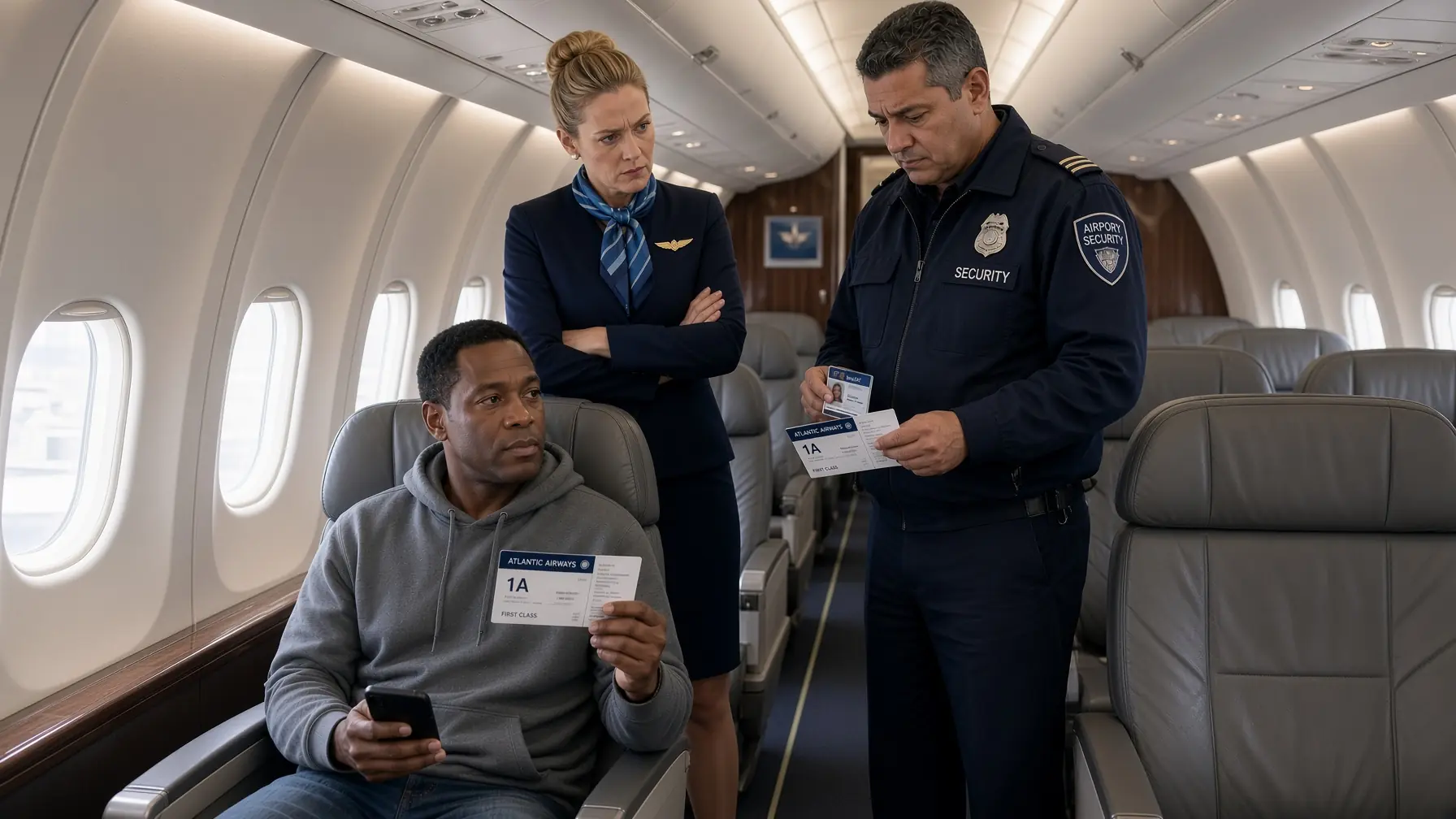
Half the first-class cabin heard her anyway.
Marcus Chen looked up from his phone.
Gray hoodie.
Faded jeans.
White sneakers.
A worn leather briefcase beneath the seat in front of him.
Nothing about him looked especially important.
That was exactly how he preferred to travel.
The flight attendant standing over him glanced at the boarding pass in his hand and then back at his clothes.
“This section is for premium passengers.”
Marcus looked toward the number above his head.
1A.
Then at the boarding pass.
1A.
Then back at her.
“I know.”
The woman’s name badge read:
SARAH MITCHELL
She tapped the tablet in her hand.
“Then I need to see your actual seat assignment.”
Marcus held up the pass again.
“This is my actual seat assignment.”
She barely looked.
“Sir.”
Something in her voice had changed.
Not louder.
More certain.
The certainty bothered Marcus more than the mistake.
“Could you check your manifest?”
Sarah exhaled.
“I already know what first-class boarding passes look like.”
Marcus glanced down at the pass in his hand.
“So do I.”
A woman seated in 3B looked up from her book.
Across the aisle, a businessman stopped typing.
Sarah’s jaw tightened.
“Can I see identification?”
Marcus reached into his wallet.
Driver’s license.
Frequent-flyer card.
He placed both beside the boarding pass.
Sarah looked at the license.
Then at Marcus.
Then at the pass.
She still did not check the tablet.
Instead she said:
“There may have been a booking error.”
“What kind?”
“You may have been assigned this seat accidentally.”
Marcus paused.
“Your system printed the pass.”
“I understand.”
“Then check the system.”
Behind Sarah, another flight attendant appeared.
Jessica Ford.
“Everything okay?”
Sarah lowered her voice, though not enough.
“Passenger appears to be in the wrong cabin.”
Jessica glanced at Marcus.
One second.
Maybe less.
Then:
“Sir, economy boarding is almost complete. If you gather your things now, we can get you seated without delaying departure.”
Marcus looked from one woman to the other.
Neither had actually verified anything.
“I’m staying in the seat I purchased.”
Sarah’s expression hardened.
“Then you’re refusing a crew instruction.”
Marcus sat back.
“No.”
“I’m asking you to verify that the instruction is based on something other than your assumption.”
That was when the first phone appeared.
A young woman in 2D quietly raised hers.
Then another passenger did the same.
Nobody said anything.
The cameras simply began recording.
Marcus had been flying Atlantic Crest Airways for eleven years.
Enough that he knew its boarding music.
Enough that he could identify which lounges had decent coffee.
Enough that his assistant stopped asking whether he wanted aisle or window.
He always wanted window.
He had flown more than three hundred thousand miles with the airline.
But he had never expected that number to matter.
He was fifty-one.
Chinese American.
Born in Cleveland.
Son of a machinist and a public-school librarian.
Founder and chief executive of Chen Meridian Group, an industrial holding company with businesses in logistics, medical equipment, data infrastructure, and manufacturing.
His company employed more than thirty thousand people.
Most strangers never recognized him.
Marcus liked that.
He was not famous in the celebrity sense.
His face appeared in trade magazines.
Business journals.
The occasional financial-news interview.
But put him in a hoodie at an airport and he became invisible.
Usually that felt like freedom.
Today it had become evidence.
Captain Daniel Reeves stepped out of the cockpit.
Fifty-five.
Silver at the temples.
Pressed uniform.
The effortless authority of a man accustomed to people following instructions the first time.
“What’s happening?”
Sarah turned toward him.
“Passenger refuses to move to his assigned cabin.”
Reeves looked at Marcus.
Not at the boarding pass.
At Marcus.
“Sir, what seat are you supposed to be in?”
“One A.”
Sarah cut in.
“That’s what he claims.”
Marcus looked at her.
“It’s printed on the pass in your hand.”
Reeves held out his palm.
“Let me see.”
Finally.
Marcus gave him the documents.
The captain looked at the boarding pass.
Then the license.
Then the frequent-flyer card.
His expression tightened.
Sarah said:
“I believe there’s been some kind of fraudulent upgrade.”
Marcus looked at her.
“Based on what?”
She hesitated.
“Experience.”
The woman in 3B closed her book.
“What does that mean?”
Sarah turned.
“Ma’am, please stay out of this.”
The woman said:
“I’m sitting three feet away.”
Reeves glanced at the growing number of phones.
His posture changed.
Not toward caution.
Toward control.
“Mr. Chen.”
“Yes?”
“We need to get the aircraft boarded.”
“So do I.”
“I’m asking you to step off for a few minutes while we verify your reservation.”
Marcus considered.
That was a reasonable request if it had been made twenty minutes earlier without accusation.
Now it had become something else.
Still, he nodded.
“All right.”
Sarah looked almost relieved.
Marcus unbuckled.
Picked up his briefcase.
Then turned on the video recorder on his own phone.
Reeves noticed.
“Sir, there’s no need for that.”
“There is now.”
“You are escalating the situation.”
Marcus looked directly at him.
“I have raised my voice zero times.”
“I have threatened nobody.”
“I have followed every instruction except moving to a seat no one has demonstrated belongs to me.”
Then:
“If documentation feels like escalation, Captain, that may be worth thinking about.”
The cabin went silent.
Marcus stepped into the aisle.
At the gate, two airport security officers were waiting.
Not police.
Contracted aviation security.
Officer Raymond Santos asked for Marcus’s boarding pass.
Marcus handed it over.
Santos studied it.
“Seat 1A.”
“Yes.”
He checked the barcode at the gate podium.
A green confirmation appeared.
Santos frowned.
He turned toward the gate agent.
“Shows first class.”
The gate agent typed.
Then typed again.
“Yes.”
“Paid ticket?”
“Yes.”
“Upgrade?”
She shook her head.
“No. Original purchase.”
Sarah had followed them off the aircraft.
“That can’t be right.”
The gate agent looked at her.
“It’s right.”
Sarah crossed her arms.
“There must have been a system issue.”
Marcus said quietly:
“You said I bought economy.”
Sarah did not answer.
“You said the pass might be fraudulent.”
Still nothing.
Santos looked increasingly uncomfortable.
“Mr. Chen appears properly ticketed.”
That should have ended it.
It did not.
Ground supervisor Valerie Watkins arrived at the gate.
She listened to Sarah.
Then Captain Reeves.
Then looked at Marcus.
“Mr. Chen, I understand there’s been a disagreement.”
Marcus almost smiled.
“A disagreement would imply both sides had conflicting facts.”
Valerie’s expression cooled.
“Sir, I’m trying to help.”
“Then start with the reservation.”
She checked.
First class.
1A.
Paid three weeks earlier.
Platinum status.
No unusual ticket activity.
Valerie’s eyes moved toward Sarah.
Sarah said:
“He was argumentative.”
Marcus looked at her.
“In what way?”
“You refused instructions.”
“I refused to surrender a seat your own system says is mine.”
Valerie said:
“Mr. Chen, because the crew is now uncomfortable transporting you—”
Marcus stopped her.
“The crew is uncomfortable?”
“Yes.”
“With me?”
“Yes.”
“What have I done?”
“You’ve challenged crew authority.”
Marcus remained quiet for several seconds.
Around them, perhaps fifteen passengers had gathered.
Some had stepped off the aircraft to see what was happening.
The woman from 3B was among them.
She introduced herself.
“Dr. Helen Brooks.”
Valerie looked irritated.
“Ma’am, please return to the aircraft.”
“No.”
Helen pointed toward Marcus.
“He showed his boarding pass before anyone called security.”
“Sarah never properly checked it.”
“Neither did the captain before accusing him of scamming an upgrade.”
A businessman beside her said:
“I saw the same thing.”
Another passenger:
“So did I.”
Valerie’s face changed.
Now there were witnesses.
Not just a difficult passenger.
Marcus looked at his watch.
Flight 447 to Chicago was already twenty-two minutes late.
He took out his phone.
Called his assistant.
“Emma.”
“Yeah?”
“I’m going to miss the three-thirty.”
“What happened?”
“Atlantic Crest has decided I’m not a first-class passenger.”
Silence.
Then:
“I’m sorry?”
“I’ll explain later.”
“Move the governance meeting.”
“Which one?”
“Meridian Infrastructure.”
“Four o’clock?”
“Yes.”
“Anything else?”
Marcus looked toward Valerie.
“Actually.”
He paused.
“Call Daniel Kline.”
His assistant became quiet.
Chen Meridian’s general counsel.
“Legal issue?”
“Potentially.”
“Personal or corporate?”
Marcus looked at Sarah.
“Both may overlap.”
“Understood.”
He ended the call.
Helen Brooks heard only part of the conversation.
She glanced at the old leather briefcase.
Then Marcus’s watch.
Then the way Valerie kept checking the booking screen.
Her expression became curious.
Valerie gave Marcus two options.
Return to the aircraft in economy.
Or take a later flight.
Marcus asked:
“Why economy?”
“For operational simplicity.”
“My purchased seat is available.”
“The crew has expressed concerns.”
“About what conduct?”
Valerie’s patience thinned.
“Sir, if you continue arguing—”
Marcus held up one hand.
“I’m asking because I want the answer recorded accurately.”
He turned slightly so his phone captured both of them.
“Am I being denied seat 1A because there is a ticketing problem?”
Valerie glanced at the screen.
“No.”
“Because there is a safety issue?”
“I wouldn’t characterize it that way.”
“Because I threatened someone?”
“No.”
“Because I was intoxicated?”
“No.”
“Because I used abusive language?”
“No.”
“Then what exactly is the basis?”
Valerie did not answer immediately.
That silence was more damaging than anything Marcus could have said.
Sarah stepped in.
“He created a hostile environment.”
Helen Brooks laughed once.
Not kindly.
“He was sitting there.”
Sarah turned toward her.
“You don’t know what happened before you started paying attention.”
Helen held up her phone.
“I recorded from the first time you asked him to move.”
The gate went quiet.
Sarah looked at the camera.
For the first time, genuine fear appeared.
Marcus did not smile.
He was angry.
Very angry.
But anger had spent his entire professional life trying to make decisions for him.
He rarely allowed it.
He opened his briefcase.
Removed a business-card holder.
Selected one card.
Held it out to Valerie.
“You asked me to file a complaint online.”
She took it.
Read.
Then stopped.
MARCUS CHEN
Chief Executive Officer
Chen Meridian Group
She looked up.
Then back at the card.
Sarah leaned over.
Captain Reeves stepped closer.
Helen Brooks whispered:
“Oh.”
One passenger immediately searched the name.
Within seconds he said:
“Chen Meridian?”
Another answered:
“The infrastructure company?”
“Not just infrastructure.”
“Look.”
Phones moved faster.
Company profile.
Revenue.
Board memberships.
Investment portfolio.
Photographs.
Marcus standing beside governors.
Marcus testifying before a congressional trade committee.
Marcus at an industry conference.
Sarah’s face lost color.
Captain Reeves looked at Marcus as though the hoodie had transformed in front of him.
Marcus noticed.
That hurt more than he expected.
Valerie said:
“Mr. Chen, I had no idea.”
Marcus looked at her.
“I know.”
“I wish you had.”
She blinked.
“What?”
“Because then we could pretend this was a misunderstanding about who I am.”
He pointed toward the booking screen.
“But you already knew the only thing you needed to know.”
“I had a valid ticket.”
Marcus’s phone rang.
Daniel Kline.
General counsel.
Marcus stepped away from the crowd.
“Daniel.”
“Emma gave me the outline.”
“You okay?”
“Yes.”
“Physical contact?”
“No.”
“Removal from purchased service?”
“Yes.”
“Witnesses?”
“Several.”
“Video?”
“Multiple.”
“Do you want me to contact Atlantic Crest?”
“Not yet.”
Daniel paused.
“Marcus.”
“Yes?”
“We have an investment relationship.”
“I know.”
Chen Meridian did not own Atlantic Crest.
That rumor would appear online within the hour.
The reality was less dramatic.
A pension-and-infrastructure fund managed by a Chen Meridian affiliate held a little under nine percent of Atlantic Crest’s publicly traded shares across several investment vehicles.
Significant.
Not controlling.
Chen Meridian also booked substantial corporate travel with the airline.
Marcus served on no airline board.
Had no authority to fire anyone.
No magic shareholder clause allowed him to run airport operations.
But nine percent was enough that executives returned calls.
More importantly, the fund had governance rights common to a major institutional investor.
Access to investor-relations leadership.
Ability to raise material risk issues.
Voting power.
The ability to request meetings with directors.
Daniel said:
“If this becomes a governance issue, you need a wall between your personal complaint and the fund’s fiduciary decision-making.”
“I agree.”
“I mean it.”
“No threatening divestment because you’re angry.”
“I know.”
“No calling directors and demanding personnel action.”
“I know.”
“No use of confidential employee files.”
Marcus looked toward Sarah.
“I know, Daniel.”
“Good.”
“Then what do you want?”
Marcus answered:
“Preserve everything.”
“Notify our investment compliance officer that I’m personally involved.”
“Recuse me from any trading decision involving Atlantic Crest until legal clears it.”
Daniel was silent.
Then:
“Done.”
Marcus continued.
“And request a formal investor meeting regarding passenger-discrimination controls.”
“Not my incident specifically.”
“The broader governance issue.”
Daniel said:
“That I can do.”
That distinction became important.
Within forty-five minutes, social media had already rewritten the story.
BILLIONAIRE KICKED OUT OF FIRST CLASS
AIRLINE HUMILIATES MAJOR INVESTOR
CEO FORCED TO PROVE HE BELONGS
Some posts claimed Marcus owned the airline.
Others said he was chairman.
One invented a story that he had secretly purchased Atlantic Crest that morning.
None was true.
Marcus disliked all of them.
Because the more powerful the internet made him, the easier it became to miss the point.
He had been right before anyone knew his title.
Atlantic Crest’s district manager arrived thirty minutes later.
Then a regional customer-experience director joined by phone.
The airline suddenly became extremely interested in solving the problem.
Marcus noticed the difference immediately.
Valerie offered him his original seat back.
A personal escort.
Travel credit.
A future upgrade voucher.
Marcus declined the voucher.
Then asked:
“Would I have gotten 1A back if that card said ‘Marcus Chen, plumber’?”
No one answered.
He looked at Sarah.
She stood several feet away now.
Quiet.
Marcus said:
“That is the problem.”
Flight 447 departed fifty-three minutes late.
Marcus sat in 1A.
A replacement cabin supervisor handled first class.
Sarah had been removed from duty for the flight pending review.
Captain Reeves remained in command because the airline’s operations team determined there was no immediate safety basis to replace him before departure.
Marcus accepted that.
Discipline belonged to an investigation.
Not a crowd.
Not an angry passenger.
Not social media.
Helen Brooks returned to 3B.
After takeoff, she leaned forward.
“Mr. Chen?”
“Yes?”
“I want to apologize.”
“For what?”
“I watched for too long before speaking.”
Marcus considered.
“Why?”
She looked embarrassed.
“I thought maybe there really was a ticket problem.”
“Then?”
“Then it became obvious there wasn’t.”
“And I still hesitated.”
Marcus nodded.
“Thank you for eventually saying something.”
“That sounds generous.”
“It’s accurate.”
She smiled faintly.
Then:
“What are you going to do?”
Marcus looked out the window.
“File a complaint.”
Helen laughed.
“I mean really.”
“So do I.”
The airline investigation began before Marcus landed.
By evening, Atlantic Crest had preserved gate video, crew reports, booking records, audio where available, and written statements.
Marcus’s lawyers sent a formal preservation notice.
Helen Brooks provided her video.
Other passengers provided theirs.
One clip mattered most.
Sarah could be heard saying:
“These people know how to manipulate the system.”
When investigators asked whom she meant by “these people,” she said she had meant passengers attempting unauthorized upgrades.
The problem was that Marcus had not been attempting an upgrade.
His ticket had always been first class.
Another clip showed Captain Reeves dismissing Marcus’s documentation without examining the reservation himself.
Valerie’s handling raised separate concerns.
She had verified the ticket was valid and still attempted to move Marcus to economy because the crew considered him “argumentative.”
The airline’s own policy required behavioral grounds for involuntary removal.
Asking staff to verify a valid ticket was not enough.
Marcus issued only one public statement.
It was four paragraphs.
He did not mention money.
Did not mention Chen Meridian’s investment.
Did not demand anyone be fired.
The line quoted most often was this:
“The embarrassing part is not that airline employees failed to recognize me. It is that they believed recognition should have been necessary.”
Then:
“A valid passenger should not need wealth, status, witnesses, or a business card before evidence is taken seriously.”
That changed the conversation.
Somewhat.
The internet still preferred the billionaire-revenge version.
But serious journalists began asking better questions.
How often were premium-cabin passengers challenged after presenting valid tickets?
What happened when employees incorrectly classified a calm passenger as “disruptive”?
Were complaint categories tracked by race?
Did supervisors review patterns?
Atlantic Crest had answers to some of those questions.
Not enough.
Chen Meridian’s investment committee met without Marcus.
He insisted.
The fund’s chief investment officer told the committee:
“We are not here because our CEO had a bad flight.”
“We are here because the incident may indicate operational, legal, and reputational risk at a portfolio company.”
They requested information from Atlantic Crest.
Not employee personnel files.
Aggregate complaint data.
Customer-removal statistics.
Discrimination allegations.
Settlement trends.
Training controls.
Escalation procedures.
The airline resisted initially.
Then its board audit-and-risk committee became involved.
The review uncovered something uncomfortable.
Marcus’s experience was not unique.
Not identical.
But not unique.
Over four years, Atlantic Crest had received multiple complaints from passengers who claimed they were challenged in premium cabins despite valid boarding passes.
Passengers of color appeared disproportionately in the complaints.
Young travelers did too.
Some incidents involved clothing.
Some involved race.
Some involved age.
Some were ordinary mistakes resolved correctly.
The deeper problem was inconsistency.
When frontline staff made an initial assumption, there was no mandatory second verification before removal or security escalation.
A wrong impression could become official simply because the first employee sounded certain.
Marcus understood that pattern immediately.
He had spent his career fixing factories.
One bad operator could make a bad decision.
A bad system allowed the decision to travel downstream without correction.
Sarah Mitchell was placed on administrative leave.
Captain Reeves was temporarily removed from passenger-facing supervisory duties during the review.
Valerie remained at work but no longer handled involuntary-removal decisions alone.
No one was “fired live.”
No security guards marched employees away while passengers applauded.
Marcus preferred it that way.
Two months later, the findings came back.
Sarah had violated ticket-verification and professional-conduct standards.
Investigators also found that two prior complaints involving her included similar assumptions about passengers’ entitlement to premium services.
Her employment ended after the disciplinary process.
Captain Reeves received a lengthy suspension and mandatory retraining for failing to independently verify facts before escalating the removal.
Valerie received formal discipline and lost certain supervisory responsibilities.
She later regained them after additional training and performance review.
Some people online complained.
They wanted everyone fired.
Marcus did not.
Accountability was not supposed to satisfy an audience.
It was supposed to match conduct.
Atlantic Crest changed three procedures.
First:
A passenger with a boarding pass matching the live manifest could not be moved from a purchased cabin solely because a crew member believed the assignment looked unusual.
Second:
Before security was called over a seating dispute, a second employee had to independently verify the reservation unless there was an immediate safety threat.
Third:
The category “disruptive passenger” required documented behavior, not disagreement alone.
Those changes sounded boring.
Marcus loved them.
Boring rules prevented dramatic harm.
The airline also commissioned an outside review of passenger-treatment complaints and created a third-party reporting channel.
Not because Marcus ordered it.
Because its board decided the risk was real.
Chen Meridian supported the reforms in its capacity as an investor.
Other shareholders did too.
Three months after Flight 447, Marcus met Atlantic Crest CEO Patricia Vance.
Privately.
No cameras.
No live stream.
No cheering crowd.
She placed a binder on the table.
“Independent review.”
Marcus did not open it immediately.
“What did you find?”
“More inconsistency than I’m comfortable admitting.”
“That’s not a number.”
Patricia smiled slightly.
“You really are an engineer.”
“My father was.”
She continued.
“Premium-cabin verification complaints were rare compared with total passenger volume.”
“But among the complaints we did have, passengers of color were significantly overrepresented.”
“Cause?”
“Not one cause.”
“Training gaps.”
“Subjective enforcement.”
“Confirmation bias.”
“Some employees escalating after they had already made an assumption because reversing themselves felt like losing authority.”
Marcus nodded.
“That last one matters.”
“I know.”
Patricia looked at him.
“I owe you an apology.”
“You apologized publicly.”
“I’m not talking about public relations.”
She paused.
“When I first heard who you were, I thought, ‘Thank God we didn’t do this to someone without resources.’”
Marcus looked at her.
Patricia continued.
“Then I realized how ugly that thought was.”
Marcus leaned back.
“It’s an honest thought.”
“That doesn’t make it a good one.”
“No.”
She opened the binder.
“We’re changing the complaint review process.”
“We’ll publish aggregate numbers annually.”
“Independent auditing for two years.”
“Scenario-based crew training.”
“And we’re separating customer disagreement from safety threat more clearly.”
Marcus nodded.
“That sounds useful.”
Patricia looked surprised.
“That’s all?”
“What were you expecting?”
“I don’t know.”
“A speech.”
Marcus smiled.
“I save those for people who pay conference fees.”
Helen Brooks stayed in touch.
She was an emergency physician.
Six months after the flight, she invited Marcus to speak to hospital leaders about what he had learned.
He refused at first.
“I’m not a bias expert.”
“You understand systems.”
“That is different.”
“Exactly.”
So he went.
He told them:
“The mistake on Flight 447 began with one person.”
“The failure happened because every layer after her trusted the first assumption more than the evidence.”
A physician in the room said:
“That sounds uncomfortably familiar.”
Marcus nodded.
“It should.”
Hospitals had their own versions.
One incorrect assumption entering a chart.
A later clinician trusting it.
Then another.
By the time anyone checked the original facts, the assumption had become history.
Marcus did not invent a “Chen Protocol.”
He would have hated that name.
But the hospital reviewed how bias could propagate through handoffs.
That pleased him more than a plaque ever could.
A year after Flight 447, Marcus flew Atlantic Crest to Chicago again.
Same route.
Different aircraft.
He boarded in jeans.
Gray sweatshirt.
Same leather briefcase.
Seat 1A.
A young flight attendant scanned the cabin.
“Mr. Chen?”
Marcus looked up.
“Yes?”
“Welcome aboard.”
“Can I get you anything before departure?”
“Coffee.”
“Black?”
“Yes.”
She smiled.
“That’s what your profile says.”
Marcus laughed.
“Now that is surveillance.”
She looked horrified.
He waved one hand.
“I’m joking.”
The coffee arrived.
Across the aisle sat a young man in work boots and a paint-stained jacket.
Seat 1C.
Nobody asked whether he belonged.
An elderly Black woman settled into 2A wearing a sweatshirt from a church choir.
Nobody asked her to prove anything beyond the boarding scan everyone else completed.
A college student with bright pink hair sat in 3D.
No one stared.
Marcus noticed all of it.
Not because diversity meant the system was perfect.
Because ordinary treatment was the goal.
Nothing happening was the victory.
Later, a business-school professor asked Marcus to describe the incident during a leadership interview.
The professor wanted to know how Marcus stayed calm.
Marcus disliked that question.
“I was not calm.”
“You looked calm.”
“That’s different.”
“What were you feeling?”
“Humiliated.”
“Angry.”
“Then why didn’t you threaten to move Chen Meridian’s business immediately?”
Marcus thought.
“Because that would have proven the wrong thing.”
“What wrong thing?”
“That people should treat you well because you can hurt them financially.”
He paused.
“I wanted the airline to treat the next passenger correctly even when that passenger had no leverage at all.”
The professor nodded.
“And did it?”
Marcus looked toward the audience.
“More often, hopefully.”
“But systems are never finished.”
“That is another mistake people make.”
“They want one incident, one reform, one training session, one villain, one hero.”
“Then the story ends.”
He shook his head.
“Real systems drift.”
“People change.”
“Management changes.”
“Memory fades.”
“The work has to continue.”
Sarah Mitchell eventually wrote him.
Two years later.
The letter came through his office.
Marcus almost did not open it.
He did.
She did not ask for forgiveness.
That helped.
She wrote that losing her job had initially made her furious.
At Marcus.
At passengers who recorded.
At Atlantic Crest.
At everyone except herself.
Months later, she began reviewing the footage again.
Not the viral clips.
The full recording.
She noticed something she had never admitted.
Before Marcus spoke a word, she had already approached him differently.
She had checked him before checking the manifest.
She wrote:
I cannot tell you exactly which part was race, which part was clothing, which part was class, or which part was my own need to be right once I had decided something. Maybe separating them is impossible. I do know the evidence was in my hand and I trusted my assumption more.
Marcus read that sentence twice.
Then continued.
Sarah had retrained in hospitality compliance.
She now worked for a regional hotel company.
She told him she used her own failure in training sessions without naming him.
At the end she wrote:
You once said people should not need status to be believed. I understand that now in a way I did not that day. I am sorry.
Marcus folded the letter.
Put it into a drawer.
He never replied.
Not because he was still angry.
Because the apology did not require his participation to be real.
People still told the story wrong.
They said Marcus Chen owned Atlantic Crest.
He did not.
They said he called the board from the gate and fired the crew.
He could not.
They said the airline lost billions in forty-five minutes.
It did not.
They said one phone call changed aviation forever.
Nothing works that way.
The real story was less convenient.
A passenger had valid documents.
An employee distrusted them.
Another employee trusted the first employee.
A captain trusted both.
A supervisor verified the documents and still treated the passenger as the problem.
Witnesses recorded it.
One woman eventually spoke.
Security checked the facts.
A complaint became evidence.
Evidence became review.
Review uncovered a process failure.
Then policy changed.
Slowly.
Imperfectly.
That was the story Marcus preferred.
Because it did not require him to be a billionaire.
If Marcus Chen had been a schoolteacher returning from vacation, seat 1A would still have been his.
If he had been unemployed, seat 1A would still have been his.
If he had been seventeen or seventy-seven, dressed in a suit or paint-stained work clothes, famous or completely unknown—
the boarding pass would still have said the same thing.
1A.
That was the fact everyone at Gate 23 had eventually been forced to confront.
His wealth never made him belong there.
It only made the consequences of ignoring the evidence harder for the airline to dismiss.
And that was precisely why Marcus refused to let his title become the moral of the story.
Years later, when a young manager at Chen Meridian asked him what he learned from Flight 447, Marcus gave a much simpler answer than expected.
“Never confuse confidence with verification.”
The manager waited.
Marcus continued.
“Sarah was confident.”
“The captain was confident.”
“The supervisor was confident.”
“They were all wrong.”
He looked down at the worn leather briefcase that had traveled with him that day.
“The truth was printed on a piece of paper in front of them.”
“And sometimes the most dangerous person in a system isn’t the person who knows nothing.”
“It’s the person who becomes certain before checking.”
That was what stayed with him.
Not the cameras.
Not the headlines.
Not the business card turning Valerie Watkins pale.
Not the investor meetings.
Not even the policy changes.
The moment he remembered most clearly was the first one.
A flight attendant standing over him.
Looking at his hoodie.
Looking at his face.
Looking everywhere except at the one thing that contained the answer.
And saying:
“Sir, you need to move to the back.”
Marcus never forgot how ordinary her certainty sounded.
That was why, afterward, he cared less about teaching employees who deserved first class.
And far more about building systems where nobody had to look deserving at all.