The trouble started with a shout.
“Stand up, kid. Quit playing games and get out of that chair.”
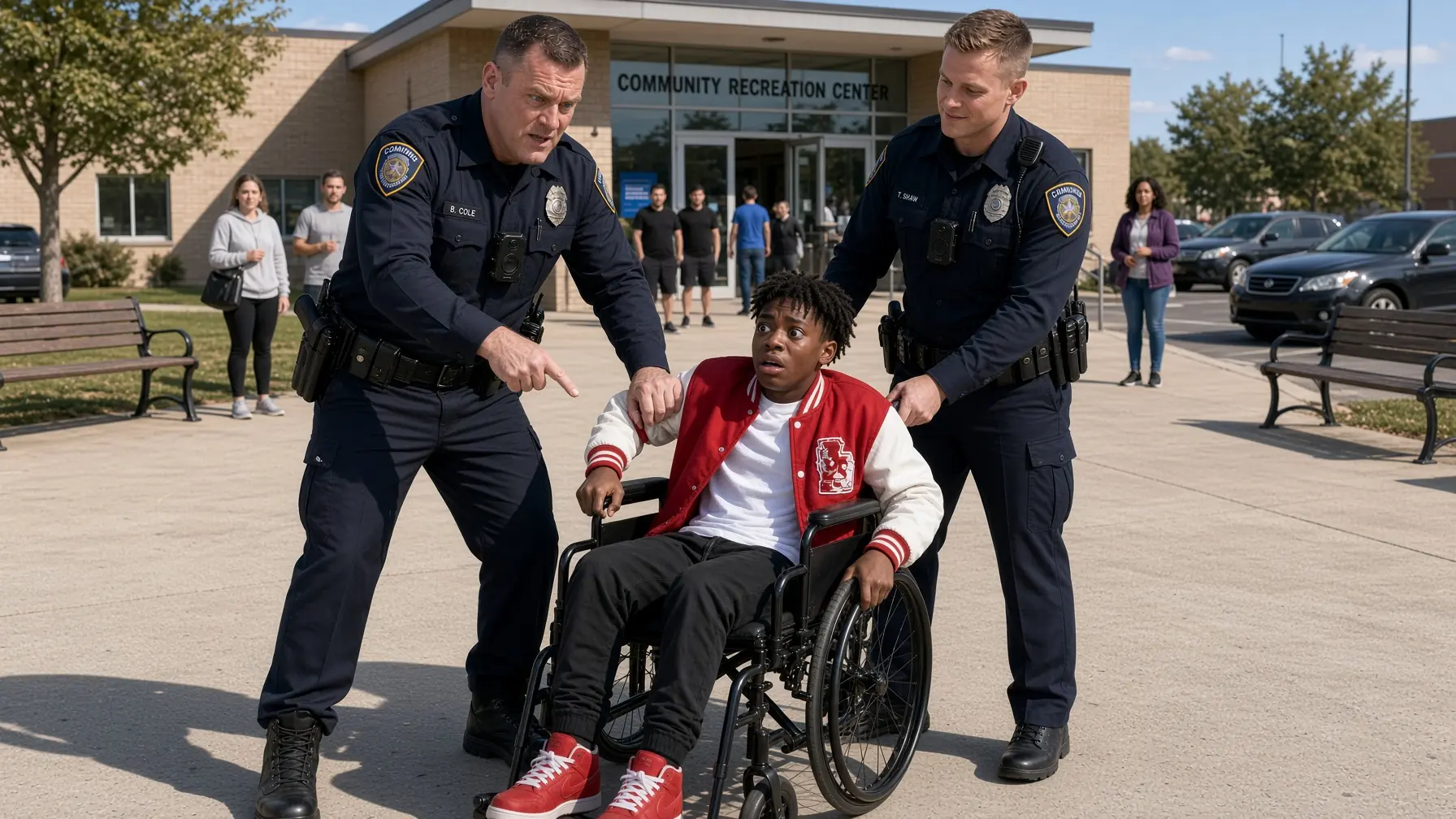
People on the sidewalk outside the Jefferson Community Recreation Center turned at the sound, but not fast enough to stop what came next.
Thirteen-year-old Malik Carter sat rigid in his lightweight black wheelchair near the curb, his red varsity jacket bright against the gray concrete, one hand clamped so tightly around the armrest that his knuckles had gone pale. His other hand gripped the wheel. His breath came short and shaky. His dark eyes were wide with the kind of fear a child could not hide even if he tried.
Towering over him was Officer Brent Cole.
Cole had the size and posture of a man who had spent too long enjoying the effect he had on people. Six foot three, thick through the chest and shoulders, pale blue eyes under a hard brow, his navy uniform stretched sharply across a muscular frame. One hand was clamped around Malik’s forearm. The other jabbed toward the pavement.
“I said up,” Cole snapped again.
“I can’t,” Malik said, his voice breaking. “Please stop.”
That only seemed to irritate Cole more.
Beside him, Officer Tyler Shaw rested one hand on the wheelchair handle, his blond head tilted slightly, the smug half-smile on his face making it clear he had already decided the boy was lying.
“Then we’ll drag you out and find out,” Shaw said.
A woman walking with a gym bag slowed to a stop near the center doors. Two teenage boys coming off the basketball court stopped talking and stared. An older man sitting on a bench leaned forward, frowning.
The officers had been called for a “disturbance.”
That was how it had started.
A caller had reported that a group of kids were cutting through the rec center parking lot, laughing too loudly, knocking into each other, and “causing problems.” By the time Cole and Shaw arrived, the other kids had already gone inside. Malik had been waiting near the curb for his father, who had run back to the car to grab the jacket he’d forgotten in the trunk.
Malik had tried to explain that.
He had told them he was waiting for his dad.
He had told them he was a member there.
He had even pointed to the automatic doors where staff inside clearly knew him.
But Cole had looked at the wheelchair, then at the boy, and decided on a story of his own.
“You kids think that chair makes you untouchable?” Cole had said when he first walked up.
Malik hadn’t even understood what that meant.
Now Cole leaned in closer, his jaw tight with annoyance.
“You think I haven’t seen this before? You fake weak, you fake hurt, you think nobody can question you.”
“I’m not faking,” Malik whispered.
Shaw gave the chair a sudden rough jerk backward.
Malik cried out and grabbed harder at the armrests, his shoulders curling in reflex. The bystanders flinched.
“Stop!” the woman with the gym bag said.
Cole ignored her.
He bent lower until his face was only inches from Malik’s.
“Then prove it,” he said.
Malik shook his head quickly, panic rising so visibly that even the older man on the bench stood up.
From across the parking lane, a voice cut through the noise.
“Malik!”
David Carter was already moving before the second syllable left his mouth.
He crossed the distance fast, phone in one hand, car keys still in the other. He was forty-five, broad-shouldered and athletic, dressed in a charcoal polo and dark trousers, his expression hardening with every step as he took in the scene: his son in the wheelchair, two officers crowding him, one gripping his arm, the other holding the chair like property.
Malik turned his head.
“Dad!”
David was between them in seconds.
“Let go of him,” he said.
His voice was not loud.
That made it land harder.
Cole straightened and released Malik’s forearm, but only so he could square up to David.
“Back up,” Cole said. “We’re conducting an investigation.”
David didn’t even look at him first. He crouched slightly, eyes on his son.
“You okay?”
Malik nodded too fast, trying not to cry. “They said I had to stand.”
David’s jaw tightened.
Then he rose slowly to his full height and looked first at Cole, then at Shaw, then at the black body cameras clipped to both their chests.
That was the moment something shifted.
Cole still had the aggressive stance. Shaw still had one hand on the wheelchair. But David’s face changed in a way neither officer seemed to understand. He wasn’t angry in the wild, shouting way people often were when police pushed too far.
He was precise.
Measured.
Dangerously calm.
“What’s your name?” Cole demanded.
David ignored the question.
Instead, he looked down at Malik’s sleeve where Cole’s fingers had wrinkled the red fabric.
Then he looked at the frightened bystanders, now openly staring.
Then back at the officers.
“You just put your hands on the wrong child,” David said.
Cole gave a short, ugly laugh. “Is that supposed to scare me?”
“No,” David said. “Facts should.”
Shaw finally took his hand off the wheelchair handle.
Cole was still pushing forward.
“This your son?”
“Yes.”
“Then maybe you should’ve taught him not to mouth off to officers.”
Malik’s eyes widened. “I didn’t—”
David lifted one hand slightly, enough to calm him without ever looking away from the men in front of him.
“Badge numbers,” David said.
Cole blinked. “Excuse me?”
“Your badge numbers.”
“Or what?” Cole shot back.
David reached into his pocket, took out his phone, and tapped the screen with his thumb.