The first offer was two million dollars, the second was five, and the third arrived in a black folder containing a number so large that Walter Groves’s granddaughter read it twice before believing it was real. Ten million dollars for 212 acres of aging pasture, red maples, a narrow creek, a farmhouse that needed a roof, and one gray barn with warped boards and three patches of mismatched tin across the top. Everybody in Ridgeway County seemed to agree that an eighty-six-year-old farmer refusing that kind of money had finally lost whatever good sense age had left him. Walter’s answer never changed: “I’m not leaving.”
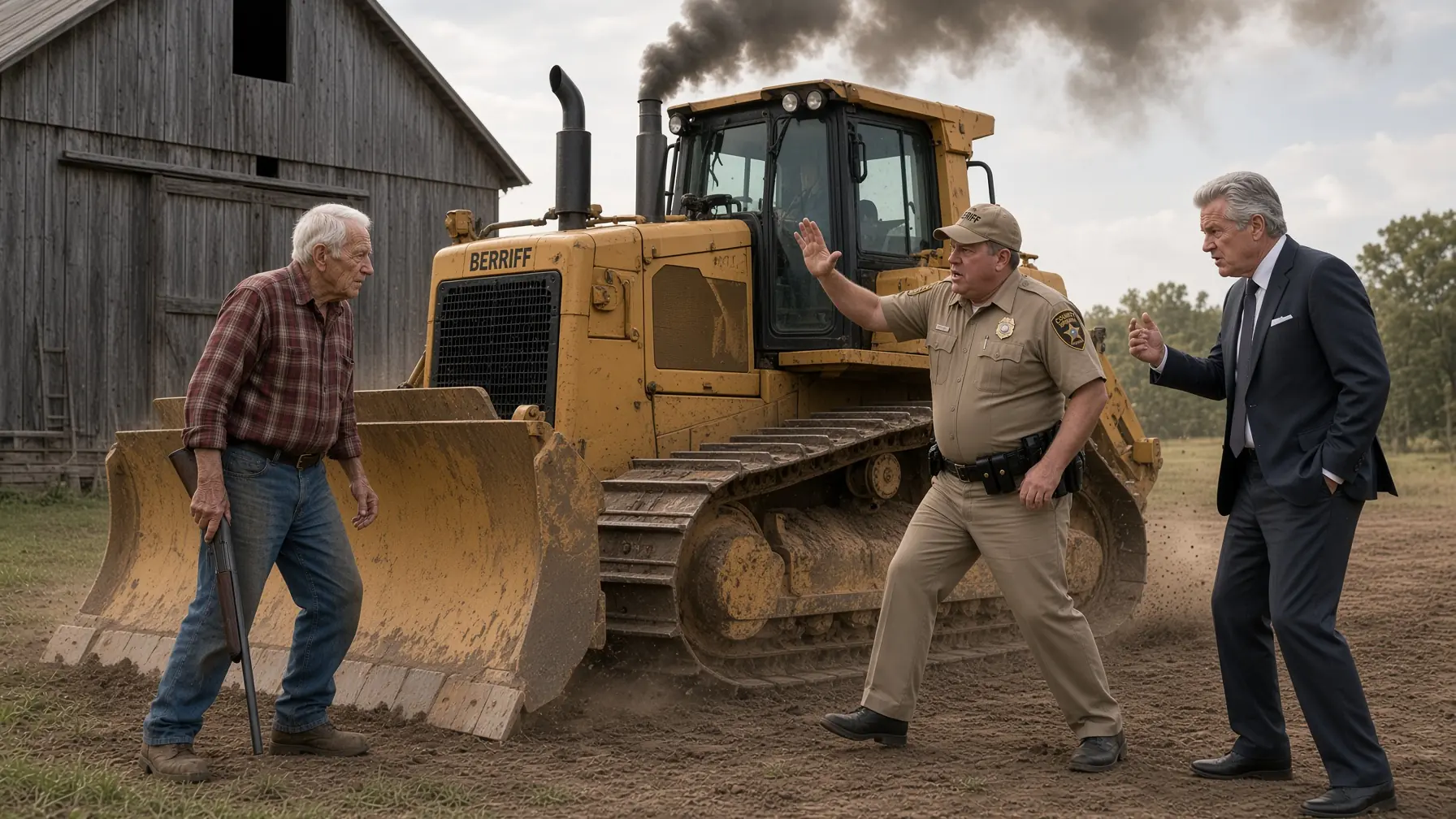
The land had belonged to the Groves family since 1919, which sounded romantic only to people who had never spent February repairing a frozen water line or August dragging fence posts through clay soil hard enough to bend a shovel. Walter knew every low place that flooded after three days of rain, every oak lightning had touched, every rock hidden beneath the lower pasture, and every section of fence deer preferred to jump instead of walking around. He had buried his father from that house, buried his wife Dorothy from that house, and watched his children leave that driveway one by one for jobs in cities that paid better than farming ever had. When developers described the property as “underutilized acreage,” Walter heard strangers reducing a lifetime to a spreadsheet.
What people found harder to explain was the barn, because Walter had stopped sleeping in his bedroom six years earlier and moved a folding cot inside the old tractor bay. Every night he carried out a wool blanket, a thermos of coffee, a flashlight, and the same twelve-gauge shotgun he had owned for decades, although nobody in the family could remember him firing it at anything larger than a groundhog. His doctors said the arrangement was ridiculous for a man whose left knee barely bent and whose heart medication had been adjusted twice that year, while Claire repeatedly offered to move him into the house or pay for somebody to stay overnight. Walter always answered, “I sleep better out there,” and never explained why.
The neighbors had explanations of their own, and none were kind. Some said grief had driven him strange after Dorothy died, others claimed he had buried cash beneath the barn because old farmers trusted banks about as much as coyotes trusted traps, and one man at the feed store joked that Walter probably had Confederate gold under the concrete. Walter heard the stories, paid for his seed, and went home without correcting anyone. Being underestimated had become one of the few advantages age still gave him.
Lakemont Partners Development Group first approached him three years before the county mentioned eminent domain. A junior executive named Prescott drove up the gravel lane in a spotless black SUV, stepped onto the porch in shoes that had never met mud, and offered two million dollars in cash for a parcel assessed at a fraction of that amount. Walter was shelling pecans into an old metal bowl while the man explained closing dates, relocation assistance, and the “once-in-a-generation opportunity” being offered to him. Without looking up, Walter said, “Not interested,” cracked another pecan, and let the shell fall into the bucket at his feet.
Prescott laughed because he assumed Walter had misunderstood. He repeated the number more slowly, emphasized that the offer was more than three times assessed value, and mentioned how comfortably Walter could spend his remaining years somewhere near his family. Walter finally looked at him and said, “Son, I heard the number the first time, but you’re confusing hearing with wanting.” Prescott left his business card on the porch railing, and the following morning Walter used it to scrape mud from the heel of his boot.
Six months later a woman arrived with a five-million-dollar offer and a better strategy. She had photographs of senior communities near Charlotte, brochures showing apartments with elevators, and language about dignity, medical access, and “reducing the burden” of maintaining so much land at Walter’s age. Walter listened politely, asked whether Lakemont offered similar kindness to every farmer in the county, and watched her avoid the question. When she finally asked what amount would change his mind, Walter said, “The problem isn’t your number.”
The ten-million-dollar offer came on a Saturday, which irritated Walter because Saturday was when he repaired things inside the barn. The man carrying the folder did not introduce himself beyond saying he represented Lakemont’s acquisitions team, and unlike the previous visitors, he did not waste time discussing Walter’s health or future comfort. “Ten million dollars, Mr. Groves,” he said, placing the folder on the porch table, “enough for your grandchildren and their grandchildren.” Walter studied the man for several seconds before asking, “What exactly do you need this farm so badly for?”
“Mixed-use development,” the man answered, describing stores, homes, improved road access, and a commercial corridor tied to the interstate. Walter listened until he finished, then picked up the folder without opening it and handed it back. “Ten million sounds like a lot until you understand what somebody thinks they’re buying,” he said. “Then sometimes it just sounds like a bribe.”
Something changed behind the man’s eyes. The professional patience disappeared for less than a second, replaced by irritation so clean and cold that Walter recognized it immediately from men he had known long before corporate developers wore tailored suits. The man returned to his SUV, drove halfway down the lane, stopped where he could still see the barn in his mirror, and remained there speaking on his phone for nearly ten minutes. That night Walter cleaned the shotgun for the first time in years.
Claire Groves arrived the following Sunday already angry. She was thirty-one, sharp, practical, and successful in pharmaceutical sales, the kind of person who planned two weeks ahead and became uncomfortable around problems that refused to behave like problems. She found her grandfather sitting in the barn on an overturned bucket with reading glasses repaired by electrical tape and a paperback western open in his hands. “Grandpa, we need to talk,” she said, while Walter turned a page and answered, “We are talking.”
Claire told him a lawyer had contacted her because Lakemont was preparing to support an eminent-domain proceeding through the county’s redevelopment authority. If the seizure succeeded, Walter might receive fair-market compensation rather than anything resembling the ten million dollars he had already rejected, which made his refusal seem even more irrational. “You could have taken enough money to change every grandchild’s life,” Claire said, sweeping one arm toward the leaking barn roof. “Instead you’re going to risk losing everything for this.”
Walter closed the book. “I’m not risking everything,” he said. “I’m protecting something.” Claire looked around at rusted tools, an old tractor axle, a broken hay rake, shelves filled with jars of screws, and the cot where an eighty-six-year-old man insisted on sleeping. “Protecting what?” she asked, and Walter answered only, “Something money can’t put back once it’s gone.”
That answer made things worse. Claire accused him of treating the family like children and hiding behind mysterious farmer wisdom whenever anyone questioned a decision that could affect all of them. Walter absorbed the anger without matching it because much of what she said was fair, and when she asked whether the thing he was protecting was inside the barn, he remained silent. Claire looked toward the concrete floor, then back at him, and asked, “Is there something buried here?”
Walter smiled faintly. “Everybody in the county thinks so.” Claire did not smile back, so he reached beside the cot and picked up an old framed photograph showing two men standing shoulder to shoulder, both younger, both exhausted, both smiling into a camera sometime decades earlier. One was Walter, perhaps in his forties, while the other was a Black man Claire remembered only vaguely from childhood. On the back, Walter had written, Elijah and me — the day we finished.
“Finished what?” Claire asked. Walter took the photograph from her and said, “Keeping a promise.” She demanded more, but he shook his head and told her that if the county actually came for the barn, he would explain everything before anyone touched it. Claire left furious enough to slam her car door, yet the photograph followed her home more stubbornly than the ten-million-dollar offer.
The county pressure increased quietly at first. Walter received a notice questioning the condition of an old drainage culvert, then another regarding fencing near a road easement, followed by a request for access to conduct a preliminary environmental survey. None of the notices alone seemed extraordinary, and Walter complied whenever compliance did not require opening the barn. What bothered him was how often contractors asked whether the building could be cleared before any other part of the property.
One surveyor stood near the barn door and asked whether it contained chemicals, fuel tanks, pesticides, or other hazardous materials. Walter answered no, and the man asked whether the concrete floor had ever been replaced, which made Walter’s hand tighten around his cane. “Why?” he asked, while the surveyor shrugged and said old agricultural buildings sometimes hid buried tanks. Walter smiled and said, “Then I suppose you’ll have something to wonder about.”