The stars are bright out here. Yeah, they are. Glad we made it. Couldn't have done it without you, Cord. The last thing Cord Rourke owned that mattered was a wrench.
Not the good kind. Not a Snap-on with a comfortable grip and a lifetime warranty. A beat-up, chrome-flaking open-end wrench he had pulled out of a dumpster behind a parts shop in Flagstaff 14 months ago, wiped clean on his jeans, and kept in his jacket pocket ever since. He had fixed four motorcycles with it, two trucks, a generator that powered a family's Christmas lights in a parking lot outside Kingman, and one very old man's lawnmower in exchange for a hot meal and permission to sleep in the garage for two nights running. That was his life.
That was the whole of it. I was sitting behind a Sinclair station on the eastern edge of Elko, Nevada, when the sun went down on the 11th night. His back was against the brick wall. The concrete was cold through his jeans. He had eaten half a gas station sandwich 2 hours ago and saved the other half for morning because that was the kind of calculation he made now without thinking about it, the way you stop thinking about breathing, the way survival arithmetic becomes its own kind of reflex after enough months of practicing it.
He pulled the photograph out of his inside jacket pocket. He had done this so many times in the past 8 months that the edges had gone soft the way paper goes soft when it has been handled by the same hands in the same weather over and over again. The image was still clear enough. A man standing in front of a workbench covered in engine parts. Big hands, wide shoulders.
A grin that did not look performed, the grin of someone who had just been told something that genuinely pleased them. Frank Rourke, his father, 52 years old in this photograph. The greatest motorcycle builder Cord had ever seen. And Cord had seen plenty in 8 months of moving through the workshops and salvage yards and and roadside garages of the American Southwest, learning from men who were generous with their knowledge when you showed up with a willingness and a work and did not complain about the hours. He stared at the photograph the way he always did.
The way he had since the night 6 years ago when he came home from school and his mother was sitting at the kitchen table with her hands flat on the surface and nothing in the house had been touched, but his father was gone. Not angry gone, not argument gone, just gone. Like a man who had made a decision a long time ago and finally followed through on it the morning Cord was at school learning things that no longer seemed to matter. Cord had been 13. He pulled out the other thing he always carried, a composition notebook, the black and white kind you buy for a dollar at a drugstore.
Except this one was not bought at a drugstore. His father had given it to him when he was 8 years old the first day Frank sat him down on an overturned bucket in the garage and started teaching him about engines. Every lesson his father had given him over the next 5 years was in this notebook in Cord's own handwriting because Frank had told him that writing something down was how you made it yours rather than just his. The cover was held together by electrical tape now. The pages were warped from humidity and one incident with a creek in New Mexico, but every word was still readable and Cord had read every word so many times he no longer needed to read them.
He just opened the notebook sometimes and looked at his own handwriting, recording his father's voice and remembered what it was like to be 8 years old and certain that he would grow up to understand everything his father understood. He had come close. He had to give himself that. He closed the notebook. He looked at the sky above the parking lot.
He thought about the compound 11 miles east of where he was sitting, which he had found 4 weeks ago and had been watching from a distance ever since he understood what was parked inside it. The Iron Testament, the motorcycle his father had spent eight years building. The motorcycle that had not run properly in 3 years. The motorcycle that 73 mechanics, some of the best in the country, had failed to fix and had left shaking their heads. The motorcycle that was supposed to lead a memorial ride for eight dead men in 6 days and currently could not do it.
He thought about what his father had told him the day he was 10 years old and Frank was teaching him about frames sitting on that same overturned bucket in the garage in Tucson with the afternoon light coming in through the high windows. The engine is the heart, but the frame is the spine. You can have a perfect heart, but if someone broke your spine, you are not walking anywhere. Every mechanic in the world will go straight for the heart when something is wrong. You go for the spine first.
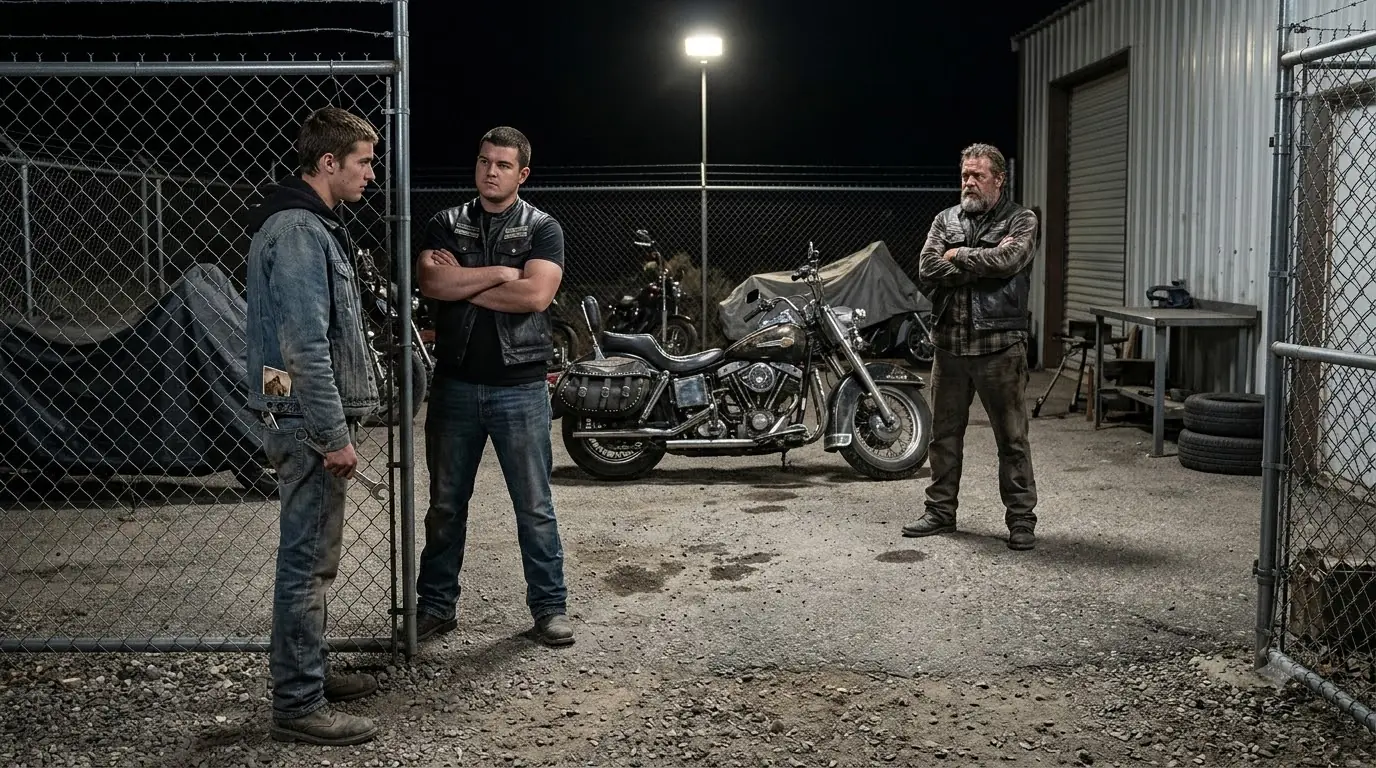
Always start with what holds everything else together. Cord stood up. He picked up his wrench. He started walking east. The gate was chain-link 12 ft high topped with three strands of wire that were not there for decoration.
Beyond it, the compound spread across 2 acres of cleared Nevada desert low buildings, a main garage with roll-up doors wide enough for six bikes abreast, a cluster of trailers that served as offices and storage, and probably a sleeping quarters for whoever drew the short end of any given week. And in the open center of everything lit by a single overhead work light that someone had left burning all night, the Iron Testament. Even from 40 ft away through the chain-link, the bike commanded attention in a way that was difficult to articulate to someone who had not spent their life around machines. It was not the largest motorcycle Cord had ever seen. Seen, it was not the most aggressively styled or the most visually imposing.
What it was was finished, completely and utterly finished in the way that machines are finished when one person has spent years making every single decision about them with full intent and full consideration. Nothing on it was there by accident. Nothing on it was there for appearance. Everything was exactly what it was supposed to be and had no interest in being anything else. His father had built it the way his father built everything.
Conversation by conversation in steel and chrome. Each choice following logically from the one before it. The whole thing adding up to something coherent and specific. The way a well-constructed argument adds up to something you cannot easily refute. There was a man leaning against the fence on the inside.
Not watching the gate, watching the bike. He was built the way certain men are built when they have spent decades doing physical work without stopping. Not bulky, just dense like the muscle had compressed over time into something permanent and load-bearing. 61 years old if the information Cord had gathered from watching and listening was accurate. A beard going silver at the edges.
Arms crossed over his chest. The expression of a man who had run out of ideas and had not yet run out of time, but could see the point coming toward him where those two things would converge. Grab Calloway, president of the chapter for 19 years. Cord had spent four weeks learning everything findable about this compound and the people inside it. He knew the chapter had been planning a memorial ride for three years.
A ride to honor eight members who had died in the years since the Iron Testament was brought here. He knew the ride was supposed to leave in six days. He knew the families of those eight men had already started arriving from three states because they had been promised this ride was happening and they had traveled a long way on the strength of that promise. He knew the bike was the only thing standing between a promise kept and a promise broken. And he knew that nobody in the world understood the Iron Testament the way he did because nobody in the world had been taught by the man and built it.
Not in workshops, not in trade schools, not in the formal instruction that produced the 73 mechanics who had come and failed. Frank Rourke had taught one person the specific language he used when he built. And that person was standing outside a chain-link fence in Elko, Nevada with a beat-up wrench in his jacket pocket and 8 months of desert road behind him. He pushed the gate open and walked in. The man who moved to block him was younger, maybe mid-20s, built with the confidence of someone who had been told he was intimidating often enough to internalize it on most occasions.