The first truck stopped on the gravel road at 4:37 in the morning.
By five, there were six more behind it.
Headlights stretched from the gate of Marie Fontenot’s farm all the way to the parish road, illuminating fifty acres of Louisiana ground that most people had considered worthless only eight months earlier.
Men who once laughed when they saw her rebuilding the pond levees now stood beside refrigerated trailers, checking watches and calling buyers in Baton Rouge, Lafayette, and New Orleans.
They had come for crawfish.
Thousands of pounds of them.
Inside the packing shed, red mesh sacks rose in neat rows beneath the fluorescent lights. Water dripped through the concrete floor. The air smelled of mud, clean pond water, and the sharp mineral scent of a harvest that had begun before midnight.
Marie stood at the sorting table wearing rubber boots, waterproof overalls, and the faded green cap that had belonged to her father.
Her dark hair was twisted beneath it. Mud streaked one cheek. Her hands were red from cold water and eight straight hours of work.
Across the shed, Beau Landry watched the scale settle on another fifty-pound sack.
He had spent most of the previous summer telling anyone who would listen that Marie had destroyed her inheritance.
Now he could not seem to find anything to say.
Marie tied the sack.
“Truck three is ready.”
One of her workers carried it toward the loading bay.
Beau finally stepped closer.
“How much have you pulled this morning?”
Marie checked the figures written on the damp clipboard.
“Just over thirty-six hundred pounds.”
His eyes moved toward the remaining baskets.
“And you’re not finished?”
“Not close.”
Outside, another buyer sounded his horn.
Marie glanced toward the rising sun.
Only the top edge was visible beyond the cypress trees.
For the first time since her father’s funeral, the farm no longer looked like something dying.
It looked awake.
Eight months earlier, nobody had expected that.
Least of all Marie.
When Lucien Fontenot died, he left behind fifty acres, a weathered farmhouse, two tractors older than his daughter, and enough debt to make the inheritance feel more like a sentence than a gift.
The property sat outside the small community of Belle Terre in southern Louisiana, where roads ran beside drainage ditches and every family seemed to have someone who could predict rain by the ache in an old injury.
The Fontenot farm had once produced rice, soybeans, and sugarcane.
By the final years of Lucien’s life, it produced mostly bills.
The soil in the northern fields had been overworked for decades. Drainage was poor. The irrigation pump failed twice in three years. Fertilizer prices rose while yields fell.
Lucien mortgaged equipment to keep planting.
Then borrowed against the house to pay for the equipment.
Every season began with hope and ended with another envelope from the bank.
Marie had watched it happen from Baton Rouge, where she worked as an accounts manager for an agricultural supply company.
She asked her father to reduce acreage.
He refused.
She suggested leasing part of the land.
He accused her of talking like a banker.
The final argument happened six months before his death.
“You can’t keep planting the same thing into ground that has stopped answering,” Marie told him.
Lucien stood near the kitchen sink, one hand wrapped around a coffee cup.
“This land fed you.”
“And now it’s eating you.”
His face hardened.
“You left. Don’t come back once a month and explain my own farm to me.”
Marie left before supper.
They spoke again, but never honestly.
Then Lucien suffered a heart attack while repairing a pump near the eastern pond.
A neighbor found him before sunset.
At the funeral, people told Marie her father had been proud of her.
She thanked them.
She did not ask how they knew.
Afterward, attorney Harold Broussard read the will inside Lucien’s kitchen.
The house and all fifty acres went to Marie.
Her younger brother, Paul, received a small life insurance policy and Lucien’s fishing boat. Paul lived in Texas and had no interest in farming.
“You always cared about the land more,” he told her.
Marie almost laughed.
Her father’s final months suggested otherwise.
The debt totaled two hundred twelve thousand dollars.
The bank gave her six months to present a repayment plan.
If she failed, the property would be sold.
Marie walked the farm alone the next morning.
The fields were pale and compacted.
Weeds filled the irrigation ditches.
The eastern pond had not held water properly in years. Its levees were broken in three places, and small willow trees had taken root along the edges. During childhood, Marie and Paul caught frogs there while Lucien used the pond to store irrigation water.
Now the basin was little more than cracked mud and dead grass.
Beau Landry found her standing beside it.
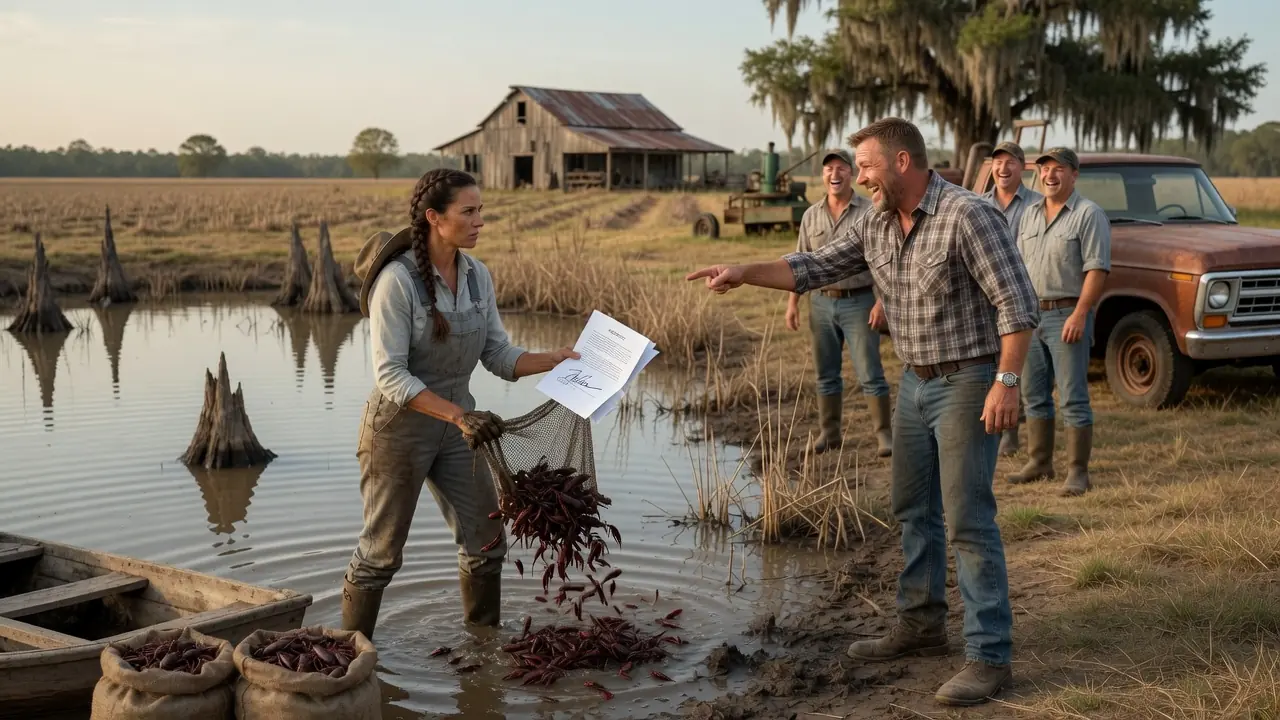
He farmed two hundred acres across the parish road and had known the Fontenots his entire life. At forty-two, he was handsome in the broad, sunburned way people trusted easily. He wore expensive work boots and spoke with the confidence of a man who inherited land without inheriting doubt.
“Bank taking it?” he asked.
Marie looked toward him.
“Good morning to you too.”
“I heard about the note.”
“People in this parish hear quickly.”
“People worry.”
“Is that what they call it?”
Beau stepped over a broken section of levee.
“Horizon Grain is leasing fields. They might give you enough to cover the interest.”
“The soil can’t support another aggressive crop.”
“They know what they’re doing.”
“They know what the land will produce for three years. They don’t care what happens in ten.”
Beau looked across the dead pond.
“What are you planning?”
“I don’t know yet.”
“You live in Baton Rouge.”
“I did.”
His eyebrows rose.
“You’re staying?”
“For now.”
Beau tried to hide his doubt.
“Farming isn’t spreadsheets, Marie.”
“No. Spreadsheets usually admit when the numbers are bad.”
He laughed.
She did not.
For two weeks, Marie studied everything Lucien left behind.
Receipts.
Planting records.
Rainfall notes.
Repair bills.
She found years of declining yields and rising input costs.
She also found a yellow legal pad in the bottom drawer of his desk.
Most pages contained figures.
On the final sheet, Lucien had written three words:
Pond won’t die.
Beneath them were rough calculations involving water depth, acreage, rice stubble, and crawfish stocking rates.
Marie read the page several times.
Her father had considered crawfish.
He had never mentioned it.
She called the parish agricultural extension office.
Dr. Celeste Morgan arrived three days later in a white pickup covered with mud.
Celeste was fifty-six, practical, and unimpressed by inherited pride. She walked the property in rubber boots, pushed a soil probe into three fields, and examined the eastern pond.
“The levees are bad,” she said.
“I can see that.”
“The bottom is uneven.”
“I can see that too.”
“The old drain structure is almost useless.”
“Is there anything I can’t see?”
Celeste crouched and picked up a handful of dark mud from beneath the cracked surface.
“This.”
She rubbed it between her fingers.
“The pond bottom still has organic matter. More than your fields.”
Marie showed her Lucien’s notes.
Celeste read them.
“Your father called me two years ago.”
Marie looked at her sharply.
“He was considering converting fifteen acres into a rice-crawfish rotation.”
“Why didn’t he?”
“He was afraid.”
“My father wasn’t afraid of much.”
“He was afraid of being laughed at.”
The answer angered Marie because she understood it.
In Belle Terre, farmers inherited more than land. They inherited methods, rivalries, and the expectation that struggle should look familiar.
A failed soybean field was unfortunate.
A failed experiment became a family story repeated for twenty years.
“Would it work?” Marie asked.
Celeste looked across the basin.
“It could.”
“That isn’t an answer.”
“It’s the only honest one.”
She explained that crawfish were not simply thrown into water and collected months later. The pond needed stable levees, proper drainage, oxygen management, forage, and careful timing.
Marie could plant a small rice crop for habitat rather than maximum grain yield. After harvest, she would flood the field and stock mature crawfish. The animals would burrow, reproduce, and emerge as water temperatures changed.
If everything worked, she could begin trapping during late winter.
If the water became too warm or oxygen levels dropped, she could lose most of the crop.
If birds discovered the pond before the crawfish established themselves, they could do serious damage.
If the winter remained too cold, the harvest would begin late.
If the market price collapsed, months of work could barely cover expenses.
Marie listened.
“How much to restore it?”
Celeste estimated nearly forty thousand dollars if Marie hired contractors.
Marie had twelve thousand dollars in savings.
The bank refused another loan.
“Your current debt-to-asset ratio is already beyond our agricultural threshold,” the loan officer said.
“So the property is valuable enough to seize but not valuable enough to improve?”
“That isn’t how we assess risk.”
“It is exactly how you assess risk.”
She left without financing.
Paul offered part of his insurance money.
Marie refused.
Their father intended it for him.
She sold her Baton Rouge car and purchased an old pickup.
She emptied her retirement account.
Then she began rebuilding the pond herself.
Beau stopped his truck near the levee one afternoon.
Marie was operating Lucien’s old John Deere with a borrowed dirt pan behind it.
“What are you doing?”
“Moving soil.”
“I mean with the pond.”
“Repairing it.”
“For irrigation?”
“Crawfish.”
Beau stared.
Then laughed.
He tried to stop.
That made it worse.
“Crawfish?”
“Yes.”
“In that?”
“It won’t look like this when I’m finished.”
He climbed from his truck.
“Marie, your father planted crops.”
“My father died owing more than the farm earned in ten years.”
The words hurt as soon as she said them.
Beau’s amusement disappeared.
“You think crawfish will save fifty acres?”
“I think repeating failure won’t.”
By evening, half the parish knew.
At the feed store, two men asked whether Marie planned to sell fishing licenses for the mud puddle.
Someone left a child’s plastic crawfish trap hanging on her gate.
Beau’s cousin called the pond “Fontenot Bayou” and began giving mock weather reports about it at the diner.
Marie ignored them.
Most days.
At night, their voices returned.
She would stand beside the basin, exhausted and unsure, and wonder whether Lucien had abandoned the idea because it was foolish rather than because he feared ridicule.
She repaired equipment with manuals spread across the workbench.
She learned to survey levee height using a borrowed laser level.
She drove thirty miles to purchase used pipe for the drainage system.
When the old tractor lost hydraulic pressure, she rebuilt the pump with instructions written in Lucien’s handwriting along the margins of a service manual.
Inside the cover, he had written:
Marie learns faster than Paul. Don’t tell either one.
She sat on the workshop floor and cried.
Not gracefully.
Not quietly.
She cried for the argument in the kitchen, for the call she never made, and for the fact that her father’s affection often appeared only after he was no longer alive to deny it.
Then she wiped her face and returned to work.
By June, the pond held water.
Not much.
A shallow test flood showed two hidden leaks along the southern levee.
Marie drained it, repaired them, and tried again.
By July, ten acres contained a low rice crop planted primarily for forage and cover.
Neighbors remained skeptical.
“The rice is thin,” Beau said when he visited.
“It isn’t for grain production.”
“Then why plant it?”
“For habitat.”
He shook his head.
“You’re growing rice for bugs.”
“Crustaceans.”
“That correction won’t help you at the bank.”
Marie kept working.
She found a crawfish farmer near Atchafalaya willing to sell her mature stock at a reduced price.
He delivered them in wet sacks before dawn.
The crawfish moved across the pond edge like a dark red wave when Marie released them.
Beau watched from the road with two other farmers.
“You just threw three thousand dollars into muddy water,” he called.
Marie did not turn.
“Then I’d better make sure it stays there.”
The first real crisis came in August.
A week of extreme heat reduced dissolved oxygen in the pond. Crawfish began climbing toward the levees during daylight, a sign something was wrong.
Marie called Celeste.
They tested the water.
The oxygen level was dangerously low.
“You need circulation,” Celeste said. “Immediately.”
The farm had no aerator.
Marie drove to Beau’s property.
He stood inside his equipment shed replacing bearings on a rice irrigation pump.
“I need your portable pump.”
He glanced up.
“For what?”
“Oxygen crash.”
“That pond?”
“Yes.”
Beau wiped his hands.
“You have your own pump.”
“It won’t move enough water.”
“You called me stupid for planting soybeans.”
“I said your input costs were stupid.”
“That is not better.”
“Beau.”
He saw her expression.
The argument left him.
“How long?”
“Two nights.”
He helped load the pump.
Together, they positioned it at the pond, pulling water from one side and spraying it across the surface to increase oxygen.
They worked until after midnight.
Beau watched crawfish gather near the moving water.
“They’re alive.”
“That is the goal.”
“I thought they stayed at the bottom.”
“They do when the water isn’t trying to kill them.”
He looked at her.
“You really know what you’re doing?”
“Not enough.”
It was not the answer he expected.
Marie continued.
“That is why I check.”
The oxygen stabilized.
Most of the crawfish survived.
Beau left his pump for a week without charging her.
He told nobody.
The second crisis came from birds.
Egrets and herons discovered the pond in September.
Marie woke one morning to white birds covering the shallow edges.
She fired no gun.
Instead, she installed lines, flags, and reflective strips. Lily Landry, Beau’s twelve-year-old daughter, helped hang old compact discs above the water.
“They make rainbows,” Lily said.
“They’re supposed to frighten birds.”
“They don’t look frightened.”
The egrets stood beneath the spinning discs.
Marie sighed.
“Maybe they enjoy music.”
Lily began visiting after school.
She asked questions constantly.
Why did crawfish burrow?
How could they survive when the pond dried?
Why were some red and others brown?
Marie answered what she knew and looked up what she did not.
Beau watched his daughter become fascinated by the pond.
His mockery stopped.
The rest of the parish continued.
At the diner, a farmer named Earl Broussard asked Marie whether she intended to open a petting zoo when the crawfish failed.
She placed her coffee down.
“How much did you spend on fertilizer last season?”
He frowned.
“What?”
“Per acre.”
“That’s none of your business.”
“You tell everyone mine.”
The table became quiet.
Marie continued.
“You planted seventy acres of soybeans and lost money after the second spray. Beau replaced a combine head he couldn’t afford. The Thibodeaux brothers are three months behind on their operating note.”
Earl’s face reddened.
“We take risks because that’s farming.”
“So do I.”
“With crawfish.”
“With a crop adapted to flooded ground in Louisiana. The strange part is not what I’m doing.”
She looked around the table.
“The strange part is how comfortable all of you became losing money the same way.”
Nobody laughed after that.
Autumn arrived.
Marie gradually lowered the pond water and allowed the crawfish to burrow. Females carrying eggs disappeared into the mud.
For weeks, the basin looked abandoned again.
The bank sent another notice.
Interest was due in January.
Marie had almost no cash remaining.
She accepted bookkeeping work at night for three local businesses. She slept in short intervals and began measuring time by tasks rather than days.
Repair traps.
Check levees.
Send invoices.
Test water.
Call buyers.
Sleep.
Repeat.
In November, heavy rain damaged the northern spillway.
Marie found the breach before sunrise.
Water poured through the levee.
She called Beau.
He arrived with a tractor.
Then Earl came.
Then the Thibodeaux brothers.
Nobody mentioned the jokes.
They worked six hours in rain, filling the break with clay and sandbags.
When the levee held, Beau climbed down from the tractor.
“You’d have done the same for us.”
Marie was not certain they would have believed that eight months earlier.
She nodded anyway.
In December, she began reflooding.
The pond rose slowly across the rice stubble.
For three days, Marie saw nothing.
On the fourth morning, young crawfish appeared near the shallow edges.
Small.
Almost transparent.
Alive.
She sat on the levee and watched them move through the water.
Lucien had been right.
The pond had not died.
It had been waiting for a different purpose.
January remained cold.
The crawfish grew slowly.
Buyers warned Marie that early-season prices were high but supply quality had to be consistent.
She ordered traps despite not knowing whether she would have enough harvest to justify them.
The bank officer called again.
“We need a payment by February first.”
“My harvest begins soon.”
“That is not guaranteed.”
“No crop is guaranteed.”
“Your loan agreement is.”
She hung up before saying something that would make future negotiations worse.
The first trapping day produced only eighty pounds.
The second, ninety-three.
The third, seventy.
Marie calculated the feed, fuel, labor, and transport costs.
At that rate, she would fail.
Beau found her in the shed staring at the numbers.
“How bad?”
“Not enough.”
“Cold weather?”
“Partly.”
“What else?”
“I may have stocked too lightly. The forage could be weak. Some might still be burrowed.”
“You giving up?”
She looked at him.
“No.”
“Good.”
“That sounded almost supportive.”
“Don’t get used to it.”
Beau began helping before dawn.
Not because Marie asked.
He said Lily wanted field experience for a school science project.
Lily appeared twice.
Beau appeared every morning.
As temperatures warmed, the catch increased.
Two hundred pounds.
Then three hundred.
By mid-February, they pulled nearly seven hundred pounds in one morning.
Marie found a direct buyer supplying restaurants rather than selling through the lowest-paying wholesaler.
She sorted by size.
Purged the crawfish in clean water.
Delivered consistent sacks.
Chefs began requesting Fontenot Pond crawfish by name.
The bank received its first payment.
Then another.
By March, harvest days began before two in the morning.
Marie hired four part-time workers.
Paul returned from Texas for a week and repaired the packing shed’s electrical system.
“What would Dad say?” he asked.
Marie looked toward the pond.
“He’d tell us the traps were set wrong.”
Paul laughed.
“Then he’d reset all of them without explaining.”
The season peaked in April.
That was when the buyers began arriving before sunrise.
The first major order came from a seafood distributor in Lafayette.
Then a restaurant group in New Orleans requested two thousand pounds weekly.
A grocery chain asked for everything Marie could supply during festival season.
She refused exclusive contracts that would leave her dependent on one buyer.
Her accounts background proved as important as anything she learned at the pond.
She calculated harvest costs by pound.
Tracked trap performance.
Adjusted feed locations.
Negotiated fuel surcharges.
The same neighbors who once dismissed spreadsheets began asking how she knew whether a buyer’s offer was fair.
By the final harvest, the pond had produced more than forty thousand pounds of marketable crawfish.
After expenses, Marie earned enough to make the overdue loan payments, rebuild an emergency reserve, and invest in permanent aeration equipment.
The pond generated more net income than the remaining forty acres had produced in any of Lucien’s final five years.
The parish newspaper published a photograph of Marie holding a full crawfish sack beside the pond.
The headline read:
DEAD WATER, NEW LIFE
Marie disliked it.
The pond had never been dead.
The following week, the county agricultural board invited her to speak.
The meeting was held inside the same community hall where farmers had once repeated jokes about Fontenot Bayou.
Every chair was filled.
Beau stood near the back.
Earl sat in the first row holding a notebook.
Marie placed several charts on an easel.
Nobody laughed at the spreadsheets now.
She explained the costs first.
Levee repair.
Stocking.
Feed.
Fuel.
Traps.
Water management.
Labor.
She described the oxygen crash and the low January harvest.
“This was not easy money,” she said. “It was a different kind of risk.”
A farmer asked what made the pond profitable.
“Knowing what the land wanted to be.”
The answer sounded sentimental, so Marie clarified.
“The northern fields drain too slowly for reliable soybeans and too unevenly for high-yield rice without expensive improvements. The pond basin already held moisture and organic material. Crawfish used the weakness instead of fighting it.”
Another farmer asked whether everyone should convert poor fields.
“No.”
The answer disappointed several people.
Marie continued.
“Not every acre should become a crawfish pond. Not every farmer has the water, soil, market access, or labor. Copying me without studying your own property would be the same mistake as copying the crop that already failed.”
Celeste smiled from the side of the room.
Beau raised one hand.
“What if someone has fifty acres that stay wet until June?”
The room turned toward him.
Marie knew the land he meant.
A low section behind his western fields had cost him money for years.
“You’d start with soil tests, water availability, and a smaller pilot.”
“How small?”
“Five acres.”
“Not fifteen?”
“You laughed at fifteen.”
The room laughed with her.
Beau accepted it.
Afterward, he waited near the door.
“I was wrong.”
Marie stacked her charts.
“About many things.”
“About you.”
She looked at him.
He did not smile.
“I thought you were trying to prove you were smarter than your father.”
“Maybe part of me was.”
“And were you?”
“No.”
Marie glanced toward Lucien’s old cap in her hand.
“I think he had the same idea. He just couldn’t risk being seen failing at something new.”
Beau nodded.
“Then you finished what he started.”
“I changed it.”
“That too.”
The following season, Marie expanded the pond by five acres.
She did not convert the entire farm.
Instead, she planted cover crops on exhausted fields and leased part of the higher ground to a young farmer growing vegetables for local markets.
The farm became more diverse.
Less dependent on one harvest.
More complicated.
More alive.
Beau created a five-acre crawfish pilot with Marie’s help.
His first season was mediocre.
He lost stock through a damaged drainage gate and complained constantly about feed costs.
Marie refused to rescue him from every mistake.
“You wanted to know how I did it,” she said. “This is how.”
“By watching money disappear into water?”
“For a while.”
Lily used the pond as the basis for a science fair project on wetland ecosystems.
She won at the parish level.
Beau displayed the ribbon in his truck.
Other farms began experimenting carefully.
Not all succeeded.
Some decided crawfish were not suitable for their properties.
But the conversations changed.
Farmers began discussing soil health, water storage, direct marketing, and alternative rotations without treating every new idea as an insult to tradition.
Marie paid off Lucien’s remaining equipment debt during her third season.
She carried the final payment receipt to his grave.
The cemetery stood on a slight rise behind the church.
She sat in the grass beside his stone.
“I saved it.”
The words felt childish.
As though she were still a girl bringing him a repaired tool and waiting for approval.
Wind moved through the oak branches.
Marie removed the yellow legal page from her pocket.
Pond won’t die.
She had framed a copy in the packing shed.
The original belonged with him.
“You should have told me.”
Her voice broke.
“I would have helped.”
She placed the paper beneath a small stone at the base of the marker.
For a long time, she sat without speaking.
Then she admitted the harder truth.
“I should have listened differently.”
Lucien had been proud, stubborn, and often impossible.
He had also been afraid.
Marie understood that now.
Fear did not always look like retreat.
Sometimes it looked like planting the same failing crop because changing direction required admitting the old direction no longer worked.
She stood.
“I’m not planting soybeans next year.”
The leaves moved above her.
Marie chose to interpret the sound as disapproval.
It made her smile.
Five years after the first harvest, Fontenot Farm employed nine people during peak season.
The packing shed had been expanded.
The pond supported crawfish, migratory birds, frogs, and vegetation Marie once considered useless.
Local restaurants advertised the farm’s harvest.
School groups visited to learn about wetland agriculture.
Marie never became the wealthiest landowner in the parish.
She did not want to.
Profit allowed her to keep the farm, pay workers fairly, improve the soil, and choose the next season without desperation making the decision for her.
That was enough.
One spring morning, she found a young woman waiting near the shed.
Her name was Danielle Broussard.
She had inherited twenty-eight acres from an uncle and was being advised to sell.
“I heard you help people figure out what land can do,” Danielle said.
“Sometimes.”
“Everyone says my property is worthless.”
“Everyone said that about this pond.”
Danielle looked toward the traps rising from the water.
“So I should raise crawfish?”
Marie shook her head.
“You should stop asking what worked for me.”
The young woman frowned.
“Then what do I ask?”
Marie pointed across the fields.
“What has your land been trying to tell you?”
Danielle remained for three hours.
They reviewed soil maps and drainage patterns.
The answer was not crawfish.
It was pecans and seasonal grazing.
Marie felt more satisfaction from that discovery than she would have from creating another imitation of her farm.
Years later, people still told the story of how Marie Fontenot made a fortune by filling a dead pond with crawfish.
The story improved with each retelling.
Some claimed she harvested one hundred thousand pounds in the first year.
She did not.
Others said she knew from the beginning exactly what would happen.
She did not.
The truth contained less magic.
Marie guessed.
Studied.
Failed.
Repaired.
Borrowed equipment.
Asked for help.
Ignored laughter.
Changed plans.
And woke before dawn more times than she could remember.
Her achievement was not that she proved everyone else foolish.
It was that she refused to let their certainty replace her own attention.
The neighbors saw mud.
Marie saw a basin that still held water.
They saw abandoned ground.
She saw evidence of what the property had once been and what it might become.
They believed honoring Lucien meant repeating him.
Marie honored him differently.
She took the question he had been too afraid to ask publicly and carried it far enough to find an answer.
On the anniversary of the first major harvest, Beau joined her beside the pond before sunrise.
The traps stood in dark rows across the water.
Mist drifted near the levees.
“You remember what I said when you started?” he asked.
“Most of it.”
“You should forget.”
“I plan to repeat it when you become unbearable.”
He looked across the pond.
“I thought land proved a man’s worth.”
Marie glanced toward him.
“And now?”
“I think it reveals whether he’s paying attention.”
She nodded.
“That is almost intelligent.”
“Careful. People may hear you.”
The first workers arrived.
Engines started near the packing shed.
A buyer’s truck turned onto the gravel road, headlights cutting through the mist.
Marie placed her father’s green cap on her head.
The county had not gone silent because her harvest made her rich.
It went silent because success forced people to confront something more uncomfortable than failure.
The land they had dismissed was not worthless.
The woman they had mocked was not reckless.
And tradition, repeated without thought, was not wisdom.
Sometimes the future of a farm did not depend on forcing exhausted ground to produce one more familiar crop.
Sometimes it began by flooding what everyone else had abandoned, kneeling beside muddy water, and waiting long enough to see what was still alive beneath the surface.