Every evening at six-thirty, Walter Hayes crossed the same hundred yards of worn grass between his farmhouse and the oldest building on Mason Ridge. He carried a dented red toolbox in his right hand, though at seventy-four the weight made his shoulder hang slightly lower on that side. The box had belonged to his father before him. Its paint was mostly gone, the corners were rounded by decades of use, and the right latch would not close unless Walter struck it once with the heel of his palm. People in the valley joked that the toolbox and the barn had the same maintenance plan: keep hitting them until they agreed to stay together.
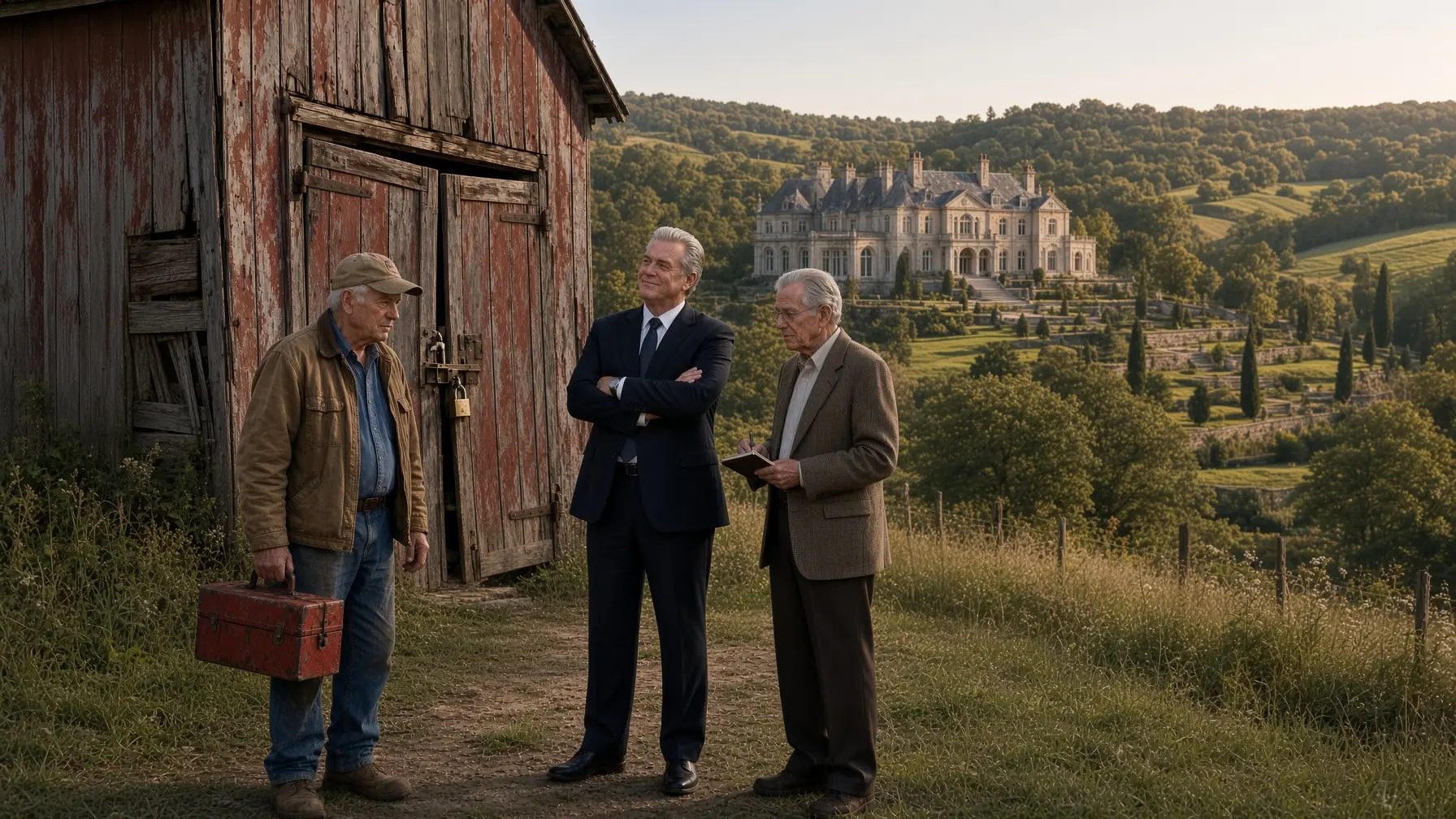
The barn stood at the eastern edge of the Hayes farm beneath a row of cottonwoods that had outlived three generations. From the county road it appeared ready to surrender. The roofline sagged perhaps four inches near the center. Gray boards bowed outward where sun and winter had worked them loose. One side leaned noticeably east, although it had leaned that way since Walter was a child. Swallows nested beneath the eaves, rust streaked the corrugated roofing, and an old sliding door wore enough peeling red paint to suggest the building had once been brighter than anyone living could remember. Tourists driving toward the vineyards sometimes slowed long enough to photograph it as an example of “authentic rural decay.”
Walter called it the machinery barn.
His neighbor, Reginald Langston, called it an embarrassment.
Langston’s property began across the narrow valley and climbed toward the sandstone bluffs. Twenty years earlier, he had purchased nearly five hundred acres after making a fortune developing high-end commercial properties outside Denver. His house stood three stories tall with a glass conservatory, heated stone terraces, a private gym, an infinity pool, and a circular driveway built around a fountain imported from northern Italy. From the western terrace, guests could look across the valley toward sunset.
Unfortunately for Langston, the sunset also contained Walter’s barn.
At dinners, he joked about it.
“That old thing has survived purely because gravity is embarrassed to finish the job.”
People laughed.
“Walter says it’s historical.”
More laughter.
“Everything becomes historical if you refuse to clean it up long enough.”
Walter heard the stories because Mason Ridge was too small for ridicule to remain private. He never responded. He repaired fences, cut hay on the thirty-eight acres he still actively managed, leased another sixty to a younger couple, and walked to the barn every evening with his toolbox. At the heavy double doors, he removed a brass key from his pocket, unlocked a modern steel padlock that looked strangely new against the weathered wood, stepped inside, and locked himself in.
The first twenty feet of the barn looked exactly as people expected.
Old shelves.
Oil cans.
A workbench darkened by grease.
Hand tools.
Two broken cultivator shanks.
A wooden ladder.
Then Walter pulled the chain on a second light.
The back half of the building appeared.
Rows of large forms sat beneath fitted canvas covers, some low and narrow, others massive enough that their rear wheels rose above Walter’s shoulders. A faint smell of gear oil, old paint, leather, dust, and dry timber filled the air. The floor looked like dirt from the doorway, but beneath a thin surface layer Walter’s father had poured concrete pads under the machinery bays decades earlier. Steel columns installed inside the original posts carried much of the roof load. The east wall might look as though the wind could push it over, but three concealed braces tied it into an interior frame built after a structural engineer inspected the barn eleven years earlier.
Walter had never cared how it looked from the road.
He cared that it stayed dry.
He moved to the first covered machine, folded the canvas back, and exposed the narrow nose of a 1936 Minneapolis-Moline.
The paint was not showroom-glossy. Walter disliked restorations that made farm equipment look more polished than it had been when new. The yellow had faded slightly. Correct reproduction decals sat beneath a layer of wax. Brass fittings had been cleaned but not buffed into jewelry. A handwritten tag tied to the steering column read:
SERIAL 57841 — MAGNETO SERVICED OCT. 12 — DO NOT FILL COOLANT UNTIL LOWER HOSE REPLACED.
Walter checked the rear tire pressure with an old gauge.
Then he moved to the next machine.
A Hart-Parr.
Then a Rumely OilPull.
Then a Fordson.
Then a tractor that very few people in Mason Ridge would have recognized because most people alive had never seen one outside an agricultural museum.
Walter did not think of any of them as treasure.
He thought of them as stories that happened to have carburetors.
The collection had begun in 1968 when Walter was twenty-one, newly married, and nearly broke. He and Ruth Hayes had inherited the remaining eighty-six acres of the original Hayes farm after Walter’s father suffered a stroke. The farm produced hay, some oats, a little corn, and enough cattle to make Walter feel permanently behind. Ruth taught fourth grade in town. They lived carefully, bought used appliances, planted a garden, and knew the exact date of every loan payment.
That summer, hay prices were unusually good.
After settling bills, Walter had four hundred thirty-two dollars more than expected.
Ruth assumed they would replace the refrigerator.
It had developed a ritual in which the compressor sometimes refused to start unless somebody kicked the lower left corner.
Walter spent three hundred seventy-five dollars on a tractor.
He arrived home after dark towing the 1936 Minneapolis-Moline behind a borrowed truck.
Ruth stepped onto the porch.
She stared at the tractor.
Then at Walter.
Then back at the tractor.
“What is that?”
Walter climbed down.
“A Minneapolis-Moline.”
“I didn’t ask its Christian name.”
“It’s rare.”
“It has grass growing through it.”
“That’ll come out.”
“The refrigerator is dying.”
“It still cools.”
“It cools when assaulted.”
Walter looked toward the kitchen.
“That means it responds to maintenance.”
Ruth remained silent for perhaps five seconds.
Then she began laughing so hard she had to sit on the porch step.
Walter smiled cautiously.
“So you’re not mad?”
“I am furious.”
“But laughing.”
“Those conditions can coexist.”
The tractor had not run in twelve years.
Walter spent fourteen months rebuilding it.
He could not afford new parts whenever parts existed, so he traded labor. He rebuilt a neighbor’s mower in exchange for a magneto. He cut hay for a retired farmer who owned a box of old bearings. When a manifold proved impossible to replace locally, he drove four hours to examine another tractor and fabricated a repair with help from a welder in Grand Junction.
Ruth kept notes.
Not because she shared his obsession.
Because Walter did not.
He remembered machines perfectly and paperwork terribly.
Her first restoration ledger contained entries like:
March 8 — Walter says carburetor is “almost done.” This phrase has no meaning.
Then:
April 22 — Bought refrigerator. Marriage continues.
And finally:
June 17, 1969 — Tractor started. Caroline cried. Walter almost did. Engine sounds terrible. He says correct sound is terrible.
That machine became number one.
The others arrived slowly.
Walter never borrowed against the farm to buy one.
That rule belonged to Ruth.
“If your historical preservation requires losing the historical farmhouse, we are doing history wrong.”
He obeyed.
A 1929 Hart-Parr came from a collapsed machine shed in Wyoming after Walter repaired two combines for the owner.
A Rumely OilPull arrived through a complicated trade involving three engines, a wagon, firewood, and an argument about whether a belt pulley counted as part of the tractor.
A rare orchard tractor came from central California after a cannery closed.
An early crawler came from a logging operation where it had been parked after a final-drive failure and used for decades as a convenient place to hang chains.
Walter bought what interested him, not what dealers said would appreciate.
He liked unusual engineering.
Machines that represented transitions.
Steel wheels becoming rubber tires.
Open gears becoming enclosed transmissions.
Hand starting giving way to electric starters.
Companies that flourished for five years and disappeared.
Experimental machines designed to solve one very specific agricultural problem and then made obsolete when agriculture changed.
Ruth learned the history despite herself.
She could identify a Fordson at a distance.
She knew Walter was more likely to buy a tractor if its manufacturer had gone bankrupt before 1940.
And she enforced the dining-table rule until the end of their marriage:
No machinery component entered the house unless completely clean.
Walter violated the rule once.
Ruth found a carburetor on a newspaper beside the salt shaker.
The resulting argument remained family legend.
Their daughter Caroline grew up inside the collection without thinking it was unusual. Other children had bicycles in garages. Caroline had to squeeze past steel wheels to reach hers. She learned to drive an old Farmall before she was tall enough for the seat and spent one summer helping Ruth type serial numbers into a computer Walter insisted was “a machine invented to lose information faster.”
By the late 1990s, however, Caroline had moved away.
She studied accounting, married, settled near Chicago, and raised three children.
Walter never resented it.
He had watched too many farmers turn children into unpaid heirs to believe land created a moral obligation.
“Come home if you want,” he told her.
“What if I don’t?”
“Visit.”
“And the farm?”
“Still here.”
The collection remained too.
By the time Walter turned sixty, the machinery barn contained thirty-seven tractors, four stationary engines, several rare implements, shelves of parts, and nearly fifty years of paperwork.
Not all were valuable.
Some never would be.
A common Fordson in mediocre condition might bring less than the cost Walter could have earned spending the restoration hours doing ordinary mechanical work. Several machines were historically interesting but commercially modest. One incomplete crawler required parts that perhaps no longer existed.
Walter never calculated return on investment.
Then Ruth got sick.
The diagnosis came after months of fatigue she blamed on age.
Ovarian cancer.
By the time surgeons operated, the disease had already spread.
Treatment bought time.
Not enough.
During Ruth’s final year, Walter placed a padded chair in the machinery barn. On evenings when she had strength, she sat while he worked. He stopped restoration projects and performed only preservation—oil cylinders, rotate engines, drain fuel, protect bare surfaces.
One evening Ruth looked across the covered machines.
“What happens to all this when you die?”
Walter did not look up.
“I’m not dying.”
“Neither was I until apparently I was.”
He stopped.
She continued.
“Caroline doesn’t want thirty-seven tractors.”
“She might.”
“She lives in Chicago.”
“Chicago has roads.”
Ruth gave him the expression that had ended hundreds of foolish conversations.
“You need a plan.”
“I have time.”
She looked toward him.
That sentence hurt them both.
After she died, Walter did not enter the barn for almost two months.
The padlock remained untouched.
Dust collected along the doors.
Neighbors assumed he had finally lost interest.
Then one evening he walked there again.
He turned on the first bulb.
Then the second.
He uncovered the Minneapolis-Moline.
On the shelf beside it sat Ruth’s original ledger.
Walter opened to June 17, 1969.
Tractor started. Caroline cried. Walter almost did.
He laughed.
Then cried harder than he had at the funeral.
The barn changed after that.
The tractors still mattered.
But Ruth’s handwriting mattered more.
Meanwhile, Reginald Langston began expanding his estate.
The two men had little personal relationship at first. Langston was not born wealthy. He had grown up outside Pueblo in a family that moved frequently as his father chased construction jobs. He built his fortune through discipline, risk, and a genuine ability to recognize where cities were expanding before everyone else did.
He also developed a habit common among people whose instincts had made them rich.
He began believing his judgment generalized to everything.
Walter’s farm looked inefficient.
Therefore it was.
The barn looked neglected.
Therefore it was.
The land between the Hayes place and the Langston estate interrupted his ability to control the western view.
Therefore eventually it would be his.
His first offer was polite.
Twenty acres.
Walter declined.
Langston doubled the number.
Walter declined again.
Then he offered to buy the entire Hayes farm while granting Walter a lifetime right to remain in the house.
Walter read the proposal at his kitchen table.
“You’d own the barn?”
“Yes.”
“What would you do with it?”
Langston smiled.
“Walter, that building is beyond saving.”
“So you’d tear it down.”
“Immediately.”
Walter closed the folder.
“No.”
Langston looked surprised.
“The price is more than the property is worth agriculturally.”
“Probably.”
“You could retire comfortably.”
“I am retired comfortably.”
“You drive a nineteen-year-old truck.”
“It starts.”
Langston leaned back.
“What are you protecting?”
Walter looked toward the barn.
“Something you don’t need.”
That answer annoyed Langston for years.
Eventually he began complaining.
Not illegally.
Not secretly.
He used ordinary channels.
County code enforcement received photographs alleging structural danger. Walter allowed the inspector inside the front section, showed the internal bracing and engineer’s report, and received an order requiring roof maintenance but no condemnation.
Langston appealed.
An independent engineer examined the building.
His conclusion frustrated everyone who wanted drama.
The barn was ugly but serviceable.
The visible eastward lean originated partly from settlement that occurred decades earlier. Interior posts had been sistered with steel and timber reinforcement. Roof sheathing required repair. Several siding boards needed replacement. The building did not meet modern standards in every respect but did not present evidence of imminent collapse under ordinary conditions.
Walter fixed what the engineer required.
He left the exterior looking almost exactly the same.
At Bell’s Diner, people joked that Walter spent more money keeping the barn looking terrible than a sensible man would spend making it good.
Pete Holloway, a local contractor, once stopped beside Walter’s mailbox.
“I’ll bulldoze it for free.”
Walter looked at him.
“Why?”
“Community service.”
“It stood before you were born.”
“That doesn’t mean it’s healthy.”
Walter glanced at Pete’s stomach.
“Neither does age, apparently.”
Pete stared.
Then laughed.
That joke traveled around Mason Ridge for weeks.
The barn jokes continued too.
Teenagers called it the Ghost Shed.
A newspaper travel column referred to it as “Mason Ridge’s stubbornest eyesore.”
Walter clipped the article and placed it beside Ruth’s ledger.
Then, one October afternoon, he found a book at the county library.
Engines of the American Farm: Experimental Tractors, 1910–1940, by Dr. Elias Thornton.
Walter borrowed it.
Three weeks later the librarian called.
“Mr. Hayes, the book is overdue.”
“I’m checking something.”
“You have checked it for twenty-four days.”
Walter reluctantly returned it.
But first he copied a page.
The page described a 1931 Centaur Model B experimental tractor manufactured by a small Midwestern company that collapsed during the Depression. Production records were incomplete. Thornton believed fourteen to eighteen had been built. Only two complete survivors were known, both in museums.
Walter had another.
He had bought it in 1983 behind an abandoned fruit-packing building in western Colorado.
The owner wanted the engine for scrap.
Walter noticed an unusual rear axle and stopped him.
Serial number B-07.
The examples in Thornton’s book were B-11 and B-14.
Walter wrote a letter.
Dr. Thornton received it ten days later.
The historian initially assumed the writer had misidentified another model. Collectors did that regularly. Walter’s four-page description changed his mind.
He included casting numbers.
Magneto type.
Final-drive design.
Dimensions of a distinctive orchard-style steering linkage.
Thornton wrote back:
Where did you examine this tractor?
Walter replied:
My barn.
Thornton asked for photographs.
Walter did not answer.
A second letter came.
Then a third.
The third contained one sentence Walter respected:
I will not disclose your location, ownership, or serial number publicly without your permission. I only want to determine whether the machine survives.
Walter called him.
Thornton arrived on a Tuesday morning driving a Subaru station wagon covered in road dust. He was seventy-one, silver-haired, narrow-shouldered, and wore a tweed jacket that appeared to have attended more archives than farms.
Walter met him near the gate.
“You Dr. Thornton?”
“Yes.”
“Nice jacket.”
“Thank you.”
“That wasn’t praise.”
Thornton smiled.
“I brought work clothes.”
“Good.”
They walked toward the barn.
The historian stopped halfway there.
“That’s it?”
“Yes.”
Thornton looked at the leaning structure.
Walter watched him carefully.
“Say it.”
“What?”
“The joke.”
Thornton smiled.
“I was thinking that if the Centaur is inside there, you have developed an aggressive theft-deterrence strategy.”
Walter considered.
“That one’s acceptable.”
He opened the doors.
At first Thornton saw the ordinary work area.
Then Walter turned on the second row of lights.
The historian stopped walking.
Canvas-covered forms stretched through the rear of the building.
“How many?”
Walter pulled the cover from the Minneapolis-Moline.
Thornton approached slowly.
“Correct wheels.”
“Yes.”
“Original engine?”
“Block is.”
“Head?”
“Replacement from a donor machine. Same casting series.”
Thornton smiled.
“You document that?”
Walter pointed toward a cabinet.
“Ruth did.”
He uncovered the Hart-Parr.
Then the Rumely.
Then an early Allis-Chalmers orchard tractor.
Thornton stopped asking questions for perhaps ten minutes.
By the time Walter uncovered the Centaur, the historian’s hands were trembling.
He did not touch it.
He crouched near the serial plate.
“B-07.”
Walter nodded.
Thornton leaned closer.
“Where did you say you found it?”
“Delta County. Old packing house.”
“Original engine?”
“Yes.”
“Transmission?”
“Yes.”
“Carburetor?”
“No.”
Thornton looked up.
Walter continued, “Body was there. Internals ruined. I machined parts using dimensions from what remained.”
“Do you have the original damaged pieces?”
“Box underneath the bench.”
Thornton stood very slowly.
“Walter.”
“What?”
“You understand how important this is?”
“It’s old.”
Thornton stared.
“Old is not the same thing.”
Walter smiled slightly.
“That’s what I keep telling Langston.”
They spent seven hours inside.
Thornton eventually asked to see records.
Walter opened the cabinets.
Ruth had preserved bills of sale, handwritten letters, transport receipts, photographs taken before restoration, serial-number rubbings, parts lists, correspondence with previous owners, and notebooks explaining what Walter had replaced.
That documentation changed everything.
Antique machinery value depended heavily on originality, rarity, completeness, condition, provenance, and whether restoration had preserved or destroyed evidence. A beautifully painted tractor with invented parts could be worth less historically than an ugly machine with original components and records.
Walter’s collection was not perfect.
But it was honest.
If a carburetor was reproduced, the notebook said reproduced.
If the rear wheel on one tractor came from another serial run, Ruth recorded it.
If Walter guessed about original paint, the file said color matched from protected surface beneath fuel bracket — approximate.
Thornton spent almost as much time reading Ruth’s notes as inspecting machines.
Near dusk, he said, “I need to bring other people.”
Walter shook his head.
“No.”
“A valuation specialist. Conservator. Agricultural historian.”
“No.”
“Walter, you have at least six machines that materially change what we know about surviving examples.”
“They survived yesterday without anybody knowing.”
“That isn’t my point.”
“It’s mine.”
Thornton looked around.
“What are you afraid of?”
Walter answered after a long pause.
“People deciding what they’re worth before deciding what they are.”
Thornton understood more than Walter expected.
He left without arguing.
Three weeks later, he mailed another letter.
Not to Walter.
To Caroline.
Walter had reluctantly given him permission.
Caroline called her father that evening.
“Dad.”
“Yes.”
“What exactly is in the barn?”
“Tractors.”
“Dr. Thornton says there may be a historically important collection.”
“Could be.”
“He says some pieces might be valuable.”
“They all have value.”
“Money, Dad.”
Walter became quiet.
Caroline sighed.
“I’m coming out.”
“You have work.”
“I have vacation.”
“You should use vacation somewhere enjoyable.”
“I’m coming.”
Caroline arrived two days later.
She had not been inside the back half of the barn in nearly nine years.
Walter uncovered the machines.
She recognized many.
Others had arrived after she moved away.
Then Walter showed her Ruth’s records.
Caroline sat at the workbench for an hour reading her mother’s handwriting.
Eventually she looked up.
“You knew she kept all this?”
“Yes.”
“Did you know she made inventories?”
“Some.”
Caroline held up a folder.
“She recorded serial numbers, acquisition costs, restoration costs, former owners, everything.”
“Your mother liked lists.”
“She was building provenance.”
“She was keeping me organized.”
“Same result.”
Caroline looked around.
“We need to know what this is worth.”
Walter frowned.
“Why?”
“Insurance, for one.”
“It’s insured.”
“For how much?”
“Barn contents.”
“That is not an amount.”
Walter looked away.
Caroline closed her eyes.
“You have thirty-seven antique tractors covered under generic farm-property contents, don’t you?”
“Probably.”
“That is not insurance. That is optimism.”
Ruth would have agreed.
Walter knew it.
That was how the experts finally entered.
Thornton returned with Dr. Melissa Crane, an agricultural technology curator from a university museum; Samuel Ortiz, a machinery appraiser experienced with antique farm equipment; and a conservation specialist named Eleanor Park.
They did not arrive with television cameras.
No reporters.
No auction company.
Walter required that in writing.
For four days they inspected the barn.
Samuel repeatedly emphasized that appraisal was not prophecy.
“Collectors get excited when somebody says rare,” he told Caroline. “Rare doesn’t always mean valuable. There are rare tractors nobody wants.”
“Then what matters?”
“Rarity, desirability, condition, documentation, market, mechanical completeness, originality. Also whether two determined wealthy collectors happen to want the same machine on auction day.”
“So you can’t give a precise number.”
“I can give ranges.”
Walter liked him immediately.
The ordinary tractors came first.
Six were valued below ten thousand dollars each.
Several fell between ten and thirty thousand.
A beautifully preserved Rumely with documented local history might bring substantially more.
The Hart-Parr was significant but not unique.
Then they reached the rare machines.
The Centaur B-07 was one.
A factory letter Walter had acquired with another tractor proved that B-07 had been sent to a Colorado fruit grower for orchard testing before the company entered full production.
Thornton had never seen the letter.
Neither had the museum that owned B-11.
Another tractor, a narrow high-clearance prototype from a failed manufacturer, appeared to be the only complete surviving example experts could currently document.
A crawler Walter assumed was merely uncommon had a factory-modified transmission built for a government soil-conservation demonstration program.
The original paint was mostly gone.
The documentation was not.
On the fourth afternoon, Samuel sat with Walter and Caroline at Ruth’s workbench.
“I’m going to give you two numbers.”
Walter looked skeptical already.
“First is a conservative insurance replacement estimate, assuming you had to source comparable examples where comparable examples exist.”
“How much?”
“Roughly one-point-eight million for the tractor collection and major associated parts.”
Caroline stopped breathing for a moment.
Walter did not move.
Samuel continued.
“That does not mean somebody will hand you a check for one-point-eight million tomorrow.”
Walter nodded.
“Good.”
“The second number is speculative auction potential if pieces were marketed individually through specialized channels over time.”
Caroline asked, “Higher?”
“Potentially.”
“How high?”
“Could exceed two and a half million if the rare machines attract serious institutional or private interest. Could also be lower. Markets change.”
Walter looked toward the covered Centaur.
“That thing?”
“That thing could be worth more than you paid for this whole farm.”
Walter laughed.
“No.”
Samuel smiled.
“Yes.”
“I paid three hundred dollars for it.”
“Then you had a good day.”
Walter leaned back.
For perhaps the first time, the numbers unsettled him.
Thornton noticed.
“Walter?”
He looked toward the historian.
“Ruth should’ve heard this.”
Caroline reached across the workbench and took his hand.
“She would’ve charged you storage.”
Walter laughed softly.
That was when the story escaped.
The experts never determined exactly how.
Someone saw university vehicles.
A county clerk heard an insurance question.
Pete Holloway drove past and noticed strangers entering the barn.
By the weekend, Mason Ridge believed Walter had hidden ten million dollars of machinery behind rotten boards.
The number was wrong.
Nobody cared.
Cars began slowing along the road.
A reporter called.
Then another.
Collectors left messages.
One offered Walter two hundred thousand dollars for the Centaur without examining it.
Walter hung up.
Reginald Langston arrived Monday morning.
Not with a purchase contract.
With curiosity.
Walter met him near the porch.
“I hear your collapsing barn is apparently Fort Knox.”
Walter looked toward the building.
“Still looks the same.”
Langston smiled.
“So it’s true.”
“What?”
“You have valuable machinery.”
“Some.”
“How valuable?”
“Enough to make people irritating.”
Langston laughed.
“I’ll make you an offer.”
“No.”
“You don’t know what it is.”
“That saves time.”
Langston stepped closer.
“I’m serious. I know collectors. Museums. Auction houses.”
“They found my phone already.”
“You could liquidate the collection, sell me the acreage, and never worry about money again.”
Walter looked toward him.
“I don’t worry much now.”
“You have a roof held together by nostalgia.”
“The roof is reinforced.”
“The building looks condemned.”
“It isn’t.”
Langston stared.
“You enjoy this.”
“What?”
“Making everyone think you’re poorer than you are.”
Walter’s expression changed.
“No.”
Langston realized he had crossed something.
Walter continued.
“I never asked anyone to think anything.”
He looked toward the barn.
“They looked at boards and made up the rest.”
That sentence traveled through town after Langston repeated it himself.
Walter gave one interview.
Only one.
The reporter, Emily Navarro, was twenty-eight and worked for the regional newspaper. She arrived expecting a delightful story about a secret millionaire farmer.
Walter disappointed her immediately.
“Are you a millionaire?”
“No.”
“But the collection—”
“Collection might be worth money.”
“So technically—”
“I own things that might sell for money. I also own hay that becomes money if cows don’t eat it first.”
Emily smiled.
“Fair.”
She asked why he had hidden the tractors.
“I didn’t hide them.”
“The doors were locked.”
“So is your house.”
“You never showed people.”
“People never asked.”
“That sounds familiar.”
Walter looked toward her.
“My wife used to say curiosity is different from entitlement.”
Emily wrote it down.
Walter frowned.
“You writing everything?”
“That’s generally how newspapers work.”
He showed her Ruth’s ledgers.
That changed the article.
Instead of centering the speculative millions, Emily wrote about two people who spent fifty years preserving machinery nobody wanted when they acquired it.
The headline read:
THE BARN EVERYONE LAUGHED AT WASN’T EMPTY
Walter approved.
Langston did not.
Public attention created a new problem.
Security.
Within three weeks, someone cut a section of fence at the back of the property.
Nothing was stolen.
Walter found tire tracks.
That frightened him more than any appraisal number.
For the first time, the collection’s value made the barn less safe.
Caroline insisted on cameras.
Motion sensors.
Improved locks.
Fire protection.
Walter agreed reluctantly.
Then county officials approached with another idea.
The agricultural historical society wanted to help establish a nonprofit preservation trust. Walter could retain lifetime control while creating a structure to maintain the collection, insure it properly, and eventually open portions to researchers and the public.
Walter refused initially.
Caroline expected that.
She did not argue.
Instead, she asked one question.
“What happens when you can’t walk to the barn anymore?”
Walter looked away.
A month later he called Dr. Thornton.
“What does a trust involve?”
That was the beginning.
Nothing happened quickly.
Lawyers drafted documents.
Insurance inspectors required electrical upgrades.
A preservation architect studied the barn.
The final engineering report made Langston’s years of jokes look almost comical.
The building did need major work.
But the old frame was far stronger than it appeared.
Hand-hewn timber posts were enormous by modern residential standards. Later interior reinforcement carried loads the exterior siding concealed. The visible sag resulted partly from an old roof repair that had altered the line without compromising the main frame.
The recommendation was not demolition.
It was repair.
Walter insisted on one condition.
“Don’t make it pretty.”
The architect stared.
“What do you mean?”
“Don’t make it look new.”
“We need to replace damaged siding.”
“Replace what’s rotten. Keep what isn’t.”
“The east wall should be straightened somewhat.”
“Somewhat.”
“The roof will look more level.”
“Can’t help everything.”
Caroline laughed.
The trust eventually raised funds through grants, private donations, and a limited gift Walter made from the sale of two tractors he considered historically redundant.
He did not sell the Centaur.
He sold a common machine he had restored well and another whose story was already represented by a better example.
The sales brought enough to surprise him.
“People pay that?”
Samuel Ortiz shrugged.
“They want them.”
Walter shook his head.
“I remember when people abandoned these behind sheds.”
“That’s why they’re scarce.”
The barn restoration lasted nine months.
Modern fire suppression was hidden between rafters where possible.
Electrical wiring was replaced.
Concrete pads were repaired.
Humidity monitoring was installed around the most sensitive paper records and leather components, though most tractors themselves did not require museum-perfect climate control.
The old siding remained gray.
The exterior still leaned just enough that strangers occasionally asked if the building was safe.
Walter considered that success.
Then Langston returned.
By then the mansion owner had become quieter about the barn.
One evening he found Walter repairing a gate.
“You still won’t sell the twenty acres?”
“No.”
Langston nodded.
“I figured.”
Walter waited.
“I owe you something.”
“Money?”
Langston smiled faintly.
“An apology.”
Walter stopped working.
Langston looked toward the barn.
“I spent years making jokes because I thought the building told me something about you.”
“What?”
“That you couldn’t afford to maintain your property.”
Walter rested one hand on the gate.
“You weren’t entirely wrong.”
Langston frowned.
Walter continued.
“I could’ve afforded better siding. Not a whole restoration.”
“That’s not what I mean.”
“I know.”
Langston looked toward his own house across the valley.
“I built everything over there to communicate success.”
“It does.”
“I assumed anything that didn’t communicate success represented failure.”
Walter considered that.
“Expensive way to think.”
Langston laughed quietly.
“Yes.”
He hesitated.
“I was wrong.”
Walter nodded.
“About the barn.”
“And you.”
Walter returned to the hinge.
“You know something funny?”
“What?”
“You never asked what was inside.”
Langston looked almost embarrassed.
“No.”
“You wanted the property for twenty years.”
“Yes.”
“Never asked.”
Langston smiled.
“I suppose I thought I already knew.”
Walter tightened the bolt.
“Most expensive mistakes start there.”
The preservation barn opened to the public on Ruth’s birthday.
Walter did not want a ceremony.
Caroline organized one anyway.
Three hundred people attended.
Pete Holloway stood near the entrance telling visitors he had personally repaired the roof and carefully omitting the years he had offered to bulldoze the building.
Walter caught him.
“You leaving something out?”
Pete grinned.
“Historical interpretation requires editing.”
Walter laughed.
Inside, the tractors no longer sat beneath every cover. Some remained covered to protect them between demonstrations, but the significant machines were displayed with modest signs.
Walter hated signs that began with auction values.
So none did.
The Centaur’s placard explained the experimental company.
Production uncertainty.
Serial number.
Colorado orchard-testing history.
Walter’s 1983 acquisition.
Restoration record.
Only at the bottom appeared:
Current monetary value varies with collector market. Historical significance considered substantial.
Visitors constantly asked guides for numbers anyway.
Children cared less.
They wanted to know whether the tractors ran.
Several did.
Walter loved demonstration days because machinery sounded more honest than speeches.
The old Minneapolis-Moline became the favorite.
He started it himself at the first public event.
The engine coughed twice.
Then settled into its uneven rhythm.
Caroline stood beside the barn doors.
For one second, Walter could almost see Ruth behind her holding a baby.
He turned away before anyone saw his face.
Dr. Thornton eventually convinced him to loan the Centaur to a national agricultural museum for a six-month exhibition.
Walter refused to fly to the opening.
“Why not?”
“Crowds.”
“You own a public museum now.”
“Temporary lapse in judgment.”
Thornton laughed.
The Centaur returned seven months later.
Walter checked it as though the museum had borrowed his child.
“They treated it better than you do,” Caroline said.
“Nobody treats your things correctly.”
“That is exactly what Mom said about you.”
The trust grew.
Families around the county donated photographs, ledgers, tools, and oral histories.
Walter insisted the barn not become a shrine to wealthy landowners and machinery collectors.
“Machines didn’t farm by themselves.”
A permanent exhibit included migrant harvest crews, women who kept farm accounts, mechanics, hired hands, blacksmiths, truck drivers, teachers who supplemented farm income, and families who lost land during hard years.
One wall displayed Ruth’s ledgers.
Her jokes became the museum’s most popular text.
May 2, 1969 — Bought refrigerator. Tractor delayed. Marriage saved.
Visitors photographed it constantly.
Walter pretended to be offended.
At eighty-one, he still walked to the barn most evenings.
Slowly now.
The red toolbox felt heavier.
Caroline spent several months each year in Mason Ridge and eventually moved back after retiring.
One autumn evening she found him sitting at Ruth’s workbench after closing.
Only the original dim bulb was on.
“You know we installed eight thousand dollars of lighting.”
Walter nodded.
“You could use it.”
“I could.”
She sat beside him.
Rows of tractors disappeared gradually into shadow.
“Do you ever wish you’d sold them?”
“No.”
“Any?”
“Some.”
She laughed.
“Which?”
“The crawler.”
“You love that crawler.”
“Final drive is hateful.”
“What about the money?”
“What money?”
“The collection.”
Walter looked toward her.
“You know what I mean.”
He thought for a while.
“No.”
“Never tempted?”
“Money is useful.”
“That sounds suspiciously like a setup.”
He smiled.
“The collection becoming valuable helped preserve it.”
“Yes.”
“But the value came after.”
She waited.
“Your mother and I cared for these when people would’ve hauled some away by the ton for scrap.”
Caroline touched the old ledger.
“So monetary value doesn’t matter?”
“I didn’t say that.”
“Then what?”
Walter struggled for the words.
“If you only protect something once experts tell you it’s expensive, you’re not protecting history.”
He tapped the ledger.
“You’re protecting an asset.”
Caroline nodded slowly.
He continued.
“Sometimes those are the same thing. Sometimes they aren’t.”
Two winters later, Walter stopped walking to the barn alone.
His knee had deteriorated badly.
Caroline drove him in a golf cart he considered humiliating.
“This thing makes me look ninety.”
“You are eighty-three.”
“Exactly.”
One cold February morning, Walter died in his bed.
No dramatic last words.
No final secret.
Caroline had been with him until midnight.
He complained that she turned the thermostat too high.
At three-seventeen she woke and found him gone.
The doctor believed his heart had simply stopped.
At his funeral, nearly six hundred people filled the church and fellowship hall.
Farmers came in work jackets.
Collectors came from several states.
Museum curators sat beside people who remembered Walter baling hay for them forty years earlier.
Reginald Langston sat near the rear.
Dr. Thornton spoke briefly.
He did not mention the appraised value.
“People say Walter Hayes kept a fortune in a collapsing barn,” he began. “That is a good headline and a poor description.”
The church became quiet.
“The fortune is easy to count afterward. Serial numbers. Auction comparisons. Replacement values. Rarity. What is harder to measure is the fifty years before anybody cared.”
He looked toward Caroline.
“Walter and Ruth preserved machines when many had almost no commercial value. They documented repairs when nobody expected scholars to read the notes. They saved letters because ordinary farmers deserved records too.”
Thornton paused.
“The barn did not become valuable when experts opened the doors.”
He looked across the congregation.
“We simply became late to understanding what was already there.”
Caroline spoke last.
She brought Ruth’s first ledger to the lectern.
“Dad hated sentimental speeches.”
People laughed.
“So I’m going to embarrass him with Mom’s handwriting.”
She found the entry.
“June seventeenth, nineteen sixty-nine. Engine started today. Walter looked happier than when Caroline was born.”
The room erupted in laughter.
Caroline waited.
Then continued.
“Mom added: This may be an exaggeration. Walter says it is not.”
More laughter.
Caroline closed the ledger.
“My father spent most of his life fixing things people had decided were finished.”
Her voice softened.
“Sometimes tractors.”
“Sometimes a barn.”
“Sometimes his own life after Mom died.”
She looked toward the casket.
“He never thought old meant better.”
That was important.
“He owned modern equipment. Used computers badly. Appreciated good engineering regardless of age. What he believed was that replacing something should not be easier than understanding it.”
She paused.
“I think that is why the barn survived.”
After Walter’s death, the Mason Ridge Agricultural Heritage Trust continued operating.
Caroline chaired it for six years.
The collection changed gradually.
A few tractors went on long-term museum loans.
Two duplicate machines were sold to fund conservation.
New materials entered the archive.
The original barn remained the heart of the site.
Its exterior never became picturesque in the polished sense.
The siding stayed gray.
The eastern wall still leaned slightly.
Swallows still returned beneath the eaves every spring.
The roof no longer leaked.
Fire sensors hid between old beams.
Security cameras watched the doors Walter once protected with one padlock and suspicion.
Across the valley, Langston’s mansion remained.
As he aged, Reginald spent less time hosting large gatherings.
One year, he donated money anonymously to replace the museum’s failing climate-control equipment.
Caroline discovered his name on the donor paperwork anyway.
She called him.
“You trying to buy the barn again?”
Langston laughed.
“Too expensive now.”
“Dad would enjoy that.”
“I know.”
Before hanging up, he asked, “Do you remember what he told me?”
“Which thing?”
“That I never asked what was inside.”
Caroline smiled.
“Yes.”
“I think about that more than I’d like.”
Years later, a school group visited the museum.
A ten-year-old boy stood in front of the Centaur and read the sign.
“How much is this worth?”
The guide, a retired farmer named Dale Morgan, smiled.
“Depends who wants it.”
“But like, a million dollars?”
“No.”
“Hundred thousand?”
“Maybe more, maybe less depending on market.”
The boy looked disappointed.
“I thought everything here was worth millions.”
Dale pointed toward the entire building.
“Together, somebody once estimated a lot.”
“Then which one is the treasure?”
Dale thought about Walter.
He pointed toward a glass display near the entrance.
Inside sat a dented red steel toolbox.
One latch remained crooked.
“That.”
The boy frowned.
“How much?”
“Almost nothing.”
“Then why?”
“Belonged to the man who kept all the rest alive.”
The boy considered that.
Then moved closer to the glass.
The museum staff had debated repairing the toolbox before displaying it.
Caroline refused.
Walter had spent years striking the bad latch with his palm.
The dent beside it had been made by the same motion thousands of times.
Repairing it would erase the evidence of use.
So it stayed.
Visitors entered through the barn doors people once mocked.
They saw tractors that survived the Depression, wars, droughts, factory closures, changes from horse farming to mechanization and from steel wheels to rubber tires.
They read Ruth’s handwriting.
They learned that Walter had not secretly purchased millions of dollars in collectibles.
He purchased machines cheaply because at the time many people no longer wanted them.
The fortune came later.
Some from scarcity.
Some from provenance.
Some from changing markets.
And some value could never be converted honestly into a price.
That was the part Walter understood before anybody else.
For years, drivers passed the Hayes place and saw bent boards, peeling paint, rusted roofing, and an old farmer carrying a battered toolbox toward a building that looked as tired as he did.
They assumed they understood both.
They were wrong.
Not because Walter was secretly rich.
Not because every ugly barn concealed treasure.
Not because old things were automatically better than new ones.
They were wrong because they mistook appearance for evidence.
Walter never corrected them because the barn did not need their approval to contain what it contained.
The machines remained rare before Dr. Thornton saw them.
Ruth’s notebooks remained important before historians read them.
The Centaur’s serial number remained B-07 while tourists laughed from the road.
And Walter Hayes remained the same man before the first expert stepped through those doors as he was afterward.
The appraisal changed what other people saw.
It changed almost nothing inside.
Long after Walter died, one sentence was painted in small black letters beside the entrance.
Caroline chose it from something her father had once told a reporter.
It did not mention money.
It did not mention tractors.
It simply read:
BEFORE YOU DECIDE SOMETHING HAS NOTHING LEFT TO GIVE, FIND OUT WHAT YOU’RE ACTUALLY LOOKING AT.
Beyond those words stood the old Minneapolis-Moline.
Ruth’s refrigerator tractor.
The first machine.
The one that started everything.
And every June seventeenth, someone from the museum staff started its engine.
It coughed.
Smoked.
Shook the old barn rafters.
Then settled into the same rough rhythm Walter had heard in 1969.
People gathered to listen.
Most had never met him.
Some did not know anything about tractors.
That did not matter.
Because for a few minutes, beneath the weathered roof everyone once thought should be torn down, the past was not abandoned.
It was running.