The first warning came from the creek.
Not from a computer.
Not from a satellite.
Not from the geotechnical reports stacked six inches thick inside the temporary engineering office.
It came from a narrow stream cutting through the back of the Harper farm in eastern Kentucky, where sixteen-year-old Lily Harper noticed that water had begun disappearing beneath a shelf of limestone that had never swallowed it before.
Most people would have walked past.
Lily stopped.
She crouched in the mud, pushed a strand of brown hair behind one ear, and watched the current.
The creek entered the bend in a silver ribbon. Twenty yards later, nearly a third of it was gone.
Not diverted.
Gone.
It vanished into three thin fractures beneath the limestone bank, carrying leaves, bubbles, and pieces of grass into darkness.
Lily opened the worn spiral notebook she kept inside a plastic feed sack.
The cover had once been blue. Years of rain, dust, grease, and soil had faded it to a color that was difficult to name. Its wire binding was bent. Several pages had been repaired with clear tape.
She wrote:
October 14.
Lower creek losing more water than last autumn.
Three openings beneath east bank.
No rain for six days.
Possible new underground drainage.
Then she drew a rough map.
A red barn.
The creek bend.
The Harper well.
The ridge where white survey flags had recently appeared.
Lily did not know that less than a year later, one of the most expensive drilling machines in the country would disappear into the ground only a few hundred yards from that spot.
She did not know that engineers would blame faulty equipment, sabotage, and even the farm family itself before they admitted what had happened.
And she certainly did not know that the mud-stained notebook in her hands contained the first record of a geological failure that powerful people were already being paid not to see.
At that moment, she knew only that the creek had changed.
And land, her grandfather always said, never changed without leaving a reason behind.
The Harper farm lay outside Briar Glen, Kentucky, where the foothills began folding toward the Appalachian Mountains.
It was not large by modern standards.
Two hundred and forty acres.
Cattle pasture.
Corn along the lower ground.
A tobacco barn no longer used for tobacco.
A farmhouse built in sections over nearly a century, with floors that sloped gently toward the kitchen and windows that rattled during winter storms.
The Harpers had owned the property since 1919.
Lily’s great-grandfather cleared some of the upper pasture with mules. Her grandfather, Walter Harper, installed the first electric pump in the main well. Her father, Daniel, expanded the cattle herd and nearly lost everything during the drought of 2012.
The farm had never made them wealthy.
It had made them observant.
A farmer who ignored changing water levels, leaning fence posts, unusual animal behavior, or soil that suddenly held too much moisture did not remain a farmer for long.
Lily had inherited that habit more strongly than anyone expected.
She began keeping notebooks when she was nine.
Her first entries were simple.
May 3. Frogs louder near the lower pond.
June 11. Ants moving eggs uphill before rain.
August 7. Old well smells like metal after thunderstorm.
At first, her mother thought it was a childhood hobby.
Her father assumed she would abandon it when school, friends, or boys became more interesting.
She did not.
Over seven years, Lily filled twelve notebooks.
She recorded rainfall totals using a jar gauge she built herself.
She measured the depth of the family well every Sunday morning.
She marked places where fence posts leaned after heavy storms.
She wrote down when cattle avoided certain patches of pasture.
She drew cracks that opened in the clay during dry summers and noted which ones closed after rain.
She tracked springs that appeared for a week and vanished.
Most of all, she studied sinkholes.
Briar Glen sat on limestone.
Everyone knew that.
Old farmers told stories about fence lines sinking overnight and ponds draining without warning. A barn three counties east had once dropped nearly four feet after a hidden cavern collapsed beneath one corner.
But those were treated as country stories.
Interesting.
Unpredictable.
Rare.
Lily did not believe they were unpredictable.
She believed people simply failed to notice the warnings.
Her grandfather Walter encouraged her.
He was seventy-three and walked with a limp caused by a tractor accident thirty years earlier. He had only finished eighth grade, but he knew every spring, hollow, and stone outcrop between the Harper farm and the county line.
“Water remembers every road it ever took,” he told Lily.
They were sitting beside the lower creek one afternoon, watching brown water rise after a storm.
“Even when the road goes underground?”
“Especially then.”
“How do you find it?”
Walter tapped her notebook.
“You don’t find the water. You listen to everything it changes.”
That became Lily’s method.
She compared one season to another.
She did not need expensive equipment because she had time.
Seven years of it.
The first survey crews arrived in the spring of Lily’s fifteenth year.
White trucks began appearing along County Road 8.
Men in reflective vests placed flags across neighboring fields.
Drones passed overhead.
Then representatives from Horizon Renewables held a public meeting inside the Briar Glen High School gymnasium.
The company planned to build the Cumberland Ridge Energy Storage Facility.
The newspapers called it a renewable-energy project.
Engineers described it as a closed-loop pumped-storage system that would use electricity from solar and wind sources to move water between upper and lower reservoirs. During periods of high demand, the stored water would flow downhill through turbines and produce electricity.
The project was valued at nearly two hundred million dollars.
It promised four hundred construction jobs.
New county tax revenue.
Road improvements.
Scholarships.
Local business contracts.
The presentation included bright diagrams, photographs of modern turbines, and smiling families standing beneath clean blue skies.
Most of Briar Glen was impressed.
Daniel Harper was cautious.
The proposed lower reservoir would sit less than a mile from his farm. The main drilling platform would be constructed on land recently purchased from the Pike family, directly above the limestone ridge Lily had been watching.
During the question period, Daniel raised his hand.
“What kind of groundwater studies have been completed?”
A senior engineer named Martin Vale answered.
Vale was in his late forties, tall, clean-shaven, and clearly accustomed to speaking to rooms that did not challenge him.
“Extensive subsurface imaging, borehole testing, hydrological analysis, and core sampling.”
“Any caves?”
“None large enough to affect construction.”
Lily sat beside her father with a notebook on her lap.
She wrote that sentence down.
None large enough to affect construction.
After the meeting, she approached a display table where Vale was speaking with county officials.
She waited until the conversation paused.
“Excuse me.”
Vale looked down.
“Yes?”
“Did your surveys include the lower creek behind our farm?”
“What farm?”
“Harper Farm. South of the Pike property.”
Vale glanced at Daniel’s work clothes, then at Lily’s muddy boots.
“Our environmental consultants reviewed the entire drainage area.”
“The creek has been losing water beneath the east bank.”
Vale smiled politely.
“That is common in karst terrain.”
“It’s losing more every year.”
“Seasonal variation.”
“There’s also a line of settling ground from our lower pasture toward the drilling site.”
Vale’s smile weakened.
“How old are you?”
“Fifteen.”
“Are you studying geology?”
“Not officially.”
A county commissioner chuckled.
Vale looked at Lily’s notebook.
“You keep observations?”
“For seven years.”
“That’s good. Curiosity is important.”
The tone irritated her more than open mockery would have.
It was the tone adults used when praising a child’s drawing without looking at it.
“I think there’s a connected void system under the ridge.”
The commissioner laughed.
“A cave big enough to swallow the project?”
“I don’t know how big it is.”
Vale straightened.
“Our imaging reaches far deeper than any surface observation.”
“Then did it show the creek water?”
“Our models account for groundwater.”
“Can I show you the maps?”
Vale checked his watch.
“You should send them through the project office.”
Daniel placed a hand on Lily’s shoulder.
They left.
Outside the gym, Lily looked back through the glass doors.
“He didn’t believe me.”
“He didn’t listen long enough to decide.”
“That’s worse.”
Daniel nodded.
“Yes.”
Construction began the following spring.
Trees were cleared from the Pike property.
Access roads cut across the ridge.
Hundreds of trucks moved through Briar Glen each week.
The drilling rig arrived in sections on twelve tractor-trailers.
It was a massive rotary machine designed to bore deep shafts through rock. Newspapers valued it at twenty million dollars.
People came to watch the assembly.
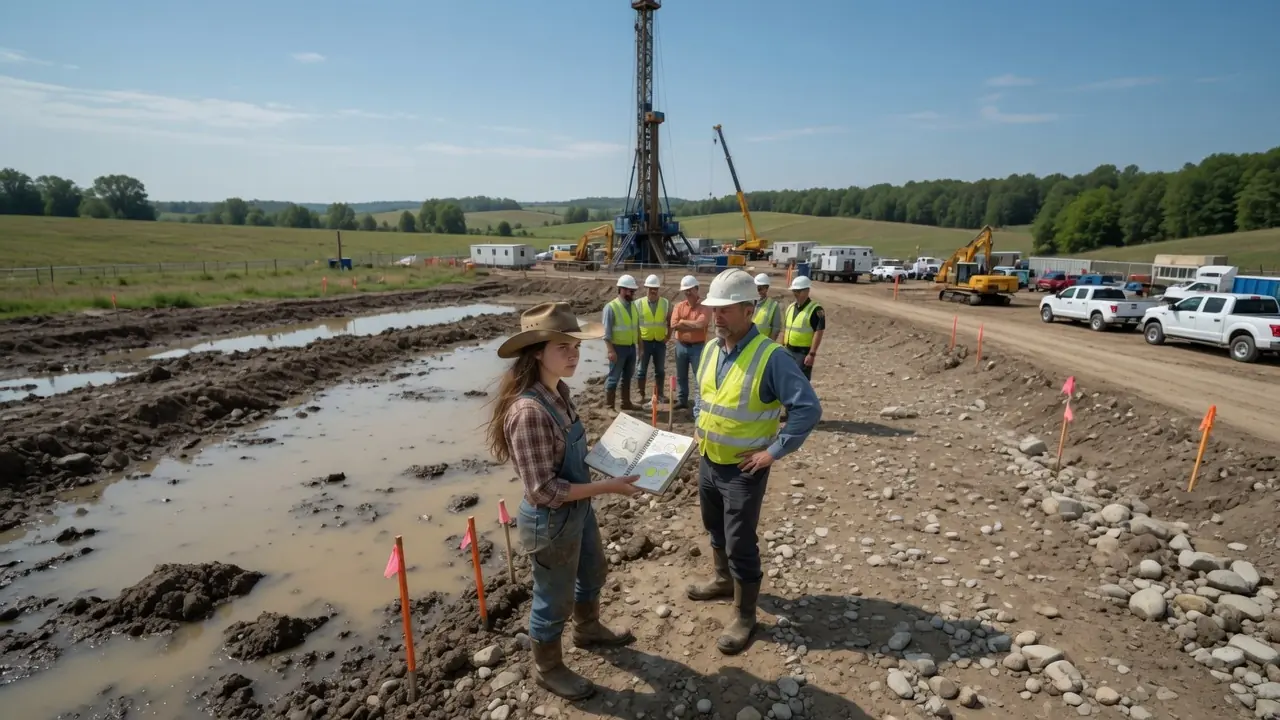
The rig’s mast rose above the trees like a steel tower. Its platform covered an area larger than the Harper farmhouse. Generators, mud pumps, fuel tanks, and control trailers surrounded it.
Horizon Renewables placed security fencing around the site.
Lily watched from the edge of her family’s upper field.
The cattle would not graze near the eastern fence anymore.
They had used that pasture for years.
Now they stopped forty yards from the construction boundary and turned back.
Lily recorded it.
April 6.
Entire herd avoiding east ridge.
Ground dry. No visible reason.
Two weeks later, she noticed fence posts leaning toward the drilling site.
Not away from the wind.
Toward the ridge.
She measured the angle with a homemade plumb line.
Three degrees.
Then five.
The ground beneath them was moving.
Lily compared the observation with an entry from two years earlier.
A shallow depression had formed near the same line after heavy rain.
At the time, Walter called it a breathing place.
“What does that mean?” Lily had asked.
“Sometimes air moves through cracks under the ground. Soil settles above them.”
“Like a cave?”
“Maybe.”
“Why didn’t we dig?”
Walter smiled.
“Because a person doesn’t always improve a hole by standing over it with a shovel.”
Now the depression had lengthened.
Lily marked the points on graph paper.
They formed a line from the creek’s disappearing water toward the rig platform.
She spent three nights organizing her notes.
Rainfall.
Well levels.
Fence movement.
Creek losses.
Animal behavior.
Aerial images printed from public county maps.
Then she rode her bicycle to the Horizon project office.
The building was a row of portable trailers surrounded by gravel.
A security guard stopped her at the gate.
“Employees only.”
“I need to speak with Mr. Vale.”
“Appointment?”
“No.”
“Then you can call the office.”
“I’ve called six times.”
The guard looked at the thick notebook beneath her arm.
“School project?”
“No. Safety issue.”
That drew a laugh from another guard inside the booth.
The first guard was less amused.
“What kind?”
“The drilling platform may be above a limestone void.”
The second guard stepped outside.
“You’re the farm girl.”
Lily looked at him.
“What?”
“Vale mentioned you. Kid who thinks she found a cave.”
“I didn’t say a cave. I said a void system.”
“Big difference.”
“It is.”
He shook his head.
“You need to leave.”
Lily placed photocopies of her maps against the glass.
“Please give him these.”
The first guard took them reluctantly.
Then Martin Vale walked from the nearest trailer carrying a hard hat.
He recognized Lily.
“You again.”
“The ground is settling.”
Vale looked toward the guards.
“Where?”
“Along our eastern fence. It lines up with the drilling platform.”
“We have monitoring instruments.”
“Have they moved?”
“No.”
“Then they may be in the wrong places.”
One guard turned away to hide a smile.
Vale’s face hardened.
“Our instruments cost more than your farm.”
Lily looked directly at him.
“That doesn’t make them correctly placed.”
The smile disappeared from the guard’s face.
Vale stepped closer.
“Listen carefully. Our site has been surveyed by licensed engineers, hydrogeologists, and federal consultants. We drilled exploratory cores at twenty locations.”
“How far apart?”
“That information is proprietary.”
“If you missed the openings between them, the cores could look solid.”
Vale stared at her.
Lily opened the notebook.
“The creek loss increased after you began drilling. The family well dropped sixteen inches in three weeks without drought. Fence posts are tilting toward your site. Cattle refuse to cross the ridge. There’s a new depression—”
“That is enough.”
“I can show you dates.”
“You can show me a child’s notebook.”
“It’s seven years of records.”
“It is mud, guesses, and farm stories.”
Lily’s face flushed.
Vale took the photocopies from the guard, glanced at the first page, and dropped them into a waste bin.
“If you enter the site again, you will be reported for trespassing.”
“I’m trying to stop someone from getting hurt.”
“You are interfering with a major infrastructure project.”
Several workers had gathered near the trailer.
A young technician laughed.
“Maybe let her inspect the rig, Martin. She brought crayons.”
More laughter followed.
Lily closed the notebook.
Vale pointed toward the gate.
“Escort her out.”
The first guard hesitated.
Then he walked beside her.
He did not touch her, but the humiliation was clear enough.
Workers watched a sixteen-year-old girl in muddy boots being removed from a two-hundred-million-dollar project because she had dared to question men with titles.
At the gate, the guard lowered his voice.
“My name’s Ben.”
Lily looked at him.
“I’ll keep the maps out of the trash.”
“Why?”
“My grandfather mined limestone. He used to say a ridge could be hollow and still grow trees.”
Lily studied him.
“Then tell them.”
“I need the job.”
“So does everyone standing over that hole.”
Ben looked back at the rig.
“I’ll mention it.”
“Mentioning isn’t warning.”
She rode home.
That evening, Walter found her sitting in the equipment shed with the notebook closed beside her.
“What did they say?”
“They laughed.”
“People laugh when the alternative requires them to stop what they’re doing.”
“They threw out the maps.”
Walter sat beside her.
“Were the maps wrong?”
“No.”
“Then paper isn’t improved by respect.”
“They have engineers.”
“Engineers can be right.”
“I know.”
“They can also be wrong.”
“I know.”
Walter picked up the notebook.
“What matters is whether you are willing to be wrong.”
Lily frowned.
“What?”
“You don’t warn people because you need to defeat them. You warn them because you believe the danger is real. Then you keep checking yourself.”
Lily reopened the notebook.
Together, they reviewed every measurement.
They repeated the fence-line survey the following morning.
The posts had shifted another half degree.
Daniel called the county emergency management office.
The official who answered promised to forward the concern to Horizon.
No one visited.
Lily emailed photographs to the state geological survey.
An automated response said reviews could take thirty days.
The next night, heavy rain moved over Briar Glen.
It was not unusual rain.
Only two inches.
But the lower creek behaved differently.
Water rose quickly, then vanished almost completely beneath the limestone bank.
At 1:12 in the morning, Lily felt a vibration through the farmhouse floor.
Not thunder.
A low pulse.
Then another.
She ran downstairs.
Daniel was already awake.
“Blasting?” he asked.
“They aren’t scheduled tonight.”
A glass trembled inside the kitchen cabinet.
Walter entered from the hall wearing his robe.
“The ground’s moving.”
They stepped onto the porch.
Across the ridge, work lights surrounded the drilling rig.
A generator droned.
Then one of the lights tilted.
Only slightly.
Lily saw it.
“The platform.”
Daniel reached for his phone.
At the construction site, the night crew had begun extending the borehole.
The drill head was nearly three hundred feet below the surface when mud pressure dropped suddenly.
A junior engineer named Rosa Chen saw the change first.
“Circulation loss.”
The operator adjusted the pumps.
Pressure continued falling.
“That’s not normal,” Rosa said.
Martin Vale stood inside the control trailer reviewing production delays.
“It happens in fractured limestone.”
“We lost forty percent.”
“Add drilling mud.”
The crew increased the flow.
Thousands of gallons disappeared into the borehole.
Nothing returned.
Rosa looked at the ground-pressure sensors.
One reading flickered.
Then went blank.
“Sensor six is offline.”
Vale did not look up.
“Electrical fault.”
“Sensor seven is dropping.”
Outside, a worker shouted.
The gravel near the eastern stabilizer had begun sinking.
At first, it resembled water draining through sand.
Then a crack opened.
Three inches wide.
Ten feet long.
It raced beneath the rig platform.
“Shut it down!” Rosa shouted.
The operator hit the emergency controls.
The drill stopped rotating.
But the ground did not.
The eastern stabilizer sank six inches.
Then a foot.
Steel screamed.
Workers began running.
Vale emerged from the trailer.
“What happened?”
Rosa pointed toward the spreading crack.
“Collapse!”
The platform tilted.
A fuel line ruptured.
Alarms erupted across the site.
The main mast leaned toward the east.
Men scrambled through mud and rain, abandoning tools, vehicles, and control stations.
For one suspended second, the twenty-million-dollar rig remained balanced above the opening.
Then the limestone roof beneath it failed.
The ground folded inward.
The eastern half of the platform vanished first.
The mast rotated slowly, almost gracefully, before accelerating into the darkness.
Steel beams snapped.
Floodlights swung through the rain.
The rig, its motors, pumps, and hundreds of feet of drill pipe dropped into the earth with a sound that shook windows across Briar Glen.
A cloud of dust, steam, and pulverized rock erupted above the site.
The final section of the mast disappeared ten seconds later.
Where the rig had stood, there was now a black crater more than a hundred feet across.
Lily watched from the ridge.
She did not feel satisfaction.
Only terror.
“Were people on it?” she asked.
Daniel was already driving toward the site.
“Stay here.”
“I know the ground.”
“Stay here!”
The command was sharper than anything he had ever said to her.
Lily stopped.
Daniel’s truck disappeared down the road.
Emergency sirens began rising from town.
At the project gate, confusion had overtaken procedure.
Workers stood in the rain, counting one another.
One man had a broken leg.
Two suffered burns from the fuel line.
Rosa Chen had a deep cut along her forehead.
But everyone was alive.
The emergency shutdown and her warning had given them just enough time to run.
Martin Vale stood near the crater covered in mud.
He stared into the darkness.
Ben, the security guard, approached him.
“The girl told you.”
Vale did not respond.
“She told all of you.”
“Not now.”
“She gave you the line.”
Vale turned.
“What?”
“The direction of the void. From the Harper creek to the platform. She drew it.”
“How do you know?”
Ben looked at him.
“Because I took her maps out of the trash.”
By sunrise, the collapse had become national news.
A twenty-million-dollar drilling rig had disappeared into an underground cavern at a major renewable-energy construction site.
Horizon Renewables released an immediate statement calling it an unforeseeable geological event.
The phrase appeared on television before investigators reached the property.
Lily heard it from the farmhouse kitchen.
Unforeseeable.
Her notebook lay on the table.
Daniel turned off the television.
“They knew you warned them.”
“They’ll say I didn’t know enough.”
Walter poured coffee.
“Knowing enough and being listened to are different matters.”
At nine that morning, three black SUVs entered the Harper driveway.
Martin Vale stepped out with Horizon’s legal counsel and the project director, Evelyn March.
They did not bring an apology.
They brought documents.
Daniel met them near the porch.
“You have five minutes.”
Evelyn March was in her fifties, with silver hair and the calm manner of someone used to controlling difficult meetings.
“We understand Lily made several observations regarding groundwater.”
“She warned your engineer.”
“We are investigating all communications.”
“You threw her maps in a trash can.”
Vale looked away.
March continued.
“We would like copies of her notebooks.”
“No.”
“They may assist the investigation.”
“They’ll assist your lawyers.”
“Our concern is public safety.”
Daniel laughed once.
“Public safety arrived after your machine disappeared.”
Lily came onto the porch.
March looked at her muddy boots, then at the notebook beneath her arm.
“Lily, we need to understand what you observed.”
“I tried to tell you.”
“I wasn’t personally informed.”
“Your company was.”
March held out a hand.
“May I see the notebook?”
“No.”
“Why?”
“Because yesterday it was childish mud and guesses. Today it’s evidence.”
Vale’s face tightened.
March studied Lily more carefully.
“What do you want?”
“The site closed until someone maps the entire system.”
“That decision requires scientific review.”
“Then review it.”
“We are.”
“By the same people who missed it?”
March lowered her hand.
“Our attorneys will contact your family.”
Daniel stepped forward.
“You do that.”
They left without the notebooks.
That afternoon, state geologists arrived.
Unlike Horizon’s executives, Dr. Samuel Ortega sat at the Harper kitchen table and listened.
He examined all twelve notebooks.
Not only the recent one.
He studied rainfall records, well levels, creek-loss sketches, soil depressions, and maps of cattle behavior.
“You measured this fence line yourself?” he asked.
“Yes.”
“How?”
“String, stakes, plumb weight, and a carpenter’s level.”
“Margin of error?”
“About half a degree, maybe more in wind.”
Ortega nodded.
“You wrote that?”
“Every measurement has the tool and conditions.”
He looked at Daniel.
“She has better field notes than some graduate students.”
Lily did not smile.
“Did the rig fall into a cave?”
“Not exactly.”
Ortega spread a geological map across the table.
“Probably a connected karst system. Water dissolved the limestone over thousands of years, creating channels and chambers. Some were filled with sediment. Drilling changed the pressure and opened pathways. The rain accelerated movement.”
“Why didn’t the surveys see it?”
“Survey methods interpret the ground from limited points and signals. A narrow chamber or clay-filled void can be difficult to distinguish.”
“But the creek showed it.”
“Yes.”
“The fence showed it.”
“Yes.”
“The well showed it.”
“Yes.”
Ortega looked at the notebooks.
“Your records captured change over time. Their surveys captured snapshots.”
The state ordered the project suspended.
Federal safety investigators followed.
Then the first twist emerged.
The original geophysical survey had not entirely missed the void.
A junior consultant had flagged an anomalous zone beneath the drilling platform eleven months earlier.
The finding appeared in an internal report.
Martin Vale had received it.
He classified the anomaly as low confidence and recommended no additional drilling because relocating the platform would delay construction and cost nearly eight million dollars.
Vale denied suppressing anything.
Then Ben provided Lily’s discarded maps.
Rosa Chen supplied the pressure readings from the night of the collapse.
A Horizon technician recovered emails showing that Vale had been warned of unusual mud losses two weeks before the accident.
The incident was no longer about a teenage girl seeing what experts could not.
It was about experts seeing enough to worry—and executives deciding delay was more dangerous than the ground.
But the deeper twist came from Lily’s oldest notebook.
Dr. Ortega noticed a recurring symbol in her early maps.
Small black crosses marked along the creek.
“What are these?”
“Places Grandpa said old miners drilled test holes.”
Walter looked up.
“My father worked limestone before the war.”
“Was there a mine here?”
“Not officially.”
Walter walked to the attic and returned with a metal cash box.
Inside were faded photographs, property maps, and payroll receipts from the 1930s.
One map showed an abandoned limestone extraction tunnel extending beneath the Pike property.
The company name was Briar Glen Mineral Works.
The tunnel had never appeared on modern county records.
It had been dug during the Depression, operated for six years, and abandoned after a collapse killed four workers.
The company sealed the entrance.
Then its records disappeared during a courthouse fire in 1948.
Walter’s father had kept copies because he did not trust the owners.
The old tunnel intersected the natural cave system.
Horizon had not merely drilled above unknown limestone voids.
It had built directly above a forgotten industrial excavation.
March’s attorneys claimed no one could have known.
Then investigators found a title document inside Horizon’s land-acquisition files.
Attached to it was a 1939 mineral survey referencing “subsurface workings” beneath the ridge.
The document had been reviewed during purchase.
Someone removed it from the final engineering package.
The project director had signed the acquisition approval.
Evelyn March had known there might be old mine workings.
Perhaps not their exact location.
But enough to demand investigation.
The project had been rushed because Horizon needed to meet a federal funding deadline.
Missing the deadline would cost the company more than thirty million dollars in subsidies.
So the anomaly was minimized.
The title warning was buried.
Lily’s maps were thrown away.
And a twenty-million-dollar rig was positioned above a chamber that had been waiting nearly ninety years to collapse.
Public opinion changed rapidly.
At first, newspapers described Lily as the “farm girl who outsmarted engineers.”
She disliked that version.
“I didn’t outsmart them,” she told a reporter. “I watched longer.”
The sentence spread across the country.
Universities invited her to speak.
Television programs requested interviews.
Companies offered scholarships before she had completed her junior year.
Lily accepted almost none of them.
She agreed to testify at the state safety hearing.
Martin Vale sat at one table with attorneys.
Evelyn March sat at another.
Lily placed her twelve notebooks on the witness desk.
One senator lifted the oldest.
“You began these records at nine years old?”
“Yes.”
“Did you understand geology then?”
“No.”
“What did you understand?”
“That the spring behind our barn stopped running after storms instead of during drought.”
The senator frowned.
“Why was that important?”
“Because it was backwards.”
She explained the creek.
The well.
The cattle.
The fence posts.
The pattern.
A lawyer for Horizon attempted to dismiss the observations.
“Miss Harper, you had no calibrated groundwater sensors, correct?”
“Correct.”
“No subsurface radar?”
“No.”
“No degree?”
“No.”
“So your conclusions were not scientific.”
Dr. Ortega shifted in his seat.
Lily remained calm.
“My conclusion could have been wrong.”
The lawyer smiled.
“Exactly.”
“That’s why I asked your company to investigate.”
The smile faded.
“I never told them to cancel the project because I knew there was a cavern. I told them the land was changing and their platform was in the direction of the change.”
The hearing room became quiet.
“You had better equipment,” Lily continued. “You had people trained to determine whether I was wrong. You chose not to check.”
The lawyer sat down.
The final investigation lasted fourteen months.
Horizon Renewables paid millions in fines and compensation.
The project director resigned.
Martin Vale lost his engineering license for professional misconduct and falsification of risk review records.
The Cumberland Ridge project was redesigned and moved nearly two miles west onto more stable ground.
It eventually opened, but only after complete karst mapping, groundwater monitoring, and consultation with local landowners.
No one called those consultations farm stories anymore.
The crater remained.
It was too unstable to fill immediately.
Geologists installed monitoring equipment around it and used remote cameras to map the underground chambers.
The missing rig was never fully recovered.
Parts of the mast were visible nearly two hundred feet below the surface, twisted among limestone columns and remnants of the old mine.
Horizon’s insurers wrote it off as a total loss.
The Harper farm changed too.
The collapse altered underground drainage and lowered the family well.
Horizon paid to connect the farmhouse and barn to a new water system. The company also compensated the Harpers for pasture damage and easements used during the investigation.
Daniel used part of the money to repair the barn roof.
He refused every offer to sell the farm.
Lily continued keeping notebooks.
The new ones were cleaner because a university sent waterproof field books.
She still carried the old spiral volumes in plastic bags.
Two years after the collapse, Lily received a full scholarship to study geology and hydrology at the University of Kentucky.
On her final evening before leaving for college, she walked to the lower creek with Walter.
The water still disappeared beneath the limestone bank.
But monitoring tubes now stood along the ridge.
A government warning sign marked the unstable zone.
Walter sat on a flat stone.
“You’ll have machines now.”
“I’ll have access to them.”
“Same thing.”
“No, it isn’t.”
He smiled.
“Good answer.”
Lily opened a fresh notebook.
“What should I write?”
Walter looked at the water.
“The same thing you always did.”
“What changed?”
“No.”
He pointed toward the creek.
“What stayed the same while everyone else changed around it.”
Lily wrote the date.
Then she looked across the valley.
The rebuilt drilling site was barely visible in the distance.
For years, powerful people had treated local knowledge as something backward.
A farmer’s memory.
An old miner’s map.
A child’s notes.
Things beneath the importance of models, contracts, and deadlines.
But the earth did not care who held a degree.
It did not care how much the drilling rig cost.
It did not care how many experts signed the report.
Limestone dissolved.
Water followed gravity.
Unsupported ground failed.
The truth waited beneath them, patient and exact.
Years later, Dr. Lily Harper returned to Briar Glen as part of a national research team studying rural groundwater and hidden karst systems.
She was thirty-one.
Her grandfather had passed away.
Daniel still ran cattle on the farm.
The old blue notebook rested inside a glass case at the county museum, though Lily insisted the exhibit include the maps of the dead miners and the names of the workers who escaped the rig collapse.
She did not want the story reduced to a clever teenager being proven right.
That was only the dramatic part.
The real lesson was quieter.
Warnings rarely arrived wearing authority.
Sometimes they appeared as cattle refusing a pasture.
A fence leaning half a degree.
A stream carrying less water than it had the year before.
A line written by a child with mud on her hands.
On the anniversary of the collapse, Lily spoke to a group of engineering students beside the fenced crater.
The rusted tip of the drilling mast remained visible far below.
One student asked the question she had heard hundreds of times.
“How did you know?”
Lily looked at the ground.
“I didn’t.”
The students seemed surprised.
“I knew enough to be concerned. That is different.”
She held up a copy of her old notebook.
“The dangerous people in this story were not the ones who lacked information. They were the ones who believed uncertainty gave them permission to continue.”
She closed the notebook.
“Good science is not proving you are the smartest person in the room. It is knowing when the room needs to stop and look again.”
Wind moved through the grass.
Below them, water traveled through unseen chambers beneath the Kentucky hills.
It had been moving there long before the Harper family arrived.
Long before Horizon Renewables.
Long before anyone placed a price on the machine that disappeared into the earth.
The engineers had spent millions trying to see beneath the surface.
Lily had spent seven years watching what rose above it.
And in the end, the muddy notebook they laughed at did not defeat science.
It reminded science to listen.