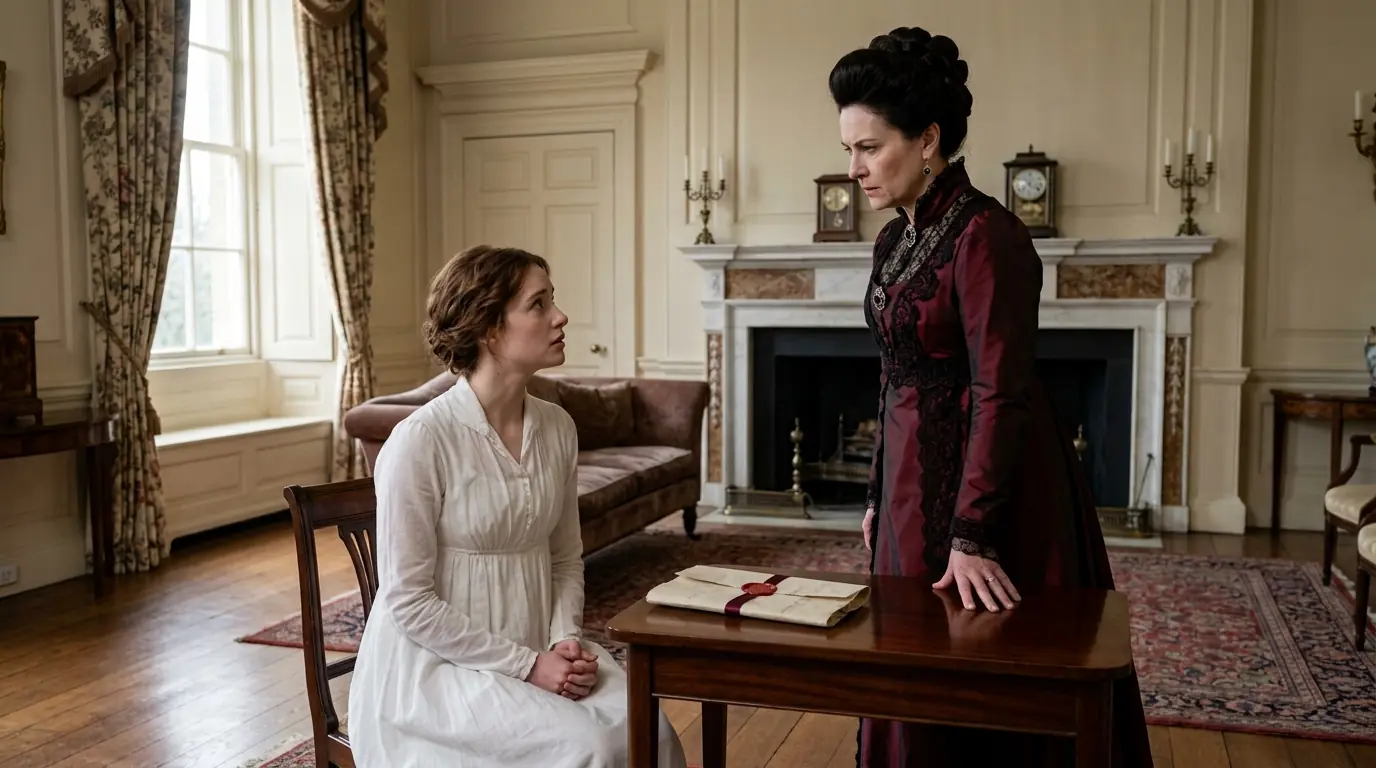
Margaret Allison, two-and-twenty, disgraced of name and emptied of dowry, stood in the cold hall of Thornveil Keep and listened to a stranger inform her that she had been married to him as a punishment. "You understand the arrangement?" said the Duke of Ashcombe, not looking up from the ledger open upon the table between them. "Your uncle wished you settled where you could do no further damage to his name. I required a wife who would not expect affection.
We have, between us, solved each other's difficulty." She had been married four hours. She had not yet removed her gloves. "I understand it perfectly, Your Grace," she said, and her voice did not shake, though something in her chest had gone very still and very cold, like a pond closing over with the season's first frost. "You require a Duchess who will not trouble you with sentiment.
I require a roof that is not my uncle's." "Indeed. We are, as you say, well matched." He looked up then, and she saw for the first time the eyes that half of London had described to her in whispered, gleeful warnings before the wedding. Pale gray, unreadable.
The eyes of a man the ton called ruined, though no one could say precisely what had ruined him, only that he had returned from the Peninsula seven years past a different man than the one who had left, and had not danced, nor courted, nor smiled in any drawing room since. Thaddeus Vane, eighth Duke of Ashcombe, was three-and-thirty, immensely wealthy, entirely friendless, and, if her uncle's gleeful malice on the morning of the settlement was to be believed, exactly the husband a disgraced young woman of compromised reputation deserved. What no one in that house yet understood was that her uncle had chosen the cruellest possible punishment by mistake, believing he was condemning her to a marriage with a broken, dangerous man, when in fact he had delivered her into the one household in England where no one yet knew her shame, and where, for the first time in eleven months, she might simply be allowed to exist without being looked at as though she had personally set fire to the family's good name. "You will have the East Wing," the Duke said, returning his attention to the ledger. "Mrs. Hartwell, my housekeeper, will show you to it.
I dine alone. I do not require you at table, nor in company, nor in my study, which is through that door, and forbidden to you. Beyond these terms, you may consider yourself at liberty to do as you please, provided you trouble no one in the doing of it." "And if I should wish to be useful, Your Grace?" He did look up at that.
A flicker, gone almost before it arrived. "No one in this house has wished to be useful to me in some years, Mrs. Vane. I find I no longer expect it." She did not weep. She did not protest.
She did not ask what had taught a man to expect so little of the people around him. The hall smelled of cold stone and tallow, and beneath it, faintly, of sandalwood and leather and ledger ink, as though the Duke himself had been pressed into the very walls of the house by long habit, present even in his absence. She marked the smell the way she had learned, in eleven ruinous months, to mark every detail of a room that might later matter, a habit born of disgrace, the particular vigilance of a woman who has learned that safety lies in noticing what others overlook. She only inclined her head, gathered the small dignity that remained to her, a worn trunk, a single trusted maid, and the ruin of a reputation she had not earned, but would carry regardless. She then went to find the East Wing and Mrs. Hartwell, and whatever life could be salvaged from the wreckage of an arrangement built entirely on punishment.
The carriage ride to Thornveil that morning had been long and silent, the Duke having ridden ahead on horseback rather than share the conveyance with his bride. And Margaret had spent four hours watching the Northumberland country roll past the window. Bleak, beautiful, scoured by a wind that came off the coast with nothing to soften it. Fells the color of old bruises beneath a sky the color of a blade. She had thought, watching it, that she understood already the sort of man who chose to live at the very edge of England, where no one came who was not determined to, and where a wounded thing might go to ground undisturbed for years.
She had not expected, on arrival, to find the great hall swept and the silver gleaming, and a fire laid in every grate she passed, though no guests had been promised, and none, she suspected, ever came. It was the first inconsistency in the picture her uncle had painted her. A madman's house did not gleam. A madman's servants did not curtsy with quiet watchful hope, as though a new mistress might at last give them something to do besides endure. It would be many weeks before she learned precisely what had been done to her, and to him, and why a marriage designed as a humiliation might yet become the truest thing either of them had ever been given.
Her disgrace, when it had come, had come quietly, as disgraces among the gentry so often did. Not with scandal sheets and public denouncement, but with whispers at a card table, a withdrawn invitation, a mother's sudden coldness. Until Margaret understood, slowly and then all at once, that her engagement to Mr. Edmund Caro had been broken not by her own conduct but by a rumor her own cousin had planted that Margaret had been seen in compromising circumstances with a married viscount she had, in fact, met exactly twice both times in the presence of a chaperone. The rumor had not needed to be true. It had needed only to be believed and her cousin, Sophronia, who stood to inherit small remaining portion should Margaret never marry respectably had seen to its believing with the patient malice of a woman who had spent a decade resenting her cousin's prettier face and quicker mind.
Her uncle, Baron Pelham, guardian of what little fortune Margaret retained until her marriage or her twenty-fifth year had not troubled himself to discover the truth. It was, after all considerably less expensive to believe the worst of his niece than to defend her. And considerably more convenient to be rid of her entirely. Which was how, within a fortnight of the broken engagement he had arranged her marriage to the Duke of Ashcombe a man rumored mad, rumored cruel rumored to have done something unspeakable during the war that no decent family would forgive. And had presented the arrangement to Margaret not as a kindness but as precisely what a ruined girl deserved.
"You are fortunate he will have you at all," her uncle had said the morning of the settlement not meeting her eyes. "A man with his reputation cannot be particular." What her uncle had not said, and what Margaret would not learn for some months was that the Duke of Ashcombe had not been particular for reasons entirely separate from desperation. He had instructed his solicitor three years prior to refuse on his behalf every introduction, every hopeful mama's daughter, every calculated overture from families eager to attach themselves to a dukedom worth £11,000 a year. He had wanted no wife at all until the particular convenience of Margaret's ruin had presented itself to him as a transaction rather than a courtship.
A woman who required rescue and would not, he had calculated, expect to be loved for the rescuing. It was a calculation he would come, in time, to regard as the single greatest misjudgment of his adult life. Though on the morning of their wedding, he had believed it flawless. She had married Thaddeus Vane believing herself condemned to a monster and had found, within four hours, only a tired man with cold eyes and a ledger who wanted nothing from her but silence and who seemed, beneath the formality of his terms, less like a monster than like a man who had simply stopped expecting kindness to exist. But the question of what, precisely, had taught him to stop expecting it followed Margaret up the stairs to the East Wing like a draft beneath the door and she found she could not entirely set it down.
The East Wing of Thornveil Keep was cold and largely unused and smelled of beeswax polish laid down by hands that had given up hoping anyone would notice the care taken. Margaret noticed. She noticed the careful mending of the curtains, the silver polished though no guests came, the kitchen garden tended with more devotion than a household of two reclusive masters should require. She noticed, within her first week, that Thornveil Keep was not a house in decline as the gossip had promised her but a house held together by people who had not been thanked for it in a very long time. And she began, in the quiet, methodical way that had always been her particular gift, to thank them.
She thanked Mrs. Hartwell for the careful arrangement of the East Wing and watched the older woman's face perform an expression of pure astonishment as though gratitude were a foreign currency she had forgotten the value of. She thanked the under-gardener for the roses cut for her room and learned that no one had requested flowers in this house in seven years. She thanked the cook for a particularly fine soup and was told, in a rush of confided gratitude, that the Duke himself rarely noticed what he ate and had not complimented a meal since before the war. It was Mrs. Hartwell, on the fourth evening, who let slip, in the manner of a woman who has waited years for someone worth telling, that the household had once been a merry one before His Grace's elder brother died and the title passed where it was never meant to. And that the young master, who had gone to the Peninsula, a second son, had returned a Duke who flinched at the sound of a door closing too quickly and had not, to anyone's certain knowledge, slept a full night since.
"What happened to him there, Mrs. Hartwell?" Margaret asked, setting down the teacup with great care, as though the question itself were a fragile thing. "That, Your Grace, is not mine to tell." The housekeeper's eyes, kind but immovable, told Margaret the asking would yield nothing further. "But I will say this, whatever was done or whatever he believes he did, he has been paying for it every day since in a coin no one but himself can see.
If you are the sort of woman who notices what others overlook, and I begin to think you are, you will likely see the bill before he ever shows it to you." By the time the candles had burned low on her second week at Thornveil, Margaret understood that she had not married a monster. She had married a household in mourning for a man who had not yet permitted himself to stop grieving, though no one would tell her yet what precisely it was he grieved. The first crack came on a Tuesday in October when a letter arrived for the Duke bearing a Spanish seal. And Margaret, passing the study door, forbidden to her but not soundproof, heard him make a sound she would spend a long while trying to name.
Not weeping. Something quieter and worse than weeping. The sound of a man absorbing a blow he'd been braced for and dreading regardless. She did not enter. She did not ask.
She only ensured that evening that a tray was left outside the study door with the soup the cook had labored over and a measure of the brandy Mrs. Hartwell had quietly indicated was his particular comfort. And a note that read only "I am told you take this with very little water. I have asked for very little water. M." In the morning the tray was empty and the note was gone.
And the Duke said nothing of it at all except that at dinner which he had never once shared with her he appeared in the doorway of the small dining room, hesitated as though uncertain of his welcome in his own house, and said, "I'm told the soup was good." "It generally is," Margaret said and did not look up from her plate sensing correctly that to make more of the moment than it was would frighten it away entirely as one does not chase a half-tamed thing across an open field. He sat. He did not speak again for the length of the meal, but he sat and ate and did not leave until she had finished. And Margaret understood that something enormously small had just occurred.
And that enormously small things were in a house like this the only honest currency available. It became, without either of them remarking upon it, a habit. He appeared three nights in five, said little, ate what was placed before him, and left when she rose, as though the dinner itself were a fragile structure that conversation might collapse. Margaret learned not to press him. She had spent eleven months learning the precise cost of being pressed by people who believed they were owed her explanations, and she would not visit that particular cruelty upon a man who had, after all, asked nothing of her but silence, and had received, instead, something gentler than either of them had bargained for.
It would have been easy, in the weeks that followed, to mistake the slow thaw between them for something simpler than it was. He began, without announcement, to leave books upon the small table in the East Wing sitting room. Agricultural treatises at first, as though testing whether she possessed the wit to follow them, and Margaret, who had managed her late father's modest estate accounts for three years before his death, and her uncle's guardianship had stripped her of the privilege, returned them within two days with marginal corrections that made the Duke, Mrs. Hartwell reported with poorly suppressed delight, laugh aloud in his study for the first time in living memory. "You have found an error in my drainage calculations," he said at dinner that evening, the closest thing to warmth she had yet heard in his voice. "I confess I did not expect my wife to understand drainage calculations."
"I confess I did not expect to marry a man who left ledgers where his wife might find them, your grace, if he did not wish her opinion of them," Margaret said. "You may take the correction or leave it, but the lower field floods every March, regardless of what either of us wishes to believe about it." He took the correction. The lower field, drained properly for the first time in a decade, did not flood that March, and the tenant who farmed it sent up, unprompted, a basket of the first spring vegetables with a note of thanks addressed with careful deliberation to Her Grace the Duchess rather than to the duke. The first time, Mrs. Hartwell informed her with evident satisfaction, that any tenant on the estate had thought to thank the house for anything at all.
He began, after the drainage, to leave novels instead of treatises and poetry. And once, memorably, a slim volume of Spanish verse with no explanation offered and none requested. Though Margaret noted the binding was worn soft at the spine in the particular way of a book read many times by hands that had loved it before it ever reached her table. She did not ask him about the Spanish verse. She had learned by then the precise shape of the silences he guarded and had begun to suspect that Spain itself was the center of whatever grief Mrs. Hartwell would not name.
But the gentleness was not the thaw. The thaw came on the night Margaret found him in the stables at two in the morning sitting on an overturned crate beside a mare she did not recognize. His coat discarded, his cravat undone, looking at nothing at all with the particular stillness of a man who has run out of places to put his grief. "Your Grace?" "Don Esteban kept this mare's dam," he said without turning.
I bought the foal eight years ago before I knew what I would become to him or he to me. She is the only living thing on this estate who remembers who I was before the Peninsula. He laughed, a short, terrible sound. I find I have very little use for anyone who remembers. Margaret did not retreat to the safety of silence, though every lesson of her ruined season had taught her that a woman's safety lay in saying nothing at all to a powerful man's pain.
She came instead and sat upon the cold stable floor beside the crate, heedless of her dressing gown, and said, "Then tell me who you were, your grace, so that someone besides a horse might remember it with you." He was a long while answering. When he did, the story came out of him the way confession comes from men who have held it too long in too small a space, in pieces, badly ordered, the worst parts arriving first. He had been, before the war, a younger son with no expectation of the title, sent to the Peninsula with a regiment he loved, and a friend, Esteban Ruiz de Alvarado, a Spanish officer attached to his command, whom he had loved as he had loved no man before or since, and whom he had, through a misjudged order given in the chaos of a retreat he should have called an hour earlier, sent directly into a French ambush that killed him, along with eleven other men under Thaddeus's command. "They called it bad fortune," he said.
"My commanding officer called it bad fortune. I call it what it was. I gave an order I had no business giving because I wished to be seen as decisive, and eleven men paid for my wishing it. And Esteban paid for it twice over because I had promised his mother I would bring him home." He looked finally at Margaret, and his pale eyes in the lantern light were the eyes of a much older man.
"I came home a duke because my brother died of fever the same season, and I've spent every year since being congratulated on an inheritance I would burn to the ground to undo, by people who cannot conceive that a title might feel like a punishment rather than a prize. "It is why you wished for a wife who would not love you," Margaret said quietly. It was not a question. It is why I wished a wife who would not look at me as though there was something in me worth the looking. I had grown tired of disappointing the hopeful.
You at least expected nothing. I thought we might suit one another's emptiness very well. "You are not empty, Your Grace." Margaret's voice was steady, though her heart was not. You are a man who has been punishing himself for seven years for a single decision made in chaos by a younger man who had not yet learned that command sometimes asks the impossible of everyone and gets it wrong regardless of love or diligence.
I have watched you these eight weeks feed a household that adores you and believes you do not know it. I have watched you leave Spanish poetry for a wife you married despite a rumor neither of us made true. A man who has stopped feeling does not do either of those things. You have not stopped feeling, your grace. You have only stopped permitting anyone to see it, which I begin to think is the loneliest occupation in England.
He did not answer her at once, but he reached in the lantern light and took her gloved hand in his, the first time he had touched her since the wedding itself, and held it as though it was something he had forgotten he was permitted to want. It was perhaps a fortnight later that the second crisis arrived, this one wearing her uncle's face. Baron Pelham descended upon Thornveil Keep unannounced with Sophronia at his side, ostensibly to inquire after his niece's adjustment to married life, and in truth, as Margaret discerned within the first quarter hour of his visit, to determine whether the Duke's reputed instability had yet rendered the marriage vulnerable to annulment, an outcome that would return Margaret's portion to her uncle's management and remove the inconvenient evidence that his cruelty had, against all his intentions, produced a contented household. "You look well, my dear," her uncle said, in the tone of a man inspecting livestock he had expected to find diminished. "Marriage to His Grace has not proved as difficult as we feared."
"Marriage to His Grace has proved a considerable improvement upon my previous circumstances, Uncle," Margaret said, with the particular sweetness she had learned in eleven months of disgrace to wield like a blade. "I find I am very well treated here." It was Sophronia who overreached, as the grasping always eventually do, remarking with poorly concealed satisfaction that surely the Duke's well-known instability of temper must make for trying evenings, and that she had heard, from sources she would not name, that he had been seen weeping in his stables like a madman only the fortnight past. The room went very still. "You have been informed upon by my own household," the Duke said, entering from the study door at precisely the moment his presence could do the most damage.
His voice quiet, in the manner of men who do not need volume to command a room. "I find that curious, Baron, given that the only persons present in my stables that night were myself, my wife, and a horse who has not, to my knowledge, learned to write a letter." He let the silence finish his accusation before continuing. "I begin to understand the source of my wife's eleven months of unjust disgrace, gentlemen. It appears the Pelham family's particular gift is the manufacture of rumor from circumstances no one present can verify, deployed against women too dignified to defend themselves in the manner such accusations require.
I wonder whether the magistrate would find the pattern as illuminating as I do." Baron Pelham's color drained with admirable speed. "Your Grace, I assure you—" "You assured my niece's intended husband of a falsehood, but cost her a respectable engagement and eleven months of her family's protection. And you assured me at our settlement that I was acquiring damaged goods rather than a woman of considerable courage who had survived your family's cruelty with more grace than any of you deserved. I find your assurances, Baron, have grown rather thin with use.
Sophronia, who had never in her life mastered the art of recognizing the moment a battle was lost, attempted one further thrust. You forget yourself, sir. Whatever Margaret has told you of our family, you would do well to remember that a duke's reputation, once questioned, suffers as readily as anyone's. The whole of London still wonders what truly happened on the Peninsula. The temperature of the room dropped considerably.
Margaret felt, rather than saw, the duke go very still beside her. Not the stillness of a man wounded, but the stillness of a man who has, at last, located precisely where to direct seven years of carefully banked fury. You will not speak of the Peninsula in this house, he said. And though his voice did not rise, every servant within hearing later swore it had carried through three rooms. You have not earned the right to invoke a tragedy you cannot begin to comprehend in service of frightening a young woman who has done nothing in her life to deserve the cruelty your family has manufactured against her twice now for the crime of being more capable and better loved than either of you will ever be.
"Get out of my house, Baron. Take your daughter with you." If either of you sets foot on Thornveil land again, you will discover precisely how thin my patience has grown alongside my assurances." They did not return. It was the work of three further weeks, conducted with the quiet, devastating thoroughness of a man who had once commanded soldiers, and had not entirely lost the habit of winning engagements, for the Duke to trace Sophronia's original rumor to its source.
A jealous lady's maid, bribed with promises Sophronia had never intended to honor, who proved, once located and treated with a kindness she had not expected from a Duke's solicitor, entirely willing to set the truth down in a sworn statement. The statement, circulated with surgical precision among precisely the drawing rooms that had condemned Margaret eleven months before, did not merely clear her name. It returned to her, intact and unlooked-for, the standing she had been told she would never again possess. Sophronia Pelham found herself, by the spring, in want of any engagement at all. The particular irony of Sophronia's situation was discussed with relish in every drawing room that had once relished Margaret's supposed disgrace, but Margaret did not gloat.
She found, somewhat to her own surprise, that she did not wish to. She had what she wanted. The wanting of further vindication seemed, against the quiet contentment she had found at Thornveil, a smaller and meaner ambition than it would once have been. "You did not have to do that," she told her husband the evening the statement reached its final drawing room. "I had made my peace with the disgrace."
"I had a household. I had—" She paused and found the word with some surprise. "I had you. It was enough." "It was not enough for me," the Duke said.
"I spent seven years believing myself a man who brought ruin to everyone who trusted him. I find I am rather attached to the discovery that I might, instead, occasionally be a man who sets a ruin right. You will permit me the indulgence, Margaret. I have had very few of late."
It was the first time he had used her given name. There are arrangements, and there are marriages, and the two are rarely the same. But Margaret Vane, Duchess of Ashcombe, standing in the doorway of a study that was no longer forbidden to her, in a house that had stopped mourning the moment she arrived in it, found that hers had become, against every calculation either party had made on their wedding day, very nearly the latter. The Spanish mare foaled in the spring, a leggy chestnut filly the Duke named, without explanation needed, Esperanza, hope, in the language of the friend he had finally permitted himself to grieve aloud, in Margaret's hearing, rather than alone in a cold stable at two in the morning.
Mrs. Hartwell wept openly at the christening of a horse, which she declared to anyone who would listen, was the first sentimental occurrence at Thornveil Keep in a decade, and credited entirely to the new Duchess. Margaret accepted that verdict with the particular grace of a woman no longer required to defend her own worth to anyone. Years later, when their eldest daughter asked how her parents had come to marry, having heard some garbled version of the story from a gossiping aunt, the Duke would tell her only that her mother had been sent to him as a punishment, and had instead arrived as the single mercy he had not believed himself permitted to receive. He was a man no one had thought to know, found against every intention of the cruelty that arranged it by a woman who had simply bothered to look.