The laughter in Dust Creek died the instant Silas Vale looked at the kneeling woman outside the saloon and asked the question nobody else had bothered to ask. “Who decided she has to wear that?” His voice was not loud, but it carried across the porch and into the street because the whole town had gone still around it.
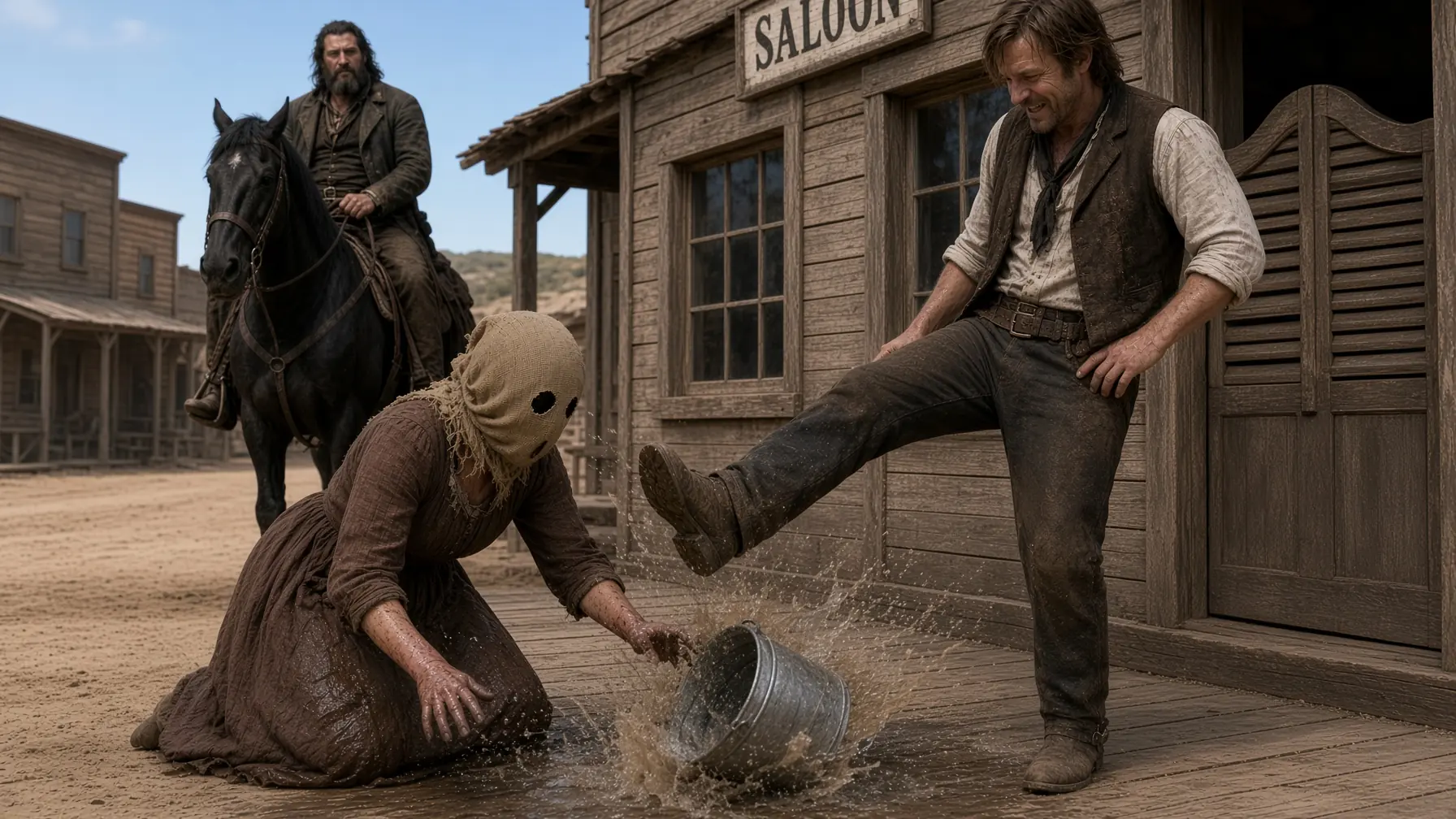
For three years, almost nobody in Dust Creek had called the woman by her real name. Abigail Fletcher had become Sackface, a cruelty repeated so often that even children who had never known the story shouted it when she passed. Every afternoon she scrubbed Jedediah Cole’s saloon porch with gray soap water while a coarse burlap sack covered her head, tied at the neck with twine and cut with two narrow eye holes.
Tobias Roach stood over her that afternoon with one boot on the porch rail and a whiskey glass in his hand. He was broad, red-faced, and mean in the lazy way of men who had been protected from consequences too long. When Abigail finished one section of boards, Tobias kicked her bucket over and sent dirty water across the work she had just completed.
“Start again, Sackface.”
The men around him laughed. Someone inside the saloon called, “Don’t let that thing slip off, Tobias. You’ll scare every horse in town.”
Abigail lowered her head. She picked up the bucket, walked to the pump, and began filling it again without answering. Three years had taught her that words rarely helped when everyone listening had already decided which version of the truth entertained them more.
Then Tobias stepped behind her and pressed the dull edge of his spur against her calf. Abigail gasped and nearly dropped the bucket. The laughter rose for half a second, then stopped when the black horse reached the edge of the porch.
Its rider had come down from the northern mountains wearing a weathered brown coat and carrying enough dust to suggest he had been on the road for days. Silas Vale was forty-four, tall without being imposing on purpose, with gray eyes, a dark beard touched with silver, and the stillness of someone who conserved movement because he had learned how quickly trouble noticed unnecessary motion. He looked at Abigail first, not Tobias.
“Stand up,” Silas said.
Tobias grinned. “She’s working.”
Silas turned his head toward him. “I wasn’t speaking to you.”
The grin disappeared.
Abigail rose slowly. Her legs trembled from kneeling, and one hand went instinctively to the knot beneath her chin as though making sure the sack remained secure. Silas noticed the gesture but said nothing about it.
He reached into his pocket and tossed a silver coin into the dirt near the pump. “Would you water my horse?”
Jedediah Cole appeared in the doorway before Abigail could move. He was a narrow man with a waxed mustache and an apron stretched across a belly earned mostly from standing near whiskey rather than drinking it. “She does not touch customers’ animals.”
Silas looked at him. “Why?”
“She’s cursed.”
“Is that a town ordinance?”
A few men shifted uncomfortably.
Jedediah’s face hardened. “You passing through?”
“Yes.”
“Then pass.”
Silas looked toward Abigail again. “Do you want to water the horse?”
Nobody had asked her what she wanted in so long that the words almost confused her. She looked from Silas to Jedediah, then toward Tobias, who watched with his jaw tight. Finally she gave a small nod.
Silas handed her the reins.
The horse was a massive black gelding named Bishop, sixteen hands high and scarred along one shoulder from an old mountain accident. Abigail approached him carefully, expecting the animal to shy at the sack the way townspeople claimed every living thing would. Bishop only lowered his head and breathed against her sleeve.
She led him to the trough.
The whispering began behind her.
“He doesn’t care.”
“Horse doesn’t know better.”
“Maybe it can’t smell her.”
Silas heard all of it. He leaned against the hitching rail and watched Abigail stroke Bishop’s nose with fingers that had forgotten what it felt like to touch something without waiting for ridicule.
Across the street, Clayton Hayes stood behind the bank window.
He was fifty-one, wealthy by Dust Creek standards, and owned half the freight wagons moving through the county. His father had built the first brick warehouse beside the rail spur, and Clayton had inherited enough land and influence that disagreements with him tended to become other people’s problems. He watched Abigail beside Silas’s horse and did not look amused.
That interested Silas.
He had learned years earlier that fear often announced itself as anger when a powerful man did not want anyone to notice it. Clayton’s face had changed the moment Abigail touched the horse. Silas filed that away.
He rented a room above the general store rather than the saloon.
The shopkeeper, Martha Bell, gave him the key and warned him quietly, “Best not involve yourself with Abigail.”
Silas set his saddlebag down. “Why?”
Martha looked toward the window. “Because Clayton Hayes doesn’t like questions.”
“That is not an answer.”
“It’s the safest one.”
Silas smiled without humor. “Usually means it’s the least useful.”
That evening, he returned to the saloon for food. Abigail was still there, carrying a bucket toward the alley while Jedediah counted receipts behind the bar. She moved slowly, shoulders bent, the burlap darkened with sweat along the neck.
Jedediah shoved the bucket toward her when she passed. “You missed the back steps.”
Abigail stumbled.
His hand rose.
Silas caught his wrist.
The room went silent.
“Let her go,” Silas said.
Jedediah tried to pull free. Silas did not tighten his grip or threaten him; he simply held the wrist until Jedediah understood the hand was not moving. Then Silas released him.
Clayton Hayes entered from the back room.
“You’re becoming inconvenient,” Clayton said.
Silas looked toward Abigail. “So I’ve been told.”
Clayton wore a dark vest, polished boots, and a gold watch chain across his stomach. He looked less like a frontier villain than a successful businessman, which was one reason people trusted him when they should have inspected his stories more closely. He walked to the bar and poured himself a drink.
“She owes money,” Clayton said. “A great deal of it.”
Abigail’s shoulders tightened.
“For what?” Silas asked.
“The orphanage fire.”
Silas looked at him. “A court entered judgment against her?”
Clayton’s expression changed by a fraction.
“The town council assessed damages.”
“That was not what I asked.”
Jedediah stepped forward. “You some kind of lawyer?”
“No.”
“What are you, then?”
Silas looked at him. “A man who notices when answers keep changing.”
Clayton set down his glass. “The orphanage burned three years ago. Four children nearly died, the building was destroyed, and Abigail Fletcher was seen outside carrying a lantern shortly before flames went up.”
“By whom?”
“Me.”
Silas nodded. “Anyone else?”
Nobody answered.
Clayton continued. “She had nowhere to go after that. We let her work down the debt instead of driving her out.”
Silas looked at Abigail. “Do you have a written account of what you supposedly owe?”
Her head moved slightly.
“No.”
Clayton answered for her. “Five thousand dollars remains.”
Silas turned. “How was it calculated?”
“Repairs, lost property, medical expenses.”
“Orphanage was rebuilt?”
“No.”
“Then what repairs?”
Clayton’s jaw tightened.
Silas pulled a leather pouch from inside his coat and set it on the bar. He opened it just enough for several gold coins to show.
Jedediah stopped breathing for a second.
Silas said, “I am not buying a woman.”
Clayton stared at the gold.
“I am offering to place the amount you claim she owes into escrow with the county clerk until somebody produces the judgment, accounting, or agreement that created the debt.”
The room became very still.
Silas continued. “If the debt is legitimate, the money can satisfy it. If it is not, you do not get a cent.”
Clayton’s face hardened. “That isn’t how things work here.”
“Then tomorrow we find out how the law says they work.”
Abigail looked at Silas through the holes in the sack.
He turned toward her. “If you want to leave Dust Creek tonight, I can take you as far as the sheriff’s station in Carson Crossing and pay for a room.”
She did not move.
“No debt gives me ownership of you,” he said. “No payment gives me ownership either.”
Clayton laughed sharply. “She won’t go.”
Silas looked at Abigail. “Do you want to?”
For a long time she said nothing.
Then she whispered, “Yes.”
Clayton’s smile vanished.
Silas did not ride out immediately because traveling mountain roads after dark with a frightened stranger made no sense. Instead, he paid Martha Bell for another room above the store, and Martha agreed to let Abigail sleep there with the door locked from inside. Silas took a chair in the hallway.
Abigail never removed the sack.
The next morning they rode north before sunrise, Abigail on a borrowed mare Martha arranged and Silas beside her on Bishop. They did not flee like fugitives because Abigail had committed no crime proven by any court. Silas left written notice at the county clerk’s office in Carson Crossing that he was prepared to secure any lawful civil claim if proper documentation existed.
Nothing arrived.
For three days they climbed into the high country.
Abigail spoke little at first. She kept the sack on while drinking water, eating, sleeping beneath a blanket, and washing at secluded streams. Silas never asked her to remove it.
On the second evening, she finally said, “You think I’m foolish.”
“No.”
“For wearing it.”
“No.”
She looked toward the fire.
“Everyone says my face is ruined.”
“Have you seen it?”
Her hands tightened around the tin cup.
“Once.”
“When?”
“After the fire.”
Silas waited.
“Clayton brought me a mirror.”
“What did you see?”
Abigail’s breathing changed.
“Bandages.”
Silas looked at her.
“You never saw your healed face?”
She shook her head.
The answer disturbed him more than a scar would have.
Abigail explained slowly. She had suffered burns on her hands and neck the night of the orphanage fire, enough that the local doctor wrapped part of her jaw and cheek for several days. Clayton visited while she recovered and told her the wounds had destroyed her face.
“He said children cried when they saw me.”
“Did you see the children?”
“No.”
“He gave me the sack when the bandages came off.”
Silas stared into the fire.
“And you never looked in a mirror after that?”
“I tried once.”
“What happened?”
“Jedediah broke it.”
Silas’s expression changed.
“He said mirrors were cruel.”
The mountain wind moved through the pines.
Silas said, “Abigail, I think somebody worked very hard to make sure you never checked what they told you.”
She began shaking.
Not dramatically.
It started in her fingers and moved upward until she clutched the cup with both hands.
Silas did not reach for her.
“You do not have to take it off tonight.”
She whispered, “What if they were right?”
“Then your face has scars.”
“And if they weren’t?”
Silas looked toward her.
“Then we have a much larger problem.”
On the fourth night, Abigail sat across from him beneath a sky crowded with stars. She had spent most of the day touching the knot under her chin without loosening it. When she finally asked Silas to help because her hands would not stop shaking, he moved slowly enough that she could stop him at any moment.
His fingers touched the twine.
“If I take it off,” Abigail whispered, “I don’t know what happens.”
Silas looked at her. “We find out what was true.”
The knot loosened.
Then hoofbeats came through the darkness.
Fast.
Silas froze.
Abigail seized the sack with both hands.
The rider appeared between the trees less than a minute later, and Silas recognized Martha Bell’s nephew, Thomas, before reaching for the rifle beside his bedroll. Thomas pulled his horse to a stop so sharply the animal nearly slid.
“You need to come back,” he said.
Silas stood. “Why?”
“Clayton’s telling everyone you kidnapped her.”
Abigail went rigid.
Thomas continued. “But that’s not the worst part.”
“What is?”
“Old Dr. Merritt came into town this morning.”
Abigail stopped breathing.
Dr. Samuel Merritt had treated her after the fire.
He had moved east two years earlier to live with his daughter and had not been seen in Dust Creek since. Thomas explained that Martha had sent him a telegram after Abigail left because she remembered the doctor once saying something strange about the burns.
“What?”
Thomas looked at Abigail.
“He says your face was never badly burned.”
Silence filled the camp.
Abigail touched the sack.
Thomas continued carefully. “Your hands were burned. Small section near the neck too. He says your face had smoke injury and superficial blistering, but nothing that should’ve left major scars.”
Abigail made a small sound.
Silas crouched in front of her.
“Do you want to finish?”
She looked at him through the eye holes.
“Yes.”
He untied the sack.
This time nobody interrupted.
The burlap loosened around her neck and fell into her lap.
Abigail kept her eyes closed.
Silas did not speak.
Moonlight fell across a face that had been hidden for three years.
There were scars.
But not the ones Clayton described.
A pale line ran from Abigail’s left jaw toward her ear. Another faint patch crossed part of her neck where heat had reached exposed skin. Her eyebrows had grown unevenly, and one small area near her temple remained lighter than the rest.
That was all.
She was not disfigured.
She was not monstrous.
She was simply a thirty-year-old woman who had been forced to live inside someone else’s lie until she became afraid of her own reflection.
Abigail opened her eyes.
Silas held out the polished metal lid from his coffee tin.
It was not a perfect mirror.
It was enough.
She looked.
For several seconds her face remained completely empty.
Then her mouth opened.
“No.”
Silas said nothing.
She touched her cheek.
“No.”
Her fingers moved over the jawline, the temple, the bridge of her nose.
“No.”
The word changed each time she said it.
First disbelief.
Then grief.
Then anger.
Abigail grabbed the burlap sack from her lap and threw it into the fire.
It caught quickly.
Flames climbed the rough fibers while she watched without blinking.
Thomas looked away.
Silas did not.
When the sack collapsed into black ash, Abigail stood.
“We’re going back.”
Silas looked at her. “Tomorrow.”
“Now.”
“No.”
She turned sharply.
“You have spent three years obeying men who told you pain had to happen immediately because they said so.”
Silas pointed toward the dark trail.
“We ride at first light when we can see the road.”
Abigail stared at him.
Then, for the first time, she smiled.
Barely.
“You’re very irritating.”
“So I’ve been told.”
They rode into Dust Creek shortly before noon the following day.
Abigail wore no sack.
People began coming out of shops before the horses reached the center of town. Someone dropped a crate outside the general store.
Jedediah walked onto the saloon porch.
Tobias followed.
Then Clayton Hayes emerged from the bank.
For perhaps ten seconds, nobody recognized her.
That was the cruelest part.
The same people who had mocked Abigail’s supposed deformity for three years had so completely accepted the sack as her identity that an uncovered woman riding beside Silas looked like a stranger.
Then Martha Bell stepped into the street.
“Abigail?”
The name moved through the crowd.
Abigail dismounted.
Nobody laughed.
Clayton’s face lost color.
Silas saw it.
Abigail saw it too.
She walked toward him.
“What happened to my face, Clayton?”
He recovered quickly.
“You were badly burned.”
“Where?”
Clayton looked around.
“You know where.”
“No.”
Abigail stepped closer.
“I want you to say it.”
Clayton’s jaw tightened.
“Your face.”
“Dr. Merritt says otherwise.”
That landed.
The crowd shifted.
Clayton said, “Merritt is old.”
Dr. Samuel Merritt stepped from inside Martha’s store.
Clayton stopped.
The doctor was seventy-two, thin, white-haired, and leaned heavily on a cane. He had arrived before them and spent the morning speaking with the county sheriff and examining records Martha had preserved.
“I remember her injuries,” Merritt said. “Because I treated them.”
Clayton turned. “After three years?”
“I kept records.”
Merritt held up an old medical ledger.
“The burns to Miss Fletcher’s face were superficial.”
Whispers spread through the street.
Abigail asked the next question.
“Who started the orphanage fire?”
Clayton laughed.
“You did.”
“Why?”
“You were seen with a lantern.”
“By you.”
“Yes.”
“Anyone else?”
Silence.
Then another voice came from the crowd.
“I saw him there.”
Everyone turned.
The speaker was Amos Pike, a former stable hand who had left Dust Creek the year after the fire. He had returned with Dr. Merritt after Martha’s telegram reached relatives along the rail line.
Clayton stared at him.
Amos swallowed.
“I saw Mr. Hayes behind the orphanage before the smoke started.”
“What were you doing there?” Sheriff Nathan Cole asked.
“Taking a horse back to the livery.”
“Why didn’t you say anything?”
Amos looked down.
“Because Mr. Hayes paid my father’s debts.”
Clayton’s face hardened.
Amos continued. “And because he told me if I spoke, my family would lose the house.”
The street went quiet again.
This time it was not the silence of fear.
It was calculation.
People were beginning to rebuild three years of memory with different pieces.
Sheriff Cole had already begun checking the old fire file after Martha contacted him. The original report contained Clayton’s statement, Abigail’s confused account, and almost nothing else because the orphanage director had died from smoke inhalation days later. No formal arson charge had ever been filed against Abigail.
That surprised half the town.
They had believed she was convicted.
She had not been.
The council had passed a resolution assigning her “community restitution duties” based largely on Clayton’s claims, but no judge had ever entered a five-thousand-dollar judgment against her. Even the supposed debt had been assembled from estimates and repeated as law until nobody remembered who had first written the number.
Silas looked at Clayton. “Where is the accounting?”
Clayton said nothing.
Sheriff Cole asked again.
No answer.
The deeper truth emerged slowly over the following weeks rather than in one glorious confession.
County records showed Clayton Hayes had been negotiating to purchase the orphanage property before the fire. The land sat near a planned freight spur and became considerably more valuable once the orphanage operation ended. Six months after the fire, a company controlled by Clayton acquired the damaged property at a fraction of its previous value.
That was motive.
It was not yet proof of arson.
Then Amos provided more.
He remembered seeing Clayton’s wagon behind the orphanage that evening with two sealed kerosene tins normally stored at the freight warehouse. One of those tins was later listed as missing inventory, but the loss had been written off without investigation.
A former bookkeeper produced an older ledger.
Two days after the fire, Clayton reimbursed himself for “damaged lamp oil stock.”
The sheriff sent the evidence to the territorial prosecutor rather than deciding guilt himself.
Silas approved of that.
Dust Creek had already ruined one life by allowing a town to confuse accusation with judgment.
They did not need another version of the same mistake merely because everyone now disliked Clayton.
Abigail stayed at Martha Bell’s house during the investigation.
The first weeks without the sack were harder than anyone expected.
She covered mirrors.
Turned away when strangers looked too long.
Once, while walking past the saloon, she heard someone laugh inside and immediately raised both hands toward her head before remembering there was nothing to hide.
Healing did not arrive simply because the lie had been exposed.
Three years had taught her body habits truth could not remove in three days.
Silas remained in town longer than he planned.
He repaired a collapsed fence for Martha, helped Sheriff Cole compare freight records, and spent several afternoons outside the stable pretending he had no reason to watch Abigail relearn the street. She noticed.
“You’re hovering,” she told him.
“I’m sitting.”
“Near wherever I happen to be.”
“Coincidence.”
“You’ve been repairing the same saddle strap for forty minutes.”
Silas looked at the strap.
“That explains why it’s excellent.”
Abigail laughed.
The sound startled both of them.
She stopped.
Then laughed again.
The territorial grand jury indicted Clayton on charges related to fraud, coercion, falsified records, and the fire investigation after additional evidence tied him more directly to the property scheme. The arson allegation itself remained contested until a former employee testified that Clayton had ordered him to move kerosene into a storage room adjoining the orphanage two days before the fire under a false maintenance pretext.
Clayton denied everything.
He had a capable lawyer.
The trial lasted twelve days.
Abigail testified on the eighth.
She walked into court with her face uncovered.
Clayton’s attorney asked whether she hated his client.
“Yes.”
A murmur went through the room.
The attorney seemed pleased.
Abigail continued. “You asked if I hate him. I do.”
The attorney asked whether hatred affected her memory.
“Probably.”
“So your testimony may be unreliable?”
“My feelings might be.”
Abigail looked toward the jury.
“That is why you should look at the records.”
Silas lowered his eyes to hide a smile.
Clayton was convicted of fraud, coercion, falsification, and several offenses connected to the scheme surrounding the orphanage property. The jury did not convict him on every count related to the fire because the evidence on exactly how ignition occurred remained incomplete.
Abigail was initially disappointed.
Then Dr. Merritt said something that changed her mind.
“A court that only gives you the verdict you want is not a court.”
She thought about that for a long time.
The town council formally withdrew the old restitution resolution.
It issued an apology to Abigail.
The apology mattered less than people expected.
What mattered more was that the council opened its archived records, reviewed how a private accusation had become years of coerced labor, and adopted procedures requiring actual hearings, written evidence, representation, and judicial involvement before anybody could be compelled to satisfy a civil claim.
Jedediah Cole lost his saloon license for a period after investigators documented his participation in forcing Abigail to work without proper wages and withholding payment under the supposed debt arrangement. Tobias Roach left town before the hearing concerning his own conduct, though civil claims followed him through an attorney in the next county.
Nobody was dragged into the street.
Nobody was whipped.
Nobody was humiliated beneath cheering crowds.
Abigail did not want that.
“I know what public humiliation does,” she said.
The sentence ended several arguments.
Clayton’s property holdings were later used in part to satisfy judgments arising from the fraud case and related civil claims. Abigail received compensation, though nowhere near enough to purchase back three years of her life.
Money could buy land.
Food.
Clothing.
Security.
It could not buy Tuesday afternoons she had spent kneeling outside a saloon while people laughed above her.
That was simply gone.
She eventually used part of the settlement to purchase six acres near the edge of town.
Silas helped repair the small cabin standing there.
He never offered to build her an enormous house.
Abigail did not need rescuing into another man’s life.
She needed a door whose key belonged to her.
Their relationship grew quietly.
He left Dust Creek twice for work in the mountains and returned both times because he wanted to, not because Abigail asked. The second time, Bishop walked directly to her fence before Silas had fully dismounted.
“You trained him badly,” Abigail said.
“He has excellent judgment.”
“He begs for apples.”
“Excellent judgment.”
She scratched Bishop beneath the jaw.
Then looked at Silas.
“You staying?”
“For a while.”
“How long is a while?”
Silas considered.
“Long enough to become inconvenient.”
Abigail smiled.
“That may take years.”
“Good.”
They married two winters later in Martha Bell’s back garden.
Small ceremony.
No spectacle.
Abigail wore her mother’s repaired blue dress and no veil.
Silas said that seemed appropriate.
Years afterward, people still told the story incorrectly.
They said a mountain man came to Dust Creek and rescued Sackface.
Abigail hated that version.
Silas did too.
He had asked a question.
He had offered transportation.
He had helped protect space around her while evidence caught up.
But Abigail had removed the sack.
Abigail had testified.
Abigail had walked back into town with her face uncovered and asked Clayton Hayes to repeat the lie where everyone could finally examine it.
That distinction mattered.
The town had also changed the story of the fire into something simpler than it deserved.
People liked saying they had been fooled by Clayton.
Some had.
Others had simply enjoyed the cruelty too much to investigate.
That was harder to admit.
One afternoon, years later, Tobias Roach’s younger brother came to Abigail’s property.
He stood awkwardly beside the gate.
“I laughed,” he said.
Abigail waited.
“I never kicked the bucket.”
“I know.”
“I never touched you.”
“I know.”
“But I laughed.”
“Yes.”
He looked down.
“I’m sorry.”
Abigail studied him.
Then said, “Good.”
He looked surprised.
“That’s it?”
“That is what an apology is.”
She opened the gate.
“It does not purchase anything.”
He nodded.
Then left.
Abigail kept no burlap sack.
She had burned the original in the mountains, and when Jedediah later produced another one from the saloon storage room during the investigation, she refused to keep it as evidence after the case closed. “I have enough reminders,” she said.
Instead, she kept Dr. Merritt’s old medical ledger page.
Not because she needed proof of what her face looked like.
Because it contained the first written evidence that somebody had recorded what actually happened before fear and power rewrote it.
Silas framed the page without asking.
Abigail complained that it looked strange hanging above the desk.
He offered to move it.
She told him not to.
The old orphanage land eventually became part of a public school.
Dust Creek debated for months over whether to name a building after Abigail.
She refused.
“Name it for the children who were there.”
So they did.
A small brass plate near the entrance listed the names of every child who had survived the fire and the two people who had died from smoke injuries afterward.
Abigail’s name appeared nowhere.
She preferred that.
One spring morning, she walked past the school while children were arriving.
A little girl stopped and looked at the pale scar along Abigail’s jaw.
“What happened?”
The girl’s mother looked horrified.
Abigail smiled.
“I got burned a long time ago.”
“Did it hurt?”
“Yes.”
The girl thought about that.
“Does it hurt now?”
“Sometimes.”
Then the child ran inside because the school bell rang.
No scream.
No horse collapsing.
No devil frightened from the road.
Just a question.
And an answer.
Silas stood beside Abigail watching the children disappear through the doorway.
“You all right?”
She touched the scar once.
“Yes.”
He nodded.
They started walking home.
Behind them, Dust Creek went on doing what towns do.
People bought flour.
Argued about prices.
Complained about weather.
Gossiped.
Forgot things.
Remembered others incorrectly.
But nobody called Abigail Sackface anymore.
Not because the town had finally discovered she was beautiful.
That would have been almost as cruel.
Her dignity had never depended on whether the sack concealed scars, beauty, or anything in between.
The real horror had been that nobody thought she deserved the truth about her own face.
Nobody except one stranger who looked at a woman on her knees, looked at the men laughing around her, and asked the question Dust Creek should have asked three years earlier.
Who decided this?
Once people were finally forced to answer, the whole lie began to come apart.