Raymond Alcott had spent forty years learning how restaurants lied. They lied with polished counters, smiling menus, cheerful slogans, and framed mission statements about family, comfort, and care. They lied most loudly when the owner was watching and most quietly when a tired stranger walked in with nothing impressive on his wrist. That was why Raymond walked into Magnolia Table Location 41 wearing a wrinkled gray polo, faded khaki pants, old sneakers, and a twelve-dollar Casio watch.
The diner sat at the end of a strip mall in Durham, North Carolina, tucked between a laundromat and a check-cashing store with peeling window stickers. Its red sign still glowed over the entrance, but two bulbs in the letter G had burned out. Through the window, Raymond saw vinyl booths, chrome counter edges, coffee pots behind the register, and a few customers bent over plates of meatloaf, biscuits, and fried chicken. It was not the prettiest restaurant in his company, but it was the last one.
Magnolia Table had started with one diner in Atlanta, built by a man who had once washed dishes for six dollars an hour and listened to customers call him “boy” without ever learning his name. That man was Raymond, though nobody in Durham knew it. Now he owned forty-one family restaurants across the Southeast, restaurants built for working people who wanted dinner to feel human. At sixty-seven, with a tired heart and a board of directors pushing him to sell, he had ninety days to find a successor who understood what the company was supposed to be.
The board wanted Ridgewell Capital to buy Magnolia Table for four hundred and ten million dollars. They called it a clean exit, a historic liquidity event, and an opportunity to protect shareholder value. Raymond called it a slow funeral with nicer paperwork. Ridgewell would cut staff, shrink portions, install ordering tablets, and squeeze every restaurant until the diners still wore the same sign but no longer carried the same soul.
So Raymond had made a private decision. He would visit every Magnolia Table location as a nobody, order a simple meal, then pretend he could not pay. He was not looking for perfect employees, polished speeches, or policy language. He wanted to know what a person did when a hungry stranger had no money and no reward waited for helping him.
The first forty restaurants had failed. In Birmingham, the manager told him to leave before customers got uncomfortable. In Savannah, a server apologized but said she could not risk her paycheck. In Raleigh, one kind young man offered to call someone for him, but still watched Raymond walk out hungry. In Jacksonville, a waitress laughed and said the diner was not a charity.
Each failure went into Raymond’s leather notebook. Forty pages, forty entries, each marked with the same word in black ink. Failed. By the time he reached Durham, only one blank page remained. If Location 41 failed, he would sign the sale papers, let Ridgewell take the company, and accept that the thing he built had already died before the lawyers arrived.
The bell above the diner door gave a thin metallic ring when Raymond stepped inside. Several customers looked up, then looked away after deciding he was no one important. Behind the register stood Mason Reed, the shift manager, a square-shouldered man in his forties with a neat beard, a pressed black shirt, and the restless authority of someone who believed a name tag made him powerful. He glanced at Raymond’s shirt, his shoes, his watch, and his tired face before Raymond even reached the counter.
“Table for one,” Raymond said politely. Mason’s eyes moved past him toward two better-dressed customers walking in behind him. “Counter’s open,” Mason said, pointing without warmth. Raymond nodded, walked to the counter, and sat on the red vinyl stool nearest the coffee machine. He noticed the cracked sugar dispenser, the tired waitress carrying three plates at once, and the way Mason watched every dollar while ignoring every face.
The waitress was named D’Niece Carter. Raymond read the name on her badge when she came over with a menu tucked beneath her arm. She was in her early thirties, with tired eyes, steady hands, and a calm face that looked like it had learned to survive long shifts without giving cruelty permission to enter. “Evening, sir,” she said, placing the menu in front of him. “You take your time, and I’ll get you started with water.”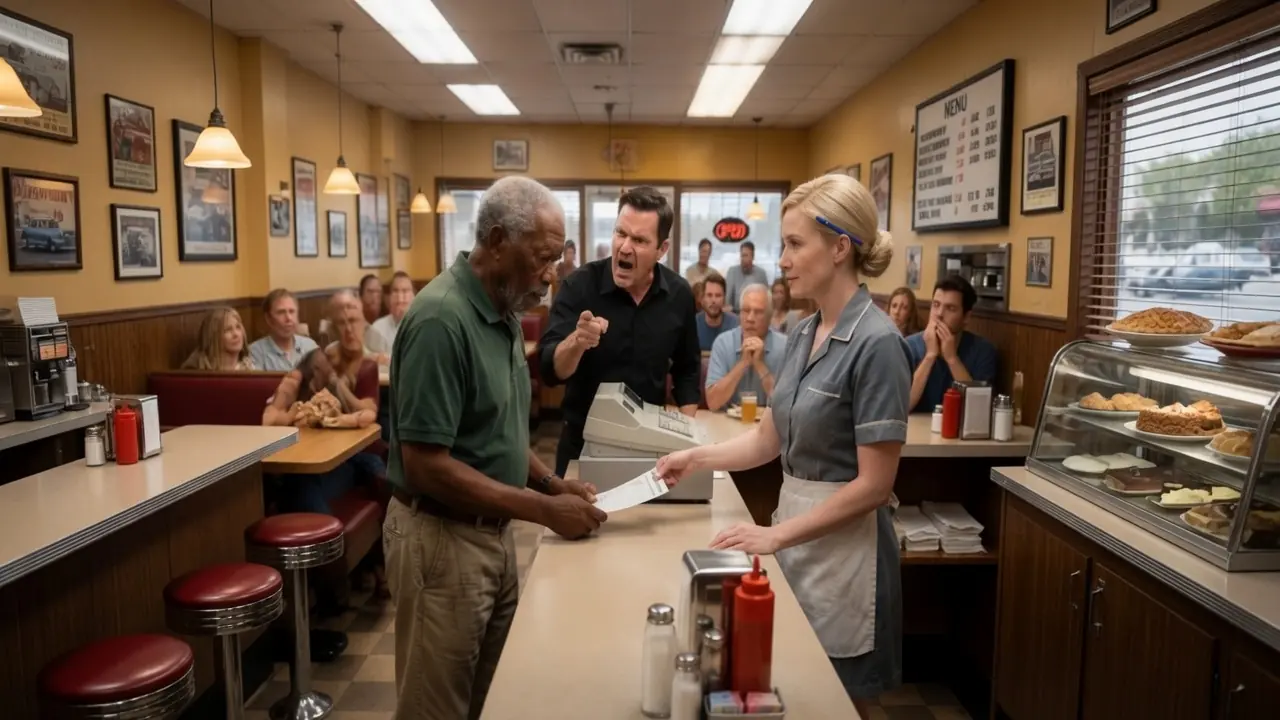
“Thank you,” Raymond said. The word made her pause, as if not every customer gave it to her. She returned with a glass of water and a napkin folded neatly beside it. Raymond opened the menu, though he already knew what he would order. Meatloaf plate, mashed potatoes, green beans, cornbread, and black coffee.
When D’Niece came back, Raymond lifted his eyes from the menu. “I’ll take the meatloaf plate and black coffee, please.” Before she could write it down, Mason stepped from behind the register and leaned against the counter. His eyes narrowed with the faint smile of a man who believed he had seen a problem before it happened. “That meal is eighteen dollars,” Mason said. “Can you pay first?”
The diner seemed to quiet by one degree. D’Niece’s pen stopped above her pad. Raymond looked at Mason, then down at the menu, then back up again. “I planned to pay after eating, like everyone else,” he said gently.
Mason’s mouth twisted. “People like you always say that before wasting our time.” The words were not shouted, which somehow made them worse. They were delivered with the comfort of habit, as though Mason had spoken them many times before and never once questioned the taste they left in the room. A woman in a booth near the window lowered her fork but said nothing.
D’Niece’s jaw tightened. “Mason,” she said quietly. He lifted one hand without looking at her. “Walk away, D’Niece.” His eyes stayed fixed on Raymond, judging the old polo, the tired posture, the ordinary shoes. “If you’ve got money, pay now. If you don’t, don’t sit down.”
Raymond held still. In his pocket, he carried a wallet with more available credit than Mason would earn in a decade, but the test depended on silence. He had heard worse words in more expensive rooms, spoken by men with cufflinks and board seats. Still, the old injury stirred in him, the memory of being sixteen at a sink full of dishes while an owner called him boy and customers pretended not to hear.
“I only asked for dinner,” Raymond said. “Not trouble.” Mason leaned closer over the counter. “Then bring money next time, or don’t waste a table.” D’Niece moved from beside the coffee machine and stepped between Mason and the register. Her face was calm, but her hand gripped the pen hard enough to whiten her knuckles.
“He can sit in my section,” she said. Mason turned sharply. “You don’t get to decide that.” “I do if I’m serving him,” D’Niece answered. Raymond watched her closely, feeling the blank page in his notebook open inside his mind. The whole company seemed to hang in the space between her voice and Mason’s next insult.
Mason snatched a blank guest check from the counter and slapped it down. “Fine,” he said. “Write your little charity note on it. When he walks out without paying, it comes out of your tips.” D’Niece reached for the check, but Mason blocked her with his arm. She did not argue. She simply reached around him, took the paper, and placed it flat in front of Raymond.
The pen moved quickly. Three words, written in firm blue ink. Sit down, sir. D’Niece slid the check toward Raymond and held his gaze.
Raymond looked down at the words. His hands went still. For a moment, he did not see the diner in Durham, the customers pretending not to watch, or Mason standing there with a smug look on his face. He saw himself at sixteen, hungry after a double shift, standing at a register with empty pockets while no one cared whether he ate.
“You do not even know who I am,” Raymond said softly. D’Niece’s expression did not change. “I know enough,” she said. “You are still a person.” The words entered the room like a match struck in darkness. Mason scoffed, but nobody else laughed.
D’Niece took Raymond’s menu and wrote his order without asking again. “Meatloaf plate, mashed potatoes, green beans, cornbread, black coffee,” she said. “You want gravy on the potatoes?” Raymond swallowed once before answering. “Yes, please.” She nodded as though nothing unusual had happened, then turned toward the kitchen.
Mason followed her halfway across the floor. “You’re paying for it,” he hissed. D’Niece did not turn around. “Then I’m paying for it.” “You think being soft makes you special?” he said. She stopped, looked back, and answered loud enough for Raymond to hear. “No. I think being cruel makes you small.”
The customers reacted with tiny movements. A man at the counter looked down at his coffee. A mother in a booth pulled her child’s plate closer. An elderly couple exchanged a glance heavy with shame. Raymond sat silently, letting the restaurant reveal itself one face at a time.
The food arrived twelve minutes later. D’Niece set the plate down carefully, added extra cornbread, and placed the coffee beside his water. “Eat while it’s hot,” she said. Raymond looked at the plate, then at her. “Thank you, Miss Carter,” he said, reading her badge again.
She gave a small smile. “Just D’Niece is fine.” Then she moved to another table before Mason could accuse her of standing there too long. Raymond ate slowly, not because he was hungry, though he was, but because every bite carried a weight he had not expected. The meatloaf was slightly dry, the green beans needed salt, and the cornbread was better than it had any right to be.
He finished the meal and waited for the final part of the test. D’Niece returned with the guest check, but she did not place it in front of him. Instead, she held it in her hand, already folded. “I covered it,” she said quietly. “You don’t need to explain anything.”
Raymond looked at her for a long moment. “That may cost you.” D’Niece gave a tired shrug. “A lot of things cost me. I try not to let my character be one of them.” Raymond almost smiled, but his throat tightened before the expression could fully form. He reached into his pocket, touched the leather notebook, and knew page 41 would not say failed.
Mason saw the exchange and stormed over. “Absolutely not,” he snapped, grabbing the check from D’Niece’s hand. “You are not comping food without permission.” D’Niece stood straight, though fear flickered in her eyes. “I said I would pay for it.” Mason jabbed the paper toward her face. “You’re not paying for anything if I take you off the schedule.”
Raymond rose from the counter stool. The movement was slow, but it shifted the room. Mason glanced at him with irritation. “You sit back down,” he said. D’Niece turned toward Raymond, her eyes warning him not to make it worse.
Raymond smiled faintly. “That was her instruction, wasn’t it?” Mason blinked. “What?” Raymond picked up the guest check with the three words still written across it. “Sit down, sir.” He folded it once and slipped it carefully into his pocket. “I think I will remember that.”
He left the diner without revealing himself. Mason called after him, “That’s right, walk away.” D’Niece watched Raymond through the window as he crossed the parking lot beneath the strip mall lights. She looked disappointed, not because she expected thanks, but because she thought the world had once again let a kind act disappear without consequence. She did not know Raymond had already called his driver.
The next morning, a black sedan stopped outside Magnolia Table before opening. Mason was inside counting the register drawer when two regional executives walked in with Raymond between them. This time, Raymond wore a sharp charcoal suit, polished shoes, and a watch old enough to look simple but expensive enough to buy the entire strip mall. Mason looked up, irritated at first, then confused.
D’Niece was filling salt shakers near the back booth. She saw Raymond and froze. For one second, her face carried the open shock of someone trying to place a stranger from a dream. Then she saw the executives beside him and stood slowly. Mason stepped forward with forced confidence. “Can I help you gentlemen?”
Raymond looked at him. “Yes, Mason. You can bring me yesterday’s closing report, your employee schedule, and the personnel file for D’Niece Carter.” Mason’s face tightened. “I’m sorry, who are you?” The regional director beside Raymond answered before Raymond could. “This is Raymond Alcott, founder and owner of Alcott Hospitality Group.”
The diner went silent. A cook visible through the kitchen window stopped moving. Mason’s mouth opened, but no sound came out. D’Niece gripped the edge of a booth, her eyes wide and stunned.
Raymond placed his leather notebook on the counter. “For four months, I visited every Magnolia Table location in disguise,” he said. “Forty restaurants forgot who we serve.” He opened the notebook and turned through the pages, each one marked failed. Then he stopped at the final page. Instead of failed, three words were taped there from the guest check. Sit down, sir.
Mason’s hands began to tremble. “Mr. Alcott, there must be some misunderstanding.” Raymond looked at him without raising his voice. “There was no misunderstanding when you asked whether I could pay before you would let me order.” Mason swallowed. “I was protecting the restaurant.” “No,” Raymond said. “You were protecting your prejudice with company property.”
D’Niece’s eyes filled, but she did not speak. Raymond turned toward her. “Miss Carter, yesterday you did what forty other locations failed to do.” She shook her head slightly, overwhelmed. “I just bought a man dinner.” Raymond’s expression softened. “You preserved the reason this company exists.”
Mason stepped forward quickly. “Sir, D’Niece violates procedure all the time. She is emotional with customers. She gives away food. She talks back.” The words tumbled out like coins from a broken drawer. D’Niece lowered her eyes, embarrassed to hear herself described like a problem. Raymond lifted one hand, and Mason stopped mid-sentence.
“You threatened to fire her for treating a hungry man with dignity,” Raymond said. “That tells me everything your performance reports did not.” Mason’s face reddened. “I didn’t know it was you.” Raymond’s eyes hardened. “You should not have needed to.”
The regional director slid a folder across the counter. Raymond opened it and removed two documents. “Mason Reed, effective immediately, your employment is terminated pending a full review of customer treatment, staff complaints, and register practices at this location.” Mason staggered back as though the words had struck him. “You can’t do that in front of everyone.”
Raymond looked around the diner. “You insulted people in front of everyone.” He closed the folder. “Accountability can stand in the same room.” Mason looked toward the kitchen, toward D’Niece, toward the executives, searching for someone willing to rescue him from the consequences of his own voice. Nobody moved.
Then Raymond turned to D’Niece. “Miss Carter, I would like to offer you Mason’s position as acting general manager, effective today.” D’Niece’s hand flew to her chest. “Me?” Raymond nodded. “With training, full salary adjustment, and authority to rebuild this restaurant the way it should have been run.” Her lips parted, but no words came.
“I don’t have a degree,” she finally whispered. Raymond smiled. “Neither did I when I washed dishes.” That sentence broke the room open. The cook in the kitchen smiled first, then one of the servers wiped her eyes, and a customer near the window began to clap softly. Soon the whole diner joined in, not loud like a celebration, but steady like people recognizing something overdue.
Mason grabbed his keys from beside the register. “This place will still fail,” he muttered. Raymond turned back to him. “Maybe.” Then he pointed to D’Niece. “But if it does, it will not be because nobody cared.” Mason’s face twisted, but he had no answer left. He walked out beneath the red sign, disappearing into the strip mall parking lot.
That afternoon, Raymond canceled the Monday signing meeting with Ridgewell Capital. His assistant called three times, asking if he was sure. The board called five times, then scheduled an emergency video conference. Raymond sat in the corner booth of Location 41 with a cup of black coffee and told them the sale was off.
The board chairman nearly shouted through the laptop. “Raymond, one waitress buying one meal does not justify rejecting four hundred and ten million dollars.” Raymond looked across the diner at D’Niece helping an elderly man carry a tray to his booth. “It just did,” he said. The room on the screen erupted, but Raymond closed the laptop before they could finish pretending outrage was wisdom.
Over the next seventy-two hours, Magnolia Table changed. Not through press releases at first, and not through speeches, but through instructions that moved from Raymond’s office to every restaurant in the chain. Every manager would be retrained or replaced. Every complaint involving customer dignity would be reviewed. Every location would begin a daily “sit down fund,” paid by corporate, so no employee had to choose between compassion and rent.
D’Niece became the face of the new policy before she was ready for it. Local news learned the story from a customer who had filmed Mason’s insult and Raymond’s return. By the second day, people were driving from other parts of Durham just to eat at the diner where three words changed a company. D’Niece hated the attention, but she loved seeing the booths full.
Raymond stayed in Durham for the first week. He sat at the counter each morning, not in disguise anymore, watching D’Niece learn schedules, invoices, vendor calls, and staff conflicts with the same steady courage she had shown him. She made mistakes, asked questions, and refused to pretend she knew what she did not. Raymond respected that more than confidence.
On the seventh day, he gave her a framed copy of the guest check. The three words were still clear in blue ink. D’Niece held the frame with both hands and laughed through tears. “I can’t believe you kept this,” she said. Raymond looked around the diner, at the full booths and tired servers moving with new pride. “I kept the first thing in four months that reminded me why I started.”
Months later, Location 41 was no longer the lowest-revenue diner in the chain. It was not because D’Niece cut staff or raised prices. She remembered regulars’ names, restored broken booths, brought back fresh cornbread, and taught every new hire that the first rule was not speed or upselling. The first rule was to see the person before the bill.
Raymond never sold Magnolia Table. The board fought him until the rising numbers made their arguments smaller. Customers returned because the food improved, but they stayed because the place felt human again. Ridgewell Capital moved on to another chain, and Raymond sent their final offer letter through a shredder without ceremony.
He still visited restaurants in disguise sometimes. Not to trap people, but to remember what power could forget if it sat too long behind glass. He knew no company stayed good by accident. Values had to be tested, protected, and sometimes rescued by the very people executives overlooked.
Years later, when people asked D’Niece how she became president of Magnolia Table operations, she always told the story the same way. “An old man ordered meatloaf,” she would say. “My manager saw a problem. I saw a person.” Then she would smile and add, “Turns out, the person owned everything.”
Raymond kept the leather notebook in his office until the day he retired. Forty pages still said failed. The final page held three words that saved not just one hungry man, but an entire company from becoming something hollow. Sit down, sir.
Those words became Magnolia Table’s new promise. They appeared in training manuals, on employee cards, and eventually in small letters near the bottom of every menu. Not because they were clever, but because they were simple enough to be true. Before profit, before policy, before pride, someone had to care enough to make room at the table.