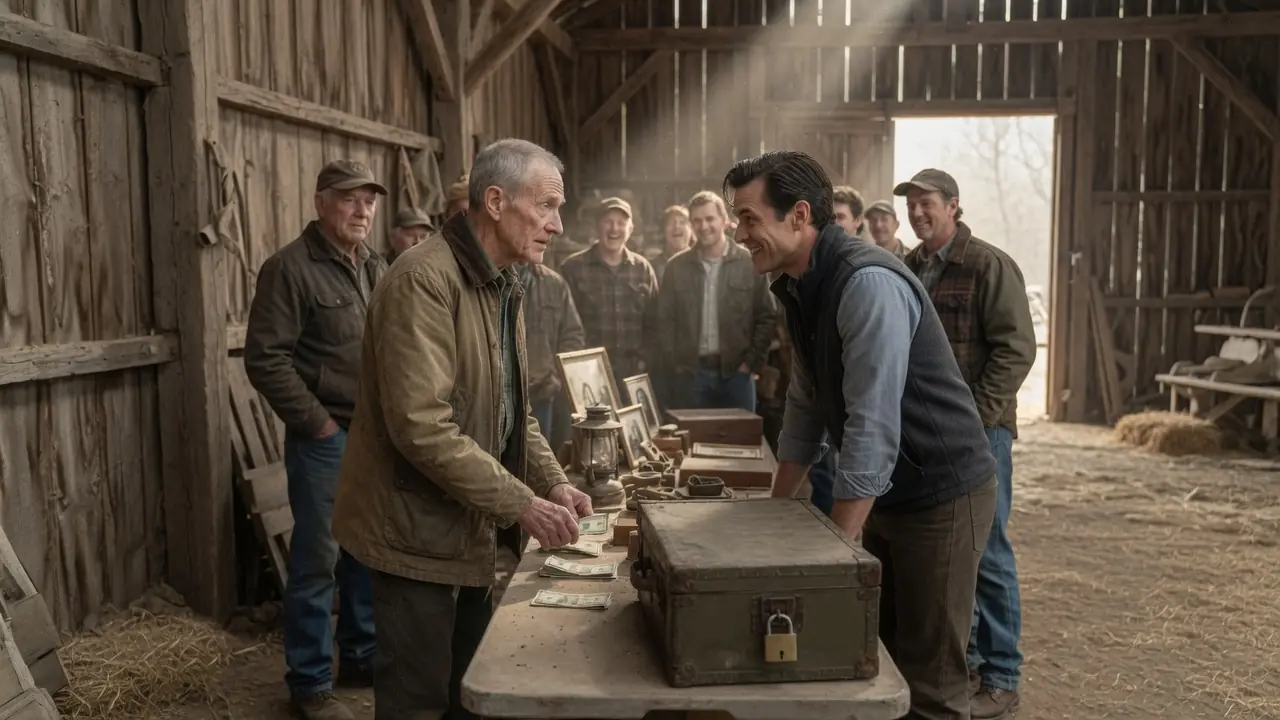
Nobody in the leaning auction barn wanted the locked army footlocker. It sat on a folding table under a stripe of pale Saturday sunlight, battered olive-drab metal dulled by age, its corners scuffed silver, its old brass padlock rusted shut like a clenched fist. The auctioneer had tried to make it sound interesting, calling it a “wartime relic,” but everyone could see the problem. There was no key, no paperwork, no promise of anything inside, and the lid was so sealed by years of dust, paint, and corrosion that even the curious buyers kept their hands in their pockets.
Then Henry Dell raised his hand.
The whole barn seemed to notice at once. Henry was seventy years old, lean and upright, with close-cropped iron-gray hair, a long weathered face, and pale blue eyes that looked calm enough to make louder men uncomfortable. He wore a tan waxed canvas barn coat over a green flannel shirt, dark trousers, and old leather shoes polished by habit rather than vanity. His hands, resting near the table edge, were square, blunt-fingered, and steady, the hands of a man who had spent fifty years opening things other people had given up on.
“Seventy-five,” Henry said.
A few people turned. Some smiled. One man laughed loud enough to make the auctioneer pause.
That man was Cody Voss, a slick young picker in a clean zip vest and white sneakers too new for the dust on the barn floor. Cody made his living moving from estate sale to estate sale, buying grief cheap and selling it online before the family had finished sweeping the house. He was all quick jokes, quick photos, quick profit, and he had no patience for old men who cared about things that could not be flipped by Monday morning. He pointed at the footlocker and grinned at the room as if Henry had just stepped into a show built for him.
“Seventy-five dollars for locked junk?” Cody called. “You gone soft, old man?”
The crowd chuckled. Henry did not look at him. He counted three folded bills into the clerk’s hand and asked, quietly, if anyone knew where the box had come from.
Cody leaned closer across the table, enjoying himself. “That’s not a footlocker, Henry. That’s a paperweight with a war story nobody can prove.” He tapped the lid with one finger and laughed again. “Could be bricks in there. Could be old socks. Could be nothing but mouse dust and your own bad judgment.”
Henry finally turned his eyes on him.
They were not angry eyes. That was what made Cody’s smile twitch. Henry laid one hand lightly on the lid, where a faded white stencil had nearly vanished beneath scratches and age. Then he said, “Loud mouths laugh first because they can’t read last.”
The laughter thinned.
Cody’s face tightened, but pride pushed him forward. “That box is dead weight, just like your old hands.”
Henry’s expression did not move. “Careful, boy,” he said, voice low and even. “These hands open what fools throw away.”
For the first time, Cody had no answer ready.
When the auction moved on, Henry bent to lift the footlocker himself. Wesley stepped forward to help, but Henry shook his head once, not rudely, just firmly. The box was heavy, but Henry handled it carefully, as if weight was less important than respect. He carried it to his old pickup and laid it on a moving blanket in the truck bed.
Wesley followed him outside. “Mr. Dell, how are you even going to open it?”
Henry looked down at the frozen padlock, then at the worn name almost erased from the lid. His thumb moved over the stencil with the tenderness of a man touching an old scar. “A lock isn’t a wall, son,” he said. “It’s a question. You just have to be patient enough to hear what it’s asking.”
Wesley remembered that sentence for the rest of his life.
Henry drove the footlocker back to his shop on Main and Depot, a narrow brick building with a faded sign, a brass bell on the door, and shelves full of locks, blanks, springs, tumblers, and drawers labeled in his own careful handwriting. He had owned the place since before Cody Voss was born. People came to him when safes jammed, when old trunks held family papers, when jewelry boxes outlived their keys, and when doors refused to forgive the forgetful. Henry did not break things open unless there was no other way.
He placed the footlocker on the workbench in the back room. There, under the clean circle of a task lamp, the old box seemed even more worn and secretive. The padlock had once been brass, but the years had stained it dark and green at the edges, with orange rust running from the shackle down over the hasp. The latches beneath it were painted over, and the paint had hardened like a second lock.
Henry did not reach for a hammer.
He reached for oil.
For nine days, he soaked the shackle. Every evening after closing the shop, he sat at the bench with a small lamp, a cloth, fine tools, and silence. Wesley came by after his shifts and watched from a stool, handing Henry oil, light, or a clean rag when asked. Sometimes an hour passed with almost no movement, just Henry’s thumb and forefinger working the lock a fraction of a fraction, feeling for the smallest place where time had loosened its grip.
On the tenth night, Wesley asked, “Wouldn’t it be faster to cut it?”
Henry did not look up. “Faster than what?”
“Than all this.”
Henry held the padlock under the light. “Faster than finding out what kind of man locked it?”
Wesley did not understand at first.
Henry set the lock down and tapped the lid with one knuckle. “Someone closed this box because something in it mattered. Maybe only to him. Maybe to nobody now. But I won’t be the man who tears through his last careful act just because I’m impatient.”
After that, Wesley never asked again.
While Henry worked slowly, Cody told the story quickly. He told it at the next estate sale, then at another sale the week after that, laughing about Henry Dell and his seventy-five-dollar locked junk box. He acted out Henry’s quiet voice and mocked the way the old man had touched the lid. People laughed because Cody made it easy to laugh. No one had seen what Henry had seen.
But Henry had not bought the footlocker blind.
Before he raised his hand in the auction barn, he had leaned close enough to read the worn stencil across the lid. Most of the name was faded, rubbed almost ghost-gray against the olive paint. But a locksmith’s eyes are trained to live with small marks, worn edges, faint impressions, and things nearly lost. Henry had read enough.
Boyd.
The name had stopped him cold.
Halford had once had a Daniel Boyd, a young soldier who left in the last year of the war and never came back. Older people remembered his mother keeping his room clean until she died. Some remembered his younger sister Alma, who grew up under the shadow of a brother no one could bury. But the town had long since let Daniel’s name thin into the dust of old church records and half-told porch stories.
Henry remembered.
Not because he had known Daniel well. Henry had been only a child when the war ended. But his father had spoken of the Boyd boy with a kind of sorrow that made children listen. “Good hands on that one,” his father used to say. “Quiet boy. Would have made something of himself.” Henry had never forgotten the way adults lowered their voices around names that did not come home.
That was why he worked the lock slowly.
That was why he refused to cut it.
Weeks turned cold. Autumn thinned into winter. The shop windows clouded around the edges in the early mornings, and people passing on Main Street saw the old army footlocker still sitting on Henry’s back workbench. Some shook their heads. Some smiled to themselves and kept walking.
Cody stopped smiling first.
His business was not doing as well as he pretended. The estate sales had become crowded with younger pickers who used the same phone apps, the same tricks, and the same false confidence. Cody had borrowed money for a van, a storage unit, and inventory he could not move fast enough. What once felt like cleverness began to feel like a trap, and the trap tightened quietly.
By December, his van was gone.
By January, the storage unit company had locked him out for missed payments.
Cody still came to sales, but he laughed less loudly.
Henry heard none of this from Cody. He heard it from customers who came in to have keys cut and liked to talk while the machine hummed. Henry never commented. He only listened, filed the key teeth smooth, and handed people back what they needed.
The footlocker opened in the deep quiet of a January evening.
Wesley was there, sweeping near the front, when he heard a sound from the back bench. Not a crack. Not a snap. A small turning sound, soft and clean as a breath released after being held too long. He looked up.
Henry held the padlock in his hand.
The shackle had opened whole.
Wesley came closer without speaking. Henry set the lock on a cloth and worked the first latch, then the second. Both resisted, both yielded, and then the lid rose slowly on stiff hinges. The smell that came out was not decay, as Wesley had feared, but old paper, canvas, metal, and closed years.
Henry did not reach in.
He stood with one hand on the open lid, looking down.
Inside, everything had been packed with care. On top lay a small leather journal wrapped in oiled cloth and tied with a bootlace. Beneath it were black-and-white photographs, a bundle of letters tied with faded string, folded cloth, a small flat box, and a pair of stamped metal tags on a beaded chain. The name pressed into the tags was clear.
Daniel Boyd.
Wesley whispered, “You were right.”
Henry’s face did not show triumph. His eyes were fixed on the journal.
“No,” he said softly. “He was.”
The next morning, Henry carried the journal and photographs to Clara Whitcomb, the town librarian. Clara knew the county’s dead almost as well as the living, and she had spent thirty years saving records other people thought nobody needed. She cleared a table in the back room and put on white cotton gloves before opening Daniel’s journal. Henry sat across from her, his hat in his hands, while Wesley stood near the shelves.
The first pages held practical things. Dates, weather, places, names of men in his unit, small notes about food, cold mornings, and letters sent home. Then the entries grew more personal. Daniel wrote about Alma, about missing the table in their kitchen, about wanting to come home before the corn was high, about fixing the back steps for his mother when he returned.
Clara stopped reading once and removed her glasses. “His sister is still alive,” she said.
Henry looked up.
“Alma Boyd Renner,” Clara continued. “Lives out on Cedar Hollow Road. Eighty-three, I believe. She never left the old family house.”
Henry closed his eyes briefly.
They did not go to Alma that day. Henry insisted on cataloging everything first, not for ownership, but for order. He believed hard news should arrive with as much care as an opened lock. Clara copied the journal pages, identified photographs, and searched church rolls and county records. Wesley helped sort the letters by date, his young face solemn as he handled a life older than his grandparents’ grief.
Folded among the letters was one Daniel had written but never mailed.
It was addressed to Alma.
The paper was worn at the fold, but the ink held. In it, Daniel teased her about stealing the last piece of pie, told her to keep his fishing pole safe, and promised that once things were finished, he would come home and take her down to the river like before. At the end, he wrote, “Tell Ma not to keep worrying. I’ve got my luck with me.”
Clara pressed her fingers to her mouth.
Henry looked away toward the window.
The following Sunday, Henry and Clara drove to Cedar Hollow Road with the footlocker secured carefully in the back seat and Wesley following in Henry’s truck. Alma Boyd Renner lived in a plain white farmhouse with blue shutters, bare winter trees, and a porch swept clean despite the cold. She opened the door herself, small and straight-backed, with silver hair pinned close and eyes that had seen enough waiting to recognize it in other people.
Henry introduced himself.
Alma looked at the footlocker behind him and went very still.
“Boyd,” she whispered.
Henry nodded. “Yes, ma’am.”
They carried the box inside and set it in the sitting room near a wood stove. Henry did not make a speech. He did not explain more than was needed. He lifted the lid and stepped back, giving Alma space to find her brother herself.
She reached first for the journal.
Her hands trembled as she opened it. For a long moment, she only looked at the writing. Then her face changed, not into happiness, exactly, but into something deeper and older than happiness. A sound left her, small and wounded.
“That’s Danny’s hand,” she said. “I’d know it if I was blind.”
Clara gently handed her the unsent letter.
Alma read the first line and sat down hard in the nearest chair. “He wrote to me,” she whispered. “All these years, and he wrote to me.”
Henry stood near the doorway, his hands folded in front of him.
Alma read the letter twice. Then she pressed it against her chest and cried without shame. She cried like someone who had been holding the same breath for forty years. Clara sat beside her, one hand on her shoulder, while Wesley looked down at the floor.
After a while, Alma lifted her face to Henry. “Where was it?”
“Estate auction off Quarry Road.”
She shook her head slowly. “His things were supposed to have gone missing. We never knew. Mother waited for anything with his name on it.”
Henry’s voice was quiet. “He was close by longer than anyone knew.”
Alma looked into the footlocker again, at the photographs, the letters, the folded cloth, the tags. “We never got him back.”
Henry’s pale eyes lowered to the box. “No,” he said. “But he left a door. It just took a long time to open.”
The story moved through Halford the way stories move in small towns, slowly at first, then everywhere. People who had laughed at the locked footlocker heard that it belonged to Daniel Boyd. They heard about the journal, the photographs, the unsent letter, and Alma receiving her brother’s voice after four decades. The laughter from the auction barn began to feel different in people’s mouths when they remembered it.
Cody Voss heard it at a diner counter.
He was stirring coffee he could barely afford when two men at the next table started talking about Henry Dell opening the old war box. They said it had carried a lost soldier’s letters home. They said the family had cried. They said Henry had known from the name on the lid.
Cody stared into his cup.
For the first time, the joke felt like it had turned around and looked at him.
A week later, Cody appeared in Henry’s shop.
The bell above the door gave its little brass ring. Henry looked up from a customer’s key and saw Cody standing near the entrance, thinner than before, his clean vest gone, his sneakers no longer bright. Wesley, now working behind the counter more regularly, stiffened slightly.
Cody cleared his throat. “I heard about the box.”
Henry finished cutting the key before answering. “Most people did.”
Cody looked toward the back room. “I didn’t know.”
“No,” Henry said. “You didn’t.”
The words were not harsh, but Cody flinched.
“I was wrong to laugh,” Cody said.
Henry looked at him for a long moment. “You were wrong before you laughed.”
Cody’s face reddened. “What does that mean?”
“It means you decided what it was worth before you understood what it was.”
Cody had no defense for that.
He looked around the shop, at the drawers, the tools, the rows of blanks, the order of everything. For the first time, he seemed to see that Henry’s slowness was not weakness. It was discipline. It was a kind of wealth Cody had never learned how to count.
“I lost my van,” Cody said suddenly. “Storage too.”
Henry said nothing.
“I thought fast was smart,” Cody continued. “Turns out fast is just fast.”
Henry set the finished key on the counter. “That is a lesson.”
Cody gave a bitter laugh. “Expensive one.”
“Most real lessons are.”
Cody nodded once, then left without asking for sympathy.
Henry watched him go and did not smile.
By spring, Alma had made her decision. The journal, copies of the letters, the photographs, the tags, and the medal would go to the county historical society. The footlocker itself would remain with her, at the foot of the bed her mother had once kept made for Daniel. Henry cleaned the old lock but replaced it with a working brass one, cutting Alma a single new key.
When he placed it in her hand, she closed her fingers around it carefully.
“So I can open it when I want,” she said.
“Yes, ma’am.”
“And close it when I need.”
Henry nodded. “That too.”
The historical society set Daniel Boyd’s things in a glass case by the front window. On bright mornings, sunlight touched the faded photographs and caught on the chain of the dog tags. Schoolchildren came through and read his name aloud. Old farmers stopped in quietly, looked at the young face in uniform, and remembered stories they had not told in years.
Wesley took to visiting the display on his lunch breaks.
He would stand there looking at the journal and think about Henry’s hands working the rusted lock evening after evening. He understood now that patience was not waiting because you had nothing else to do. Patience was believing something deserved not to be ruined by your hurry.
Years later, Wesley would take over Henry’s shop on Main and Depot.
He would keep the drawers labeled the same way. He would teach young apprentices to listen to a lock before forcing it. And whenever someone brought in an old box or trunk and said, “Just break it open,” Wesley would hear Henry’s voice in his head.
A lock isn’t a wall.
It’s a question.
Henry Dell never made himself the hero of the footlocker story. When people came by to praise him, he shrugged and said the box belonged to Daniel, not to him. When they asked how he knew, he said only that he had read the name. When they asked why he paid seventy-five dollars for something no one else wanted, he replied, “Because nobody else was looking at the right thing.”
On the last gold evening of that winter, before the story became county memory instead of fresh wonder, Henry drove out to Alma’s house one more time. The footlocker sat at the foot of the bed, cleaned but still scarred, its old metal carrying every year it had survived. Alma had placed Daniel’s last unsent letter in a frame beside a photograph of him smiling in sunlight.
Henry stood beside the box and rested one hand on the lid.
Cody would have seen rust.
The auction crowd had seen junk.
Henry had seen a name.
That was the difference between the man who laughed and the man who opened it.
Outside, the bare trees moved slightly in the evening wind. Inside, a sister who had waited forty years could finally read her brother’s words whenever she wished. In town, behind glass, Daniel Boyd’s face looked out at Halford again, no longer a forgotten name fading from an old lid.
And somewhere, in the quiet back room of a lock shop, Wesley Pruitt filed keys under a clean white lamp, learning that the world is full of sealed things louder people have dismissed.
Some hold nothing.
Some hold a life.
And some wait for one patient hand to prove the whole room wrong.