Cruelty always seemed to find extra room in towns like Red Gulch. By the end of August 1887, everybody knew the boardinghouse fire had left six unmarried women and widows without rooms, wages, or family nearby, and Mayor Hollis Cobb had decided the problem could be solved through what he grandly called a “placement gathering.” Men needing housekeepers, cooks, hired help, or wives were invited to the courthouse porch to meet the women and make arrangements acceptable to both sides, though by noon the event had become little more than entertainment for drunks from the saloon.
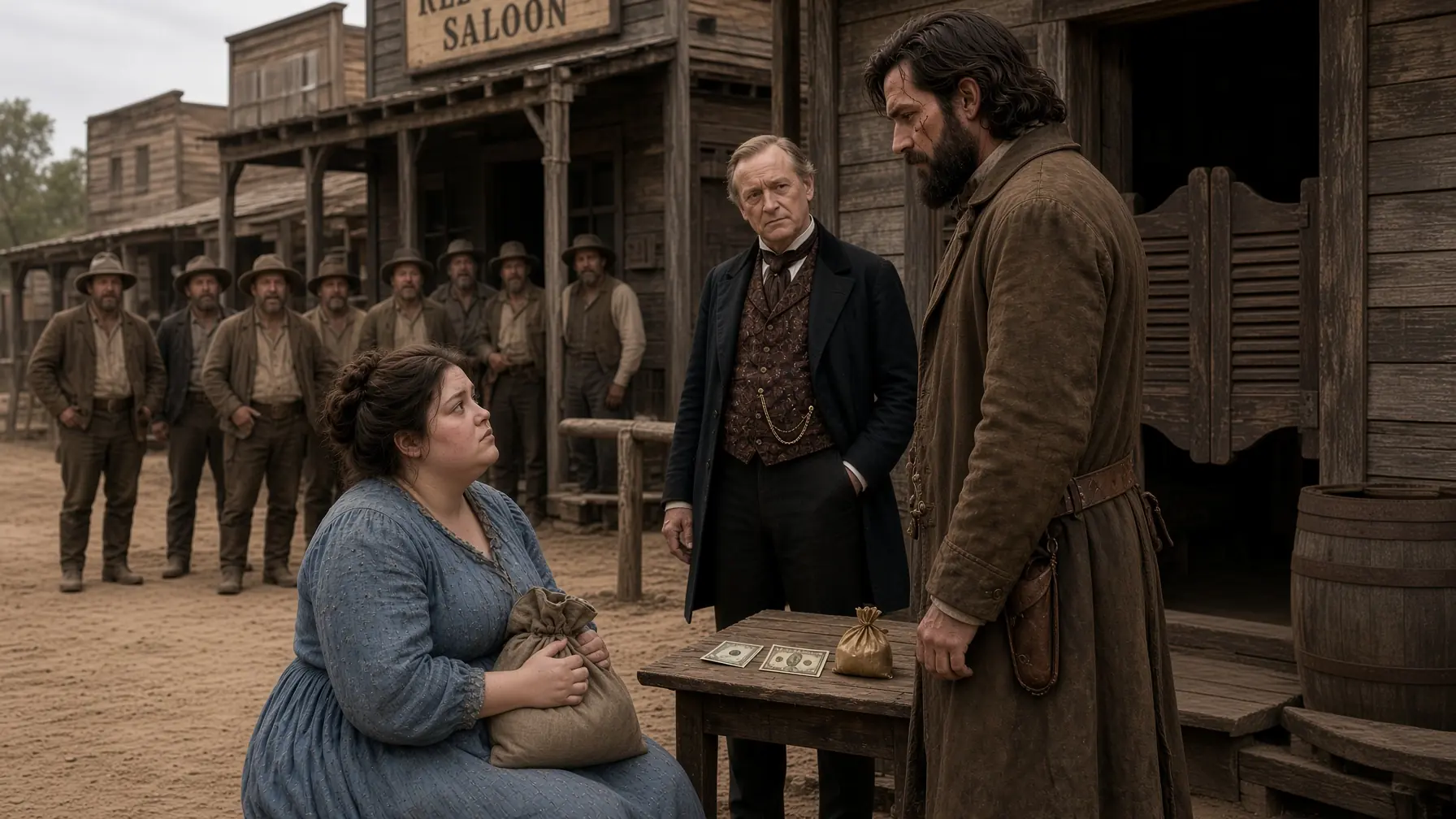
Maeve Holloran sat on a reinforced packing crate beside the assayer’s office and kept her eyes fixed on her boots. She was twenty-four years old, nearly six feet tall, and weighed close to three hundred pounds, a fact Red Gulch discussed with more interest than her ability to sew, preserve meat, manage accounts, or work sixteen-hour days. Sweat darkened the faded blue cotton across her back while dust clung to the hem of her dress, but she barely moved because movement attracted attention. Attention in Red Gulch usually came attached to a joke.
“Careful who takes that one,” Amos Pike called from the saloon rail. He was a lean prospector with broken teeth and enough whiskey in him to make cowardice sound like wit. “Put her on a saddle horse and you’ll need a second horse underneath the first.”
Men laughed. Another shouted that Maeve would require a freight wagon, and someone else wondered aloud how many sacks of flour a husband would need just to keep her through winter. Maeve did not cry because she had stopped granting strangers that satisfaction years earlier. She simply folded her broad hands together and waited for Mayor Cobb to announce that nobody wanted her.
The boardinghouse fire had not been her fault. A chimney spark had landed in dry roof shingles three nights earlier, and within twenty minutes the building where Maeve cooked, washed linens, scrubbed floors, and rented a narrow attic room was gone. The owner had no insurance, the surviving residents had nowhere to sleep beyond temporary cots in the church hall, and Red Gulch possessed neither organized relief nor much appetite for supporting women who could not immediately repay the cost.
Maeve had been offered two choices before the gathering. She could take unpaid kitchen work at the saloon in exchange for a corner of its storeroom, or she could meet men willing to provide housing in return for wages, domestic work, or marriage if both parties agreed. Neither option felt like freedom, but the second at least left open the possibility that somebody might see something besides her body.
Nobody did.
A rancher selected a widow who knew dairy cattle. Two sisters found work cooking for a mining camp and arranged to share a cabin until spring. By afternoon, Maeve was the last woman still sitting beside the courthouse while Mayor Cobb repeatedly consulted his watch.
Then the laughter stopped.
A tall man had appeared at the far end of the street, walking with an uneven gait that made his left shoulder dip slightly every third step. His beard was dark with threads of premature gray, a white scar pulled the corner of his left eye downward, and his coat smelled of wood smoke, pine resin, and months spent beyond the reach of barbers. His name was Harlan Creed.
Everybody in Red Gulch knew Harlan, though few knew him well. He lived almost eleven miles north on Widowmaker Ridge, where he trapped in winter, cut timber in summer, and owned a thirty-eight-acre claim around a spring-fed creek. Ten years earlier, a grizzly had torn open his thigh and left the limp; five years later, the woman he married had left after a doctor told them an illness from Harlan’s youth had probably left him unable to father children.
His wife had not departed quietly. She told half the town that Harlan was “a man with no future,” then left with a traveling machinery salesman. Harlan moved higher onto the ridge and stopped coming into Red Gulch except for salt, ammunition, tools, and the occasional legal paper.
He walked to Mayor Cobb’s table and placed money beside the marriage-license forms. “I’m looking for someone willing to come up the ridge,” he said. His voice was rough, partly from an old throat injury and partly from using it so rarely.
Cobb looked toward Maeve. A smile formed.
“Well, Creed, you have excellent timing.” He raised his voice so the saloon porch could hear him. “One candidate left, though I should warn you she’ll put your winter stores to a serious test.”
Laughter started again.
Harlan did not look at the mayor. He turned toward Amos Pike, who still held a whiskey cup against his chest, and simply watched him. The laughter around Amos died first, then the rest followed.
Harlan crossed the street to Maeve. He did not inspect her face and then let his gaze travel downward the way most men did; instead, he looked at her hands. They were broad, calloused, and marked with old burns from the boardinghouse stove.
“You butcher game?” he asked.
Maeve swallowed. “Yes.”
“Preserve meat?”
“Yes.”
“Handle a wood stove during a long freeze?”
“I kept the boardinghouse kitchen running through last winter.”
Harlan nodded. “My place gets snowed in. Some years I don’t see town between December and March.”
Maeve finally looked directly at him. “That sounds quiet.”
“It is.”
“Then I can handle it.”
Mayor Cobb called from across the street, “You two planning to stand there all day?”
Harlan ignored him. “I’m not hiring a servant. I need somebody willing to work the place with me, and if we decide marriage makes sense, we file it because both of us choose it. You want to see the place first?”
Maeve blinked. “You’d take me up there without marrying me?”
“My neighbor’s widow lives two miles below my cabin. You can stay with her a week if you decide you don’t want the claim.”
That was the first genuine choice anybody had offered Maeve since the fire.
“Yes,” she said.
Harlan picked up her canvas bag only after asking whether she wanted him to carry it. Maeve stood from the crate, ignoring the groan of the boards beneath her, and followed him toward a heavy freight wagon waiting near the livery. Behind them Amos muttered, “Two useless things found each other.”
Maeve heard it.
So did Harlan.
Neither turned around.
The wagon had thick timber rails and was drawn by two Belgian draft horses, animals built for pulling logs rather than impressing townspeople. Maeve stopped beside the iron step and looked at the horses, then at the wagon springs. Shame tightened across her chest before she could stop it.
“I can walk behind on the steep sections.”
Harlan looked down from the driver’s bench. “Why?”
“To make it easier on the team.”
“These horses drag pine trunks heavier than both of us through mud.”
Maeve looked away.
Harlan’s voice softened slightly. “Get on the wagon, Maeve.”
She climbed aboard.
For the first three hours, they barely spoke. The trail twisted upward through ponderosa pine and blue spruce, leaving the dry heat of Red Gulch behind until mountain air cooled the sweat along Maeve’s neck. Whenever the wagon tilted and her shoulder brushed Harlan’s coat, she immediately pulled away and apologized.
The fourth time, Harlan stopped the horses.
Maeve stared at him.
“You don’t need to apologize every time the wagon leans.”
“I’m crowding you.”
“It’s a wagon bench.”
Maeve waited.
Harlan added, “You’re allowed to occupy part of it.”
Something about the sentence struck harder than any insult.
Maeve had spent most of her life learning how to fold herself inward. She sat at the edges of tables, chose corners at church, held her elbows close, ate less in public than hunger required, and apologized whenever another body touched hers accidentally. Slowly, she let her shoulders relax.
The mountain did not care how wide she was.
Neither, apparently, did Harlan’s wagon.
They reached Widowmaker Ridge shortly before sunset. Harlan’s cabin stood inside a clearing protected on three sides by timber, with a barn, smokehouse, chicken shed, woodshed, and stacked logs high enough to survive a serious winter. It was not pretty, but everything looked built for use.
Inside was another matter.
Dust coated the shelves. Traps, chain, hides, tools, and split kindling occupied the room according to a system known only to Harlan, while three iron pans sat beside the stove in various stages of neglect. Maeve looked around and understood immediately that the man knew how to survive but had little interest in the difference between survival and a home.
Harlan carried venison inside an hour later and stopped in the doorway.
The stove was burning. The floor had been swept, the cast iron cleaned, and water heated in a pot while Maeve stood beside the table with her sleeves rolled above thick forearms. She looked exhausted but satisfied.
“You didn’t have to do all this.”
Maeve looked at him. “It needed doing.”
Harlan set the meat down. “Fair enough.”
That was as close to praise as he came the first week.
They worked together to butcher the venison. Maeve separated meat from sinew efficiently, saved usable fat for rendering, and trimmed pieces for stew while Harlan prepared strips for smoking. He watched her hands once, then nodded.
Maeve recognized that nod by the third day. It meant good work.
At supper, she cut her venison into tiny bites and ate slowly. Harlan finished half his plate before noticing. He pushed another piece of meat toward her.
Maeve stiffened. “I have enough.”
“You’ve eaten half what I did.”
“I don’t need as much.”
Harlan looked at her for a moment. “Winter’s coming.”
Maeve’s jaw tightened.
He continued, “Food is fuel up here. Eat until you’re fed, not until some drunk in Red Gulch would approve.”
She stared at him.
“I keep plenty,” Harlan said. “If provisions run short, we hunt more or change rations together. I’m not counting your mouthfuls.”
Maeve looked down at the meat.
Then she ate it.
The first week became two. Maeve visited Mrs. Lydia Sloan, the widowed neighbor Harlan had mentioned, but returned to the ridge by sunset and announced she preferred his cabin. At the end of the trial period, Harlan asked one question.
“Still want to stay?”
“Yes.”
“Still want the marriage license?”
Maeve considered it.
“Why do you?”
Harlan sat across from her at the table. “Because if we’re going to build this place together, marriage gives you clearer standing if something happens to me, and I don’t want every distant cousin I’ve forgotten arguing you were only hired help.”
That answer pleased her more than any romantic speech could have.
“But,” he added, “if you don’t want it, we make another arrangement in writing.”
Maeve was quiet.
“I want it.”
They rode to a smaller settlement beyond Red Gulch rather than giving Cobb the satisfaction of performing the ceremony. A justice of the peace checked that both were consenting adults, entered the license, and watched them sign. There were no flowers, no wedding feast, and no crowd laughing outside.
On the ride home, Maeve asked, “Are we supposed to say something different now?”
Harlan considered. “I don’t know.”
“Good.”
“Why good?”
“Means I’m not the only one.”
Autumn settled over Widowmaker Ridge.
They developed a rhythm built less on tenderness than reliability. Harlan trapped, cut timber, repaired fencing, and hunted; Maeve managed the smokehouse, garden stores, accounts, cooking, mending, and preservation. They shared anything requiring two strong backs.
Maeve discovered something the town had never considered. Her size was not a moral defect or proof of laziness; much of her body was simply her body, and years of hard labor had given her extraordinary strength beneath it. She could brace a rendering cauldron with one hip while guiding it onto stove hooks, carry sacks other women divided into smaller loads, and work steadily without tiring as quickly as men expected.
Harlan never treated that as remarkable.
He simply used the strength available.
“Other end,” he would say when lifting something heavy.
Maeve took the other end.
That was all.
By November the first real storm arrived. Wind buried the windows beneath snow, and for four days the ridge vanished from the rest of the world. Maeve sat at the table repairing Harlan’s winter coat while he sharpened a skinning knife beside the fire.
The silence did not frighten her.
That surprised her.
In Red Gulch, silence usually meant people were waiting for her to pass before laughing. On the mountain, silence meant snow outside, fire inside, and another person nearby who did not require her to defend existing.
Harlan finally said, “They laughed at me too.”
Maeve looked up.
He kept his eyes on the blade. “You heard Cobb.”
“I did.”
“The doctor never said impossible. He said unlikely after the fever I had. My first wife decided unlikely was enough to hate me.”
Maeve put down the coat.
Harlan continued. “She wanted children badly. I couldn’t promise them, and eventually she decided I had stolen something from her.”
“You didn’t.”
“No.”
He looked toward the fire.
“But I understand why she left.”
Maeve studied him. “I understand why she wanted another life.”
Harlan nodded.
“I don’t understand why she had to humiliate you on the way to it.”
His eyes shifted toward her.
Maeve took a breath. “Doctor in Red Gulch told me when I was eighteen that pregnancy might be dangerous at my size. Maybe he was right, maybe he wasn’t, but everybody turned it into something else.”
“What?”
“That nobody would want me because I was too large to be useful as a wife.”
Harlan’s face changed.
Maeve laughed once, bitterly. “Funny, isn’t it? They decided you were defective because you might not father children and decided I was defective because carrying them might be difficult.”
Harlan placed the knife on the table.
Maeve continued, “Maybe I would have wanted them if anyone had let me think about it without telling me what my body meant first. I don’t know.”
Harlan said nothing.
“That’s the part I hate,” she said. “Not knowing whether the choice was ever mine.”
The wind hammered the cabin.
Harlan stood and crossed the room.
He stopped far enough away that Maeve could decide whether she wanted him closer.
“This part is.”
Maeve looked at him.
“What part?”
He gestured around the cabin. “Staying.”
She swallowed.
“Working here.”
He paused.
“Being my wife.”
Maeve felt something inside her loosen.
Harlan added, “Any day you decide otherwise, we deal with that day when it comes.”
She reached out.
Not toward his face.
Toward his hand.
Their fingers closed together.
Winter deepened.
They did not become lovers immediately. Affection grew through smaller things: Harlan bringing Maeve a smooth blue stone because she once said she liked the color, Maeve saving the crisp edge of the skillet bread because she noticed he preferred it, Harlan repairing the back of her chair before she realized it had begun to loosen. Their marriage existed legally months before it began feeling intimate.
Maeve liked that.
Nobody was rushing her toward a role.
By February, Red Gulch was in trouble.
An early winter had trapped supply wagons beyond the pass, and a fire damaged part of the town warehouse where Mayor Cobb had concentrated too much of the community’s flour and preserved meat. Food did not vanish entirely, but prices rose sharply and poorer families struggled.
Harlan heard about it from a timber buyer who managed to reach the ridge.
Maeve’s first reaction surprised her.
She was angry.
Not because Red Gulch deserved starvation.
Because part of her wanted the people who mocked her to feel consequences.
Harlan listened.
Then he said, “You don’t owe them food.”
“I know.”
“You also don’t have to become them just because they were cruel.”
Maeve stared at him.
“I hate when you say sensible things.”
“I don’t do it often.”
The mountain household had enough food for themselves because they had planned carefully, but not enough to supply an entire town without risking their own survival. They sent dried venison, beans, and preserved vegetables to Lydia Sloan and two families with small children. Nothing went to the saloon.
Nobody in Red Gulch knew.
Spring arrived violently.
Snowmelt turned trails into mud, branches cracked under changing weight, and the creek roared louder each afternoon. Harlan and Maeve survived the winter with more pelts, smoked meat, tallow, and preserved goods than they needed personally. For the first time, Harlan suggested something larger than simply selling everything to traveling buyers.
“We’re leaving money on the mountain,” he said.
Maeve looked at the inventory ledger.
“Yes.”
Harlan frowned. “You answered too fast.”
“I’ve been thinking the same thing for three weeks.”
They began planning.
Rather than haul raw hides cheaply to Red Gulch, they contracted with a better fur buyer farther south. Maeve started producing shelf-stable smoked meat, tallow candles, preserved onions, dried mushrooms, and heavy wool-lined mittens from scraps, while Harlan expanded trapping selectively and cut timber only where the claim could sustain it.
Maeve handled the accounts.
That became important.
She discovered Harlan had spent years accepting whatever fur price buyers offered because he disliked negotiating.
“You’re terrible at business.”
“I’m good at trapping.”
“That is why you need me.”
Harlan smiled.
“Yes.”
The first year’s profits paid for a second wagon, better roof shingles, a storage shed, and two additional draft horses. The second year they hired one seasonal hand and began supplying three mining camps directly instead of selling through Red Gulch merchants.
People started calling the operation Creed Ridge Supply.
Maeve changed it.
“Holloran-Creed.”
Harlan looked at the painted sign.
“Long name.”
“You’ll survive.”
He left it.
Their success reached Red Gulch slowly.
At first people said Harlan had struck gold.
He had not.
Then they said Maeve must have inherited money.
She had not.
Eventually an assayer who bought smoked venison explained the boring truth: the Creeds knew how to produce valuable goods, keep records, negotiate, and avoid wasting money.
That explanation disappointed everyone.
Amos Pike refused to believe it.
Three years after the day he mocked Maeve outside the assayer’s office, Amos climbed Widowmaker Ridge with Mayor Cobb’s nephew and two merchants. Red Gulch had recovered from the difficult winter, but the local saloon and general store had both fallen into debt after their owners borrowed heavily to restock at inflated prices. The men were not starving this time.
They wanted business.
Maeve saw them from the porch.
She was still large.
Still broad.
Still wearing a heavy apron over her dress.
The difference was that nobody on that mountain had ever asked her to make herself smaller.
Amos stopped when he saw her.
“You remember me?”
Maeve folded her arms. “Unfortunately.”
He laughed nervously.
“We’ve come to talk trade.”
Harlan appeared from the barn carrying a ledger box.
Amos’s eyes moved toward him and then back to Maeve.
“Town store needs smoked meat, candles, pelts, whatever you’ve got. Cobb thinks we can make an arrangement.”
Maeve said, “Cobb can write an offer.”
Amos blinked. “You handle the business?”
“I do.”
He looked embarrassed.
Maeve noticed.
She did not rescue him from it.
They sat at the outdoor table.
The offer from Red Gulch was poor.
Maeve read every line and pushed the paper back.
“No.”
Cobb’s nephew frowned. “That’s the town rate.”
“It’s below what the mining camps pay.”
“You’d have shorter hauling.”
“Not enough shorter.”
The merchant leaned forward. “You owe Red Gulch some loyalty.”
Maeve looked at him.
“For what?”
Nobody answered.
Harlan remained silent.
Maeve continued, “If you want our goods, you pay our rate. If you don’t, someone else will.”
Amos shifted in his chair.
Years earlier, he had laughed at the idea that anybody would spend resources feeding Maeve.
Now he had ridden eleven mountain miles to ask her to feed his customers.
The irony needed no speech.
They returned two days later with a better offer.
Maeve accepted.
That contract changed everything.
Holloran-Creed Supply expanded into Red Gulch, not by buying the town with gold thrown dramatically into mud but by purchasing the old boardinghouse lot after its owner decided not to rebuild. Maeve used the site to open a warehouse and kitchen that sold smoked provisions, bread, preserved vegetables, and winter supplies.
She hired women first.
Not exclusively.
But deliberately.
Widows, unmarried women, women too old to interest men looking for wives, women considered plain, difficult, heavy, poor, or otherwise inconvenient. Maeve paid wages in coin and listed deductions clearly because she remembered what it felt like when survival depended on somebody else’s private arithmetic.
Harlan handled hauling, timber, livestock, and mountain production.
Maeve ran Red Gulch.
Mayor Cobb disliked that arrangement until he realized her taxes arrived on time.
Amos avoided the store for six months.
Then one December morning he entered because his wife needed lamp oil and every other merchant had sold out.
Maeve stood behind the counter.
Amos placed his hat against his chest.
“Morning.”
“Morning.”
He looked around at the stocked shelves.
“You’ve done well.”
“We have.”
Amos shifted.
“I was pretty rough on you back then.”
Maeve waited.
“I was drunk.”
“You were cruel sober too.”
His face reddened.
“Yes.”
Maeve said nothing.
Amos finally looked at her.
“I’m sorry.”
She studied him.
“Thank you.”
He seemed almost disappointed.
“That’s all?”
Maeve raised one eyebrow. “Did you apologize because you were sorry or because you wanted me to make you feel better?”
Amos stared at his boots.
“Fair.”
Maeve sold him the lamp oil at the normal price.
She did not overcharge him.
That mattered to her more than forgiveness.
By then, her marriage to Harlan had become something neither expected on the courthouse porch.
They fought occasionally.
Maeve accused him of disappearing into the timber whenever an emotional conversation lasted longer than four minutes. Harlan accused her of reorganizing everything he owned until a man required written directions to locate his own gloves.
Both accusations were accurate.
Their first kiss happened almost a year after the marriage license.
Not because they lacked desire.
Because neither wanted closeness built on desperation.
One evening after a long trip from the mining camps, Maeve found Harlan asleep at the kitchen table with his head resting on folded arms. She covered him with a blanket and started to walk away.
He caught her hand.
Maeve turned.
Harlan looked exhausted.
“Stay.”
She sat.
After a moment, he said, “I love you.”
Maeve’s heart began pounding hard enough to annoy her.
“You sure?”
“Yes.”
“Why?”
Harlan frowned. “You want a list?”
“Maybe.”
He thought.
“You make this place make sense.”
Maeve smiled.
“That sounds like employment.”
“I’m not finished.”
He squeezed her hand.
“You make me want to come home.”
The smile left Maeve’s face.
That was different.
She leaned closer.
“This is me choosing,” she said.
“I know.”
Then she kissed him.
Years passed.
The operation grew steadily rather than magically. Holloran-Creed employed nine people by its seventh year, operated two wagons, supplied four mining settlements, and owned the Red Gulch warehouse outright.
Harlan never became a railroad baron.
Maeve never owned the whole town.
They owned enough.
More importantly, nobody owned them.
One evening, long after Mayor Cobb left office, Maeve stood outside the warehouse watching children run through the street. Two girls helped load sacks into a wagon under the supervision of a woman who once worked beside Maeve in the boardinghouse kitchen.
Harlan came to stand beside her.
“You’re thinking.”
“Dangerous habit.”
“About what?”
Maeve looked toward the old assayer’s porch.
The reinforced crate was gone.
“I sat there for six hours.”
Harlan followed her gaze.
“I remember.”
“I kept trying not to move.”
“Why?”
“So nobody would notice how much space I took.”
Harlan was quiet.
Maeve looked at him.
“Do you remember what you told me on the wagon?”
“No.”
“You said I was allowed to occupy the bench.”
Harlan frowned as though trying to recall something completely unimportant.
“That sounds like me?”
“It was.”
He nodded toward the warehouse.
“You’ve occupied considerably more since.”
Maeve laughed.
The sound traveled across the street.
Nobody stopped talking.
Nobody looked shocked.
Nobody called her a cow or warned the floorboards.
She was simply Maeve Holloran-Creed, owner of half the largest supply concern in Red Gulch, wife to an irritating mountain trapper, employer, bookkeeper, cook, negotiator, and woman who still weighed considerably more than most of the people around her.
Her body had never become the lesson.
That was important.
She did not lose half her weight and suddenly earn respect.
Harlan did not discover she was secretly beautiful according to somebody else’s standard.
She remained Maeve.
The town changed what it believed her size meant.
Or, more accurately, Maeve stopped waiting for the town to decide.
Harlan’s infertility stopped defining him too.
They never had biological children.
For several years they discussed adoption and decided against it because neither wanted parenthood simply to prove something had been repaired.
Their household remained two people.
Sometimes three when workers stayed through storms.
Occasionally six when stranded travelers slept on the floor.
It was enough.
The legacy Harlan once believed required sons appeared elsewhere.
It stood in the storage buildings.
The maintained trails.
The wages paid every Friday.
The widows who could afford rooms without marrying strangers.
The mountain cabins they helped supply before winter.
And every contract Maeve wrote in plain language because she believed people should know what they were agreeing to before they signed.
When Harlan turned fifty, Red Gulch held a dinner for them in the warehouse.
Amos Pike attended.
So did former Mayor Cobb, considerably older and less important than he remembered being.
Somebody made a joke about Harlan being the luckiest man in the territory.
Harlan looked toward Maeve.
“No.”
The room quieted.
Maeve raised an eyebrow.
Harlan continued, “Luck was finding her sitting there.”
He took her hand.
“The rest was work.”
Maeve smiled.
That was the truest thing anybody said all evening.
Later, after the lamps were extinguished and the last guests left, they rode slowly toward Widowmaker Ridge. The trail had been widened over the years, bridges replaced dangerous crossings, and small markers showed mileage between the town and their claim.
Maeve sat beside Harlan on the wagon bench.
She no longer apologized when the road tilted and their shoulders touched.
Halfway up the ridge, she leaned against him deliberately.
Harlan glanced down.
“Tired?”
“No.”
“Cold?”
“No.”
“What, then?”
Maeve looked ahead at the mountains.
“Taking up space.”
Harlan smiled.
The wagon climbed higher.
Far below, Red Gulch disappeared into the darkness.
Years earlier, its people had looked at a large unwanted woman and a scarred childless trapper and decided they were a joke that had accidentally found itself a marriage license.
They had been wrong about nearly everything.
Maeve had not needed a man to build an empire for her.
Harlan had not needed a woman to prove he was complete.
What each needed was rarer.
A place where usefulness was recognized without humiliation.
A partnership where difference was not treated like debt.
And enough distance from other people’s laughter to hear their own lives clearly.
The town had believed it was throwing two unwanted people together.
Instead, it had watched two capable people walk away.
Everything that came afterward began with that.