By the winter of 1882, everybody in Ash Creek, Wyoming Territory, knew two things about twenty-four-year-old Hazel Donnelly. The first was that her father’s general store was failing so badly that suppliers had stopped extending him credit. The second was that Hazel was large enough to inspire jokes from men who had never lifted half the weight she carried before breakfast.
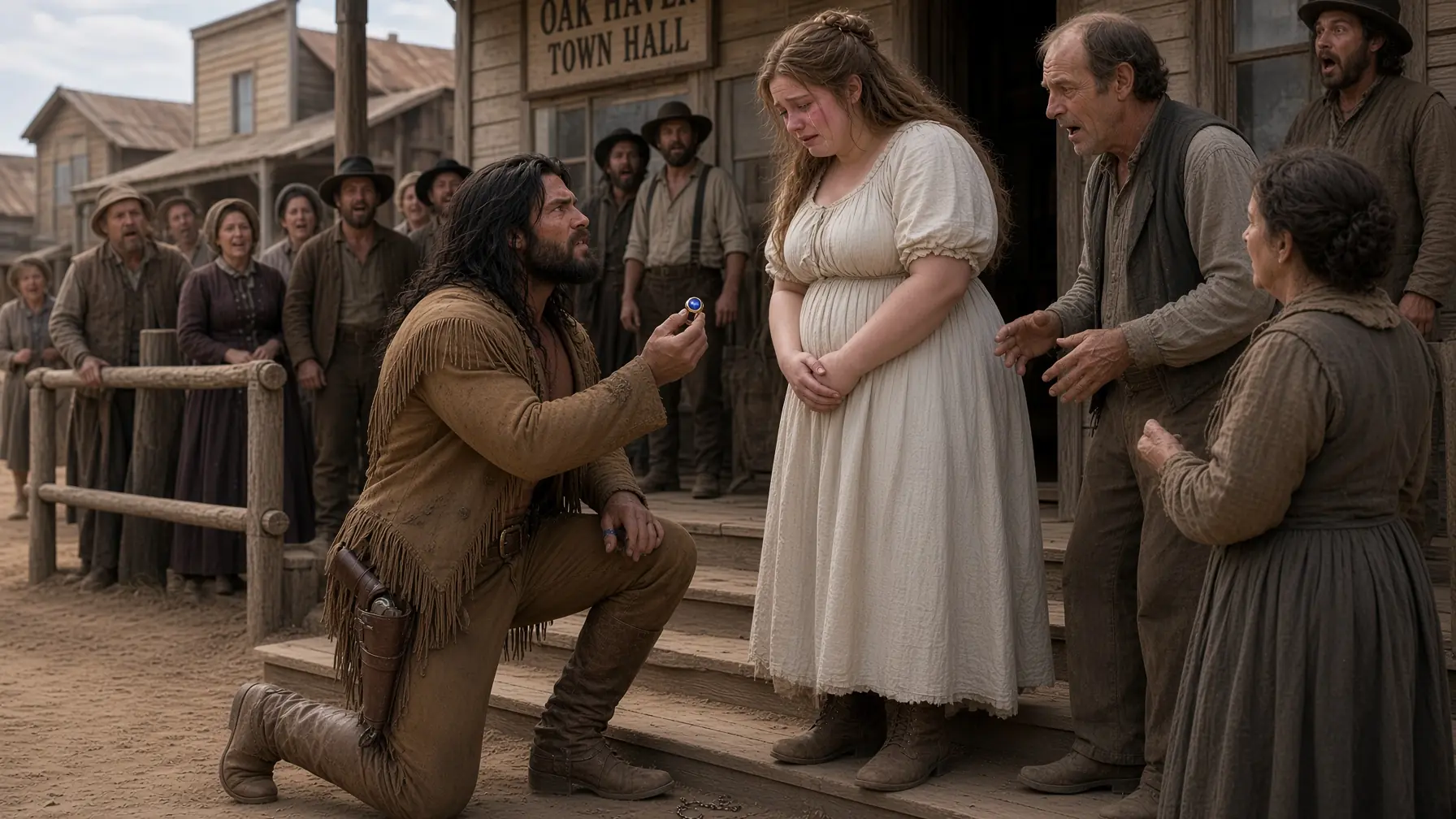
Hazel was tall, broad through the shoulders, heavy through the hips and waist, with thick arms strengthened by years of hauling flour sacks, splitting kindling, carrying water, and scrubbing floors. Her younger sister Lila had inherited their late mother’s narrow frame and delicate face, while Hazel had inherited their mother’s hands and their grandfather’s build. Ash Creek decided early which set of traits deserved admiration.
Her father, Edwin Donnelly, rarely defended her. He had become a bitter man after his wife died, and desperation made him crueler as his store slipped toward bankruptcy. Hazel’s stepmother Ruth treated her as unpaid labor, while Lila discovered before she turned sixteen that mocking Hazel earned laughter from almost any room.
“Careful with the biscuits,” Lila said one morning as Hazel carried breakfast to the table. “Father may need to order them by the wagonload if you keep eating like that.” Ruth laughed, Edwin kept reading his ledger, and Hazel placed the plate down without answering.
Silence had become the cheapest protection available to her. When people insulted her, she worked. When they stared at her body, she lowered her eyes and found something heavy enough to require both hands.
The store finally failed in January. Edwin owed the bank, the county, two eastern wholesalers, and a freight company that had already threatened to stop deliveries. He owned one additional piece of property along Cottonwood Creek, but the land was rocky, poorly fenced, and worth far less than the amount he needed.
That was when Luke Carver came down from the Wind River foothills.
Luke was thirty-seven and lived nearly twelve miles above Ash Creek on a high valley claim surrounded by timber. He trapped during winter, guided survey crews during summer, raised pack horses, and came to town only when he needed salt, tools, coffee, ammunition, or paperwork. A scar ran from beneath his left ear toward his jaw, and an old injury made him favor one leg when the weather turned cold.
Children had invented stories about him. Some said he had killed three men in Montana, others said wolves followed him through the mountains, and one particularly imaginative boy claimed Luke slept outside in blizzards because cabins made him nervous. The truth was considerably less exciting: Luke disliked crowds, spoke little, and preferred animals because they rarely asked questions they did not need answered.
Edwin approached him behind the livery stable.
Hazel happened to be in the loft retrieving an oat sack when she heard her father’s voice below. She stopped when he said, “I need money, Carver.”
Luke did not answer immediately.
Edwin continued. “Bank gives me until Friday. Fifty dollars gets me breathing room, and those three draft horses of yours would let me move my own freight instead of paying Nolan every month.”
“What are you offering?”
Hazel almost climbed down when she heard Luke speak.
Then Edwin said, “My eldest.”
Hazel stopped breathing.
Luke was silent.
Edwin hurried forward as if silence meant negotiation. “Hazel. She’s twenty-four, knows cooking, livestock, preserving, sewing, all of it. Strong as two hired men too, if you don’t mind the size of her.”
Hazel gripped the railing.
“She needs a husband,” Edwin continued. “You need someone up on that mountain. I need cash and horses. We could solve three problems at once.”
Luke’s answer came slowly.
“You’re offering your daughter as payment?”
Edwin lowered his voice. “Call it marriage.”
“I asked what you meant.”
Hazel heard her father exhale. “Three horses, fifty dollars, and you take over that useless Cottonwood parcel. I’ll arrange the marriage and she leaves Sunday.”
Another long silence followed.
Hazel expected Luke to laugh.
Instead, he asked, “Has Hazel agreed?”
Edwin scoffed. “She’ll do what I tell her.”
Luke said something too quietly for Hazel to hear.
Then boots crossed the stable floor.
The conversation ended.
That evening Edwin announced Hazel’s engagement over supper.
Ruth immediately began calculating what the horses might bring if one were sold. Lila laughed so violently that she had to put down her cup, then asked Hazel whether mountain cabins required wider doors. Edwin ignored all of it.
“You’ll marry Sunday,” he said.
Hazel looked at him. “Do I have a choice?”
Edwin’s fork stopped.
“You have eaten beneath my roof for twenty-four years.”
“I worked beneath it.”
“Same difference.”
Hazel felt something cold settle inside her.
Edwin continued, “Carver has money, land, livestock, and no family. You are not likely to receive another offer this good.”
“Good for whom?”
His face reddened.
Ruth whispered, “Hazel.”
But Hazel kept looking at her father.
Edwin finally said, “Sunday.”
Nothing more.
The next four days passed like a fever. Ruth gave Hazel a bolt of inexpensive cream muslin and told her to make her own wedding dress, while Lila repeatedly came into the sewing room pretending to offer advice so she could laugh at the shape of it. Hazel stitched until her fingertips hurt.
She imagined Luke Carver’s mountain home constantly. Perhaps he wanted a servant who could not easily run away. Perhaps he expected a wife who would cook, clean, and warm his bed because he had effectively paid her father for the privilege.
Yet one thing bothered her.
Luke had asked whether she agreed.
Nobody else had.
Sunday arrived cold and brilliantly clear. Word had spread through Ash Creek, and nearly forty townspeople gathered outside the small courthouse because people would travel astonishing distances to witness another person’s humiliation. Men from the saloon took bets on how long Hazel would last in the mountains.
Hazel stood near the courthouse door wearing the dress she had made.
It fit badly.
Ruth had refused enough additional cloth for Hazel to cut it properly, so the sleeves pulled across her arms and the waist sat too high. She knew exactly what the crowd saw.
She heard Mrs. Fletcher from the bakery whisper, “Poor Carver. He’ll spend all winter feeding her.”
Someone answered, “Maybe he plans to use her to block the north wind.”
Laughter followed.
Hazel looked at the ground.
Then hoofbeats entered the square.
Luke Carver arrived on a black gelding with three draft horses tied behind him. He wore no animal skins and looked nothing like the wild creature Ash Creek expected; he had shaved his beard close, washed his dark hair, and wore a clean charcoal coat over a white shirt. The scar remained.
So did the limp when he dismounted.
Luke tied the horses and walked directly toward the courthouse.
Edwin hurried down the steps. “Carver.”
Luke handed him a folded document.
Edwin opened it.
His face changed.
“What’s this?”
“Deed transfer.”
“For the Cottonwood parcel?”
Luke nodded. “Purchase completed yesterday at the county office.”
Edwin stared.
Luke handed him a second paper. “Receipt for the horses.”
“And the fifty dollars?”
“Paid to the bank against your note.”
Edwin smiled.
Hazel felt sick.
Everything had been completed.
Her father had received his payment.
Reverend Amos Bell stepped outside carrying a Bible and suggested they begin before the wind became worse. Hazel climbed the courthouse steps on legs that barely felt connected to her body.
Luke stood beside her.
He smelled of cold air, leather, and pine smoke.
Reverend Bell began.
Edwin interrupted when the minister asked about rings. “I handled that.”
He reached into his pocket and produced a circle of twisted iron wire.
Several men laughed immediately.
Edwin held it up. “Strong ring for a strong bride.”
Lila covered her mouth.
Hazel closed her eyes.
Then something hit the wooden floor.
She opened them.
Luke had knocked the wire from Edwin’s hand.
The laughter stopped.
Edwin stared at him. “What the hell are you doing?”
Luke turned toward Reverend Bell. “Stop the ceremony.”
The preacher blinked.
“What?”
“I said stop.”
Hazel looked at Luke.
Edwin stepped forward. “We have an agreement.”
“Yes.”
“You paid.”
“Yes.”
“Then finish it.”
Luke looked at him.
“The agreement I signed yesterday was for your land and horses.”
Edwin’s face tightened.
Luke continued. “There is no woman written anywhere on those papers.”
The courthouse steps went completely silent.
Edwin lowered his voice. “Carver.”
Luke ignored him.
Instead, he removed his hat and turned toward Hazel.
For the first time that morning, someone looked at her face instead of her dress.
“Hazel.”
Her throat tightened.
“You heard what your father intended?”
She nodded.
“Do you want to marry me?”
People behind them began whispering.
Hazel stared at him.
Luke continued, “The land is already purchased. Your father already has the bank payment. The horses are already his.”
Edwin stepped closer. “Don’t be a fool.”
Luke raised one hand without looking at him.
Edwin stopped.
Luke returned his attention to Hazel. “If you say no, nothing goes back to him. You can walk down those steps and decide where you want to go.”
Hazel’s eyes filled.
She had spent four days believing she had been sold.
Now the supposed buyer was telling her the transaction did not contain her.
“Why?” she whispered.
Luke understood the question.
“Why would I still marry you?”
Hazel nodded.
Luke reached into his coat and removed a small ring. It was not covered in diamonds or designed to astonish a crowd; it was a wide gold band with a small blue stone worn smooth around the setting.
“My mother’s,” he said. “Only thing of hers I kept.”
Hazel looked at it.
Luke closed his hand around the ring.
“You can ask me anything before you decide.”
The crowd waited.
Hazel asked, “Why me?”
Luke’s expression softened.
“I’ll tell you on the mountain if you come.”
“That isn’t an answer.”
The corner of his mouth moved.
“No.”
Hazel almost smiled despite herself.
Luke said, “But it is the honest one I can give you in front of these people.”
Then Hazel looked at her father.
Edwin’s face contained anger rather than concern. Ruth looked frightened that the arrangement might collapse, while Lila seemed embarrassed simply because the crowd was no longer laughing in the direction she expected.
Hazel looked back at Luke.
“Will I have my own room?”
“Yes.”
“Will I be allowed to leave if I hate it?”
“Yes.”
“Will you hit me?”
Luke’s face changed.
“No.”
“Even if I disobey you?”
“You’re not my employee.”
A few men shifted uncomfortably.
Hazel looked down at her badly sewn dress.
Then she said, “Yes.”
Luke did not cheer.
He simply nodded.
Reverend Bell began again.
When the time came, Luke slid his mother’s ring onto Hazel’s finger. It was slightly loose, something that pleased her strangely because it meant he had not somehow measured her hand in advance as though preparing equipment.
Before they left, Edwin pulled Hazel aside.
“You made me look like a fool.”
Hazel looked at him.
For most of her life, that sentence would have made her apologize.
It did not now.
“You managed that yourself.”
She walked away.
Luke had brought a broad-backed bay mare for her.
Hazel hesitated beside the saddle, and he noticed.
“Problem?”
She looked toward the animal. “I’m heavy.”
“So?”
“I don’t want to hurt her.”
Luke rubbed the mare’s neck. “She carries elk quarters over mountain trails.”
Hazel remained uncertain.
Luke added, “I chose her because she’s steady and strong. Not because I expected you to apologize to her.”
Hazel looked at him.
“Does everybody know I apologize?”
“You do it constantly.”
She climbed into the saddle.
The mare barely reacted.
They rode north.
Three hours later, the trail began climbing into the Wind River foothills. Cottonwood and scrub gave way to pine, the air grew colder, and snow appeared in shaded crevices between rocks.
Hazel tried not to complain when the temperature dropped.
Luke noticed anyway.
He stopped beneath a stand of pine and took a heavy wool-lined coat from his saddle roll.
“Put this on.”
“I’m fine.”
“You’re shaking.”
Hazel accepted it.
The coat was enormous.
For perhaps the first time in her life, an item of clothing felt too large.
She almost laughed.
Luke saw her expression. “What?”
“Nothing.”
“That didn’t look like nothing.”
Hazel pulled the coat tighter. “I’ve never worn anything that made me feel small.”
Luke considered that.
“Mountain should fix that.”
It did.
By sunset, Hazel understood what he meant.
The valley containing Luke’s claim rose beneath peaks so large that every cabin, tree, horse, and human being looked temporary beneath them. His home stood on the sheltered side of the valley, a sturdy two-room log cabin with a stone chimney, barn, smokehouse, chicken enclosure, and woodshed.
It was not luxurious.
It was well built.
That surprised Hazel more.
Inside, the floor was swept, the stove clean, and the furniture plain but cared for. There were books beside the hearth, jars stacked inside a pantry, tools hanging in sensible places, and a second bedroom with a proper bed.
Luke pointed toward it.
“Yours.”
Hazel set down her bag.
Clothes waited on the bed.
Not dresses.
Wool trousers, thick shirts, socks, underlayers, gloves, and a heavy pair of boots.
Hazel touched one shirt.
“You bought these?”
“Ordered them.”
“How did you know my size?”
“I didn’t.”
She looked at him.
“I bought large and asked the seamstress to leave extra cloth.”
Hazel almost laughed again.
Luke looked embarrassed.
“That was the best plan I had.”
“It was a good plan.”
She changed behind the closed door.
When she looked into the small mirror afterward, she barely recognized herself. Without the tight bodice Ruth insisted women should wear and without a dress deliberately cut to hide her body, Hazel looked less like the figure Ash Creek mocked and more like someone prepared to work.
She stepped into the main room.
Luke looked up from the stove.
“Better?”
“Much.”
He nodded.
Hazel sat opposite him.
“You said you would answer me.”
Luke knew immediately.
“Why you?”
“Yes.”
He leaned back.
“Three winters ago, I came through Ash Creek during a storm.”
Hazel waited.
“I tied my horse behind your father’s store. There was a dog under the stairs.”
She remembered.
Small.
Brown.
Half-starved.
One ear torn.
“Lila kicked him,” Hazel said.
Luke nodded.
“You came out afterward.”
Hazel looked down.
“You brought warm milk and bread.”
“He was dying.”
“You sat with him.”
Hazel’s throat tightened.
“He was scared.”
“It was snowing.”
“I know.”
“You didn’t have a coat.”
“He needed it more.”
Luke looked at her.
“No.”
Hazel frowned.
“He needed somebody. You gave him that.”
She looked toward the fire.
Luke continued, “I remembered you.”
“For three years?”
“Yes.”
Hazel almost did not believe him.
Luke said, “When your father approached me, I realized he was trying to use you to solve his debt.”
“So you agreed?”
“I wanted you out of that house.”
Hazel looked at him sharply.
Luke added, “But wanting you out didn’t give me the right to decide where you went.”
That sentence settled between them.
“I bought the Cottonwood land because I wanted it anyway,” he continued. “Creek runs through the north corner, and I can use it for summer pasture.”
“And the horses?”
“Your father asked too little.”
Hazel smiled faintly.
“So the terrible mountain man was robbed?”
“Badly.”
The first weeks were awkward.
Hazel kept expecting hidden conditions.
Luke kept forgetting that ordinary explanations mattered to someone who had spent her life anticipating punishment.
One morning he said, “I’ll be back tomorrow,” then found Hazel waiting near the barn with panic in her face.
“Where are you going?”
“South trap line.”
“Overnight?”
“Yes.”
Hazel looked toward the mountains.
Luke realized what he had done.
“I should have told you last night.”
She nodded.
“I’m not leaving.”
Another nod.
“If weather turns, I’ll shelter at the lower cabin.”
Hazel looked at him.
“And if I don’t return by noon tomorrow, you go to Lydia Kerr’s place two miles downhill.”
“Why?”
“Because then something went wrong.”
Hazel breathed easier.
Luke learned.
So did she.
She discovered that he truly did not care how much she ate. When she took small portions at supper out of habit, he asked whether the stew was bad.
“No.”
“Then why aren’t you eating?”
Hazel hesitated.
Luke understood.
“There’s enough.”
“I know.”
“Then eat until you’re full.”
She looked at him.
“Food isn’t a moral test up here, Hazel.”
Slowly, she filled her bowl again.
Their work became shared rather than divided strictly into husband’s work and wife’s work. Hazel cooked because she enjoyed it, but she also kept livestock records, helped mend tack, sorted supplies, and became better at managing the root cellar than Luke had ever been.
Luke handled most heavy timber work.
Hazel sometimes handled it with him.
The first time they lifted a feed trough together, Luke said, “Other end.”
Hazel took the other end.
That was all.
Nobody said she was surprisingly strong for a woman.
Nobody compared her to an ox.
Strength became simply useful.
Their marriage changed quietly.
At first they slept in separate rooms.
Then they began sitting closer beside the fire.
One evening Hazel fell asleep in the chair while reading and woke with Luke’s blanket around her shoulders.
Another evening he returned from the barn with a split across one glove, and Hazel repaired it while he sat opposite her.
“You don’t have to do that,” he said.
“I know.”
Luke became quiet.
Hazel looked up.
“What?”
“Nothing.”
“You’re terrible at lying.”
He smiled.
“Wasn’t lying.”
“Then what?”
Luke looked toward the repaired glove.
“Nobody ever did something for me because they wanted to.”
Hazel understood immediately.
Neither spoke for a while.
By late November, winter arrived harder than expected.
Weather closed the high trail, snow buried the lower fences, and Luke began running a guide rope between the cabin and barn so neither of them could lose direction during whiteout conditions.
One afternoon the storm worsened so rapidly that daylight vanished before three.
Luke went to check the horses.
Hazel stayed beside the stove.
Ten minutes passed.
Then twenty.
She became uneasy.
The barn stood less than fifty yards away.
She walked to the window.
Snow erased everything beyond the porch.
Then she heard a gunshot.
Hazel froze.
A horse screamed outside.
She moved toward the door but stopped before opening it.
Luke had told her never to step blindly into a whiteout after a suspicious sound.
Another sound came.
A man shouting.
Not Luke.
Hazel extinguished the lamp near the window and moved away from the glass.
Someone pounded on the door.
“Mrs. Carver!”
Hazel’s heart slammed against her ribs.
“Open up!”
She recognized the voice only vaguely.
Then she remembered a man Luke had pointed out once in Ash Creek.
Russell Dane.
A drifter suspected of robbing isolated camps.
“Your husband fell,” Dane called. “He needs help.”
Hazel approached the side window carefully.
Through the blowing snow, she saw a shape near the barn.
Luke.
He was down.
Another man stood near him.
Hazel’s fear changed.
It did not disappear.
It became useful.
She barred the door.
Dane struck it again.
“We know Carver keeps gold in there.”
Hazel said nothing.
“We’re coming in one way or another.”
Luke kept little gold in the cabin, but rumors from Ash Creek had apparently grown during their journey uphill. Somebody had seen Edwin’s bank payment and the horses and transformed Luke into a mountain miser sitting on treasure.
The door shook again.
Hazel retrieved the rifle Luke kept secured inside the cabin.
He had taught her basic safe handling months earlier because isolation required both adults to understand every emergency tool in the house. Hazel hated the weapon.
She was glad she knew enough not to panic around it.
“Leave,” she shouted.
Dane laughed outside.
“Woman, put that rifle down before you hurt yourself.”
Hazel heard the words.
She had heard versions of them her entire life.
Too big.
Too clumsy.
Too stupid.
Too much.
The door cracked near the latch.
Hazel moved behind the heavy table rather than standing directly in front of it.
“Last warning.”
One of the men forced part of the door inward.
Hazel fired once.
The shot struck the doorframe close enough to send both intruders scrambling backward into the snow.
She did not chase them.
She stayed behind cover.
Outside, one man cursed.
Another shouted that she was crazy.
Hazel shouted, “Go.”
The second man moved toward the window.
Hazel changed position.
Before either intruder tried again, a sound came from the barn.
Luke.
He had reached the side wall and was pulling himself upright.
Dane turned.
Hazel saw movement through the window, then heard the horses erupt inside the barn as Luke struck the emergency bell hanging near the stall door. The sudden noise, the rifle inside the cabin, the worsening storm, and the realization that Luke was still conscious changed the intruders’ calculations.
They ran.
Hazel waited until the sounds faded.
Then she tied herself to the guide rope and went outside.
Snow struck her face so hard she could barely open her eyes.
She followed the rope toward the barn.
Luke lay against the wall.
Blood darkened his coat near the shoulder.
“Hazel.”
She dropped beside him.
“I’m here.”
“Men?”
“Gone.”
“You hurt?”
“No.”
Luke tried to stand.
His leg collapsed.
Hazel put one arm around him.
“Don’t.”
“Need inside.”
“I know.”
He looked at her.
Hazel planted her boots and pulled him upright enough to move.
Luke weighed more than two hundred pounds.
She could not simply carry him like a heroic figure from a dime novel.
Instead, she used the guide rope, a small utility sled beside the barn, and every bit of leverage and strength available to her.
Getting him inside took nearly twenty minutes.
Twice Hazel fell.
Once Luke nearly slid from the sled.
By the time they crossed the threshold, Hazel’s lungs burned and both knees were bleeding beneath her trousers.
She barred the damaged door.
Then she examined Luke.
The bullet had passed through the fleshy upper portion of his shoulder rather than entering his chest, a fact that may have saved his life. Hazel cleaned around the injury as best she could, applied clean dressings and pressure, kept him warm, and watched constantly for worsening bleeding or confusion.
She did not dig for bullets.
She did not stitch gunshot wounds with household thread.
She did what the old midwife who once lived beside the Donnelly store had taught her during years of helping with minor injuries: keep the wound protected, control bleeding, keep the patient warm, and get proper help as soon as travel became possible.
Luke developed a fever the second night.
Hazel barely slept.
The storm broke on the third morning.
She saddled the strongest horse and rode to Lydia Kerr’s ranch for help, leaving Luke with water, food, and the fire banked safely. Lydia’s two grown sons returned with Hazel and transported Luke downhill by sled to a doctor near Ash Creek.
He survived.
Russell Dane did not disappear either.
The sheriff followed reports from three isolated properties robbed that winter and eventually arrested Dane and his partner after stolen goods were found in a rented stable outside Lander. Hazel gave a statement.
She did not tell the story as though she had defeated an army.
She told the truth.
Two frightened criminals thought an isolated woman would surrender.
She did not.
Luke returned to the mountain six weeks later with his arm still stiff.
Hazel met him at the barn.
For several seconds, neither spoke.
Then Luke said, “I heard what you did.”
Hazel folded her arms.
“What did Lydia tell you?”
“Enough.”
“She exaggerates.”
“She said you dragged me through a blizzard.”
“With a sled.”
“Still counts.”
Hazel looked away.
Luke stepped closer.
“I thought I was taking you away from Ash Creek.”
She looked at him.
“I thought I was giving you somewhere safe.”
His voice became rough.
“You saved my life.”
Hazel swallowed.
“So?”
Luke blinked.
“So?”
“You made me safe before I ever did anything for you.”
His expression changed.
Hazel continued, “Now we’re even.”
Luke smiled.
“No.”
“No?”
“I don’t want even.”
Hazel waited.
“I want years.”
She stared at him.
Luke removed one glove.
His hand was shaking slightly.
“Haze, I married you because I respected something in you before I even knew you.”
She said nothing.
“I love you because I know you now.”
Hazel’s eyes filled.
Luke continued, “If you don’t feel the same—”
She kissed him.
It was not graceful.
Luke’s bad shoulder made him wince, Hazel nearly stepped on his injured foot, and they both began laughing before the kiss was fully over.
That made it better.
Their marriage became real that winter.
Not because a preacher had signed a certificate months earlier.
Because somewhere between fear, work, arguments, meals, bad weather, and surviving something terrible together, they stopped thinking of themselves as two people sharing a contract.
They became partners.
Years later, Luke expanded the horse operation.
Hazel expanded everything else.
She kept breeding records, negotiated supply contracts, managed accounts, selected which animals should be sold and which should remain, and discovered that she was considerably better at business than either Luke or her father had ever been.
The Carver place never became an empire.
It became something more believable.
A good ranch.
They employed three men seasonally and one married couple year-round. Travelers knew they could buy a meal there, injured stock could usually be sheltered for a night, and nobody working for Hazel was allowed to be mocked at her table for appearance, accent, poverty, or anything else she considered irrelevant.
Her father’s store failed two years after the wedding.
The Cottonwood land Luke purchased from him turned out to be useful summer pasture after drainage and fencing improvements, but the money Edwin received merely postponed problems created by years of bad decisions. He eventually moved east with Ruth.
Lila remained in Wyoming.
She wrote Hazel once after her own marriage ended.
The letter began awkwardly.
I know I was cruel to you.
Hazel read it twice.
She did not burn it.
She also did not pretend childhood had never happened.
Lila eventually visited the mountain.
When she stepped from the wagon, she stared at Hazel for a moment.
Hazel was thirty-one then.
Still large.
Still broad.
Still unmistakably the sister Lila had mocked.
But she stood in heavy ranch trousers beside a barn she partly owned, holding an account book in one hand while two hired men waited for her decision about a horse sale.
Lila looked down.
“I thought you would change.”
Hazel frowned.
“Change how?”
Lila gestured vaguely.
“Become thinner, maybe.”
Hazel laughed.
“No.”
Lila looked embarrassed.
Hazel continued, “The strange part is that almost everything changed except the thing everybody told me had to.”
Luke heard that later.
He repeated it for years.
Hazel never became a delicate frontier beauty after marriage.
She did not lose half her body weight and reveal some hidden woman worthy of admiration beneath it.
She remained Hazel.
Her knees hurt after long rides.
She occasionally tore clothing at the seams.
She ate when hungry.
She grew older.
Luke loved her as a person rather than as a lesson.
They eventually had one child, a daughter named Rose, after several years of assuming parenthood might never happen. Hazel’s pregnancy was followed carefully by a doctor and an experienced midwife because every pregnancy on an isolated frontier ranch carried risk, and Hazel refused to accept either the town’s old belief that her body made motherhood impossible or the equally foolish idea that strength made medical caution unnecessary.
Rose arrived healthy.
Hazel decided one child was enough.
Luke agreed.
That decision belonged to them.
When Rose was six, she found the old gold ring in Hazel’s jewelry box.
“Was this Grandma’s?”
“Your father’s mother.”
“Did Dad give it to you when he bought you?”
Hazel became still.
Children heard stories.
Even stories adults wished would disappear.
“No.”
Rose looked confused.
Hazel sat beside her.
“Grandpa Edwin tried to make a bargain that included me.”
“Did Papa buy you?”
“No.”
“Why does everybody say he did?”
“Because it makes a better story.”
Rose frowned.
Hazel took the ring.
“Your father bought land.”
She slipped the ring over her finger.
“He bought horses.”
She looked toward the barn where Luke was working.
“Then he asked me a question.”
“What question?”
“Whether I wanted to go with him.”
Rose considered that.
“What if you said no?”
Hazel smiled.
“Then this would be a very different story.”
Decades later, Hazel still remembered the courthouse steps.
Not the laughter.
Not Edwin’s face.
Not even the iron wire ring hitting the wood.
She remembered Luke asking her whether she wanted to marry him after everybody else had behaved as though her answer was the least important detail of the day.
That question changed her life more than gold or horses ever could.
People in Ash Creek had believed Luke Carver shocked the town because he defended a woman nobody respected.
Hazel eventually understood the deeper reason.
He did not rescue her by declaring her valuable.
He did something rarer.
He allowed her to decide what happened next.
Everything after that—the mountain, the ranch, the storm, the marriage, the daughter, the years beside a man who learned how to talk more and a woman who learned she did not need to disappear—grew from that decision.
Hazel Donnelly had spent twenty-four years being told she occupied too much space.
Luke never taught her to become smaller.
The mountain never asked her to.
And the life they built together finally gave her something Ash Creek never had.
Enough room to stand exactly as she was.