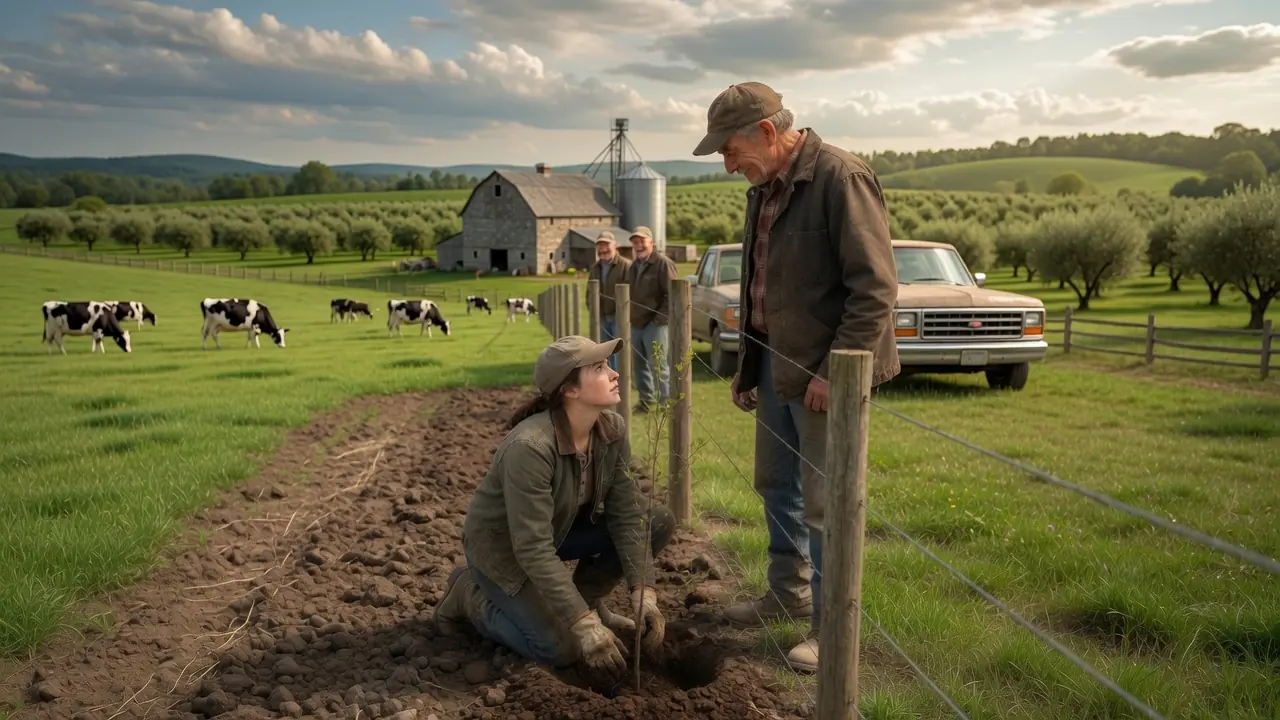
Ruby Callaway was kneeling beside the wire fence when Burl Simmons first laughed at her. The morning light lay flat across the Hatchie River lowlands, turning the muddy field a dull brown-green, while the red barn and pale farmhouse stood far behind her like quiet witnesses. A dusty pickup truck sat near the fence line, and three older farmers leaned along the road as if the whole county had gathered to watch one young woman make a mistake. Ruby pressed both gloved hands into the damp soil around a young native tree, packing it gently into the edge of the wide unplowed strip she had chosen to protect.
She was only twenty years old, with dark brown hair tucked under a beige work cap, freckles across her cheeks, and a faded olive jacket pulled tight against the March chill. Her boots were sunk deep into the soft Tennessee ground, and her knees were muddy from the work she had started before sunrise. To anyone passing by, she looked like a girl planting sticks where a tractor should have been cutting rows. To Ruby, every root she placed in the ground was part of a plan her neighbors were not ready to understand.
Burl Simmons leaned on the other side of the fence, his weathered face full of amusement. He was a hard-faced farmer with a gray mustache, deep-set eyes, and the kind of confidence that came from forty years of being listened to. Behind him, Dale Huckett and Tom Pruitt watched with folded arms, boots planted in the gravel, pretending curiosity had brought them there instead of judgment. Burl pointed toward the strip of tall grass and unturned soil along the creek side of Ruby’s field.
“Ruby, your daddy would have had that whole acre turned before breakfast,” he said. His voice carried across the fence, loud enough for the other men to hear. Dale chuckled under his breath, and Tom shook his head like he was already calculating the lost yield in his mind. Ruby did not stop packing soil around the roots.
“Daddy taught me to plant crops,” she said calmly. “Grandpa taught me to listen to the water.”
Burl laughed again, this time louder. “You are leaving the richest soil on this farm to weeds.” Ruby looked up at him, her hazel eyes steady beneath the brim of her cap. “No, Mr. Simmons,” she replied. “I am leaving it strong enough to stop what is coming.”
The men went quiet for one brief second, then Burl gave a dry little snort and turned toward the road. Ruby knew what they thought. They thought grief, youth, and inexperience had made her sentimental about a strip of ground that should have been worked. They thought she was too young to understand that spring did not wait for feelings.
Ruby’s neighbors had their rows cut straight and dark. The earth behind their tractors rolled over cleanly, exposing the rich bottomland that had fed families for generations. Ruby had worked most of her forty acres too, driving her father’s old John Deere carefully across each field before the rain came. But along the lowest eastern edge near Cane Branch Creek, she had deliberately left one acre unplowed.
That was the acre everyone noticed. It stretched long and rectangular along the creek side, thick with native sedge, switchgrass, tangled roots, and young trees she had begun planting by hand. In a county where good bottomland soil was treated like money lying open on the ground, leaving even a narrow strip untouched looked foolish. Leaving a full acre looked almost unforgivable.
Ruby understood why they were talking. The Callaway farm had already been under pressure for two years, ever since her father’s heart trouble took him out of the fields. James Callaway could still sit on the porch, read weather reports, and tell by the wind whether rain would hold or pass. But the heavy work had fallen to Ruby, whether the neighbors believed she was ready or not.
Her mother had died when Ruby was nine. After that, Ruby and her father had moved through the seasons together, each one learning to fill the silence in practical ways. James taught her to change oil, set a fence post, drive straight rows, and sharpen a blade. He also taught her that land remembered every mistake, even when people forgot.
The idea for the unplowed strip had not come from Ruby alone. It began in the back of the equipment shed, inside a water-stained cardboard box she found during a winter cleanup. The box held notebooks belonging to her grandfather, Earl Callaway, a man Ruby barely remembered except through faded photographs and her father’s stories. Those notebooks changed the way she saw the farm.
Earl had written down everything. He recorded rainfall, yield, flood depth, soil color, seed timing, creek movement, wind direction, and even where driftwood collected after storms. He sketched maps of Cane Branch Creek and marked the exact places where water jumped the bank. His handwriting was cramped, old-fashioned, and stubbornly precise.
One passage stopped Ruby cold. It described the strips of rough grass along the creek that he refused to plow even when neighbors called them wasted. The roots held the soil, he wrote, and the tall grass slowed the water before it reached the crop rows. The strip was not empty land. It was a brake.
Ruby read that page so many times the words seemed to settle inside her. That winter, after chores, she drove to the public library and searched for soil conservation bulletins on an old computer. She found articles about vegetative buffer strips, riparian zones, sediment control, root-bound native grasses, and floodwater energy. The official words were different, but the meaning was exactly what her grandfather had written sixty years earlier.
When she explained it to her father, James listened from his armchair near the window. His skin looked pale against the blanket over his knees, but his eyes were sharp. Ruby spread the old notebook, her hand-drawn maps, and printed bulletins on the coffee table. She pointed to the low field and the strip beside the creek.
“If we leave this part rough, it can slow the water before it crosses the rows,” she said. “It will take one acre out of production, but it may protect everything above it.” James studied the map for a long time. “Your grandfather believed that too,” he said at last.
“You think I should try it?” Ruby asked. James looked through the window toward the field he had worked his whole life. “I think if you have listened this carefully, you have earned the right to test what you know,” he said. “But Ruby, people will talk.”
Ruby smiled faintly. “They already do.”
So when March arrived, Ruby made the decision no one else understood. She plowed the higher ground, worked the middle fields, checked the planter, repaired a weak fence line, and then drove the John Deere in a wide curve around the acre near Cane Branch Creek. She left the grasses, sedge, roots, and young saplings in place. Then she parked the tractor and started planting more.
That was the scene Burl Simmons saw from the road. A young woman kneeling in mud where a tractor should have gone. A field left rough while every other farmer was chasing perfect rows. A girl, as he surely thought of her, trusting old notebooks and library papers instead of the habits of men who had farmed longer than she had been alive.
April came wet. Not dangerously wet, not at first, just the ordinary dampness that made Tennessee fields difficult and farmers impatient. Three hard rains passed through the lowlands, and after each one, Ruby walked the unplowed strip with a notebook in her pocket. She watched where the water slowed, where the soil collected, and where the field above the strip drained faster than it had in past years.
The first time she saw the pale silt drop at the grass boundary, her heart beat faster. It was exactly what Earl Callaway’s notebook said would happen. The creek water pushed toward the field, struck the thick rooted vegetation, and lost speed. Sediment fell out before it could spread across her rows.
Ruby told no one except her father. Each evening, she came inside with mud up to her calves and notes tucked under her arm. James sat at the kitchen table, reading glasses low on his nose, listening while she described water movement the way another person might describe a family member’s habits. Sometimes he nodded. Sometimes he simply smiled.
In early May, Burl drove past again while Ruby was measuring water marks near the strip. “Counting weeds now?” he called from his tractor. Ruby lifted one hand in a polite wave and kept walking. She had learned that not every insult needed an answer in the moment.
Still, she felt the weight of their laughter. At the feed store, conversations paused when she stepped inside. At church, two older men asked her if she planned to “farm grass” all season. Even the county extension agent, though kinder than most, told her that giving up one productive acre was a serious decision for a small farm already under strain.
Ruby did not argue. She kept records. She measured the strip at sixty feet wide in most places, wider where the creek bent hard and water historically pushed strongest. She marked where sedge had deepened, where switchgrass had returned naturally, and where the saplings might someday strengthen the bank.
By the second week of June, the forecast changed. A slow-moving weather system settled over the region, pulling moisture north in long bands from the Gulf. Rain chances became flood watches. Flood watches became warnings. The Hatchie River gauge rose inch by inch, then foot by foot.
Every farmer along County Road 7 began preparing for trouble. Equipment was moved to higher ground. Seed bags were stacked above floor level. Drainage ditches were checked, pumps tested, and insurance papers pulled from drawers. Men who had laughed at Ruby now looked toward the sky with the same hard expression she had seen in her father’s face during bad seasons.
On Thursday night, rain began tapping against the windows of the Callaway farmhouse. James sat in his chair near the front room while Ruby came in from the barn soaked at the shoulders. “You ready?” he asked. Ruby hung her jacket by the door and looked toward the dark window.
“I think so,” she said.
By Friday morning, the rain had settled in. It did not come as a dramatic wall of water, but as something worse, steady and patient. It soaked the fields, filled the ditches, softened the banks, and turned every low place into a dark mirror. Cane Branch Creek began to climb.
By Saturday, the water was high enough to make even the old men nervous. Burl Simmons’s lower field had standing water across several rows. Dale Huckett’s drainage tile could not keep up. Tom Pruitt drove past Ruby’s farm twice, slowing near the fence but not stopping.
Ruby spent the day moving between the barn, the house, and the field edge. She wore knee-high rubber boots and a rain jacket that had stopped keeping anything dry hours earlier. Her notebook stayed wrapped in plastic inside her coat. Her eyes stayed on the strip.
By Sunday afternoon, Cane Branch Creek was out of its banks. Water pushed hard across the lowlands, carrying pale silt, broken twigs, and mud from higher ground. It moved across neighboring fields in sheets, filling furrows and cutting across rows that had looked clean and hopeful only days earlier. The sound was not loud, but it was relentless.
Ruby stood near the fence where she had planted the young tree in March. The sapling bent in the rain but held. The grass strip shivered under the pressure of the water, its roots gripping the wet soil beneath. Then the floodwater reached it.
It did not stop completely. Ruby had never expected that, and anyone who promised to stop floodwater entirely was lying. But the water slowed as it entered the thick unplowed strip. Its forward force broke apart, spread sideways, and lost the hard push that had once carried silt straight into the planted rows.
Ruby watched the sediment drop. Pale mud collected at the edge of the grasses instead of smothering the crop rows above. The planted field beyond the strip took water, but not the destructive surge her neighbors were facing. Within hours, the difference was visible even through the rain.
By Monday morning, the lower third of several nearby fields was underwater. Burl lost part of his creek bank. Tom Pruitt’s young soybeans lay beneath a sheet of silt. Dale Huckett stood at his field edge with his hands on his hips, staring at rows he would likely have to replant.
At the Callaway farm, the flood line had stopped where Ruby hoped it would. The unplowed strip was battered, bent, and loaded with sediment, but the crop rows above it remained largely clear. Water drained back toward the creek instead of sitting heavy across the whole low field. The one acre everyone called wasted had protected many more.
Ruby stood in the thinning rain on Tuesday morning, looking at the line where damage stopped. She did not feel victorious. She felt tired, cold, and deeply grateful in a way she could not explain. Her grandfather’s handwriting, her father’s trust, and her own stubborn work had all met in that field, and the land had answered.
Burl Simmons came four days later. He did not arrive with jokes. He walked slowly from the road, boots still muddy from his own damaged field, and stopped at the fence line where Ruby was checking the young trees. His face looked older than it had in March.
Ruby stood and waited. Burl looked across the unplowed strip, then at the clean rows above it, then toward the silt line trapped in the grass. For once, he did not speak first with a grin. “I need you to tell me what you did here,” he said.
Ruby brushed mud from her gloves. “Sixty feet along the creek,” she said. “Grandpa’s notes said forty might hold, but I went wider because this bend gets the strongest push.” Burl nodded slowly. “What kind of grass?”
“Native sedge, switchgrass, some big bluestem that came back on its own,” Ruby said. “I added saplings where the bank was weakest.” Burl looked down at the grass he had once dismissed as weeds. “And you knew it would work?”
Ruby shook her head. “I hoped it would. But I had records, old maps, and two seasons of watching the water.” Burl’s jaw tightened, not in anger, but in the discomfort of a man having to respect what he once laughed at. “Your granddaddy wrote all that down?”
“He did,” Ruby said. “I just listened.”
Dale came two days later. Tom came the day after him. The county extension agent arrived with a measuring tape, a camera, and a notebook of his own. One by one, the same people who had treated Ruby like a child now walked the strip with serious faces and muddy boots.
Ruby showed them Earl Callaway’s notebooks. She showed them her own notes from March, April, May, and June. She explained how plowed ground allowed water to move faster, how dense roots slowed it, how sediment dropped when the flow lost energy. Nobody laughed this time.
Her father watched some of it from the porch, wrapped in a light blanket despite the June warmth. His health had not returned, but his pride in Ruby seemed to put strength back into his eyes. That evening, after the extension agent left, Ruby sat beside him on the porch steps and leaned her elbows on her knees. The fields smelled of mud, rain, and survival.
James looked toward the strip along Cane Branch Creek. “Your grandfather would have liked you,” he said. Ruby swallowed hard. It was a simple sentence, but it landed deeper than praise.
The following spring, three farms along County Road 7 left buffer strips along their creek edges. Not as wide as Ruby’s at first, because pride often compromises before it learns. But they left them. Burl Simmons even planted native grass along the bank he had lost.
The county extension office held a workshop on riparian buffers and asked Ruby to speak. She stood in front of farmers twice her age, wearing the same beige cap and olive jacket, with her grandfather’s notebook beside her on the table. Her voice shook at first, but only for a moment. Then she began explaining the land the way she had learned to see it.
Two years later, aerial photographs showed new green lines along the Hatchie Basin where plowed soil had once run straight to the water. Those lines did not solve every problem. Floods still came, rain still tested the fields, and farming never became easy. But the water moved differently where the land had been given something strong to meet it.
Ruby never claimed she had invented anything. She always said her grandfather had written it down and the land had confirmed it. But everyone knew it took Ruby to open the box, read the pages, trust the evidence, endure the laughter, and kneel in the mud while other people mistook wisdom for foolishness. That was no small thing.
Years later, when young farmers asked her about that acre, Ruby would point toward the creek and tell them to watch before they plowed. “The land speaks before it fails,” she would say. “Most folks hear it only after the damage.” Then she would smile, not with pride, but with the calm of someone who had learned the difference between noise and truth.
The acre she left unplowed became the most important acre on the Callaway farm. It grew thick with roots, trees, sedge, and memory. It held silt, slowed water, sheltered birds, and saved crops more than once. What the men on County Road 7 called wasted ground became the reason Ruby’s farm survived.
And on quiet spring mornings, when fog settled low over the Hatchie River fields, Ruby sometimes knelt beside the fence to press new roots into the soil. She could still hear Burl’s laughter from that first day, but it no longer bothered her. The flood had answered louder than any argument she could have made.
She had not left the acre empty. She had left it ready.
And when the water came, it knew exactly where to stop.