The morning Ruby Callaway left a full acre of good bottomland soil unplowed, the men along County Road 7 laughed like they had just watched common sense fall off a tractor. It was mid-March in the Hatchie River lowlands of western Tennessee, and every field within five miles was being worked hard while the weather held. Diesel smoke hung over the road, wet clay stuck to tires, and tractors moved back and forth across the dark ground like iron beetles. Every farmer knew the planting window was short, and every farmer knew you did not waste workable soil when a season could turn against you overnight.
But Ruby turned her father’s old John Deere around the long strip of creek-side grass and kept going. She was twenty years old, short and strong from work, with her brown hair tucked under a faded cap and her face set in the calm expression people often mistook for uncertainty. The strip she left untouched ran nearly the full length of the lowest field, about sixty feet wide, full of tall matted grass, native sedge, switchgrass, and patches of big bluestem that had come back on their own. To the men at the fence, it looked like weeds.
Burl Simmons stood with one boot on the bottom rail and a dry little smile on his weathered face. He had farmed the land north of the Callaways for longer than Ruby had been alive, and he trusted plows more than theories. Dale Huckett stood beside him, scratching under his cap. Tom Pruitt shook his head slowly, as if the mistake hurt him personally.
“What in the world is that girl doing?” Dale asked.
Burl laughed. “Wasting the richest strip she’s got.”
Tom looked toward the Callaway farmhouse, where Ruby’s father, James, had not been strong enough to work a full day in two years. “Her daddy would have had that turned before breakfast.”
Ruby heard them, but she did not look over. She guided the tractor around the grass strip with deliberate care, watching the distance from the creek bank, the slope of the soil, and the line where floodwater usually entered the field first. Then she finished the pass, parked near the barn, climbed down, and walked inside without hurrying. She knew exactly what they thought.
The Callaway farm had been struggling since her father’s health failed in the winter of her eighteenth year. Before that, James Callaway had worked the forty acres with patience, thrift, and the kind of discipline that kept a small farm alive without ever making it rich. Ruby’s mother had passed when Ruby was nine, and after that it had been Ruby and James moving through the seasons together. She learned by doing, and later she did because there was no one else.
People called her a girl because it made them feel safer about ignoring her. She was young, yes, but she had been waking before dawn since childhood. She knew the sound of a bearing going bad in the old John Deere. She knew how clay soil behaved after three days of rain. She knew where water gathered in the low field before any puddle showed above the crop rows.
The men at the fence knew farming, but Ruby knew that particular farm.
That was different.
The idea had started the previous winter when she found her grandfather Earl Callaway’s notebooks in a water-stained cardboard box at the back of the equipment shed. She had been looking for an old part manual and found the box behind a rusted cultivator blade. Inside were ledgers, journals, sketches, rainfall records, crop notes, and maps drawn by hand. Earl had farmed the same ground decades earlier, and he had written down things no one else had thought important enough to save.
Ruby carried the box into the kitchen and spent nights reading while her father slept in the next room. Her grandfather’s writing was careful and plain, the handwriting of a man who expected paper to outlive him. He had recorded yields, storms, creek behavior, recovery times, erosion lines, and how each field responded after heavy rain. In one notebook from the mid-1960s, she found the passage that changed everything.
“The strips I leave rough along the creek are the ones that slow the water down when it comes,” Earl had written. “The grass holds, the roots hold, the soil holds, and everything above it holds too.”
Ruby read those lines again and again. Then she began comparing them to her own memory of the farm. The low field along Cane Branch Creek was always the first to take water and the slowest to recover. When the Hatchie rose, the water came through the creek bend and pushed across the planted rows, leaving pale silt that dried hard as concrete. Every flood stole a little more from them.
Most farmers treated it as the price of farming lowland soil. You drained what you could, replanted what survived, and swallowed the loss. Some years the loss was small. Some years it took enough from you that winter bills became a quiet threat. Ruby had heard men talk about it her whole life like weather was a ruler no one could reason with.
But her grandfather’s notes suggested the water’s behavior could be changed before the rain arrived.
Not stopped. Ruby was never foolish enough to think that. Water in flood season did not obey a girl with a notebook. But maybe it could be slowed. Maybe the force could be broken before it reached the rows. Maybe a strip of root-bound grass could do what a plowed field could not.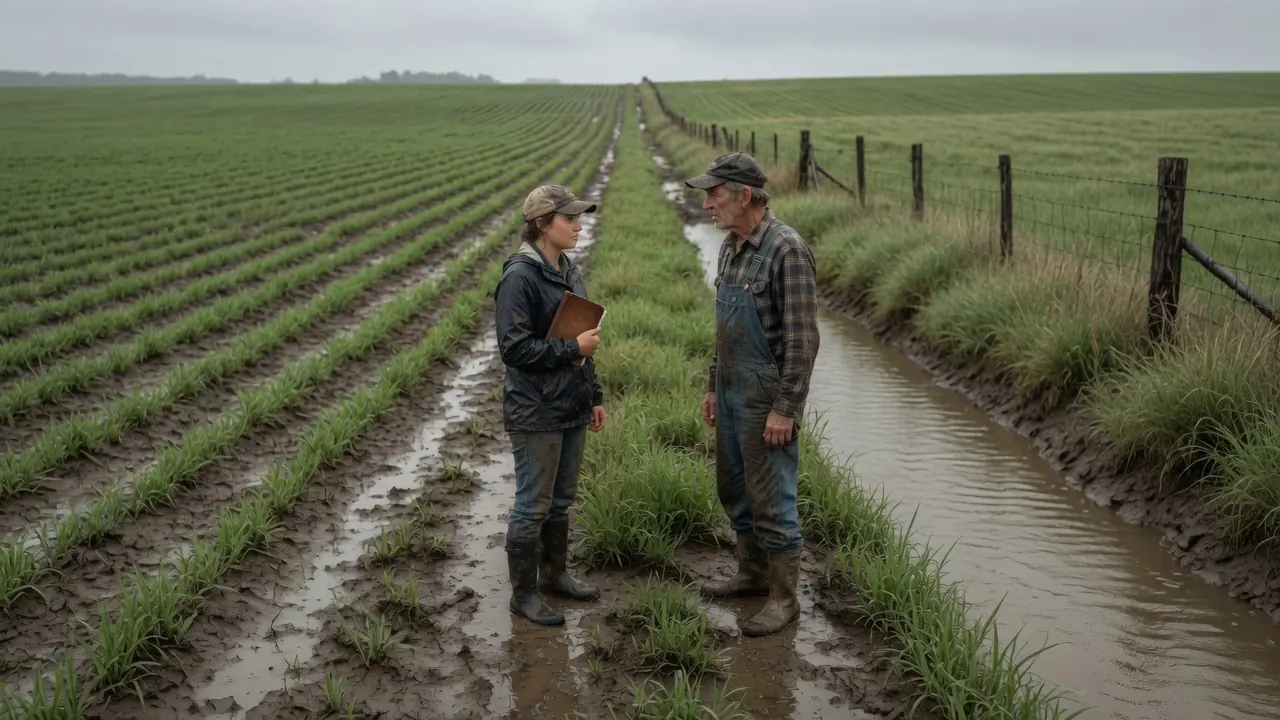
Ruby did not rely only on the notebooks. She rode into Savannah and used the library computer to look up soil conservation bulletins. The term she found was vegetative buffer strip. The language was dry, technical, and a little hard to follow at first, but the meaning matched Earl Callaway’s old observations. Dense native vegetation could slow runoff, trap sediment, reduce erosion, and protect the land beyond it.
She printed what she could, took notes in her own spiral notebook, and laid everything on the kitchen table beside her grandfather’s pages. Her father watched from his chair, wrapped in an old sweater, his face thinner than it used to be but his eyes still sharp. Ruby explained it without fancy words. “Grandpa Earl left those strips for a reason, and I think I know what it was.”
James looked at the papers for a long time. “You believe it?”
“I believe it enough to test it.”
He nodded. “Then test it.”
That was all he said, and that was enough.
So in March, when everyone else plowed every inch they could reach, Ruby left the acre along the creek untouched. It hurt her to do it. She knew the numbers. The Callaway farm needed every bushel it could grow, and leaving rich bottom soil unplanted looked like a luxury they could not afford. But every flood had cost them more than that acre ever produced.
Burl Simmons did not see calculation. He saw a young woman making a sentimental mistake with land her father had worked properly for decades. A few days after the first plowing, he caught Ruby near the fence while she was checking the grass strip. He leaned his arms on the top rail and gave her the look older men reserve for advice they expect to be obeyed.
“Ruby, your daddy would’ve had that rich strip turned before breakfast.”
Ruby held her notebook against her side. “Grandpa Earl left it rough for a reason.”
Burl gave a short laugh. “That ain’t farming, girl. That’s wasting land you can’t afford to lose.”
Ruby looked toward Cane Branch Creek. “When the flood comes, we’ll see what’s wasted and what’s working.”
Burl shook his head and walked away. He told Dale and Tom what she had said, and by evening half the road had heard about Ruby Callaway waiting on a flood to prove weeds were farming. Some laughed openly. Others felt sorry for James. A few said she was trying her best, which was often a kinder way of saying she was failing.
April came wet, but not unusually so at first. Three hard rains rolled across the lowlands during the first two weeks, leaving puddles in the ruts and a shine on the creek bank. After each rain, Ruby walked the strip before breakfast. She measured where the water had pushed, where it had pooled, and where sediment had dropped.
She saw small signs that made her heart beat faster. The water hit the grass and spread sideways instead of charging straight into the rows. Pale silt gathered at the edge of the strip, caught in tangled stems and root mats. The planted field above it drained better than she expected. Nothing was proven yet, but the pattern was beginning to speak.
Ruby said nothing to the men at the fence.
She only wrote it down.
By early May, the low field was growing steadily. The planted rows above the unplowed strip looked strong, the young crops green and evenly spaced. Burl drove past once while she was walking the creek edge and called something about raising weeds for market. Ruby lifted one hand in a small wave and kept walking. She did not need to answer every man who mistook patience for weakness.
The forecast changed in June.
A slow-moving system stalled over Arkansas and began pulling heavy moisture north from the Gulf. The radio talked about multi-day rainfall. The Hatchie River gauge at Pocahontas rose. The one downstream at Belvoir was already above flood stage. Farmers who had laughed in March now watched the sky with the old tightness around their mouths.
Ruby had already made her preparation list. Equipment moved higher. Seed stored dry. Fuel cans secured. The irrigation pump hauled into the barn loft. Fence tools and feed sacks shifted away from the low ground. Her father watched from the porch when she came in soaked each evening.
“You ready?” James asked one night as rain began tapping against the window.
Ruby stood in the doorway, tired and muddy. “I think so.”
By Friday morning, the sky looked like cast iron.
Then the rain came hard.
It did not fall in one violent burst and pass. It settled in, steady and patient, the kind of rain that soaks through fields, roads, roofs, and nerves. Furrows turned into little channels. Ditches filled and spilled. Cane Branch Creek rose by inches, then feet, brown and restless against its banks.
By Sunday, the creek was out.
By Monday morning, the lower third of every field on the east side of County Road 7 had water standing in it. Dale Huckett lost nearly thirty acres of corn to water that would not drain. Tom Pruitt’s soybean field took a pale sheet of silt that spread across the rows like a burial cloth. Burl Simmons stood at the edge of his field and watched part of his creek bank collapse, taking years of built soil with it.
Ruby stood in knee-high rubber boots at the edge of her low field, rain jacket soaked through, notebook wrapped in oilcloth beneath her arm. The water came out of Cane Branch the way she had always seen it come, brown and carrying silt from above. It pushed toward the planted rows. It reached the grass strip.
Then it slowed.
Not stopped. Not defeated. Slowed.
The thick native grass bent but did not break. The roots held the soil like woven hands. The water lost speed, spread sideways, and dropped its heavy silt at the edge of the strip instead of carrying it into the crops above. Ruby stood in the rain and watched her grandfather’s handwriting become real in front of her eyes.
The flood still marked the land. It left puddles, flattened edges, and stress in the lower rows. But the damage line stopped at the grass. The pale silt piled where it could do the least harm. Above the strip, the planted rows drained within hours of the water pulling back. They looked tired, but alive.
When the rain finally thinned on Tuesday morning, Ruby walked the whole boundary. Her boots sank into mud, and cold water slipped down her sleeves, but she barely felt it. The silt line stopped exactly where she had hoped it would stop. The grass strip had held.
Compared to her neighbors, the difference was stark. Burl’s adjacent field wore three inches of deposited silt across its lower quarter. Tom was already talking about replanting. Dale’s drainage had simply been overwhelmed. The Callaway low field, known as one of the worst-positioned pieces of ground in the basin, had come through with the least damage.
Ruby did not feel triumph.
She felt relief.
She also felt gratitude toward a dead man she barely remembered, a grandfather who had written down what he observed by lamplight and trusted that maybe someday someone would listen. She stood beside the grass strip with his notebook in hand and wished she could tell him. Maybe, in some way, the field already had.
Four days later, Burl Simmons walked over from his farm.
Ruby saw him from the barn. He did not come with the swagger he had worn in March. He did not lean on the fence or call out a joke. He walked slowly, boots still muddy from his own ruined field, shoulders low under the weight of loss. When he reached the strip, he stopped and stared.
For a long time, neither of them spoke.
Burl looked at the silt trapped in the grass, then at the clean rows above it, then at the neighboring field beyond the fence where mud and pale crust covered everything. His face had changed. The dryness was gone. So was the mockery. What remained was a tired, humbled confusion.
“Ruby,” he said at last, “my whole lower field is buried, but yours held.”
Ruby stood beside him, holding her grandfather’s notebook. “The grass slowed the water before it could climb into the rows.”
Burl rubbed a hand over his mouth. “I laughed when you left this acre wild.”
Ruby looked across the field. “Then don’t laugh this time. Watch it, learn it, and save your own land.”
He did not answer immediately. He only nodded, once, small and serious. Then he asked her to explain what she had done.
Ruby did.
She told him about the sixty-foot width, about the native sedge and switchgrass, about the way root-bound soil absorbed the first force of the water. She showed him the sediment line. She showed him where the water spread sideways instead of straight upward. She opened her grandfather’s notebook and let Burl read the passage from the 1960s.
He held the notebook carefully, as if it had become something more than paper.
“What kind of grass?” he asked.
“Native sedge, switchgrass, big bluestem. Most of it came back on its own. You don’t plant it like corn. You stop disturbing it and let it remember what it is.”
Burl looked toward his own damaged field.
Two days later, Dale Huckett came. The day after that, Tom Pruitt. Neither man laughed. They walked the strip, asked questions, and listened when Ruby answered. They looked at the clean rows behind her and the trapped silt at their feet, and they began understanding what the flood had explained more clearly than Ruby ever could have.
The county extension agent arrived the following Thursday with measuring tape, a notebook, and a serious face. He walked the strip with Ruby for almost two hours. He measured width, slope, creek position, sediment deposit, crop damage, and water marks. Ruby showed him her grandfather’s journals and the conservation bulletins she had printed from the library.
He asked careful questions.
She gave careful answers.
By then, something had shifted along County Road 7. The same men who once spoke about Ruby as if she were a child now stood in her field waiting for her to explain water behavior. The same acre they had called wasted had become the most studied acre in the county. The wild grass that looked like neglect in March looked like wisdom in June.
Ruby did not act proud about it. She had not done it to humiliate anyone. She had done it because the farm needed saving, because her father had trusted her, and because her grandfather had left behind knowledge that deserved testing. If she felt satisfaction, it was quiet and private, like a seed opening underground.
Her father sat on the porch the afternoon the extension agent left, wrapped in a light blanket despite the June warmth. His health had weakened, but his eyes were bright when Ruby sat beside him. She told him how Burl had asked about the grass, how Dale had brought a notebook, how the extension agent wanted copies of Earl’s observations. James listened the way he always did, not interrupting, not rushing her.
When she finished, he looked toward the low field.
“Your grandfather would have liked you,” he said.
Ruby turned away for a moment because the words struck deeper than praise. They were not grand. They were not dramatic. But they were exactly what she needed to hear. Earl Callaway had watched the same land decades before and written down what most men forgot by morning. Ruby had found his notes, trusted them, and given the land room to prove him right.
The following spring, three farms along County Road 7 left buffer strips along their creek edges. Burl was the first to mark his line, sixty feet wide like Ruby’s. Dale went with fifty. Tom tried forty and later widened it after the first hard rain. Men who had once joked about weeds now argued over switchgrass, sedge, and root density like they had discovered a secret language.
The county extension office held a workshop on riparian buffers that drew farmers from four counties. Ruby stood near the back at first, uncomfortable being the reason everyone had gathered. The extension agent called her forward anyway. He asked her to explain what she had done, and she did, plain and practical, with her grandfather’s notebook open in her hands.
Nobody laughed.
Nobody had anything left to laugh about.
Two years after the flood, aerial photographs of the Hatchie basin showed more than a thousand linear feet of new native grass strips along creek edges that had once been plowed clean. Not every field was saved from every flood. Water remained water, and the Hatchie still did what rivers do. But the damage changed. The land held better where farmers gave it room to hold.
The Callaway farm did not become rich. It remained forty acres, modest, difficult, and beautiful in the way honest land can be beautiful. But the low field stopped bleeding money every wet year. Ruby’s decisions became quieter, stronger, less questioned. People still called her young, but they said it differently after that, as if youth and wisdom were no longer enemies.
Burl came by sometimes to ask about grass management, silt depth, or what her grandfather’s notes said about a particular creek bend. He never apologized in a big speech. Farmers often do not. But one morning he brought Ruby a stack of old survey maps from his father’s attic and said she might make better use of them than he ever had. That was apology enough.
Ruby kept Earl Callaway’s notebooks in the kitchen after that, not hidden in a shed. She added her own notes beside his, season by season, flood by flood, year by year. Her handwriting was different, smaller and faster, but the purpose was the same. Watch the land. Write what it tells you. Leave something for whoever comes next.
Years later, people would tell the story as if Ruby had known with perfect certainty what would happen. She always corrected them. She had not known. She had only listened, studied, and trusted the possibility that the land remembered more than the men at the fence did. Courage was not always loud. Sometimes it looked like leaving one acre alone while everyone laughed.
Ruby Callaway did not set out to prove anyone wrong.
She set out to protect her father’s farm.
In the end, she protected more than that. She protected a piece of forgotten wisdom, gave it back to the county, and changed how men twice her age looked at water, grass, and the quiet intelligence of land left undisturbed. The flood came, as floods always do, and it counted everyone’s choices honestly.
The plowed fields showed one answer.
Ruby’s grass strip showed another.
And after the water pulled back, the laughter was gone.