“Look at those ribs.”
The auctioneer’s assistant did not bother lowering his voice.
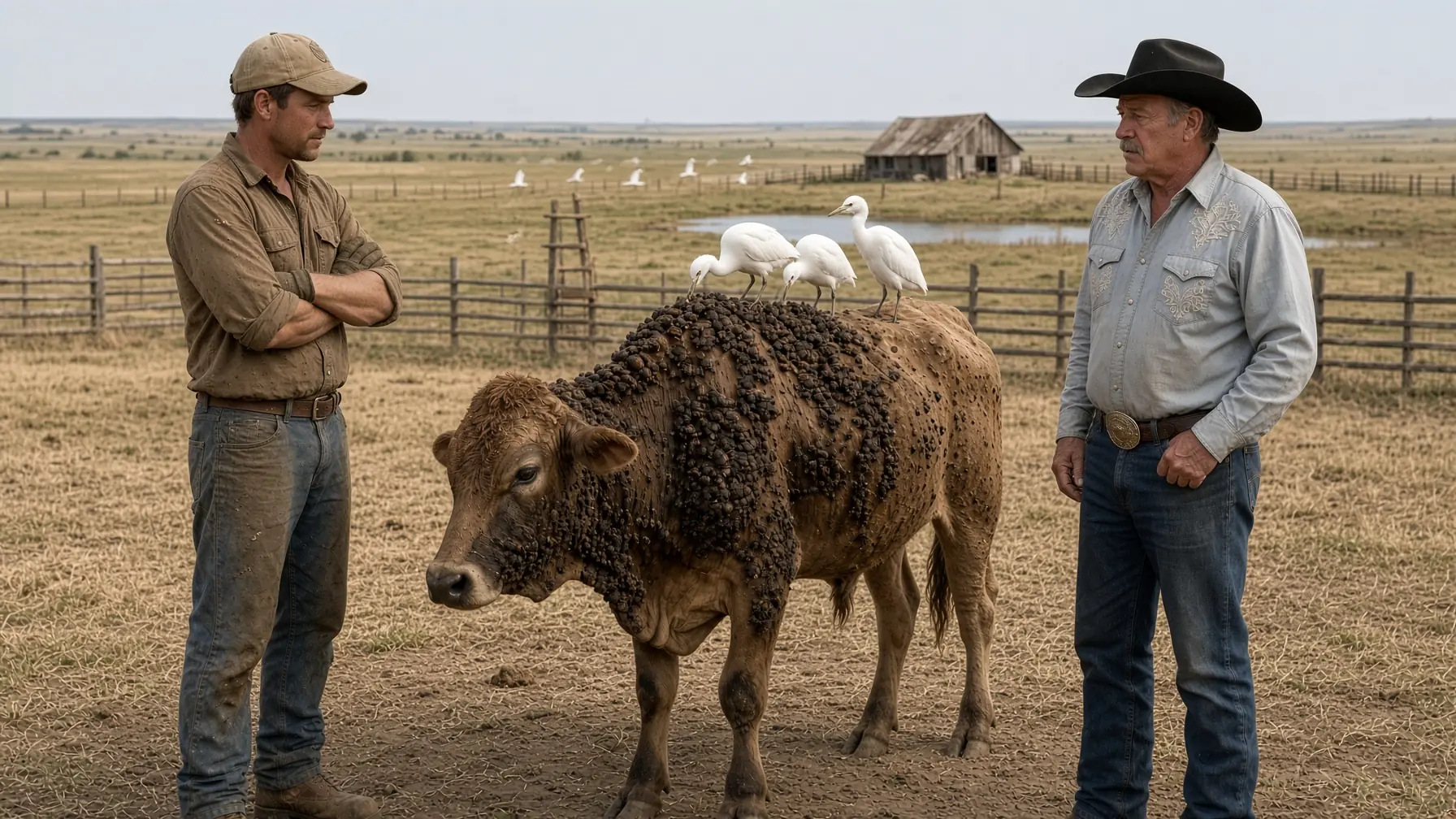
Across the covered arena at the Brazos County Livestock Exchange, twenty-two cattle shuffled into the sale pen with their heads low.
Gray dust covered their hides.
Their hips stood out.
Two cows carried raw patches where months of parasite irritation had opened the skin.
And the young bull near the rear looked worse than all of them.
Ticks clustered so thickly along his neck, dewlap, spine, and shoulders that from twenty feet away his hide seemed to have a second texture laid over it.
Someone behind the rail whistled.
“That's a dynamic sight.”
A few men laughed.
The auctioneer lifted his microphone.
“Lot forty-seven. Estate cattle. Herd’s been without regular management going on four months. County extension flagged parasite load and anaplasmosis risk. We’re selling as-is.”
Nobody moved.
The auctioneer looked around the ring.
“Do I hear two hundred a head?”
Silence.
Somebody coughed.
A boot scraped against the metal bleacher.
Then a bidding paddle rose.
Cole Whitfield’s.
The auctioneer spotted it immediately.
“Two hundred.”
Heads turned.
Cole was thirty-four years old and six months into owning the 180 acres his grandfather had left outside Dell Creek, Texas.
The place needed fence.
Roof.
Water-line work.
Equipment.
Almost everything except another problem.
Yet there he stood with his paddle still raised.
Another buyer offered two-oh-five.
Cole answered.
Two-ten.
The bidding lasted eleven seconds.
“Two hundred ten a head. Going once.”
The young bull shifted painfully in the pen.
“Going twice.”
Dutch Kesler leaned toward the rancher beside him.
Dutch ran nearly nine hundred head and had spent four decades developing a reputation for saying aloud what most men preferred to think privately.
“Boy’s buying himself a vet bill and a funeral.”
His voice carried.
“Those ticks will have half that herd sick before the leaves turn.”
The auctioneer’s gavel came down.
“Sold.”
A ripple of laughter moved through the arena.
Not vicious laughter.
Something worse in its own way.
Confident laughter.
The sound experienced men made when they believed they were watching a beginner make a mistake too obvious to require explanation.
Cole lowered his paddle.
Twenty-two head.
Four thousand six hundred twenty dollars.
By the time he paid transport and the immediate feed and mineral costs, most of what remained of his savings would be gone.
Dutch looked toward him from three rows away.
“You own a shovel, Whitfield?”
Cole frowned.
“For what?”
Dutch smiled.
“Burials.”
More laughter.
Cole folded the sale receipt and put it into his shirt pocket.
He did not defend himself.
That irritated Dutch almost as much as an argument would have.
Because Cole had learned something during the six years he spent away from Dell Creek.
Explaining a plan to people who had already decided it was foolish rarely improved the plan.
Results might.
So Cole said nothing.
He borrowed a livestock trailer.
And began hauling the sorriest cattle in Brazos County home.
It took three trips.
His nearest neighbor, Arlon Puit, happened to be checking fence when the final load arrived near sunset.
Arlon was sixty-seven, widowed, cautious, and generally kind in the way men become kind after enough years teach them how expensive certainty can be.
He watched the trailer back toward Cole’s holding pen.
Then watched the cattle stumble out.
When the young bull appeared, Arlon actually removed his hat.
“My God.”
Cole shut the trailer gate.
Arlon leaned on the fence.
“Heard you bought the estate cattle.”
“News travels.”
“Dutch Kesler’s helping it.”
“I figured.”
Arlon studied the herd.
“You overpaid.”
“Maybe.”
“No, son. I’m serious.”
“So am I.”
Arlon pointed toward the bull.
“That animal needs treatment yesterday.”
“I know.”
“You dipping them?”
“No.”
“Spraying?”
“Not the whole herd.”
Arlon’s face changed.
“You have another treatment plan?”
“Yes.”
“What?”
Cole looked across the pasture.
“First I need to see what I actually have.”
Arlon followed his gaze.
“You have ticks.”
“I noticed.”
“A lot of them.”
“Also noticed.”
Arlon sighed.
“Your grandfather would’ve called the vet before he unloaded.”
“My grandfather had more money than I do.”
“That doesn't make sick cattle cheaper.”
“No.”
Cole leaned on the gate.
“But it does make me careful about where I spend it.”
Arlon studied him.
“You think those cattle are going to heal themselves?”
Cole shook his head.
“No.”
“Then what?”
Cole looked toward the fading sky.
“Grass. Water. Nutrition. Targeted treatment where it’s actually needed.”
He paused.
“And habitat.”
Arlon blinked.
“Habitat.”
“Yes.”
“For cattle?”
“For everything around them.”
Arlon stared at him for several seconds.
Then put his hat back on.
“I liked you better before you explained.”
Cole smiled.
“I had a feeling.”
Arlon drove home convinced the county was right.
Cole Whitfield had lost his mind.
What almost nobody in Dell Creek knew was that Cole had not spent the previous six years simply working away from home.
He had worked as a range technician for a wildlife-conservation nonprofit along the Texas Coastal Plain.
His job had placed him on cattle operations that managed pasture differently from most conventional ranches he had grown up around.
Rotational grazing.
Native forage restoration.
Reduced broad-spectrum pesticide use.
Wetland edges.
Wildlife corridors.
Bird habitat.
Low-input systems built around the idea that the pasture was not just a surface for growing grass.
It was an ecosystem.
Cole was not romantic about that word.
He had seen badly managed “natural” systems fail.
He had seen animals require medicine whether the owner liked chemicals or not.
He had learned that refusing treatment simply because something was synthetic could be every bit as foolish as applying treatment without asking whether it was necessary.
But he had also seen ranches reduce insect pressure by restoring systems that conventional management had gradually removed.
Cattle egrets followed grazing herds.
Other insect-eating birds worked pasture edges.
Dung beetles broke manure apart.
Healthy native grass supported more insect diversity than chemically simplified pasture.
Birds did not replace veterinary medicine.
They did not magically sterilize a herd.
But on the operations Cole had worked, they formed part of a larger pest-management system that reduced pressure enough to matter.
And pressure mattered.
Less pressure meant fewer severe infestations.
Fewer treatments.
Lower costs.
Slower development of pesticide resistance.
Cole had spent six years watching those relationships.
Then his grandfather died.
He came home.
Inherited 180 tired acres.
And discovered that knowledge was the only capital he possessed in abundance.
For six months he repaired what he could.
Fence first.
Then barn roof.
Then water.
He calculated what a conventional herd would cost him.
The answer was more than he had.
Then lot forty-seven entered the sale ring.
Twenty-two cattle nobody wanted.
Cole had not seen healthy animals beneath all those ticks.