I was 71 years old the morning I bought that swamp. And every man at the county auction thought I’d finally lost my mind. It was a Tuesday in late March of 1998. Cold enough that the auctioneer’s breath came out in clouds. And the mud along County Road 14 was frozen into ruts deep enough to snap an axle.
The property was 10 acres of standing water and cattails, 2 miles south of Ottumwa, Iowa in Wapello County. No road access except a washed-out gravel track. No drainage. The county had seized it for back taxes 3 years running and nobody wanted it. The bidding opened at $5. Nobody raised a hand.
The auctioneer, a man named Harlan Voss who’d sold off half the farms in the county during the 80s, looked out over the crowd of maybe 30 people and said, “Come on now. It’s 10 acres. Somebody give me five.” Nothing. He dropped it to three. Still nothing.
Then I raised my hand and said $10. Harlan blinked at me like I’d offered to buy the moon. “10 dollars,” he said. “Going once.” He waited. “Going twice.” A few men turned to look at me. One of them, a seed dealer named Pritchard, shook his head and smiled the way you smile at a dog that’s too old to know better.
“Sold,” Harlan said. “To Howard Hope for $10.” I paid in cash, one $10 bill, and signed the deed right there on the hood of my truck, a 1979 Ford F250 with 240,000 miles on it. Pritchard walked past me on his way to his Suburban and said, “Howard, what in God’s name are you going to do with a swamp?” I folded the deed into my jacket pocket and said, “Guess I’ll find out.” He laughed and so did the two men with him.
I drove out to the property that same afternoon. The access track was worse than I thought. Rutted clay, pools of standing water, brush growing up through the middle. I parked at the road and walked in. It took me 20 minutes to reach the center of the 10 acres. The ground was soft, black mud under a thin crust of ice, cattails and willow scrub everywhere.
The smell was sharp, organic, like turned earth and rot, and something else I couldn’t place. I stood there in my boots, sinking an inch with every step, and I thought about my father. He died in 1964, 34 years before that morning. But I remembered something he told me when I was 12 years old. Something about mud and roots, and a plant most people had forgotten.
My father grew up in the depression, and his father before him knew what it meant to pull food from ground that nobody else wanted. In the winter of 1936, my grandfather found work draining a marsh outside of Ottumwa for a man who wanted pasture. The pay was 50 cents a day. He worked that job for 3 weeks, and on the last day, he filled a burlap sack with roots he’d been pulling all month, thick, segmented things, pale yellow under the mud, some as long as his forearm.
He brought them home and my grandmother boiled them. They ate them with salt pork. My father said they tasted like turnips, only sweeter, and that they kept the family fed until spring when the garden came in. The plant was called cattail root, or Typha latifolia, if you want the Latin. Most people think cattails are just marsh weeds.
They don’t know the roots are edible or that the pollen can be used as flour or that native tribes and settlers alike survived winters on them when nothing else would grow. By the time I was born, nobody talked about cattail roots anymore. Grocery stores had everything. But my father remembered and he made sure I did, too.
Standing there in that frozen swamp, I bent down and pulled at the base of a cattail stalk. The root came up slow, trailing black mud. It was thick as my thumb, segmented like bamboo. And when I wiped it clean on my jacket, the flesh underneath was pale cream. I pulled another, then another. In 15 minutes, I had a dozen roots lying on the ice beside me.
I took one and bit into it raw. It was starchy, fibrous, faintly sweet, exactly like my father had described. I walked back to the truck, put the roots in a feed sack, and drove home. That night, I sat at the kitchen table with a pencil and a sheet of paper. I did the math.
10 acres of cattails, dense growth, maybe 8,000 plants per acre, each plant producing two to four harvestable roots per year. Even at conservative estimates, that was a quarter million roots annually. The question wasn’t whether the swamp had value. The question was whether anyone still remembered what cattails were worth.
I spent the next 3 days in the county library, not the new branch in Marion, the old Carnegie building in Fairfield, where Mrs. Evers still kept the agriculture section exactly as it had been filed in 1952. I pulled everything they had on cattails, wetland crops, and Depression era subsistence farming. Most of it was thin. Government pamphlets, extension bulletins from the 30s and 40s.
But there was one book published in 1936 by the Iowa State Agricultural College called Marsh Plants of economic value. It had a whole chapter on cattails. The roots, it said, could be dried and ground into flour. The young shoots could be eaten like asparagus. The pollen, harvested in June, was a protein supplement.
And the fluff from the seed heads, what my father had called the down, was used for insulation, pillow stuffing, and life vests during the First World War. I made notes on the back of a deposit slip. Then I drove to the extension office in Mount Pleasant and asked to speak to someone who knew wetlands. They sent me to a man named Harlan Voss.
He was maybe 40. Wore wire-rimmed glasses and had the cautious politeness of someone used to dealing with old farmers who thought they’d discovered perpetual motion. I told him what I had. He listened without interrupting. When I finished, he leaned back in his chair and said, “You’re not wrong. Cattails are underutilized, but there’s no market infrastructure, no processors, no distribution. You’d be starting from zero.”
I said, “What if I wasn’t selling food?” He looked at me. I said, “What if I was selling the fluff?” He blinked. Then he pulled a binder off the shelf behind him and flipped through it. He stopped on a page, read for a moment, and looked up. “There’s a company in Michigan,” he said. “They make biodegradable packing material. They’ve been experimenting with natural fibers, milkweed, cattail down, things like that. They’re small, but they’re serious.”
He wrote the name on a slip of paper and slid it across the desk. “No promises,” he said. “But if you can harvest clean fluff in volume, they might talk to you.” I folded the paper and put it in my shirt pocket. I thanked him and left. On the drive home, I thought about my father standing in that swamp in 1944, pulling roots in the rain, and I thought about what he would say if he knew I was about to turn his old secret into a business.
I called the Michigan company the next morning. A woman answered. Her name was Linda Marsh, and she was the operations manager. I told her I had cattail fluff, clean and dry, and that I could harvest it in volume. There was a pause. Then she said, “How much volume?” I said I didn’t know yet, but I had 10 acres of dense cattail marsh, and I was willing to find out.
She asked where I was located. I told her. She said, “That’s a 12-hour drive.” I said I knew. She said, “Can you send samples?” I said I could. She gave me the address and told me to include moisture content, weight per cubic foot, and any contamination notes. I said I would.
I spent the next 3 days in the swamp. I cut heads, stripped fluff, dried it in the barn on wire racks under the heat lamps I used for seedlings in spring. I weighed it, measured it, checked it under the lamp for bits of leaf or seed. It was clean. I packed 2 lb of it into a cardboard box, wrote up a sheet with the numbers and drove it to the post office in town on a Thursday morning.
Marge Holloway was behind the counter. She looked at the address and said, “Michigan.” I said, “Yes.” She said, “What are you sending them?” I said, “Cattail fluff.” She blinked then stamped the box without another word. Two weeks passed. I kept working the swamp, cutting, stripping, drying. I filled eight burlap sacks and stacked them in the barn.
The work was slow and my hands were raw, but I didn’t mind. There was something steady about it. Something that made sense in a way that corn and beans hadn’t in years. On a Tuesday in late September, the phone rang. It was Linda Marsh. She said, “We tested your samples.” I waited.
She said, “It’s good. Better than good. The fiber length is consistent. The moisture’s right. And there’s almost no contamination. We’d like to place a trial order. 200 lb delivered within 60 days. We’ll pay $4 a pound.” I did the math in my head. $800 for fluff. I said, “I can do that.” She said, “If the trial works, we’ll talk about a contract.”
I thanked her and hung up. I stood in the kitchen for a long time looking out the window at the swamp. The cattails were turning brown now. Their heads heavy and splitting in the wind. I walked back out to the swamp that afternoon with a different kind of purpose.
200 lb in 60 days. That was roughly 3 and a third pounds a day, every day. With no room for weather or equipment failure or my own back giving out. I had maybe 40 good stalks per square yard in the densest sections, and each stalk, once stripped and dried, gave me about an ounce and a half of usable fluff.
I did the math standing knee-deep in cold water. I need to harvest close to 2,000 stalks. The swamp was 10 acres, but only about four were thick enough to work. I marked the northwest corner with a length of orange baling twine tied to a willow branch and started there the next morning.
The work settled into a rhythm. I’d wade out before sunrise when the air was still and the mosquitoes hadn’t woken up yet. I used the same machete my father had used to clear fence line in 1967. Wooden handle, 12-in blade, edge I kept sharp with a bastard file every third day.
I cut low, just above the root crown, and bundled 20 stalks at a time with jute twine. By midmorning, I’d have six or seven bundles stacked on the dry ground near the truck. Then I’d drive them back to the barn, hang them from the rafters, and let them dry for 5 days before processing.
The processing was the bottleneck. I tried using my hands at first, pulling the fluff free from the core, but it tore unevenly and left too much stem mixed in. Then I remembered the old corn sheller my grandfather had bolted to the workbench in 1954. A hand-crank McCormick with cast-iron gears and a hopper that could be adjusted for width.
I pulled it down, cleaned 40 years of dust and mouse nests out of the mechanism, oiled the pivot points with 3-in-1, and fed a dried cattail through. The gears caught the stalk, stripped the fluff clean, and dropped the core out the bottom. It worked. I could process 30 stalks an hour if I kept the rhythm steady and didn’t let the hopper jam.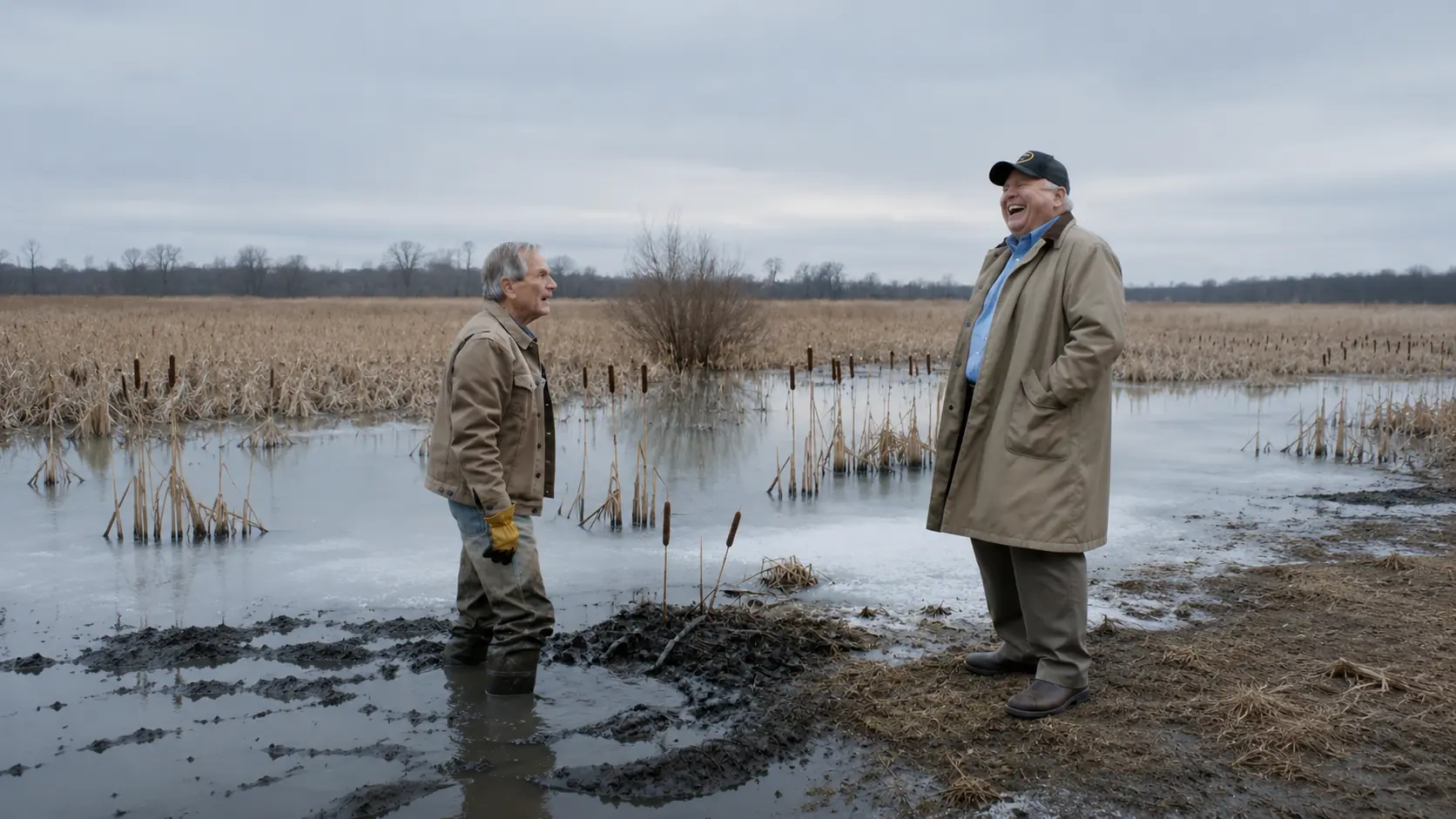
By the second week of October, I had 63 lb bagged and labeled in the barn. The nights were getting colder. Frost came early that year, October 9th, a Thursday, and turned the outer edges of the swamp black overnight. I knew I had maybe two more weeks before the whole swamp froze and the cattails turned to mush.
I worked dawn to dusk, pulling what I could reach from the edges, wading in boots when the water was low enough, dragging bundles back to the barn on a sled I’d built from 2x4s and an old truck tailgate. My hands cracked from the cold and the constant wet. I wrapped them in electrical tape at night.
By October 23rd, I had 112 lb processed and stored in feed sacks, stacked against the north wall where the air stayed dry. That same week, a man named Gerald Pitts drove out from the county extension office in a white Dodge pickup. He’d heard something from someone at the co-op. He stood in my barn doorway, looked at the sacks, picked one up, opened it, ran his fingers through the fluff, held it up to the light.
He didn’t say anything for a long time. Then he asked if I knew what the going rate was for raw kapok substitute in bulk. I told him I didn’t. He said it was running between four and six dollars a pound, depending on purity and moisture content, and that there were three textile mills in southern Ohio that would pay cash on delivery if the material met spec.
He said the spec was less than 8% stem contamination and under 12% moisture. He pulled a sample from my bag, put it in a Ziploc, and said he’d have it tested at the ag lab in Columbus if I wanted. I said, “I want it.” He called me on November 2nd, a Saturday just after breakfast. The sample came back at 6% contamination, 9% moisture.
He said that was cleaner than most of the imported stuff they were seeing. He gave me a name, Riverside Fiber Company in Marietta, and a phone number. I called that afternoon. The man who answered asked how much I had. I told him 112 lb, maybe more if the weather held.
He said, bring it down. They’d pay $5.20 a pound if it matched the sample. I did the math on the back of an envelope. $582 for cattail fluff from a $10 swamp nobody wanted. I drove down to Marietta on November 9th, a Wednesday morning, with six canvas feed sacks in the bed of the truck, each one stuffed tight and tied with baling twine.
The route took me south on 77, then east on seven along the river. Riverside Fiber was in an old brick building two blocks off Front Street near the railroad siding. The loading dock smelled like burlap and machine oil. A man in a green work shirt met me at the scale. His name was Vernon Coss, and he had ink stains on his fingers like he’d been writing invoices all morning.
He weighed each sack separately, wrote the numbers in a ledger with a mechanical pencil, then pulled samples from three of them and rubbed the fluff between his thumb and forefinger. He didn’t say much, just nodded, went inside, came back 10 minutes later with a check for $604. 116 lb total. He asked if I’d have more in the spring. I said, I thought so.
He said they’d take it, same terms, long as the quality held. I folded the check into my shirt pocket and drove home with the empty sacks rattling in the truck bed. That winter I went back to the swamp every week or two, even after the first snow. The cattails don’t stop being useful just because it’s cold. They dry standing and the heads stay intact if you’re careful.
I cut another 60 lb by Christmas. Stored in the barn loft where the air moved but the rain couldn’t reach. In February I started thinking about the rest of the land. The swamp was maybe an acre and a half but the whole parcel was 10. The other eight and a half were scrub willow, soft ground, a few patches of wild rice near the inlet where Stony Creek fed in from the north.
I walked it on a Saturday when the ground was frozen enough to hold my weight. There were muskrat runs along the bank and I found three old beaver chewed stumps near the back corner, which meant the water table stayed high year-round. Good for cattails. Good for anything that didn’t mind wet feet.
I started mapping it in my head where I could expand, where the ground was too soft even in summer, where the cattails would spread on their own if I just cleared the willow and let the light in. By March I had a plan. I’d take out the scrub along the eastern edge, maybe half an acre, and let the cattails colonize it naturally. Wouldn’t cost me anything but time and a chainsaw.
The willow wasn’t worth keeping, too thin for firewood, too crooked for anything else. I spent two weeks cutting it back, piling the brush on high ground to dry. The stumps I left low just above the waterline. Cattails don’t care about stumps. They grow right through.
April brought the melt, and the water came up fast. The whole parcel turned into a shallow lake for about 10 days, maybe 8 in deep in the low spots. I couldn’t walk it. Couldn’t work it. Just had to wait. But I could see what I’d done. Where I’d cleared the willow, the sun hit the water directly for the first time in probably 20 years.
The old cattail roots were still there under the mud. Dormant. Waiting. By the first week of May, I saw the new shoots coming up. Pale green and sharp. Pushing through the surface in rows like corn. It was working.
I didn’t tell anyone what I was doing. Didn’t see the point. Carl stopped by once in late May. Saw the cleared ground and the new growth. Asked if I was trying to farm the swamp now. I said something like that. He shook his head. Said I was wasting my time on weeds when I could have planted beans.
I didn’t argue. Beans need dry ground and diesel and seed loans. I had wet ground and free labor. And a crop that planted itself. We weren’t farming the same way anymore. By June, the new cattails were waist-high. I had maybe 2 and 1/2 acres of harvestable stand now.
The original acre and a half, plus the cleared section filling in fast. I started thinking about volume. If I could pull 150 lb a week through the summer, I’d have close to 2,000 lb by fall. At $6 a pound wholesale, that was $12,000. More than I’d made in a year since the dairy closed.
I started keeping a ledger in one of Dad’s old ruled notebooks, the kind with the marbled black and white cover. Date, pounds pulled, condition of the roots, weather. Tuesday, June 9th, 1998. 140 lbs, firm, no rot, overcast and cool. Thursday, June 11th. 162 lbs. Some soft ends trimmed off, hot, 92° by noon.
I wrote it all down the way he used to write hog weights and corn moisture. It made the work feel real. Like it was something that mattered beyond just me standing in the mud. By mid-June, I was pulling close to 170 lbs a week. The Hmong buyer started coming every Saturday instead of every other week.
They’d back the van up to the barn, weigh everything on a hanging scale they brought with them, count out cash in 20s and 10s. No receipts, no taxes, no questions. The older man, Khao I learned his name finally, told me the restaurants in the cities were asking for more. Said the roots I was pulling were cleaner and bigger than what they were getting from the other suppliers.
I didn’t know there were other suppliers. I just nodded and took the money. The first Saturday in July, Khao handed me $340. I stood there in the barn with the bills in my hand, smelling the mud and the cattail fiber drying on the workbench. And I thought about the $1,600 I’d paid for the land. At this rate, I’d have that back by September.
Everything after that was profit. I folded the cash and put it in my shirt pocket and asked if he thought the demand would hold through fall. He said it would. Said his nephew was opening a second restaurant in St. Paul and wanted a standing order. I told him I’d keep pulling as long as the frost held off.
That week I cleared another quarter acre on the north side where the ground sloped just enough to drain a little faster. The cattails there were thinner, crowded out by reed canary grass, but I figured if I could knock the grass back and let the cattails spread, I’d have another good stand by next summer.
I worked in the early mornings before the heat set in, pulling grass by the root and piling it on the high ground to dry. It was slow, repetitive work, the kind that lets your mind go quiet. I’d look up sometimes and see the heron standing in the shallows, one leg folded, waiting.
By mid-September, the water had dropped another 6 in. You could see the mud cracks forming along the edges where the cattails thinned out. And the smell changed, less green, more mineral. I was pulling roots 4 days a week now, sometimes five. My hands had toughened up enough that I didn’t need gloves anymore, just calluses thick as boot leather.
I’d fill the truck bed by noon, drive into Fairmont, unload at the co-op dock, and be back by 2:00 to check the water level and mark where I’d work next. It became a rhythm I didn’t think about, the way you don’t think about breathing. The second week of September, Harlan called and said his nephew wanted to visit the property. Wanted to see where the roots were coming from.
I told him that was fine, but I wasn’t going to put on a show. He laughed and said the kid just wanted to understand the supply chain, whatever that meant. They came out on a Thursday morning, the nephew and a woman with a clipboard, who said she was a buyer for a distributor in Minneapolis. She wore rubber boots that looked like they’d never seen mud.
The nephew was maybe 30, clean-shaven, asked a lot of questions about yield per acre and whether I could scale up. I told them I was one man with a spade and a 10-acre swamp. He nodded like he was taking notes in his head. The woman walked the perimeter, took photos with her phone, asked if I owned the land outright. I said I did.
She asked if I’d ever considered leasing it to a commercial operation. I said, “No.” She didn’t press. They stayed maybe 40 minutes, then drove off in a white SUV that sat too high for the county roads. Harlan called that evening and said they were impressed. Said the distributor wanted to put in a standing order for 200 lb a week through October, maybe into November if the ground didn’t freeze.
I asked what they were paying. He said, “60 cents a pound, delivered.” I did the math in my head. That was $120 a week, near 500 a month if it held. I told him I’d do it. I started pulling every morning at 5:30 before the sun came up over the tree line. The mud was cooler then, easier on the back.
I’d work 2 hours, sometimes three, fill the baskets, rinse them in the creek, lay them out on the same plywood sheets I’d used for drying tobacco 30 years back. By noon, they were clean enough to weigh. I bought a hanging scale from the co-op in Greenfield, the kind they used for hog carcasses, and hung it from a beam in the barn.
Every pound went into waxed cardboard boxes Harlan dropped off on Tuesdays. He’d pick them up Thursdays, drive them to the distributor in Columbus. The first week I sent 187 lbs. The second week, 212. By the third week, I was pulling 220, 230 without trying. The ground just kept giving.
The distributor paid on time every 2 weeks by check. I deposited it at the Farmers and Merchants in town, same teller window my father used. The first check was $240. The second was 270. I didn’t spend it. I let it sit. By mid-September, I had over $1,000 in the account that hadn’t been there in July.
The tractor payment came due in October. I wrote the check without touching what I’d saved from the corn. That was the first time in 11 years I’d made a payment and still had money left over. Harlan came by one Saturday in late September with a man from the distributor. Older guy, maybe 70, wore a canvas jacket and boots that had seen real mud.
He walked the swamp with me, asked how deep the roots went, how I knew where to pull. I told him I just felt for them. He nodded, said he’d been in the business 42 years, and never seen ginseng grow this thick in bottomland. Said most of it came from the mountains, North Carolina, Tennessee, places where the soil drained.
He asked if I’d planted it. I said no. He looked at me for a long moment, then said, “Your grandfather might have.” I didn’t say anything to that. But I went back to the house that night and pulled out the ledger again. Flipped through the pages slow, looking for something I might have missed.
And there it was, third page from the back, a line I’d read a dozen times but never understood. Plant it root stock. North quarter bottom land. September 1947. Let it go wild. That was all. No explanation. Just those seven words in his hand.
He’d known the land would flood. Known it would sit there looking worthless for decades. And he’d planted it anyway. Because he understood something the rest of us forgot. That patience isn’t just waiting. It’s planting something you’ll never harvest yourself.
I kept pulling roots through November. The ground froze hard by Thanksgiving and I stopped. Final count for the year came to just under 9,000 lb dried. Harlan’s distributor paid $4,100 for the lot. I put half in the bank, used the rest to fix the barn roof, and buy seed for spring.
The swamp’s still there. I’ll pull again next fall and the fall after that. And when I can’t anymore, maybe someone else will remember what it’s for. People ask me sometimes why I didn’t sell that land when I had the chance. Why I held on to 10 acres of mud that couldn’t grow corn and couldn’t be built on.
I tell them the same thing my grandfather would have told me if he’d lived long enough. You don’t measure land by what it does for you today. You measure it by what it remembers. And what it’s willing to give back when you finally learn to ask.
If you’ve got a piece of ground people told you was worthless. Or a machine they said would never run again. Or a box of papers you almost threw out. Maybe take another look. Sometimes the thing everyone laughs at is the only thing that’ll save you when the bill comes due.