The laughter started before Harriet Vale even lifted the lid of her Dutch oven. The black iron pot struck the long table inside Bitter Creek’s town hall with a heavy thud that rattled teacups and drew every eye in the room toward her. Harriet knew those looks because she had lived beneath them for years, the quick measuring glance that began with her flour-roughened hands, traveled over her broad shoulders and heavy body, then ended in the private satisfaction of women who knew society had placed them above her. At twenty-eight, Harriet had learned that Bitter Creek admired usefulness in a woman only as long as usefulness never became visible enough to demand admiration.
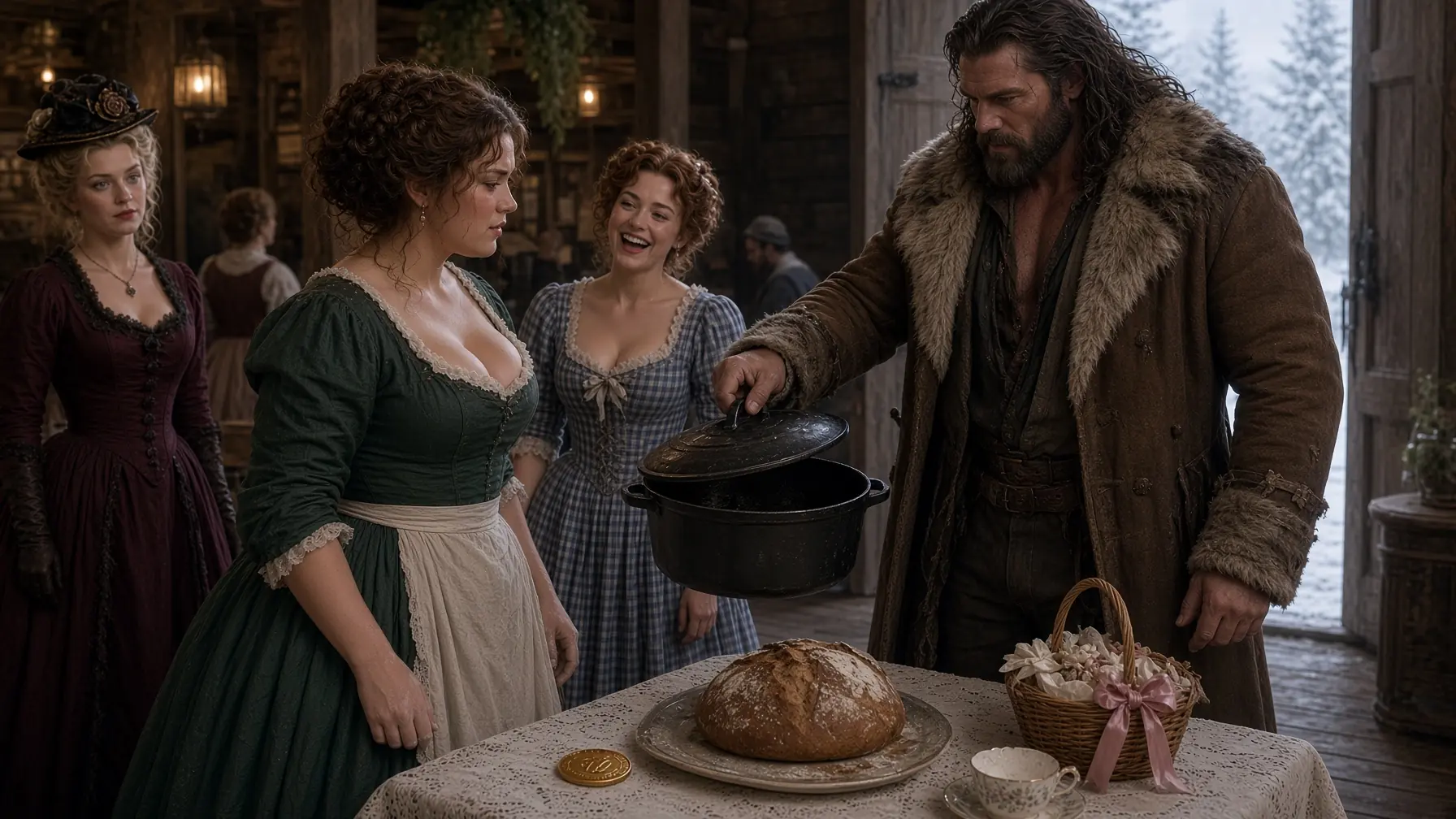
The hall smelled of lavender water, damp wool, sugar icing, beeswax candles, and the faint coal smoke rolling from the iron stove near the stage. Young women stood beside baskets tied with ribbon, pies decorated with leaves cut from pastry, sponge cakes light enough to tremble when carried, and delicate sandwiches arranged on embroidered cloths. Harriet had brought a sourdough loaf baked with wild yeast, toasted oats, molasses, and a crust nearly as dark as polished mahogany, the kind of bread that could feed a working man through a day of cutting timber or driving cattle. There was nothing delicate about it, which was probably why Pearl Fairchild smiled before the lid was fully removed.
“My word, Harriet,” Pearl said, leaning over the pot as though examining an animal someone had accidentally brought indoors. “It looks like a paving stone.” A few of the younger women covered their mouths, and Pearl tapped one perfectly manicured finger against the crust before adding, “Did you mix it with a shovel?” Harriet lowered her eyes because she had discovered long ago that sometimes silence preserved more dignity than answering people who had already decided cruelty was entertainment.
Josephine Bell stood beside an angel food cake so pale and airy it looked like something made from clouds rather than flour. She was the wife of Bitter Creek’s assayer, wore imported gloves despite being indoors, and carried herself with the quiet confidence of a woman whose husband’s position made invitations appear automatically. “Tonight is a box social,” Josephine reminded Harriet in a voice sweet enough to make the insult worse. “The men are supposed to bid on something that reflects the woman who made it, so I suppose your loaf is very honest.”
The room went still just long enough for everybody to hear what Josephine meant. Harriet’s cheeks warmed, but she replaced the lid over the bread with steady hands and said, “We’ll see.” Pearl exchanged a look with Josephine, and another ripple of laughter moved along the table. Harriet stepped backward until the wall touched her shoulders and wished, not for the first time, that strength could be worn as beautifully as lace.
She had not intended to attend the social at all. Her father, Amos Vale, had been ill for almost a year, and the boarding house they owned on Copper Street had become Harriet’s responsibility in everything but name. She rose before dawn to mix bread for eight boarders, hauled water when the pump froze, cleaned rooms, butchered chickens, kept accounts, mended blankets, scrubbed floors, and cooked enough food each week to feed a small military company. By Saturday evenings, Harriet often felt as though every joint in her body had been replaced by something made of stone.
Amos had insisted she go. “You spend six days feeding men who smell like horses and axle grease,” he had told her from the chair beside the kitchen stove. “You can spend one evening around men who at least washed first.” Harriet reminded him that Bitter Creek’s unmarried men rarely noticed her unless they wanted a second biscuit, but Amos waved the objection away as if refusing to accept the possibility could make it untrue.
Her father had always believed somebody would eventually see what he saw. Harriet knew he worried that illness had trapped her beside him, that every year she spent keeping the boarding house alive was another year during which marriage, children, and some imagined gentler future drifted farther away. She never told him that Bitter Creek had taught her to stop expecting such things long before his lungs began failing. Hope was harder work than bread, and unlike bread it frequently left a woman hungry.
The bidding began after seven. Men gathered around the long tables with coins in their pockets and enough whiskey in several of them to make generosity competitive. Pearl’s gingham-wrapped basket brought three dollars from a young store clerk who nearly fought a ranch hand over it, while Josephine’s cake prompted a ridiculous contest between the bank teller and telegraph operator until her husband finally cleared his throat from across the room. Every successful bid brought applause, teasing, blushing, and the promise that the winning man would share the meal with the woman who had prepared it.
Harriet’s Dutch oven remained untouched. Men looked at it, then at her, and found some reason to move toward another basket. A railroad worker she had fed almost every morning for two years briefly appeared interested before one of his companions whispered something into his ear and both men laughed. Harriet watched the moment without changing expression, though something inside her folded smaller.
Pearl noticed too. “Don't fret,” she murmured as she passed Harriet carrying her purchased basket. “Maybe Reverend Clay will bid out of charity.” Harriet stared at her until Pearl’s smile weakened, then looked away rather than give her the satisfaction of an answer. There were humiliations too old to surprise a person, but familiarity did not make them hurt less.
The auctioneer was beginning to gather the remaining unsold dishes when the town hall doors slammed open. Freezing November air swept across the room, carrying a scatter of snow and causing candles to flicker. Conversations stopped as a tall man filled the doorway, one shoulder dusted white and a rifle slung across his back. Harriet recognized him before anybody spoke his name.
Harlan Jessup lived farther up Bitter Ridge than any sane person was supposed to live through winter. People called him a mountain man, trapper, prospector, wolf hunter, and occasionally worse things when they thought he could not hear them. He came into town perhaps twice a month for flour, coffee, lamp oil, salt, cartridges, and mail, rarely remained more than an hour, and spoke to almost nobody unless business required it. Children whispered stories that he had killed a grizzly with a knife, though Harriet suspected most Bitter Creek legends grew by one bear every time they crossed a saloon.
He wore an oiled canvas coat lined at the collar with wolf fur, rough trousers tucked into mud-blackened boots, and a dark beard that covered most of his lower face. Snow melted slowly in his hair as he stepped inside, and the room seemed to make space for him without anyone deciding to move. Harriet had seen him occasionally at the boarding house when he stopped for a meal during storms, though he always sat alone near the kitchen door and paid exactly what he owed. He never stared at her the way some men did, whether from pity or amusement, and that alone had made her remember him.
Harlan moved past the decorated cakes first. He ignored a lemon sponge, a basket of sugared biscuits, three meat pies, and a platter of cucumber sandwiches that had already been declared elegant by half the women present. Then he stopped beside Harriet’s Dutch oven. Pearl laughed nervously and said, “Mr. Jessup, surely you don’t want that one unless you need something to hold your cabin roof down.”
Harlan looked at her. The glance lasted only a second, but Pearl’s mouth closed. He lifted the lid, tore away a thick piece of bread with his fingers, and chewed while every person in the room waited. Harriet wished she could disappear through the wall behind her.
Harlan swallowed. “Who made it?” he asked. Nobody answered at first because everybody knew.
Harriet stepped forward. “I did.” Harlan looked at her as though confirming something he already expected.
His hand disappeared inside his coat. A moment later, a twenty-dollar gold coin struck the table with a metallic crack so sharp that somebody near the stove gasped. Harlan said, “That’s the one I’m taking home,” and the entire hall became silent enough for Harriet to hear the small hiss of snow melting near the doorway.
Twenty dollars was absurd. Most baskets had sold for less than three, and the highest previous bid had been five. Even the auctioneer stared at Harlan as though unsure whether the man understood money. Harlan did not look toward anybody except Harriet.
He lifted the Dutch oven with one hand. “You make this every day?” Harriet shook her head.
“Not exactly this loaf.” She paused, confused by the seriousness of his question. “But I bake at the boarding house.”
Harlan nodded. “It’s good.” His gray eyes met hers without apology or amusement. “Real food.”
Josephine’s face tightened. Pearl looked as though someone had publicly rearranged the social order without asking permission. Several men who had ignored Harriet’s bread were suddenly studying the Dutch oven as if value might be contagious. Harriet felt a strange, almost painful urge to laugh.
Then Harlan asked, “You got a coat?” The room changed again. Harriet stopped breathing for a heartbeat because in Bitter Creek, a man winning a woman’s basket and asking whether she had a coat meant he intended to take their shared supper somewhere beyond the crowd.
Harriet glanced toward the table. “Yes.” Harlan waited.
“Then get it.” His tone was not romantic, but neither was it dismissive. “Too many people in here.”
Pearl gave a strangled laugh. “Surely Harriet isn’t going up the ridge tonight.” Harlan finally looked at her again.
“I didn't ask Harriet to climb a mountain.” He shifted the Dutch oven against his hip. “I asked if she wanted supper somewhere quieter.”
Harriet suddenly realized that nobody had asked what she wanted. Pearl assumed she would be afraid, Josephine assumed she would be grateful for any man’s attention, and half the room assumed Harlan’s preference had transformed her automatically into an object of curiosity. Harriet looked directly at him. “Where?”
Harlan tipped his head toward the street. “Dawson’s stable has a stove room off the back.” Harriet knew it, a plain room where drivers sometimes warmed themselves while waiting for horses. “Public place,” he added, and the words told her he had already anticipated why a woman might hesitate to follow a solitary man anywhere after dark.
Harriet felt some tension leave her shoulders. “Give me a moment.” Harlan nodded once and turned toward the door.
When Harriet returned wearing her heavy brown coat and gloves, Josephine intercepted her. “Be careful,” she whispered, though her tone contained more offense than concern. “People don't really know that man.” Harriet fastened the top button of her coat.
“People here seem certain they know me.” Josephine blinked.
Harriet continued, “They’re usually wrong.” She walked away before Josephine could answer.
Outside, snow floated through the light of the town hall windows. Harlan waited beside the hitching rail with Harriet’s Dutch oven in one hand. He offered his other arm only after she reached him, and when she did not take it, he lowered it without offense.
They walked three blocks without conversation. Harriet became increasingly aware that she had left a crowded hall beside a man who looked capable of carrying an elk over one shoulder, yet the only fear she felt came from the possibility that she had somehow misunderstood his interest. Hope, she reminded herself, could humiliate a person more thoroughly than Pearl ever had.
Dawson’s stable room was small and smelled of hay, leather, horse sweat, and iron stove smoke. Harlan placed the Dutch oven near the heat, found two tin plates, and cut the loaf with a knife from his belt. He also produced a wrapped packet of smoked venison and a wedge of hard cheese from his coat. Harriet stared at the food.
“You planned supper?” she asked. Harlan shook his head.
“I planned to eat.” He handed her a plate. “You happened.”
The answer made her laugh before she could stop herself. Harlan looked surprised by the sound, then the corner of his mouth lifted. Harriet sat on an overturned feed crate.
For several minutes they ate quietly. Harlan spread cheese over the bread and seemed to consider each bite seriously. Harriet finally asked, “Why twenty dollars?”
He shrugged. “Wanted the bread.”
“That's enough money for flour to make more than a hundred loaves.” Harlan looked down at the crust.
“Then maybe I bought future bread.” Harriet raised one eyebrow. “You haven't.”
Harlan looked back at her. “Fair.”
She waited, expecting more. He finally said, “Everybody in that room was acting like the thing wasn't worth eating because it wasn't pretty.”
Harriet’s jaw tightened. “I noticed.”
“I've lived through winters when pretty food would get a man killed.” Harlan bit into another piece. “That loaf would keep somebody standing.”
Harriet looked at him. “So you paid twenty dollars to make a point?”
“No.” His answer came immediately. “I don't spend gold on other people's lessons.”
“Then why?” Harlan seemed almost annoyed by having to explain something that felt obvious to him.
“Because it was worth twenty dollars to me.” Harriet stared.
Nobody had ever said something so simple to her and made it feel so large. Bitter Creek constantly told women what things were worth based on the number of people competing to possess them. Harlan spoke as if value could exist before recognition.
He wiped crumbs from his beard. “You don't believe me.”
“I believe you liked the bread.” Harriet looked toward the stove. “I'm not sure I understand the rest.”
“You don't have to.” Harlan cut another slice.
Harriet watched him. “You knew which one was mine before you tasted it, didn't you?”
Harlan stopped moving. That silence answered enough.
“How?” she asked. He looked toward the wall.
“I've eaten at your boarding house.” Harriet waited.
Harlan added, “Three times.” She remembered.
“You always sit by the back door.” He nodded.
“So you recognized my bread?” Harlan shifted.
“Recognized the smell.” Harriet almost smiled.
“That's either flattering or concerning.” Harlan finally met her eyes. “Your kitchen is the only place in town where coffee tastes like coffee.”
“Now I know you're lying.” Harlan almost laughed.
He finished one piece of bread and said, “Your father still sick?” Harriet’s smile faded.
“You know about that too?” Harlan shrugged.
“Small town.” Harriet looked at the stove.
“He has good weeks and bad ones.” She folded her hands. “More bad lately.”
Harlan nodded. “Lung trouble?”
“Yes.” She wondered how much Bitter Creek had discussed her family when she was not present.
Harlan seemed to understand the thought. “Dawson mentioned it last month when I asked why your father stopped fixing harness.”
“You asked about my father?” Harriet looked up.
“I needed harness fixed.” Harlan’s expression remained blank enough that she could not tell whether he was avoiding another truth. “Dawson said you were running the house alone.”
“Mostly.” Harriet’s shoulders ached as if responding to the admission.
Harlan leaned back against the wall. “You need help?”
The question offended her before she understood why. “I'm managing.”
“I didn't ask that.” His voice stayed calm.
Harriet lifted her chin. “Then what exactly are you offering?”
“Nothing yet.” Harlan took another bite. “Just asked whether you needed help.”
Harriet stared at him. Most people offered assistance in forms that demanded gratitude before usefulness. Harlan seemed to be asking for information.
“My father needs medicine from Cheyenne every six weeks,” she said slowly. “The stage doesn't always run once snow gets heavy.” Harlan nodded.
“I ride that direction twice a month until the north pass closes.” Harriet frowned.
“Why?”
“Trapping line and supply trade.” He looked at her. “I could bring it.”
Harriet immediately shook her head. “I can pay.”
“Didn't say you couldn't.” Harlan’s eyes hardened slightly. “Don't turn every offer into charity before it's made.”
The words struck her. Harriet looked down at her hands.
“Sorry.” Harlan exhaled.
“Don't be.” He paused. “People probably give you reasons.”
They finished the meal without much more conversation. When Harriet stood, Harlan wrapped the remaining bread carefully inside a cloth. She noticed he left half behind.
“You paid for all of it,” she said. Harlan put on his coat.
“I ate enough.” Harriet pointed toward the loaf.
“Take it.” He shook his head.
“Your father might want some.” Harriet stared at him for several seconds.
“Thank you.” Harlan opened the door.
“That's what people say when somebody gives them something.” Harriet almost laughed.
Outside, he walked her all the way to the boarding house. Snow had thickened, turning Copper Street pale and muffled. When they reached the porch, Harlan stopped before the steps rather than following her toward the door.
Harriet looked at him. “Are you always this quiet?” Harlan considered.
“No.” She waited.
He added, “Sometimes I'm asleep.” Harriet laughed.
Harlan’s expression softened again. “Good night, Harriet.”
“Good night, Harlan.” Saying his name felt unexpectedly intimate.
She carried the Dutch oven inside. Amos sat beneath a blanket beside the kitchen stove waiting for her, and his eyebrows rose when he saw the missing bread. “Either the town finally developed taste or somebody stole supper.”
Harriet removed her coat. “Harlan Jessup paid twenty dollars.”
Amos stared. Then he began coughing so hard Harriet had to cross the room and steady him.
When the coughing finally eased, Amos wiped his eyes. “Twenty?”
“Yes.”
“For bread?”
“Yes.”
Amos smiled. “Good bread.”
Harriet glared at him. “Don't start.”
“Start what?” His expression became innocent.
“Whatever foolish story is already growing in your head.” Amos leaned back.
“You came home smiling.” Harriet stopped.
“I am not smiling.” Amos’s grin widened.
“Then your face has suffered an unfortunate accident.” Harriet threw a dish towel at him.
She went to bed irritated with her father. She remained awake for nearly an hour thinking about Harlan’s gray eyes.
By Monday, everybody in Bitter Creek knew about the twenty-dollar loaf. Harriet discovered that gossip moved faster than stagecoaches and survived weather that stopped mail. Boarders teased her, customers asked whether the bread contained gold dust, and two women who had ignored her at the social suddenly stopped by the boarding house asking whether she had extra loaves for sale. Harriet refused both requests because they wanted novelty rather than food.
Pearl came three days later. She entered near noon wearing a dark green coat and a smile that suggested the visit had required rehearsal. Harriet was rolling biscuit dough.
“Busy?” Pearl asked. Harriet looked around at twelve cooling loaves, two pots simmering on the stove, and a chicken waiting to be dressed.
“A little.” Pearl seemed not to notice the sarcasm.
“I wanted to apologize if anything I said at the social sounded unkind.” Harriet stopped rolling.
“If it sounded unkind?” Pearl’s smile tightened.
“You know how women tease.” Harriet looked at her.
“No, Pearl, I know how you tease.” The room became quiet.
Pearl lowered her voice. “I don't want unpleasantness between us.”
“Then don't create it.” Harriet returned to the dough.
Pearl stood awkwardly for several seconds. “Harlan has been in town again.”
Harriet’s hands stopped. She hated herself for giving the reaction.
Pearl noticed. “He was at Nolan’s store yesterday.”
“People buy things there.” Harriet rolled again.
Pearl said, “Josephine thinks he probably chose your bread because mountain men don't care about appearances.”
Harriet looked up slowly. “Was that supposed to comfort me?”
Pearl’s cheeks reddened. “I only meant Harlan is different.”
“Yes.” Harriet nodded. “He seems less interested in being cruel for entertainment.”
Pearl’s mouth opened. Harriet continued kneading.
“You can leave now.” Pearl did.
Harriet’s hands shook afterward. She hated that too.
Harlan returned that evening carrying a small paper packet. He entered through the boarding house kitchen because Amos had once told him travelers who smelled like wet horse should avoid the front parlor. Harriet turned from the stove and saw snow in his beard.
“You're becoming predictable.” Harlan set the packet on the table.
“Your father's medicine.” Harriet stared.
“You went to Cheyenne?”
“Passed through.” He removed his gloves. “Doctor changed the instructions.”
Harriet opened the packet. Inside was Amos’s tonic, properly labeled, along with a small note from the physician.
“How much?” Harlan told her.
Harriet reached for the cash tin. Harlan accepted the exact amount without hesitation.
She realized how much that mattered. No refusing payment so he could perform generosity, no creating a debt she had not agreed to owe. Harriet counted the coins into his palm.
“Thank you.” Harlan nodded.
“Coffee?” He looked toward the pot.
“Your father still makes it?”
Harriet narrowed her eyes. “Leave.”
He smiled. She poured anyway.
Harlan began stopping by once or twice a week. Sometimes he had business in town; sometimes Harriet suspected he invented business but did not challenge him. He never stayed long enough to become part of the boarding house rhythm, yet his presence became familiar enough that the boarders stopped staring. Amos watched the change with infuriating satisfaction.
One evening Harlan brought a sack of dried mushrooms. “Found them last autumn.”
Harriet opened the sack. “You carried mushrooms down a mountain for me?”
“For soup.” He shrugged.
“You want soup?” Harlan nodded.
“Tomorrow.” Harriet looked at the mushrooms.
“You assume I'm cooking them.” Harlan tilted his head.
“You're better at it.” She laughed.
“Flattery from Harlan Jessup.” Harriet pretended to fan herself. “I'll mark the day.”
He looked at her for a long moment. “You laugh more now.”
The observation caught Harriet unprepared. Her smile disappeared.
“Do I?” Harlan nodded.
Harriet looked away. “Maybe people have become funnier.”
“Maybe.” Harlan finished his coffee.
Amos’s health worsened after Christmas. The cold settled heavily in his lungs, and several nights Harriet sat beside him counting breaths while boarders slept upstairs. Doctor Lyle began visiting weekly and eventually told Harriet that her father might survive the winter but would likely never work again. The boarding house income remained enough to feed them, but repairs and medicine consumed almost everything left over.
Harriet did not tell Harlan. He discovered it anyway when he came in one morning and found her asleep at the kitchen table with account books beneath her head. She woke at the sound of his boots.
“What time is it?” Harlan looked toward the window.
“Almost six.” Harriet sat up.
“I slept?” Harlan nodded.
“Reckless.” She rubbed her eyes.
“I was balancing accounts.”
“I figured.” He looked at the pages.
Harriet closed them. “Private.”
Harlan raised both hands. “Didn't ask.”
She immediately felt guilty. “I'm sorry.”
“Stop apologizing when you're tired.” He sat opposite her.
Harriet looked at him. “You sound like my father.”
“That's insulting.” Amos called weakly from the adjoining room, “I heard that.”
Harlan grinned. Harriet laughed.
Then Amos coughed, and the laughter ended. Harlan stood before Harriet could move, entered the room, and added another log to the stove beside the old man’s chair. He did not fuss over Amos or ask questions that might humiliate him.
He simply said, “Morning.” Amos looked up.
“Mountain man.” Harlan nodded.
“Boarding house tyrant.” Amos smiled.
“You've learned.” Harriet stood in the doorway watching them.
Later, after Harlan left, Amos said, “Marry him.”
Harriet nearly dropped a bowl. “No.”
“Why?” Amos asked.
“Because he has not asked.” She flushed.
Amos noticed. “Interesting that this was your first objection.”
Harriet pointed the spoon at him. “Eat.”
He obeyed, still smiling.
The first real argument between Harriet and Harlan happened in February. He arrived near closing time carrying an envelope from Doctor Lyle’s supplier. Harriet opened it and found an unpaid bill marked overdue.
Her face burned. “Why do you have this?”
“Supplier gave it to me because I was coming this direction.” Harlan took off his coat.
“You read it?”
“No.” Harriet knew immediately she had accused him unfairly.
Still, anger remained because shame had already arrived. “I don't need people carrying my debts around town.”
Harlan’s expression hardened. “Then tell the supplier.”
“I will.” Harriet shoved the paper into a drawer.
Harlan watched her. “How bad?”
“None of your concern.” She turned toward the stove.
“Harriet.” His voice changed.
She spun. “What?”
“I'm not trying to own your problems.” Harlan’s jaw tightened. “I'm asking because I care whether you drown under them.”
Harriet stared at him. The word care frightened her more than the bill.
“I can handle my family.” Harlan nodded slowly.
“I know.” She waited.
He added, “Doesn't mean nobody's allowed to stand beside you.”
Harriet looked down. “You don't understand.”
“Then explain.” Harlan crossed his arms.
She laughed bitterly. “Every time somebody helps a woman like me, they expect gratitude large enough to become obedience.”
Harlan’s face went still. Harriet continued.
“My father got sick, and suddenly everybody had advice about what I should sell, who I should marry, whether I should close the boarding house, how grateful I should be if somebody offered half what the property was worth.” Her voice thickened. “Men who've eaten at my table for years started talking to me like desperation had made me stupid.”