The final tumbler moved at 4:17 in the morning.
Earl Tasker heard it through the steel door.
A small, clean click.
Not the scrape of damaged metal.
Not the tired complaint of rusted gears.
A lock releasing after more than half a century.
Earl removed his hand from the brass dial and stood perfectly still inside the barn.
Rain tapped against the tin roof. A single work lamp hung over the object in front of him, throwing long shadows across the floor.
The safe looked worse beneath that light than it had at the auction.
Its black paint had blistered into rough scales. The upper corner had warped in the fire. Soot filled the decorative grooves around the door, and one hinge carried a deep orange line of corrosion.
Anyone else would have called it scrap.
Most people already had.
Earl placed both hands on the handle.
Behind him, his sixteen-year-old granddaughter, Lucy, sat wrapped in a quilt on an overturned feed bucket.
“Did it open?” she whispered.
“I believe so.”
“Then why aren’t you pulling?”
“Because believing and knowing are different things.”
He tested the handle gently.
It moved one inch.
A breath escaped him.
Lucy stood.
Earl pulled again.
The seal around the door resisted. Smoke residue and decades of hardened insulation held it closed.
He braced one boot against the base and leaned back.
The hinges groaned.
A line of black dust fell onto the barn floor.
Then the door opened.
Cold air escaped from the interior.
Not smoke.
Not decay.
Just air that had remained trapped since Lyndon Johnson was president.
Lucy stepped closer.
Inside were three shelves, a narrow inner compartment, and a metal document box wrapped in oilcloth.
On the bottom shelf rested several cloth bank bags.
One had split along the seam.
Silver coins had spilled into a dark pile.
Lucy stared.
“Grandpa.”
Earl did not answer.
His attention had moved to the document box.
Across the lid, written in faded white paint, were two words:
TASKER FARM
For the first time that night, Earl’s hands began to shake.
The county auction had taken place fourteen hours earlier.
Every spring, Bell County sold abandoned equipment, seized vehicles, forgotten storage items, and property removed from condemned buildings.
Farmers came looking for tools.
Contractors came for machinery.
Scrap dealers came for anything heavy enough to sell by weight.
The auction occupied a gravel lot behind the county maintenance garage in Pine Ridge, Kentucky.
Earl arrived in a faded green pickup held together by careful repairs and stubbornness.
He was seventy-four years old, narrow through the shoulders, with white hair beneath a sun-bleached cap.
His boots had been resoled twice.
His denim jacket carried a patch at one elbow.
Most people assumed he had come for cheap fencing or tractor parts.
They were partly correct.
The Tasker farm needed both.
It covered sixty-eight acres outside Pine Ridge, though only forty were still cultivated. The lower pasture flooded in spring. The ridge field had become too rocky for modern equipment, and the main tractor required a hydraulic pump Earl could not afford.
His wife had died six years earlier.
His son worked construction in Tennessee.
Lucy had lived with Earl since her mother entered long-term rehabilitation after years of addiction.
Earl never described himself as poor.
He said the farm had “more land than money.”
The distinction mattered to him.
At ten that morning, auctioneer Billy Harlan climbed onto a flatbed trailer and began selling items in numbered lots.
Old generators.
Office desks.
Road signs.
A school bus without an engine.
Three washing machines damaged by floodwater.
Then the forklift carried out Lot 143.
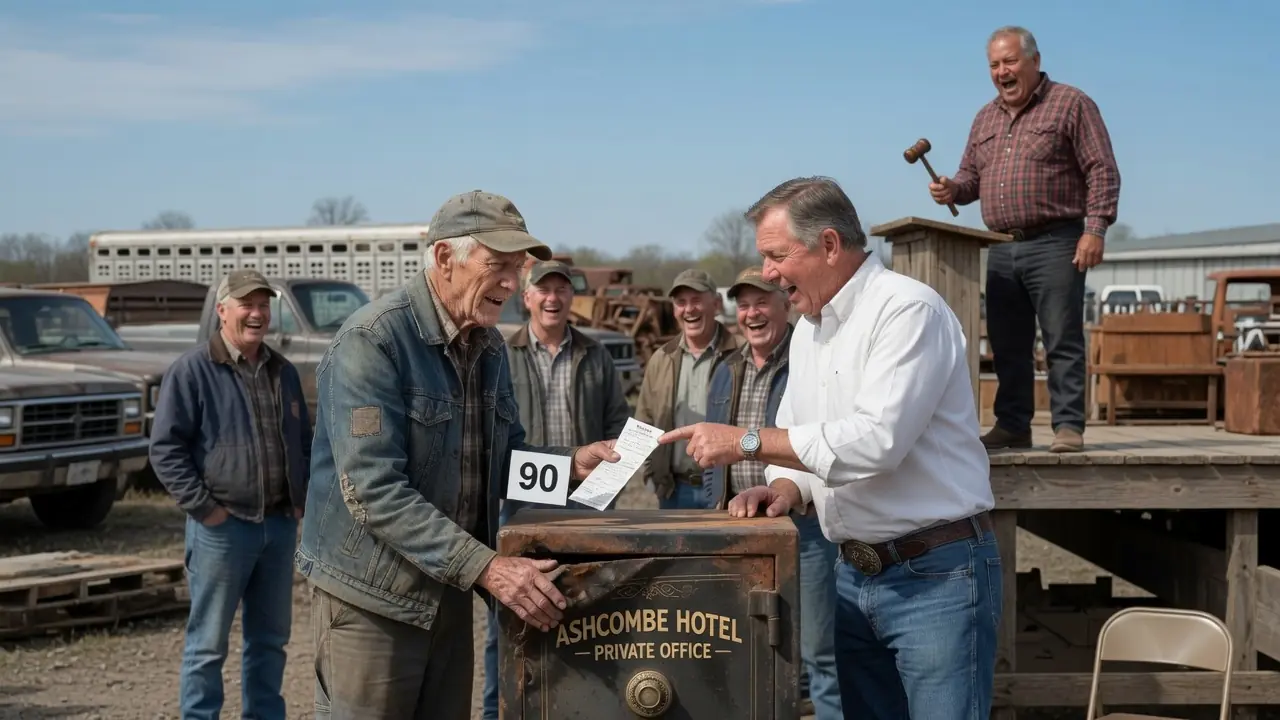
The burned safe.
It stood nearly five feet tall and weighed close to nine hundred pounds. Heat had twisted one side panel. The faded gold lettering across the top could barely be read.
ASHCOMBE HOTEL
PRIVATE OFFICE
The Ashcombe Hotel had once stood in downtown Pine Ridge.
Built in 1912, it hosted traveling salesmen, politicians, coal executives, wedding receptions, and families waiting for trains that no longer ran.
A fire destroyed the upper floors in 1968.
The building was repaired, declined, changed owners, and finally closed in the late 1980s.
When demolition began decades later, workers found the safe behind a false wall in the old manager’s office.
Nobody had a combination.
The county hired a locksmith to inspect it.
He examined the fire damage and estimated that opening it professionally would cost more than the safe was worth.
The demolition contractor surrendered it to the county rather than pay for disposal.
Billy slapped one hand against the scorched door.
“Here it is, gentlemen. Finest hotel safe in all of Bell County, assuming you don’t mind that the hotel burned down around it.”
The crowd laughed.
“Weighs close to half a ton. Perfect for anyone needing an anchor, a roadside monument, or the world’s ugliest gun cabinet.”
More laughter.
“Contents unknown and sold as-is. Buyer responsible for removal.”
A scrap dealer called out.
“Door’s warped. Nothing inside but smoke.”
Billy pointed toward him.
“You interested?”
“At five dollars.”
“Five dollars from Mr. Kline. Do I hear ten?”
Nobody answered.
Earl stood near the back.
He was not looking at the burned paint.
He was looking at the handle.
The handle hung level.
Fire could warp steel, destroy insulation, and seize hinges.
But a damaged locking mechanism usually left signs.
Loose spindle.
Dropped handle.
Dial tilted away from the door.
This one remained centered.
Earl moved closer.
A man beside him laughed.
“You thinking of keeping your fortune in there?”
The speaker was Dale Coburn.
Dale owned the largest farm-supply dealership in the county and several hundred acres inherited from his father.
He was fifty-eight, heavy in the chest, and dressed for auctions as though he expected photographers.
Clean boots.
Pressed shirt.
Large silver belt buckle.
Dale had known Earl since childhood.
He had spent most of those years treating him as evidence that hard work did not guarantee intelligence.
Earl ignored him.
Billy called again.
“Ten dollars?”
Dale looked toward the crowd.
“Old Earl might need it. Bank won’t have anything left to repossess if he hides the farm in there.”
Several men laughed.
Earl stepped closer to the safe.
He examined the hinge pins.
The upper pin had darkened but remained straight.
He crouched and looked beneath the dial.
A small brass service plate had melted partly away.
Behind it, the dial spindle remained clean.
Not new.
Protected.
The safe’s outer shell had taken the fire.
The door mechanism might have survived.
Dale saw him studying it.
“You planning to talk it open?”
Earl stood.
“No.”
“Then what are you doing?”
“Looking.”
Dale spread his hands toward the crowd.
“Everybody hear that? Bell County’s poorest farmer is inspecting nine hundred pounds of burned garbage.”
Billy tried to return attention to the sale.
“I have five dollars. Do I hear ten?”
Earl raised one finger.
“Ten.”
The crowd reacted immediately.
Dale laughed loudest.
“Earl, you don’t have ten dollars to throw away.”
“I have ten.”
“For scrap?”
“No.”
Dale looked toward the safe.
“You think something’s inside?”
“I don’t know.”
“That means yes.”
Billy pointed toward Earl.
“Ten dollars. Do I hear twenty?”
Dale raised his hand.
“Twenty.”
Earl turned toward him.
Dale smiled.
“What? I may need a mailbox.”
Earl knew what he was doing.
Dale did not want the safe.
He wanted the entertainment of making Earl overpay.
“Thirty,” Earl said.
“Forty.”
“Fifty.”
A few people stopped laughing.
Billy’s voice quickened.
“Fifty dollars from Mr. Tasker. Do I hear sixty?”
Dale raised his hand.
“Sixty.”
Lucy, standing near Earl’s truck, hurried over.
“Grandpa, what are you doing?”
Earl watched Dale.
“Seventy.”
Dale grinned.
“Eighty.”
Billy looked toward Earl.
For several seconds, the old farmer said nothing.
Dale lifted both hands in mock triumph.
“Finally found his limit.”
Earl thought about the tractor pump.
The overdue electric bill.
The groceries Lucy would need before school reopened.
Then he looked at the lock again.
The dial had not sagged.
The handle had not dropped.
And around the lower door seam, beneath the soot, he could see a thin line of pale insulation.
The inner seal might still be intact.
“Ninety,” Earl said.
Dale’s smile widened.
Billy turned toward him.
“Do I hear one hundred?”
Dale looked at the safe.
Then at Earl.
He could easily continue.
But one hundred dollars would make the joke less satisfying if Earl suddenly stepped away.
Dale lowered his hand.
“No. Let the old fool have it.”
Billy brought down the wooden gavel.
“Sold. Ninety dollars to Earl Tasker.”
Applause and laughter followed.
Dale stepped close enough that only Earl and Lucy could hear him.
“You know why people laugh at you?”
Earl looked at him.
“Because you keep mistaking patience for a plan.”
Earl signed the sale receipt.
“Sometimes they’re the same thing.”
Getting the safe home required more work than buying it.
The county forklift placed it onto Earl’s flatbed trailer.
The trailer springs sank nearly to the tires.
Lucy stood beside the truck, staring at the scorched steel.
“What do you think is inside?”
“Could be empty.”
“You paid ninety dollars for empty?”
“I paid ninety dollars for the chance to find out.”
“That sounds like gambling.”
“Gambling depends on luck.”
“What does this depend on?”
Earl looked toward the lock.
“Whether I noticed correctly.”
At the farm, he backed the trailer into the barn and used a chain hoist mounted to an overhead beam.
The process took almost two hours.
Twice, Lucy suggested waiting for help.
Earl refused.
By sunset, the safe stood upright on oak blocks near his workbench.
He cleaned the dial with kerosene.
The numbers appeared beneath the soot.
He rotated it slowly.
The movement remained smooth.
Lucy leaned against the bench.
“How do you know about safes?”
“I don’t know much.”
“You knew enough to buy this one.”
Earl removed the damaged service plate.
“My father repaired locks at the Ashcombe Hotel.”
Lucy straightened.
“Your father?”
“Your great-grandfather Calvin.”
Earl had rarely spoken about him.
Calvin Tasker farmed during the day and repaired equipment throughout Pine Ridge at night. He fixed clocks, cash registers, door locks, and hotel boilers.
People remembered him as quiet and capable.
They also remembered the accusation.
After the Ashcombe fire in 1968, hotel owner Preston Ashcombe claimed several thousand dollars had disappeared from the manager’s office.
Calvin had been seen entering the office during the evacuation.
No money was found on him.
No charge was filed.
But suspicion settled over the Tasker family.
Preston told people Calvin had used the fire as cover.
Calvin denied it.
The town preferred the more interesting story.
Business disappeared.
Neighbors stopped sending repair work.
The bank declined a loan Calvin needed after a bad harvest.
Within two years, he lost nearly half the family acreage.
He died when Earl was twenty-three.
“He always said that safe had not been opened,” Earl told Lucy.
“People thought he stole from it?”
“Preston Ashcombe said money was missing from the office.”
“But if the safe stayed locked—”
“That did not matter once people enjoyed the accusation.”
Lucy looked toward the burned door.
“Why didn’t your father prove it?”
“He tried.”
Earl rotated the dial again.
“He said Preston kept the combination in a code book. After the fire, the book disappeared.”
“Did he ever know the combination?”
“No.”
“Then how are you going to open it?”
Earl pointed toward the dial.
“Old mechanical locks speak if you turn them slowly enough.”
Lucy smiled uncertainly.
“That sounds made up.”
“Most useful things do before someone learns them.”
Earl did not drill the door.
He did not strike the lock.
He spent the evening cleaning.
He removed soot from the dial ring and lubricated the external spindle.
Then he turned the dial hundreds of times, listening through a mechanic’s stethoscope once used on tractor engines.
He made marks in a notebook.
Several numbers produced subtle changes in resistance.
At ten that night, Lucy brought him coffee.
At midnight, she brought a blanket.
At one, she fell asleep on the feed bucket.
Earl continued.
He remembered watching Calvin repair locks at the kitchen table.
“Force is what people use when they have stopped paying attention,” his father once said.
Earl had been nine.
He remembered the sentence because Calvin applied it to almost everything.
Bolts.
Animals.
Weather.
People.
At three thirty, Earl believed he had identified two possible numbers.
The third remained uncertain.
He worked through combinations slowly.
At 4:17, the final tumbler moved.
When the door opened, Earl and Lucy stood before the sealed interior.
The cloth bank bags contained silver coins.
Most were old half dollars and dollar coins.
One bag carried a hotel label dated 1967.
Another contained rolls of quarters and dimes.
The metal document box mattered more.
Earl placed it on the workbench.
The small latch had no lock.
Inside were ledgers, envelopes, insurance papers, property records, and a leather notebook.
On top rested a yellow envelope addressed in faded ink.
CALVIN TASKER
PERSONAL
Earl sat.
Lucy remained beside him.
“Open it.”
He did not move.
“Grandpa?”
“That writing belongs to Preston Ashcombe.”
“You’re sure?”
“I saw it on the letter that accused my father.”
Earl slid one finger beneath the brittle flap.
Inside was a three-page statement dated November 4, 1968.
He read the first paragraph silently.
Then he stopped.
“What does it say?” Lucy asked.
Earl handed her the paper because his eyes had filled too quickly to continue.
Lucy read aloud.
Calvin,
I owe you a truth I did not have the courage to speak while the town was angry.
You did not take the hotel money. I did.
Lucy looked up.
Earl stared at the barn floor.
She continued.
Preston described months of financial trouble.
He had removed cash from hotel accounts to cover gambling debts and hidden the shortages from his family.
When the fire damaged the building, he used the confusion to explain the missing money.
Calvin became an easy target because witnesses saw him enter the office.
In truth, Calvin had entered to carry an unconscious desk clerk out through the rear stairwell.
Preston allowed rumors to spread because they protected him.
The letter contained more.
Before the fire, Calvin had discovered irregularities in the hotel books.
Rather than expose Preston publicly, he gave him one week to replace the money.
The fire occurred two days later.
Afterward, Preston claimed Calvin had stolen it.
Guilt followed him for years.
The letter ended with a promise to clear Calvin’s name.
It had never been delivered.
Beneath it rested a signed statement witnessed by two hotel employees.
Both confirmed that Calvin had rescued guests and workers during the fire.
One described seeing Preston remove money from the office days earlier.
The leather notebook contained the missing financial records.
Every payment.
Every withdrawal.
Every false entry.
Lucy lowered the papers.
“He proved your father was innocent.”
“Too late.”
“Not for you.”
Earl looked at her.
She turned toward the safe.
“What about the coins?”
They counted only enough to understand the scale.
The bags contained hundreds of silver coins, most collected by the hotel over decades and stored as emergency reserves.
The inner compartment held a smaller box.
Inside were twelve gold coins wrapped individually in tissue paper.
A typed inventory described them as Preston Ashcombe’s private collection.
At the bottom lay a sealed deed and a letter transferring ownership of a forty-acre parcel called Laurel Ridge to Calvin Tasker.
The land bordered the remaining Tasker farm.
Earl recognized the description.
Dale Coburn currently used Laurel Ridge for cattle.
His father had purchased it from the Ashcombe estate after Preston’s death.
Lucy read the transfer letter twice.
“Does this mean the land belongs to us?”
“I don’t know.”
“But it has your father’s name.”
“Paper can tell the truth and still require a court to listen.”
Earl gathered the documents carefully.
“Nothing leaves this barn until we speak to an attorney.”
“Not even Dad?”
“We’ll call him after sunrise.”
“What about Dale?”
Earl looked toward the dark window.
“Especially not Dale.”
By eight that morning, word had already spread that the safe was open.
A farmhand passing the Tasker property saw light in the barn before dawn and later noticed Earl’s truck at the office of attorney Miriam Cole.
Miriam had practiced law in Pine Ridge for thirty-one years.
She read every document twice.
She inspected the auction receipt.
“Contents included?”
Earl pointed toward the bottom.
The terms stated that each lot transferred as-is, including unknown internal contents, subject to claims by identifiable legal owners.
Miriam leaned back.
“The coins and personal property may belong to the Ashcombe estate or its heirs. We will notify them.”
Lucy appeared disappointed.
Earl did not.
“And the letter?” he asked.
“That belongs to history.”
“The deed?”
Miriam examined the notarized document.
“This will be complicated.”
“Is it real?”
“It appears real.”
“Was it delivered?”
“The fact that it was sealed inside a safe rather than given to Calvin creates questions.”
She looked through the supporting papers.
“But Preston’s letter says he intended the property to compensate Calvin for the damage caused by the false accusation. There may also be claims involving the estate sale and subsequent purchasers.”
“Dale’s family.”
“Yes.”
Earl nodded.
Miriam studied him.
“You understand that this could take years.”
“I’ve farmed the same ground for fifty-six.”
“That is not an answer.”
“It is the only one I have.”
By noon, Dale Coburn’s truck entered Earl’s driveway.
He stepped into the barn without knocking.
The safe stood open.
The shelves were empty because the documents and coins had been moved to secure storage.
Dale looked inside.
“What did you find?”
Earl continued repairing a hay rake.
“Morning, Dale.”
“People say there was money.”
“People say many things.”
“How much?”
“Enough to interest people who laughed yesterday.”
Dale’s expression hardened.
“I offered you eighty dollars for that safe.”
“You offered the auctioneer eighty.”
“I pushed the price up.”
“That was your choice.”
Dale walked toward the open door.
“Anything inside connected to the Ashcombe Hotel?”
Earl stopped working.
“Why?”
“My father bought some hotel property.”
“Laurel Ridge.”
Dale’s jaw tightened.
The reaction answered more than his words could.
“You found something about it.”
Earl placed the wrench on the bench.
“You knew there might be.”
“No.”
“You came quickly for a man who believed the safe was burned garbage.”
Dale looked toward Lucy, who stood near the barn entrance.
“This is adult business.”
“She lives here,” Earl said. “You don’t.”
Dale lowered his voice.
“My family has used Laurel Ridge for forty years.”
“Then you should have records.”
“We do.”
“So do I.”
Dale stared.
“What kind?”
“The kind my attorney will discuss with yours.”
The color changed in Dale’s face.
“You think a ninety-dollar safe makes you a landowner?”
“I was a landowner before yesterday.”
“You know what I mean.”
“Yes.”
Earl stepped closer.
“You mean you thought being richer allowed you to decide which man looked foolish.”
Dale glanced at the open safe.
“What do you want?”
“The truth.”
“Truth doesn’t pay taxes.”
“No. But land sometimes does.”
Dale left without another word.
The Ashcombe heirs arrived two weeks later.
Preston’s granddaughter, Eleanor Ashcombe, was a retired school librarian living in Lexington.
She had never seen the safe.
She knew little about the hotel fire.
When Miriam showed her the confession, Eleanor cried.
“My grandfather spent the rest of his life angry,” she said. “We never understood why.”
Earl did.
Anger was sometimes guilt searching for another name.
The estate formally surrendered any claim to the silver and gold coins after reviewing the auction terms, old probate records, and Preston’s written intention that the safe’s contents compensate the Tasker family.
The process took months.
The coins were eventually appraised and sold through a reputable dealer.
They did not make Earl a millionaire.
They gave him enough to replace the tractor’s hydraulic system, clear the farm’s remaining debt, repair the roof, and establish a modest education fund for Lucy.
The Laurel Ridge dispute took longer.
Dale’s attorneys argued that his father had purchased the property legally from the Ashcombe estate.
Miriam presented the original deed, Preston’s confession, estate correspondence, and records showing that the transfer to Calvin had been concealed rather than canceled.
The case never reached a jury.
During mediation, evidence emerged that Dale’s father had found references to the missing deed decades earlier and chosen not to investigate.
Dale agreed to return most of Laurel Ridge to the Tasker farm in exchange for a settlement resolving improvements and boundary questions.
The agreement was signed eighteen months after the auction.
Earl walked the ridge with Lucy on the first morning it legally returned.
The land contained oak trees, limestone outcrops, and a spring that continued running even during dry summers.
Lucy climbed onto a stone ledge.
“Was it worth ninety dollars?”
Earl looked across the valley.
“No.”
She stared at him.
“The safe was worth more?”
“The safe was worth whatever someone wanted to pay.”
He rested one hand against an oak trunk.
“What was inside had been waiting sixty years for someone patient enough not to destroy it.”
The confession changed Pine Ridge.
The local newspaper printed the full account of the 1968 fire.
Witness statements described Calvin Tasker carrying two hotel guests and an injured clerk through smoke.
The town historical society added his name to its permanent fire exhibit.
A plaque was placed near the site where the Ashcombe Hotel once stood.
It read:
CALVIN TASKER
WHO ENTERED THE FIRE TO SAVE OTHERS
AND CARRIED AN ACCUSATION HE DID NOT DESERVE
Earl attended the dedication but refused to give a speech.
Dale stood near the back.
Afterward, he approached alone.
“I owe you an apology.”
Earl looked toward him.
“For the auction?”
“For more than that.”
Dale removed his hat.
“My father told me Taskers were dishonest. I never asked why.”
“People prefer inherited opinions. They require less work.”
“I laughed because I thought you were wasting money.”
“You laughed before I bid.”
Dale lowered his eyes.
“That’s true.”
Earl waited.
Dale finally said, “I thought men like you stayed poor because you didn’t understand value.”
Earl looked toward the plaque.
“My father understood value.”
“He lost half his land.”
“He saved three people in a burning hotel.”
Dale had no response.
Earl continued.
“Your mistake was believing money and value were the same thing.”
He walked away.
The safe remained in Earl’s barn.
He cleaned the exterior but did not repaint it.
The fire scars stayed visible.
So did the warped upper corner and the blackened Ashcombe Hotel lettering.
Lucy asked why he did not restore it.
“Because then it would look like every other old safe.”
“Isn’t that the point of restoration?”
“Not always.”
He touched the scorched door.
“Sometimes damage is part of the evidence.”
Years later, after graduating from college, Lucy returned to Pine Ridge and converted part of the barn into a small workshop teaching local teenagers mechanical repair.
The safe stood near the entrance.
Students often asked what it contained.
Lucy never began with the coins.
She told them about Calvin.
About the fire.
About the accusation.
About Preston’s letter waiting behind steel while an innocent man’s name carried the damage.
Then she told them about the auction.
A crowd saw burned paint.
Dale Coburn saw an opportunity to embarrass a poor farmer.
The scrap dealers saw weight.
Earl saw a level handle, straight hinges, and a lock that had not surrendered.
He did not know treasure waited inside.
He knew only that the people laughing had stopped looking closely.
That was enough.
The summer after Laurel Ridge returned, Earl planted clover on the upper slope and repaired an old springhouse near the trees.
At sunrise, he sometimes stood where the property overlooked the Tasker farm.
The barn roof caught the first light.
Beyond it stretched fields that had survived debt, drought, accusation, and generations of people deciding the family would eventually disappear.
Earl never claimed the safe saved the farm.
The farm had survived because people worked it.
The safe merely returned what should never have been taken.
Land.
Money.
And a good man’s name.
At the county auction, Dale Coburn believed ninety dollars had purchased Earl Tasker one final humiliation.
Before sunrise the following morning, the burned safe opened.
Inside was proof that patience could outlive mockery.
That truth could survive fire.
And that something dismissed as worthless might be holding the one thing an entire family had been waiting generations to recover.