“Three dollars each.”
The laughter began the moment twenty-four-year-old Nora Whitaker raised her hand inside the Hart County Dairy Cooperative warehouse. Seven hundred wooden butter churns sat stacked four high on pallets, their oak darkened by decades of milk residue, basement moisture, rust, and neglect. The cooperative considered them useless equipment from another age and wanted the warehouse space back before winter.
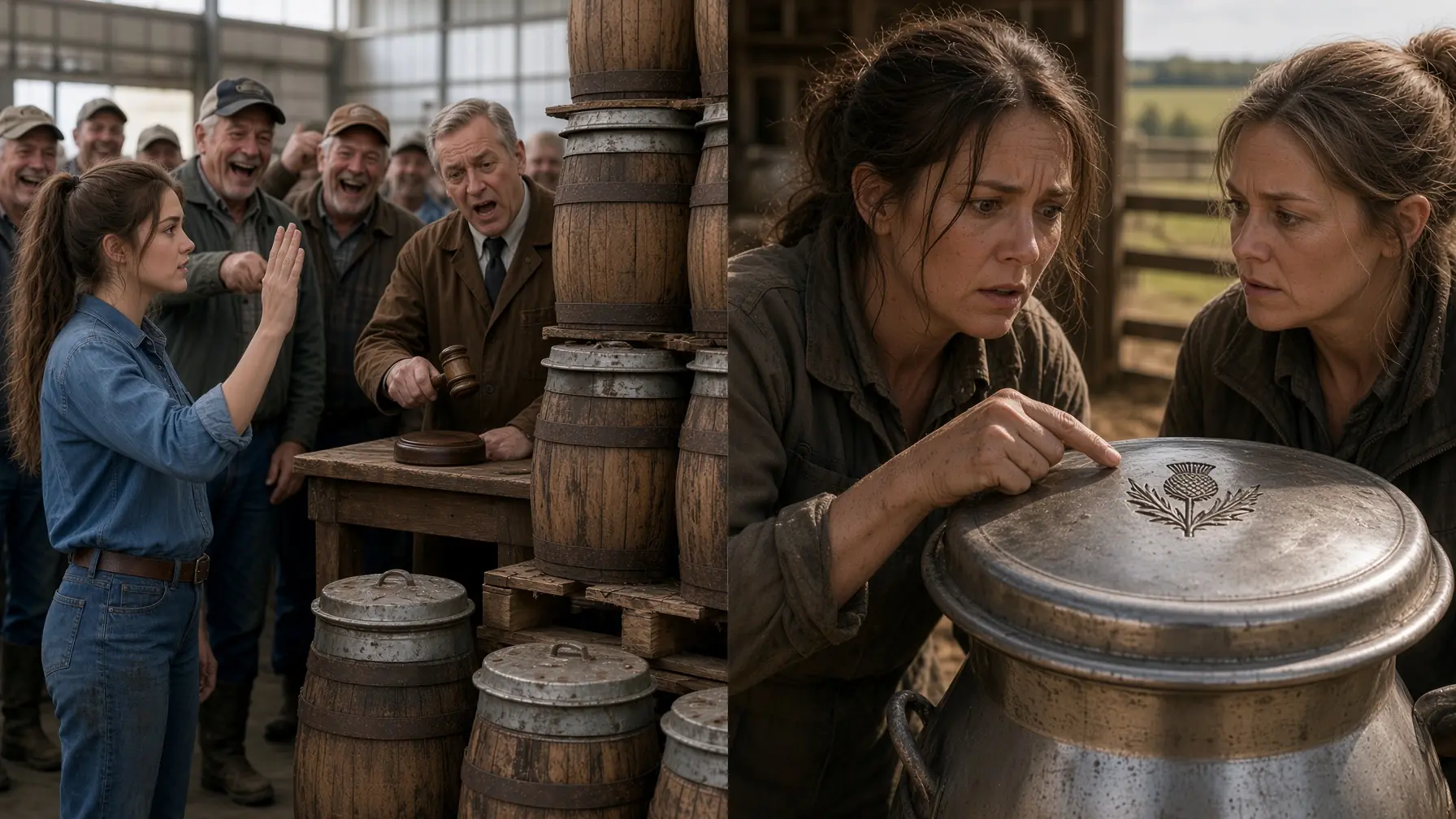
Auction manager Malcolm Pierce looked over his glasses. “You’re bidding twenty-one hundred dollars for the entire lot?” he asked, making sure the room understood exactly what Nora was doing. When she nodded, somebody near the loading doors laughed and said Everett Whitaker’s granddaughter had inherited the old man’s madness along with his failing farm.
Another farmer called, “Turn them into flowerpots, Nora. Might get your money back by retirement.” More laughter followed, but Nora kept her hand raised until the auctioneer called for another bid three times. Nobody offered one.
The gavel came down.
Seven hundred unwanted butter churns became hers.
Three months earlier, Nora had buried her grandfather on a frozen Kentucky hillside behind the small white church where generations of Whitakers had been married, baptized, and mourned. Everett Whitaker was seventy-eight when his heart failed, leaving Nora ninety acres of exhausted dairy ground, nineteen aging Holsteins, a milking parlor that needed repairs, a farmhouse with two leaking sections of roof, and more than eleven thousand dollars in farm debt. Everyone in Cedar Ridge assumed she would sell before spring.
Malcolm Pierce arrived at the farm six days after the funeral. He wore polished brown shoes that collected mud before he reached the porch, a navy suit too expensive for a December farm call, and the same leather clipboard he carried through every cooperative meeting. Malcolm managed operations for the dairy cooperative and had a reputation for knowing exactly which farmers were struggling before the farmers admitted it themselves.
“I’m trying to save you six months of pain,” he told Nora. His offer for the land was considerably lower than the price two nearby farms had recently brought, though high enough to clear Everett’s debt and leave Nora with a modest amount of cash. “You’ve got no capital, no milk contract beyond the spring review, and half the equipment out there belongs in a museum.”
Nora folded the paper.
“The farm isn’t for sale.”
Malcolm smiled as if she were a child refusing medicine. “Old men die and leave young people messes all the time. Sentiment doesn’t make a balance sheet work.”
“Neither does selling land cheap.”
His smile faded slightly.
He left the offer on her kitchen table.
Nora burned nothing, signed nothing, and spent the next week doing something considerably less dramatic: opening drawers. Everett had saved everything, including bolts, feed invoices, bent hinges, seed catalogs, handwritten milk records, and pieces of machinery nobody manufactured anymore. Beneath a stack of old coveralls in a cedar trunk, Nora found fourteen leather journals tied together with baling twine.
The first pages contained ordinary farm records. Then came drawings of butter churns, dairy separators, cream cans, butter molds, hand-crank washers, and coopered vessels, all measured with the precision of an engineer despite Everett having completed only eight years of school. Beside many sketches were maker’s marks Nora had never seen: bells, crowns, stars, oak leaves, birds, numbers, and occasionally a tiny three-leaf thistle.
One sentence appeared on the inside cover of the first volume.
Waste is just a failure of imagination.
Nora read the journals for three nights.
Everett had spent forty years repairing equipment for neighboring dairy farms when winter work grew slow. He seemed especially fascinated by wooden churns built before electric cream separators and mechanical butter makers became common on Kentucky farms. Several pages referred repeatedly to something he called Blue Thistle work, followed by measurements, initials, and notes such as check beneath lid band, ironwork different after 1912, and cooperative still has dozens upstairs.
That last line mattered.
The Hart County Dairy Cooperative had been storing old churns for decades. When farms modernized, members sometimes hauled obsolete equipment to the cooperative rather than throw it away, partly because older farmers hated destroying tools that had worked for their parents. By the time Malcolm scheduled the warehouse auction, the collection had become seven hundred awkward wooden objects nobody had cataloged carefully in years.
Nora attended because of Everett’s journals.
She never told Malcolm that.
After the auction, practical reality arrived quickly. Nora owned seven hundred churns but no easy way to move them, only one aging flatbed trailer and a truck that protested whenever she asked too much of it. It took nearly three weeks of repeated trips to bring everything home.
Neighbors slowed along the county road to stare.
By January, churns stood beneath the equipment shed, filled part of an unused tobacco barn, and lined one side of the machine shop beneath tarps. Some were tall barrel churns with dashers, others squat crank models with iron gears, while dozens were missing lids, handles, hoops, or entire sections of wood. Several were so rotten Nora could push a finger through the base.
Her uncle Nathan visited after the last load arrived.
He stared at the barn.
Then at Nora.
“You spent twenty-one hundred dollars on this.”
“Yes.”
“Do you know what they’re worth?”
“No.”
Nathan rubbed both hands over his face. “I admire the confidence with which you say things that terrify me.”
Nora laughed.
Then she opened Everett’s first journal.
She began with the worst churns because she could afford to ruin them. Nora learned how old coopered wood reacted after decades of drying, which rusted bands could be stabilized and which had lost too much metal, how replacement staves changed the shape of an original piece, and why aggressive sanding could erase exactly the tool marks collectors might someday care about. She made mistakes constantly.
One churn collapsed while she was tightening its bands.
Another developed a split after she added moisture too quickly.
She ruined the surface of a third by trying to make one dark stain disappear and accidentally removing a faint burned mark underneath.
Nora wrote every failure down.
Everett had.
She would too.
The farm itself did not politely wait while she became an amateur conservator. Cows still needed feeding before sunrise, milk prices remained weak, a vacuum pump failed in February, and the farmhouse roof leaked above the upstairs hall whenever rain came from the west. Nora worked the dairy by day and studied the churns at night beneath a hanging shop lamp.
Malcolm occasionally passed the property.
Twice he stopped.
The first time he stood beside the truck and looked toward the rows of wood beneath the shed. “Still collecting garbage?”
“Still running a cooperative?”
He smiled. “For now.”
“So am I.”
“You’re running a farm.”
Nora looked toward the churns. “For now.”
By spring, she understood enough to recognize that Everett’s journals were not random notes. He had been building a reference system. Measurements of lid diameter, hoop placement, handle style, gearing, wood species, tool marks, and stamps appeared in combinations that repeated across different years.
The thistle became the mystery.
Nora found the first one beneath the iron band of a badly damaged crank churn. The mark was smaller than her thumbnail, stamped into the oak beneath decades of grime and oxidation. Three leaves formed a simple thistle above the letters M & B.
She found another eight days later.
Then another.
By summer, she had identified twenty-seven.
The journals hinted at a maker but never gave Nora the complete answer. Everett repeatedly wrote McBride?, Bell?, Glasgow men in Frankfort?, and one frustrating note that simply said, Ask W.H. next trip—he knows the factory story. Whoever W.H. had been, Everett never recorded the conversation.
Nora searched county libraries.
Nothing.
She checked old agricultural catalogs.
Nothing conclusive.
She wrote to two historical societies and received polite responses saying they had no records matching the mark.
So she kept working.
The dairy lost money that first year.
Not disastrously, but enough that Malcolm returned with another offer.
“This one expires in thirty days.”
Nora looked at the number.
It was slightly higher than before.
“Why?”
“Land values improved.”
“Or you really want this road frontage.”
Malcolm’s eyes shifted toward her.
Nora smiled.
“Thirty days,” he repeated.
She handed the paper back.
“No.”
The following morning, Nora sold three cows.
That hurt more than refusing Malcolm.
She used part of the money to repair the vacuum system and part to pay down feed debt. It was the first time she fully understood that saving a farm did not mean preserving every part of it unchanged. Sometimes survival required shrinking one thing so another could remain alive.
The churns continued accumulating dust more slowly than before.
Nora cleaned only enough to reveal construction details and preserved original surfaces whenever possible. She stopped trying to make them look new. The best examples began looking instead like what they were: old working tools whose scratches, dents, stains, and repairs told the story of people who had used them.
She sold her first restored churn for one hundred eighty dollars to a woman furnishing a historic bed-and-breakfast.
The second brought two hundred twenty-five.
The third sold to a collector in Ohio for four hundred because of an unusual hand-forged crank assembly.
Nathan stared at the check.
“You might actually know what you’re doing.”
“No.”
“That answer again.”
“I know more than last year.”
That became Nora’s business model.
Not certainty.
Improvement.
She created a simple catalog with photographs and detailed measurements, refusing to claim dates or makers she could not document. Buyers appreciated the honesty. A restored churn labeled Kentucky farm origin, maker unknown, circa early twentieth century based on construction sold more slowly than one accompanied by a dramatic invented story, but Nora slept better.
During the second winter, the dairy finally reached break-even.
Nora reduced the herd to fourteen healthier cows, shifted part of the acreage into hay and rotational grazing, and stopped chasing milk volume the farm could not produce efficiently. She also repaired the tobacco barn roof and converted one section into a climate-controlled storage room for the most promising churns.
Malcolm noticed.
At the annual cooperative meeting, somebody asked how Everett Whitaker’s granddaughter was doing.
Malcolm answered, “Selling old buckets to city people.”
The room laughed.
Nora heard about it later.
She wrote the sentence in her ledger beside the year’s restoration income.
Then she went back to work.
The breakthrough came almost three years after the auction.
Nora had taken four restored pieces to a regional antiques market outside Louisville, including one of the thistle-marked churns. She priced it at nine hundred dollars, more than she had ever asked for a single item, not because she knew it was worth that much but because Everett’s notes convinced her it was different.
A dealer photographed the mark.
Two weeks later, Nora received a telephone call.
“Is this Nora Whitaker?”
“Yes.”
“My name is Eleanor Hartwell. I deal in early American domestic and agricultural material.”
Nora waited.
“I saw photographs of a churn you had in Louisville.”
“The thistle?”
Silence.
Then, “You know the mark?”
“I know my grandfather cared about it.”
Eleanor asked how many Nora had.
“Marked with the thistle?”
“Yes.”
“Forty-one confirmed.”
Another pause.
“What about uncleaned examples?”
“Hundreds.”
Eleanor’s voice changed.
“May I visit?”
She arrived the following Thursday in a dusty Volvo carrying two jeweler’s loupes, white cotton gloves, a camera, a notebook, and the energy of somebody trying very hard not to appear excited. Eleanor was sixty-two, silver-haired, small, and incapable of walking past an old object without turning it over.
She spent the first hour saying almost nothing.
She examined the thistle churn Nora had taken to Louisville.
Then another.
Then another.
At the twentieth, she asked for Everett’s journals.
Nora hesitated.
“Why?”
“Because I think your grandfather spent forty years documenting a maker historians barely know existed.”
That got Nora’s attention.
They sat at the kitchen table.
Eleanor explained what she knew carefully because she did not want speculation to become fact. Between approximately 1890 and the First World War, a small cooperage and dairy-equipment partnership operated intermittently between Frankfort and Louisville under several related names. Surviving trade references mentioned Scottish-born cooper Andrew McBride and machinist Thomas Bell producing unusually durable butter churns for regional dairies, but almost none of their business records survived.
“The workshop burned,” Eleanor said. “Around 1918, according to two newspaper references I’ve found.”
Nora opened Everett’s journal.
“M and B.”
“Possibly McBride and Bell.”
“And the thistle?”
“Probably their mark.”
“Probably.”
Eleanor smiled.
“You are definitely Everett Whitaker’s granddaughter.”
They spent three days cataloging.
Not every old churn was valuable.
Not remotely.
Many were common twentieth-century production pieces worth perhaps fifty to two hundred dollars depending on condition. Others were too damaged for anything beyond parts, education, or display.
But eighty-six carried some version of the thistle.
Fifty-three retained enough original construction to interest serious collectors.
Seventeen had hand-forged mechanisms matching an early pattern Eleanor had seen only in photographs.
Four were exceptional.
One retained a faded shipping label connecting it to a family dairy listed in an 1897 county directory.
Another carried a serial number matching a handwritten sequence in Everett’s journal.
The most important discovery, however, was not any single churn.
It was the collection.
Everett had recorded where dozens came from.
Beside sketches were family names, farm locations, repair dates, inherited ownership histories, and notes such as Mrs. Talley says her mother used this before electrification or brought from Washington County after marriage, 1911. Nora had unknowingly purchased not merely seven hundred old objects but a scattered physical history of Kentucky dairy households.
Eleanor stood inside the barn near sunset on the third day.
She removed her loupe.
“This isn’t scrap.”
Nora said nothing.
Eleanor looked down the long rows.
“Do you have any idea what you’ve been protecting?”
Nora thought about the auction.
“Apparently more than twenty-one hundred dollars.”
Eleanor laughed.
“Yes.”
Then she became serious.
“But don’t make the mistake everyone else is going to make.”
“What mistake?”
“Thinking the story is that you found seven hundred treasures.”
Nora waited.
“You didn’t.”
Eleanor gestured toward the rows.
“You found perhaps eighty or ninety objects with strong collector interest, several hundred useful historical examples, a large quantity of ordinary material, and a remarkable body of provenance because your grandfather documented where things came from.”
She touched Everett’s journal.
“The paper makes the wood more valuable.”
That sentence changed everything.
Eleanor recommended independent appraisals before Nora sold another thistle-marked piece. She also contacted a curator at a regional agricultural museum, who visited two weeks later with a dairy historian from the University of Kentucky. They confirmed that the marks deserved further research but refused to assign spectacular values based on excitement alone.
Nora liked them immediately.
Over the next six months, the story became clearer.
Researchers located advertisements for McBride & Bell Cooperage and Dairy Apparatus in regional farm newspapers from the 1890s and early 1900s. The company had never become a national manufacturer; it served Kentucky and neighboring states and apparently disappeared after a fire and the deaths of its founders. Surviving marked pieces were scarce partly because wooden dairy equipment was usually discarded, burned, repurposed, or left to rot.
Nora’s eighty-six examples became the largest documented group anyone had identified.
That did not make every churn worth ten thousand dollars.
The finest examples appraised in the low thousands.
Many sat in the hundreds.
Damaged examples were valuable mainly for research.
But taken together, with Everett’s journals and reconstructed farm histories, the collection carried institutional value far beyond what Malcolm’s warehouse auction had recognized.
The first formal appraisal gave a conservative range for the entire historically significant portion.
Nora read the number three times.
Nathan read it once.
Then he sat down.
“That’s more than the farm debt.”
“A lot more.”
“How much are you selling?”
Nora closed the report.
“Not much.”
Nathan stared at her.
“After everything you went through?”
“That’s exactly why.”
Nora sold six duplicate examples through Eleanor.
The proceeds cleared Everett’s remaining debt, repaired the farmhouse roof, replaced the oldest section of the milking equipment, and funded proper storage for the pieces she kept. She could have sold more.
She chose not to.
The museum proposed something better.
Nora loaned thirty-five pieces for a two-year exhibition about Kentucky dairy history, accompanied by Everett’s drawings, photographs of the farms where the churns originated, oral histories from surviving families, and a section explaining the shift from household butter making to cooperative dairy production. The exhibition was called Hands Before Machines.
Visitors came.
So did newspapers.
That was when Malcolm Pierce’s problem began.
A reporter asked a simple question.
“How did a historically significant collection end up being auctioned for three dollars per piece?”
The cooperative board asked the same thing.
Malcolm initially defended the sale.
“They were obsolete equipment taking warehouse space.”
Technically true.
The board chairman asked whether anyone had appraised them.
“No.”
Had anyone reviewed old donation records?
“No.”
Had anyone consulted the cooperative archives?
“No.”
Malcolm became irritated. “They were rotting butter churns.”
The chairman looked toward the museum curator sitting at the other end of the meeting table.
“Apparently some of them were not.”
The issue was not that Malcolm had secretly stolen a fortune.
There was no evidence of that.
The auction had been publicly advertised.
Nora had not hidden information from competing bidders.
Nobody had been prevented from inspecting the lot.
The cooperative attorney eventually concluded that the sale itself was valid.
That disappointed people who wanted a dramatic courtroom battle.
The governance problem was more ordinary.
Cooperative policy required significant asset disposals to receive reasonable valuation review when there was uncertainty about market worth. Malcolm had decided the churns were scrap before asking whether anyone knew what they were. Worse, archived cooperative correspondence revealed that Everett Whitaker had once written asking the board not to destroy or dispose of older marked churns until he could help catalog them.
The letter was twelve years old.
Malcolm claimed he had never seen it.
That was possible.
But the cooperative had.
Nora sat in the back row during the members’ meeting when the letter was read aloud.
Everett’s handwriting appeared on the projector.
Some of the older churns in upper storage appear to carry regional maker marks that may no longer be documented elsewhere. I recommend that we identify them before disposal. Once the history is gone, buying it back will be expensive.
Nora lowered her eyes.
He had known.
Not everything.
Enough.
Several older farmers remembered Everett talking about the churns.
One admitted he had laughed.
Another said Everett offered years earlier to inventory them for free but the project never became a priority.
Nobody laughed now.
Malcolm remained operations manager through the initial review but lost authority over asset disposal while the board rewrote its procedures. Months later, after an audit uncovered several unrelated management issues involving poor inventory controls and undocumented decisions, he resigned. There was no handcuffing, no fraud conviction, and no satisfying scene where somebody marched him through the warehouse.
He simply stopped running the cooperative.
Nora found that more believable.
And enough.
The next spring Malcolm drove to the Whitaker farm.
Nora was repairing fencing when his truck stopped.
He remained beside the road for several seconds before walking toward her.
“I owe you an apology.”
Nora leaned against the post driver.
“For which part?”
Malcolm almost smiled.
“Probably several.”
She waited.
“I should not have talked to you the way I did after Everett died.”
“No.”
“And I should have had the warehouse lot reviewed.”
“Yes.”
Malcolm looked toward the restored tobacco barn.
“I thought they were garbage.”
“So did everyone.”
“You didn’t.”
Nora considered that.
“I wasn’t sure.”
That surprised him.
“You spent twenty-one hundred dollars.”
“I was betting on Grandpa.”
Malcolm nodded slowly.
“That may have been smarter.”
“Not necessarily.”
Nora looked toward the barn.
“I ruined twelve before I understood what I was doing.”
Malcolm laughed softly.
“People don’t put that part in the newspaper.”
“No.”
“They make it sound like you knew they were valuable.”
“I didn’t.”
“What did you know?”
Nora thought about Everett’s journals.
“That he had spent forty years paying attention.”
Malcolm looked down.
After a moment, he said, “For what it’s worth, I’m glad you were right.”
Nora answered honestly.
“So am I.”
The dairy changed too.
Nora never became a giant milk producer.
She stopped trying.
Instead, she reduced the herd again, improved pasture management, sold breeding stock selectively, and began producing a small amount of farmstead butter and cultured dairy products through a licensed local creamery partnership. The old churn story gave her publicity, but she refused to market food as though the antiques themselves somehow improved flavor.
The business grew slowly.
Eleanor Hartwell visited several times a year.
She and Nora eventually created a small restoration and research workshop in the old tobacco barn, where families brought inherited dairy tools they had nearly thrown away. Nora charged for restoration when appropriate, but sometimes the best advice was not to restore something at all.
“Leave that paint alone,” she told one customer holding a nineteenth-century butter mold.
“But it looks terrible.”
“It looks old.”
“Can you make it look new?”
“Yes.”
“Will that make it worth more?”
“No.”
The customer blinked.
Nora smiled.
“Sometimes my job is preventing people from paying me to ruin their belongings.”
Everett would have liked that.
Five years after the auction, the museum exhibition returned several of Nora’s churns and asked to purchase four exceptional pieces permanently. Nora agreed on the condition that Everett’s cataloging work remained attached to their display. The museum also digitized portions of his journals so researchers could use them without handling the originals.
The farm debt was gone by then.
Not because all seven hundred churns had become priceless.
They had not.
Nora still possessed dozens worth less than what it would cost to restore them properly.
Some eventually became teaching pieces.
Several damaged examples donated intact staves or hardware to historically appropriate repairs.
Others remained exactly as she bought them because their wear patterns told useful stories.
The irony amused Nora.
People had once laughed because she paid three dollars for something they believed worth nothing.
Years later, visitors occasionally assumed every churn on the farm must be worth thousands.
Both assumptions were lazy.
Value required looking.
One autumn afternoon, the cooperative invited Nora to speak at its annual meeting.
She almost declined.
Then she saw the topic.
Preserving Agricultural History During Modernization.
Nora stood inside the same warehouse where the auction had taken place years earlier. The pallets were gone, the floor had been repainted, and younger employees probably had no idea seven hundred butter churns once occupied the northern wall.
She brought one object.
Not the most valuable.
The worst one she still owned.
Its base was cracked, two staves were replacements Nora had installed badly during her first winter, and the lid carried a scar where she had accidentally sanded through part of an old surface mark. She set it on the table beside the microphone.
“This is one of the churns I ruined.”
Several people laughed gently.
Nora smiled.
“I brought it because people prefer stories where somebody sees hidden treasure and instantly understands everything.”
She looked across the room.
“That isn’t what happened.”
“I bought seven hundred objects I barely understood because my grandfather’s notes suggested some might matter.”
She rested one hand on the damaged churn.
“Then I spent three years becoming less ignorant.”
The room went quiet.
Nora told them about maker marks.
Provenance.
Appraisals.
Failed repairs.
Ordinary churns.
Rare churns.
The difference between historical significance and monetary value.
Then she showed a photograph of Everett’s first journal.
Waste is just a failure of imagination.
Nora looked at the sentence for a moment.
“I used to think Grandpa meant everything thrown away could become valuable.”
She shook her head.
“I don’t think that anymore.”
Several people looked surprised.
“Some waste really is waste.”
That got a laugh.
“What he meant, I think, was that calling something useless should be the end of an examination, not the beginning.”
She looked toward the old warehouse wall.
“If you haven’t asked what something is, where it came from, who used it, what it can still do, or what somebody else might know about it, then you haven’t decided it is waste.”
“You’ve only decided you’re finished looking.”
Malcolm Pierce did not attend.
Nora was glad.
The story was no longer about him.
Years passed.
Everett’s journals eventually became the foundation of a regional database of dairy implements, and researchers identified additional Blue Thistle pieces in Tennessee, Indiana, Ohio, and West Virginia. Some of Nora’s original conclusions changed as better evidence appeared.
She liked that too.
Being wrong for good reasons was still being wrong.
Everett had understood that.
Many pages in his journals contained crossed-out guesses.
Nora never erased hers either.
At thirty-four, she still lived in the leaking farmhouse, though it no longer leaked. The dairy barn had been rebuilt in sections, the pastures carried fewer but healthier cows, and the tobacco barn held rows of carefully tagged churns with stable humidity instead of rain blowing through broken boards. The farm was not rich.
It was sound.
That mattered more.
One evening, Nora sat on the porch with Nathan after they finished unloading hay.
He looked toward the restoration barn.
“How many of the original seven hundred do you still have?”
“Four hundred twelve.”
“You know exactly?”
“Of course.”
“How many are valuable?”
Nora smiled.
“Define valuable.”
Nathan groaned.
“I walked into that.”
“Yes.”
He pointed toward the barn.
“Money.”
“Maybe ninety worth serious collector attention. Another hundred and fifty useful historically or decoratively. Some common working examples. Some parts.”
“And the rest?”
Nora looked toward the darkening fields.
“Still teaching me things.”
Nathan laughed.
Everett’s original brass folding rule sat inside Nora’s shirt pocket.
She used it almost every day.
The engraved numbers were worn, the hinge loose, and one corner had been repaired with a tiny brass pin Everett installed sometime before Nora was born. A collector once offered her six hundred dollars for it after learning whose notes it had created.
Nora refused.
Not because it was priceless.
Because she still needed it.
That distinction pleased her.
The story people told about Nora Whitaker eventually became simpler than the truth.
They said a young woman bought seven hundred worthless butter churns for twenty-one hundred dollars and discovered they were worth a fortune.
That version fit nicely into newspaper columns.
It was also mostly wrong.
She had bought hundreds of common churns, dozens of damaged ones, a significant group from a forgotten regional maker, and something more important than any single antique: her grandfather’s unfinished research connected to physical objects that had somehow survived long enough for somebody else to finish looking.
The money saved the farm.
The history changed it.
And every time somebody asked Nora how she knew to raise her hand that morning, she gave the same answer.
“I didn’t know.”
People rarely liked that.
They wanted instinct.
Secret knowledge.
A hidden clue she had understood before everyone else.
Nora would shake her head.
“My grandfather thought there was something worth studying.”
Then she would look toward the rows of old oak vessels sitting beneath the barn lights.
“I trusted him enough to spend three dollars finding out.”
That was all.
At the cooperative auction, seven hundred churns had sat in a warehouse while an entire room of farmers saw only wood taking up space.
Nora had not seen treasure.
She had seen a question.
Three years later, when Eleanor Hartwell lifted a lid, found the tiny thistle underneath, and asked Nora whether she understood what she had been protecting, the answer was still no.
But Nora understood something better by then.
You did not have to know the value of a thing before treating it carefully.
Sometimes care was how you discovered the value in the first place.