By the middle of July 1988, nobody in Independence County, Arkansas, bothered checking the thermometer unless they wanted another reason to feel miserable. The glass tubes nailed beside farmhouse doors had climbed past one hundred degrees so many afternoons in a row that the numbers seemed almost decorative. Creeks narrowed into warm ribbons between exposed stones. Shallow ponds retreated from their banks until cattle had to wade through black mud for water. Corn that should have been shoulder-high had curled inward against the sun, its leaves rattling like dry paper whenever the wind moved across the fields. Soybeans stalled low to the ground. Pastures faded from green to tan and then from tan to a color that looked almost gray.
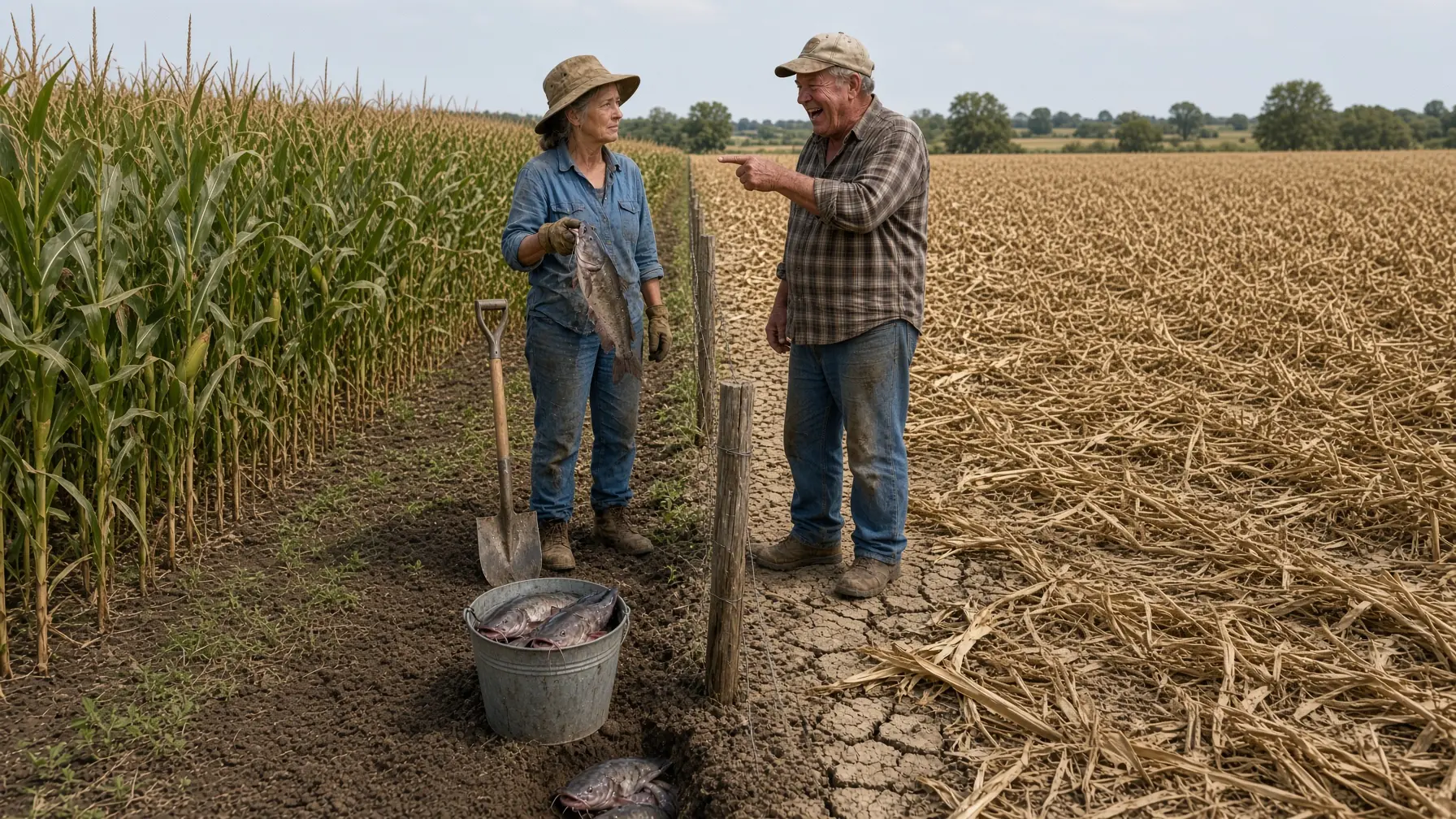
Farmers drove more slowly that summer. They watched one another’s land the way people watched smoke rising beyond a tree line, trying to decide whether someone else was doing better or whether everyone was burning at the same rate. Hay trucks arrived from Missouri, Tennessee, and farther north carrying round bales priced at figures that would have sounded absurd the previous winter. Auction barns stayed open late because ranchers were liquidating cows they could no longer afford to feed. The Farmers & Merchants Bank in Batesville began sending notices reminding borrowers of autumn payments everyone already remembered perfectly well.
Nobody needed reminding.
Then there was the Sutter place.
Eighty acres of mixed bottomland and worn upland fields along a county road east of the White River, neither the best farm in the area nor the worst. It had suffered from the same heat, received the same lack of rain, and sat beneath the same white summer sky as every property around it. Yet by July, people driving past began noticing that the color looked wrong.
Not lush.
Certainly not healthy by ordinary standards.
But not dead.
The corn on the east field curled during the afternoon, but many leaves opened again after sunset. Soybeans remained shorter than they should have been, yet enough of them still carried pods to make a combine worth starting. Where neighboring ground broke into wide, hard cracks, sections of the Sutter field developed only a thin crust over darker soil beneath. Even the weeds looked less defeated.
People slowed their trucks.
Some stopped.
A few walked to the fence.
And nearly every one of them remembered what they had said about Verna Sutter the winter before.
They remembered the smell.
They remembered the flies.
They remembered the old pickup pulling away from the White River with a tarp stretched across barrels full of fish waste.
Most of all, they remembered laughing when a fifty-two-year-old widow spent months burying fish heads in the poorest ground on her farm.
Depending on who told the story later, Verna buried ten thousand, fifteen thousand, or enough fish to empty half the river.
The number in her own notebook was closer to twelve thousand heads, give or take several barrels nobody had bothered counting individually.
But the number was never the important part.
Neither were the fish.
Verna herself would spend years correcting people on that point.
The real story had begun before anyone knew the summer of 1988 would become one of the driest in memory, back when the greatest threat to the Sutter farm was not drought but the simple mathematics of keeping it.
Her husband, Dale, died in January of 1987.
He had been sixty, though Verna still thought of sixty as young because death had made every year before it seem insufficient. He went out after breakfast to replace a broken cedar post along the north fence. When he had not returned by lunch, Verna drove the tractor lane looking for him and found him lying beside the auger with one glove still on his hand.
The doctor called it a massive heart attack.
The words were clean.
The reality was not.
For twenty-six years, Dale had been the person who knew the farm without needing to explain how. He could drive through a field once and tell whether a yellow patch came from wet feet, nutrient stress, insects, or shallow soil. He remembered which corners had been limed and when. He knew which pasture stayed wet after a spring storm and which one would burn first if July turned dry. He could estimate a hay cutting by looking across it from the road and usually come within a few bales.
Verna knew more than people realized.
She kept the books.
Handled seed orders.
Ran equipment.
Helped with calves.
Drove grain to the elevator.
Walked beans when herbicide money was tight.
She had been a farmer in every practical sense except the one the county used when it decided who counted as the farmer.
After Dale died, people began speaking to her as though the land had also become widowed.
“You thinking of selling?”
“You know, eighty acres is a lot for one person.”
“My cousin might be interested in the south forty.”
“Good time to get out before you get buried in debt.”
Most said it kindly.
That made it worse.
Verna listened, thanked them, then returned home and opened Dale’s ledger at the kitchen table.
The numbers were not kind.
A note remained on the tractor.
Another on the land.
The previous soybean crop had been mediocre. Fertilizer and diesel had cost more than expected. Two calves had died during a wet spring. The east forty, which Dale had cropped hard through the late seventies and early eighties, had become increasingly difficult to manage. Water ran across it during heavy rain instead of sinking in. A week of summer heat could turn the surface into powder. Crop roots stayed shallow in places where repeated wheel traffic had compressed the soil.
Dale knew it.
Verna found notes in the margins of his ledger.
East 40 getting tired.
Then, a year later:
Need more residue. Stop working so wet.
And beside a soybean yield:
Can’t fertilizer our way out forever.
That last sentence bothered her.
Dale had not solved the problem before he died.
Now she would have to.
She requested a soil test through the county extension office. The results came back with nothing mystical in them. pH needed adjustment in places. Phosphorus and potassium varied. Organic matter was low on the hardest-used ground. The recommendation sheet suggested lime where needed, balanced fertility according to crop requirements, residue management, erosion control, and avoiding unnecessary tillage.
All sensible.
All of it cost either money, time, or both.
Verna could afford very little of the first.
So she began thinking about what she did have.
Manure.
Crop residue.
Leaves.
Wood ash.
Time, if she counted her own labor as free, which farmers often did when they should not.
And memory.
Her father, Earl Benton, had farmed through the Depression before fertilizers arrived in brightly printed bags at every cooperative. Nothing organic left his place if he could find some use for it. Barn manure went to corn ground. Garden waste disappeared into piles behind the smokehouse. Leaves were spread beneath fruit trees. After butchering, scraps that could not be fed to hogs were buried deeply away from the well and house.
“Nothing that lived is useless after it dies,” he used to tell her. “But you better know where you put it.”
The second half of that sentence became important later.
At first Verna remembered only the first.
The idea arrived during Sunday dinner with her cousin Roy Benton.
Roy operated a small fish-cleaning shed near the White River. Commercial fishermen and local anglers brought him catfish, buffalo, drum, gar, and whatever else came in the nets. Roy sold some product locally, prepared some for restaurants, and accumulated barrels of heads, frames, skin, and viscera faster than he could find people willing to take them.
That Sunday he complained about disposal costs.
“I swear I’m working half the week just to pay somebody to haul away what the fish leave behind.”
Verna looked up from her beans.
“How much?”
“How much what?”
“Waste.”
Roy laughed.
“You want pounds or stink?”
“Both.”
Her cousin studied her.
“What are you thinking?”
“I’m thinking fish used to be fertilizer.”
Roy stopped chewing.
“In gardens.”
“Fields are big gardens.”
“No, Verna. Gardens are small fields.”
She ignored him.
“You ever have anybody take it for farmland?”
“Hog people take some. Garden folks grab heads now and then.”
“How much would you charge me?”
“For fish guts?”
“Yes.”
Roy stared for another moment.
Then he started laughing.
“I’ll pay you if you take enough.”
That was how it began.
Not with twelve thousand fish heads.
With one pickup load.
Verna chose a small strip on the east field where soybean growth had been poor for three consecutive seasons. She did not spread raw fish over the surface. Even she knew what that would create. Dogs, raccoons, vultures, flies, odor, and neighbors with legitimate reasons to hate her.
She dug trenches.
Too shallow at first.
That was her first mistake.
Within two nights, animals found several buried pieces and scattered them.
Verna spent the next morning collecting remains while questioning every decision she had made since Dale’s funeral.
She went deeper after that.
She also stopped pretending she knew enough.
At the extension office, a young agent named Harlan Voss listened while she described what she was doing.
“Raw fish waste?”
“Heads mostly.”
“How much?”
“Few hundred so far.”
He removed his glasses.
“Verna, I’m not telling you it can’t provide nutrients.”
“So it can?”
“Of course it can. Fish tissue contains nitrogen, phosphorus, calcium depending on the material. That doesn’t mean dumping a mountain of it into a field is automatically smart.”
“I’m burying it.”
“That solves some problems and creates others if you overdo it.”
“Such as?”
“Salt depending on source, nutrient concentrations, smell, scavengers, uneven decomposition, possible groundwater concerns if you pile too much in one area. And raw material can create localized conditions that are not friendly to roots while it breaks down.”
Verna nodded.
“What would you do?”
Harlan leaned back.
“I would not build a farming program around fish heads.”
“That wasn’t what I asked.”
He smiled reluctantly.
“All right. If you insist on experimenting, keep it away from the well, drainage ways, and low wet areas. Spread the material across a larger area instead of concentrating it. Cover it thoroughly. Keep records. And don’t treat it like complete fertilizer. Test the soil.”
Verna wrote everything down.
That surprised him.
“You’re actually taking notes.”
“I drove twelve miles to ask.”
He nodded.
“Good.”
Then added, “And start small.”
She did.
For about three weeks.
Then winter came, and Roy called because his waste barrels were full again.
A few hundred heads became eight hundred.
Eight hundred became perhaps fifteen hundred.
Verna stopped counting every individual fish and started estimating from barrel volume. She incorporated chopped stalk residue nearby. She hauled aged manure from the cattle lot. Leaves from the fence rows went into windrows and rough compost piles rather than being burned. Wood ash from the stove was used sparingly only where she believed it made sense after discussing pH with Harlan.
She did not mix everything uniformly.
She could not have if she wanted to.
The farm became an uneven patchwork of experiments.
That imperfection would later make the results more useful.