When Walter Hale carried the first sack of ginseng seed into Miller’s Feed & Supply, three men at the coffee counter stopped talking long enough to watch him walk past.
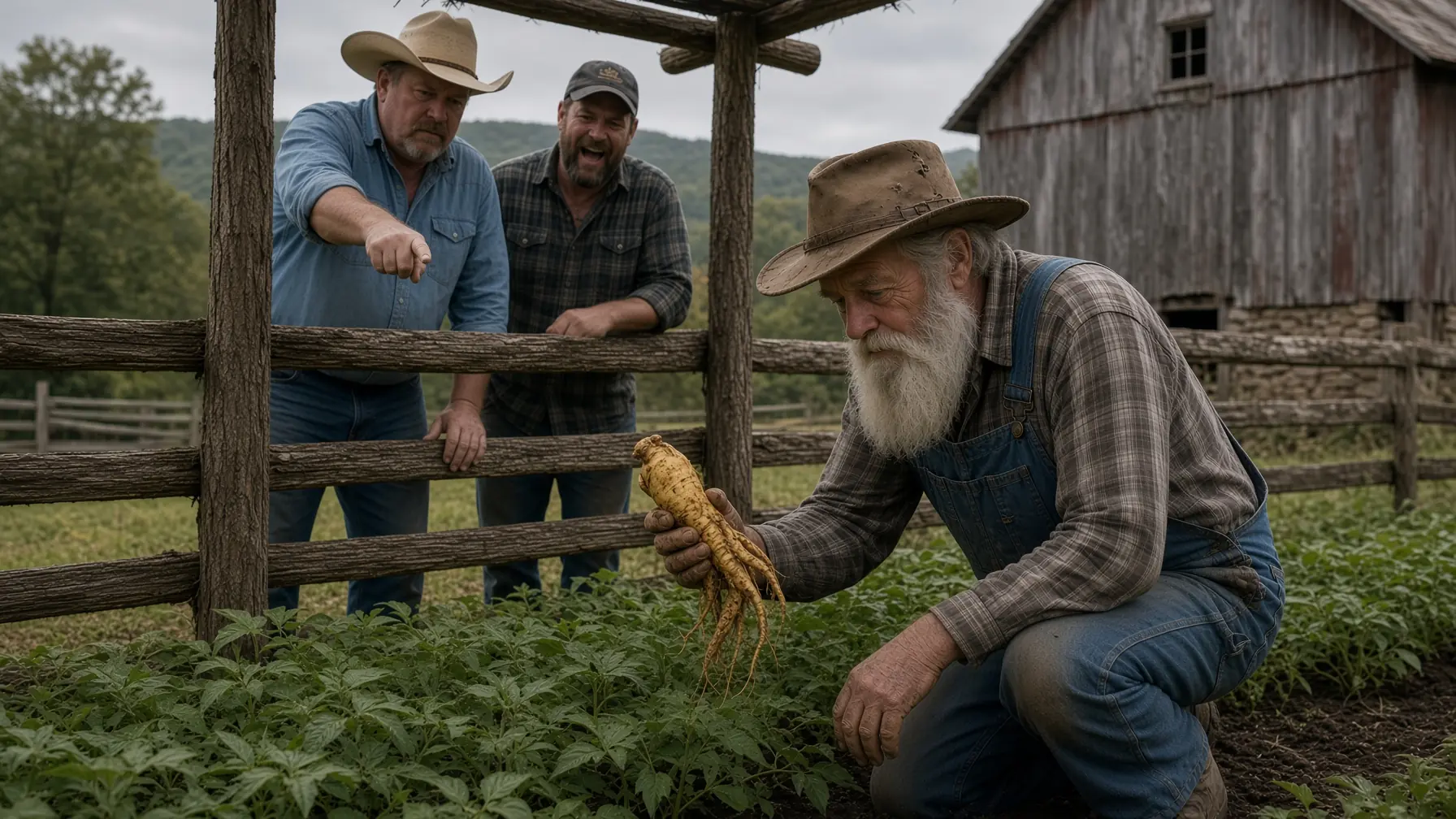
That alone should have warned him.
Cotton County, Kentucky, was not the kind of place where people ignored a farmer buying something unusual. If Walter had carried corn seed, nobody would have looked twice. Soybeans might have earned a conversation about prices. Clover would have started an argument about hay.
But the label on the brown paper sack read:
AMERICAN GINSENG — STRATIFIED SEED — 5 LB.
Earl Watson read it aloud.
Then he laughed.
“What are you doing with that, Hale?”
Walter placed the sack on the counter and reached for his wallet.
“Planting it.”
Earl looked toward Don Mercer and Travis Boone as though Walter had just delivered the first half of a joke.
“In a field?”
“No.”
“Greenhouse?”
“No.”
Walter counted the cash.
“Woods.”
That did it.
Don slapped one hand against the coffee counter.
“Lord, he’s farming weeds now.”
Even Linda Miller, who owned the store and had learned not to laugh at customers before their checks cleared, gave Walter a curious look.
“Five pounds is a lot of seed.”
“I know.”
“You ever grown it before?”
“No.”
Earl leaned back.
“Then this ought to be educational.”
Walter took the receipt.
“Most mistakes are.”
He lifted the seed sack.
Earl called after him.
“Walter, you know why nobody around here farms ginseng?”
Walter stopped at the door.
“Why?”
“Because if there was real money growing under trees, every farmer in Kentucky would already be doing it.”
Walter looked at him for a moment.
“That’s possible.”
Earl smiled, pleased.
Walter added, “It’s also possible most farmers don’t like waiting seven years to find out whether they were right.”
The smile weakened.
Walter walked outside.
He was fifty-six years old, recently widowed, carrying forty-three thousand dollars in farm debt and five pounds of seeds that would not produce anything he could sell for years.
By ordinary standards, Earl Watson probably had the stronger argument.
Walter knew that.
He planted them anyway.
The Hale farm sat along the eastern edge of Cotton County where cultivated bottoms gave way to wooded limestone ridges. Walter’s grandfather had bought the first eighty acres after returning from World War II. Walter’s father added another forty. By the time Walter inherited it, the farm contained pasture, a modest hay field, two barns, one old tobacco shed, a farmhouse, and thirty-eight acres of mature hardwood forest climbing the north ridge.
For decades the woods had been the least important part.
The Hales cut firewood there.
Hunted deer.
Gathered morel mushrooms in spring.
Walter’s wife, Margaret, collected black walnuts and complained every autumn about squirrels beating her to them.
Nobody called it productive acreage.
The money came from cattle and tobacco until tobacco contracts disappeared, then cattle and hay, then increasingly from whichever thing happened not to lose money that year.
By 2019, Walter was tired of farming according to that sentence.
Whichever thing happened not to lose money.
Diesel rose.
Fertilizer rose.
Veterinary costs rose.
Equipment repairs rose.
The cattle did not become more considerate because Walter’s margins were shrinking.
Then Margaret got sick.
Breast cancer.
Surgery.
Chemotherapy.
Two years of appointments in Lexington.
Walter reduced the herd, rented twelve acres to a neighbor, sold a second tractor, and told Margaret the finances were fine every time she asked.
She knew he was lying.
One evening after treatment, she sat at the kitchen table with a cup of tea she could barely taste and said, “You’re going to lose this place trying to make sure I don’t think you’re worried about losing this place.”
Walter kept looking at the farm ledger.
“We’re not losing it.”
“Walter.”
“We’re not.”
“You have always been terrible at lying.”
“I married you.”
“That proves poor judgment, not dishonesty.”
He smiled despite himself.
Margaret reached across the table.
“You need something besides cattle.”
“Like what?”
“I don’t know.”
“That’s useful.”
She squeezed his hand.
“Something that fits the land instead of making the land fit you.”
At the time he thought it was one of those things people said when they were tired and frightened and trying to make the future sound larger than a hospital room.
Margaret died eleven months later.
Walter found the ginseng idea because of an unpaid electricity bill.
He was sitting at the kitchen table three weeks after the funeral, sorting mail he had ignored for too long, when he discovered an old county extension newsletter beneath a stack of insurance statements.
The headline read:
FOREST FARMING WORKSHOP: GINSENG, GOLDENSEAL, AND OTHER SHADE-GROWN CROPS
Margaret had circled it.
In red ink.
Next to it she had written:
“Something that likes your useless hill?”
Walter stared at the handwriting for nearly a minute.
Then he folded the newsletter and put it in his shirt pocket.
The workshop had already happened.
That annoyed him.
So he called the extension office.
That was how he met Dr. Hannah Reed.
Hannah was thirty-nine, a forestry and specialty-crop extension specialist who had heard every version of the ginseng fortune story.
Walter arrived at her office carrying the newsletter.
“I want to grow this.”
Hannah looked at him.
“Why?”
“Because my wife thought I should.”
“That is a terrible agronomic reason.”
Walter liked her immediately.
“What’s a better one?”
“Suitable forest. Correct slope. Good companion plants. Drainage. Enough patience to wait years. Enough discipline not to believe every price you read online.”
“I’ve got the patience.”
“Everybody says that before year three.”
Walter sat.
“What’s the catch?”
“Which one?”
He raised an eyebrow.
Hannah began counting.
“Seed can fail. Mice eat it. Turkeys scratch beds. Deer browse tops. Slugs love seedlings. Disease becomes a problem if you plant too densely. Theft becomes a problem if people know where it is. Market prices fluctuate. Regulations matter. Export rules matter. Harvest season matters. Root age matters. Some states have specific legal requirements. And if you think planting ten acres today means becoming a millionaire in seven years, go home.”
Walter stared.
“You finished?”
“No.”
“Good.”
That surprised her.
Walter continued. “I don’t want ten acres.”
“How much?”
“I don’t know yet.”
“Better answer.”
Hannah pulled a topographic map toward them.
“Where’s your farm?”
Walter pointed.
She studied it.
“North-facing woods?”
“Mostly north and northeast.”
“Hardwood?”
“Sugar maple, poplar, basswood, hickory. Some oak.”
Her expression changed.
“Mayapple?”
“Everywhere.”
“Bloodroot?”
“Yes.”
“Black cohosh?”
“Some.”
“Christmas fern?”
“Yes.”
Hannah looked up.
“Those are useful indicators.”
“So Margaret wasn’t crazy.”
“I didn’t say you have ginseng ground. I said I want to see it.”
Three days later Hannah walked Walter’s north ridge.
She carried a soil probe, field notebook, and the energy of someone who became happier the farther she moved from pavement.
Walter followed.
Near the middle slope she stopped beside a patch of mayapple.
“This.”
Walter looked around.
“What?”
“Good canopy. Eastern exposure with northern component. Deep leaf litter. Calcium-loving associates. Not waterlogged.”
She scraped soil away carefully.
“Still need testing.”
Walter pointed downhill.
“Whole slope?”
“No.”
“Why?”
“Because forests change every fifty feet.”
She continued walking.
Twenty yards later she rejected an area for being too dry.
Another was too exposed.
A lower section held water after storms.
Eventually she marked three separate patches totaling slightly over two acres.
Walter looked disappointed.
“I’ve got thirty-eight acres.”
“And maybe two or three are naturally favorable without major manipulation.”
“That all?”
Hannah smiled.
“You wanted something that fits the land.”
Walter understood.
Do not make the land fit you.
Margaret again.
Walter sent soil samples.
Calcium was promising in two sites, moderate in another. Organic matter was high. pH varied but remained workable for wild-simulated planting in selected zones.
Then Hannah introduced him to the difference that would shape everything.
“Woodsgrown and wild-simulated are not the same.”
Walter listened.
“Woodsgrown can involve prepared beds, more intensive management, sometimes denser planting. You can produce larger roots faster under controlled conditions, but they may look different from truly wild roots.”
“And wild-simulated?”
“Plant seed in suitable forest with minimal disturbance. Let natural conditions do most of the work. Lower yield. Higher mortality. Slower. But mature roots can develop characteristics buyers value.”
“How slow?”
“Usually you should think seven to ten years, sometimes longer, depending on your goal.”
Walter whistled.
“So Earl was right.”
“Who’s Earl?”
“Man at the feed store who thinks I’m stupid.”
Hannah shrugged.
“He may still be right. We haven’t finished.”
Walter bought five pounds of stratified seed that autumn.
Then he made his first major mistake.
He planted too much of it in one place.
Hannah discovered the problem when she visited.
“You did what?”
Walter pointed proudly toward the forest floor.
“Planted.”
“How close?”
“About six inches.”
She closed her eyes.
“That dense?”