The laughter started before Earl Maddox had even lowered his hand.
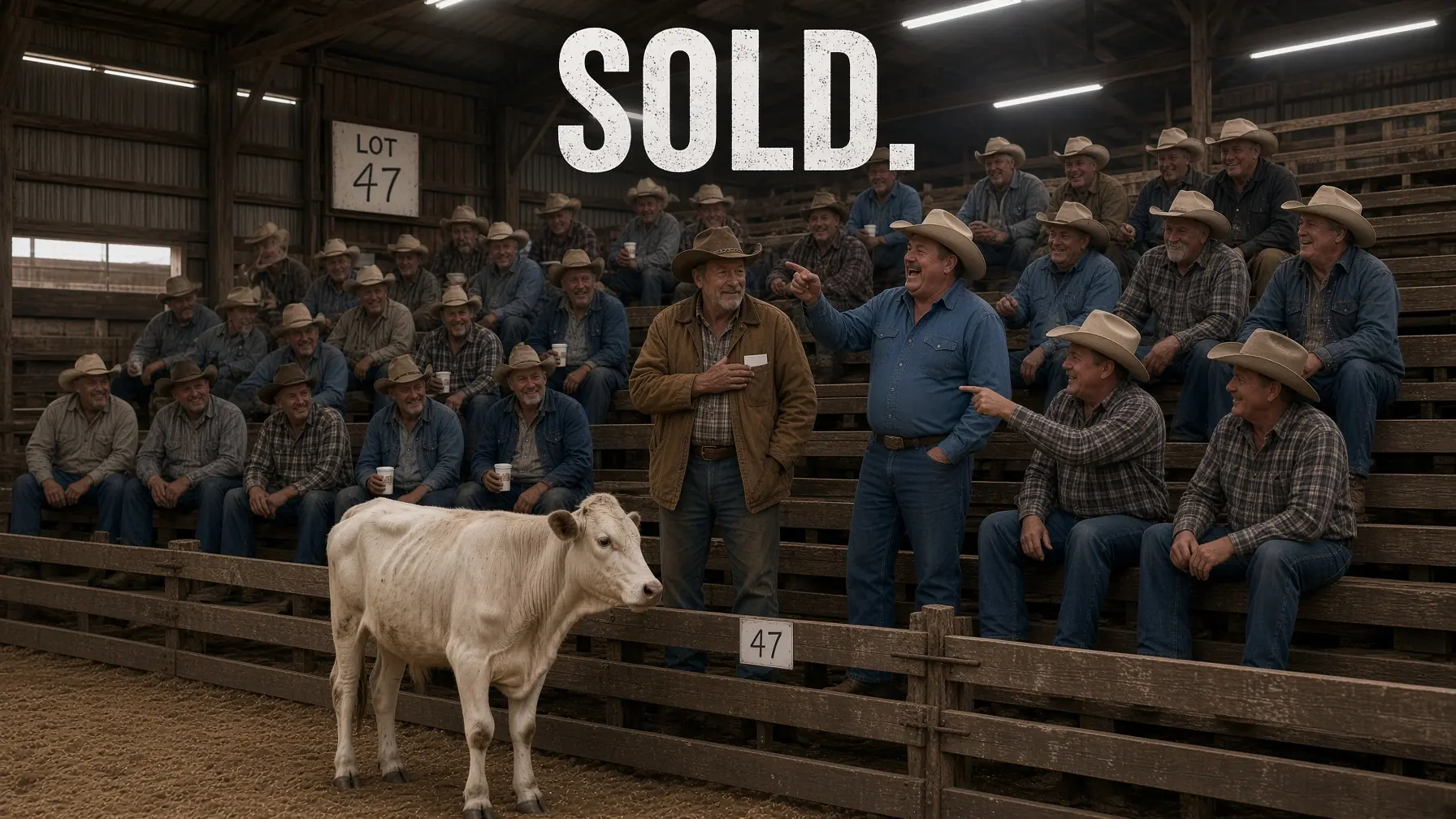
By the time the auctioneer called his seventy-five-dollar bid, half the wooden bleachers inside the Sedalia Livestock Auction were turned toward him instead of the animal standing in the ring.
Earl felt every eye.
He also heard every word.
“Seventy-five dollars for that?”
“Somebody check the old man’s temperature.”
“Better buy a shovel with the change.”
The bull stood beneath the auction lights as though none of it concerned him. Pale cream hair covered a long body that looked almost painfully thin beside the thick Hereford and Angus bulls that had crossed the ring before him. His hips showed. His ribs were visible. His head seemed too small for his frame, and his legs made him look taller and narrower than he actually was.
To most of the cattlemen inside that barn, he looked like the kind of animal a man bought only because he could not afford anything better.
Earl knew exactly how that looked.
He had arrived with six hundred dollars folded inside the inner pocket of his coat.
Nearly two years of spare money.
Fence repairs done for neighbors after dark.
Firewood cut through winter.
A tractor clutch replaced for a widow who could pay only half until spring.
Every dollar had a job waiting for it at home.
The kitchen stove had one burner that worked only if Lorraine struck the side with a wooden spoon.
The farmhouse roof leaked above the back bedroom.
The west fence leaned so badly that the next windstorm might hand eight Maddox cows to the neighboring county.
Lorraine knew about the six hundred dollars.
She did not know Earl planned to spend any of it on a bull.
That conversation was still waiting for him.
The auctioneer looked toward Earl.
“Seventy-five?”
Earl nodded.
The auctioneer looked around the room.
“Anybody give eighty?”
Silence.
Then Glenn Kirby stood.
Glenn owned the John Deere dealership in Sedalia and carried himself with the relaxed confidence of a man who had spent twenty years watching other farmers need something he sold. He was forty-seven, broad around the middle, always clean-shaven, and somehow managed to make a work jacket look expensive.
He pointed toward the bull.
“Earl, you better dig the grave now while the ground’s still soft.”
The room exploded.
Glenn waited for the laughter to settle.
“That thing won’t see July.”
Banker Ray Morrison called from two rows below, “Don’t listen to Glenn. It’ll make July.”
A few men quieted.
Ray grinned.
“Just won’t make August.”
More laughter.
Tom Garrison shouted, “Maybe Earl’s starting a dairy!”
Someone else yelled, “French cheese!”
The handlers inside the ring were smiling now.
Even the auctioneer looked uncomfortable.
Earl’s face burned.
He had known most of these men for twenty years. Some had borrowed tools from him. Some had eaten Lorraine’s pie at church suppers. Two had called on Earl after his father died.
None of that prevented a good joke when one appeared.
Earl looked at the bull.
The bull looked back.
On the inside of its left ear was a faded tattoo.
M-417.
That was what mattered.
Not the ribs.
Not the narrow hips.
Not Glenn Kirby.
Not the laughter.
M-417.
Earl raised his eyes toward the auctioneer.
“Seventy-five.”
The auctioneer hesitated.
“Mr. Maddox, you already have the high bid at fifty.”
“I know.”
“So you’re bidding against yourself.”
“I know that too.”
The room became quieter.
The auctioneer shrugged.
“Seventy-five dollars. Going once.”
Nobody moved.
“Twice.”
Glenn called, “Last chance to save him from himself.”
“Sold.”
The auctioneer’s hand came down.
“Seventy-five dollars to Earl Maddox.”
The laughter started again.
Earl stood, walked to the clerk’s window, and counted out three twenties, a ten, and a five.
The clerk looked through the window toward Lot 47.
“You sure?”
Earl took the receipt.
“No.”
The clerk stared.
Earl folded the paper.
“But I’m sure enough.”
Twenty minutes later the pale bull was inside Earl’s livestock trailer.
Glenn Kirby found him fastening the rear gate.
“Dead by July,” Glenn called.
Earl checked the latch.
“Morning, Glenn.”
“You hear me?”
“I hear everybody.”
“You really think you know something the rest of us don’t?”
Earl looked at him.
That question came much closer to the truth than Glenn realized.
“Maybe.”
Glenn laughed.
“About that animal?”
“Maybe.”
“What?”
Earl climbed into his truck.
“Wouldn’t be something I knew if I told you.”
He pulled away before Glenn could answer.
Only when Sedalia disappeared behind him did Earl reach beneath the seat.
A folded envelope lay inside an old tobacco tin.
The stamp was French.
The handwriting was blue.
The letter had arrived six months earlier.
Earl had read it so many times that the folds were beginning to tear.
He could recite most of it without opening the envelope.
But at the first quiet stretch of road, he pulled onto the shoulder anyway.
The bull shifted behind him.
Earl unfolded the paper.
At the top was the name of a farm near Charolles, France.
Below that, in careful English translated by the breeder’s daughter, were the words Earl had been waiting six months to act upon.
Regarding the bull calf recorded through the American intermediary as M-417…
Earl’s hands tightened slightly.
Then he read the next lines again.
The calf’s dam was descended from a French cow line selected for maternal ability, frame, and longevity.
Its sire was a bull from a line being used in performance-tested Charolais herds for growth and muscling.
The animal itself had not been imported secretly, nor was it some priceless royal bull disguised by fate.
Nothing that convenient.
He was an American-born fullblood Charolais calf produced from imported French breeding stock brought through legal channels by a Missouri cattleman named Henry Morrow.
Morrow had died suddenly the previous autumn.
His farm went into a messy estate liquidation.
Some cattle were sold privately.
Others were sent to local auctions.
Registration papers had not followed every animal cleanly because the estate executor knew equipment better than pedigrees.
Earl had seen M-417 once before.
Six months earlier.
Standing behind a sagging fence on the Morrow place.
Thin even then.
But something about his structure had bothered Earl enough that he wrote the ear number in his pocket notebook.
Then he started asking questions.
That was how the letter from France came.
Not prophecy.
Pedigree.
And pedigree was not performance.
Earl understood that better than anyone laughing in the auction barn.
Good ancestry did not make a starving bull valuable automatically.
Genetics could be ruined by poor feet, bad fertility, disease, poor management, or simple bad luck.
The letter told Earl only one thing.
Lot 47 might be far better than he looked.
That was enough.
He folded the letter.
“Now we find out,” he said.
The bull shifted inside the trailer.
Earl drove home.
Lorraine Maddox was standing on the porch when the truck appeared.
Earl saw her hands move immediately to her hips.
That was not encouraging.
She was fifty-five, five years younger than Earl, with gray beginning at her temples and the kind of stillness that usually appeared just before she said something devastatingly reasonable.
Earl stopped the truck.
Lorraine looked at the trailer.
Then at Earl.
Then back at the trailer.
“What did you buy?”
“A bull.”
“I can see that.”
Earl climbed down.
Lorraine walked toward the trailer.
She looked through the slats.
Her expression did not improve.
“You paid money for that?”
“Some.”
“How much is some?”
Earl considered several bad answers.
Then selected honesty.
“Seventy-five.”
Lorraine stared.
“That is supposed to make me feel better?”
“It could have been seven hundred.”
“You had six hundred.”
“Yes.”
“Earl.”
“Yes?”
“We need a roof.”
“I know.”
“We need fencing.”
“I know.”
“The stove has declared war on breakfast.”
“I know.”
“And you bought a bull that looks like somebody already ate half of him.”
Earl looked toward the trailer.
“That’s temporary.”
Lorraine closed her eyes.
“Of course it is.”
“I’ve been following him.”
“You’ve been what?”
“Not literally.”
“Good. Because that would make this conversation worse.”
Earl removed the French letter from his pocket.
Lorraine looked at it.
“What’s that?”
“Why I bought him.”
They sat at the kitchen table.
The stove failed to light twice while Earl made coffee.
Lorraine pointed at it.
“Exhibit one.”
Earl handed her the letter.
She read carefully.
Unlike Earl, Lorraine had finished high school and worked several years at a bank before marrying him. She read contracts, statements, and pedigree documents with the same suspicion.
When she finished, she placed the letter flat on the table.
“So he has good parents.”
“Good blood behind him.”
“That is not the same thing.”
“No.”
“He might be infertile.”
“Yes.”
“Bad feet.”
“Yes.”
“Poor breeder.”
“Yes.”
“Die.”
“Everything does.”
Lorraine stared.
“That was not comforting.”
“I know.”
She tapped the letter.
“And you knew all that?”
“Yes.”
“Still spent seventy-five?”
“Yes.”
“Why?”
Earl took a breath.
“Because if he’s sound, I couldn’t afford him after somebody else figures out what he is.”
Lorraine leaned back.
That was the argument she had not expected.
Earl continued.
“I’ve been watching what buyers are paying for Charolais-cross calves. Some feeders like the growth. Bigger weaning weights if the cross works.”
“Bigger cows eat more.”
“True.”
“Big calves create calving trouble.”
“Can.”
“So you’re not replacing everything.”
“No.”
“What are you doing?”
Earl pulled a notebook from his coat.
Lorraine sighed.
“You made a plan.”