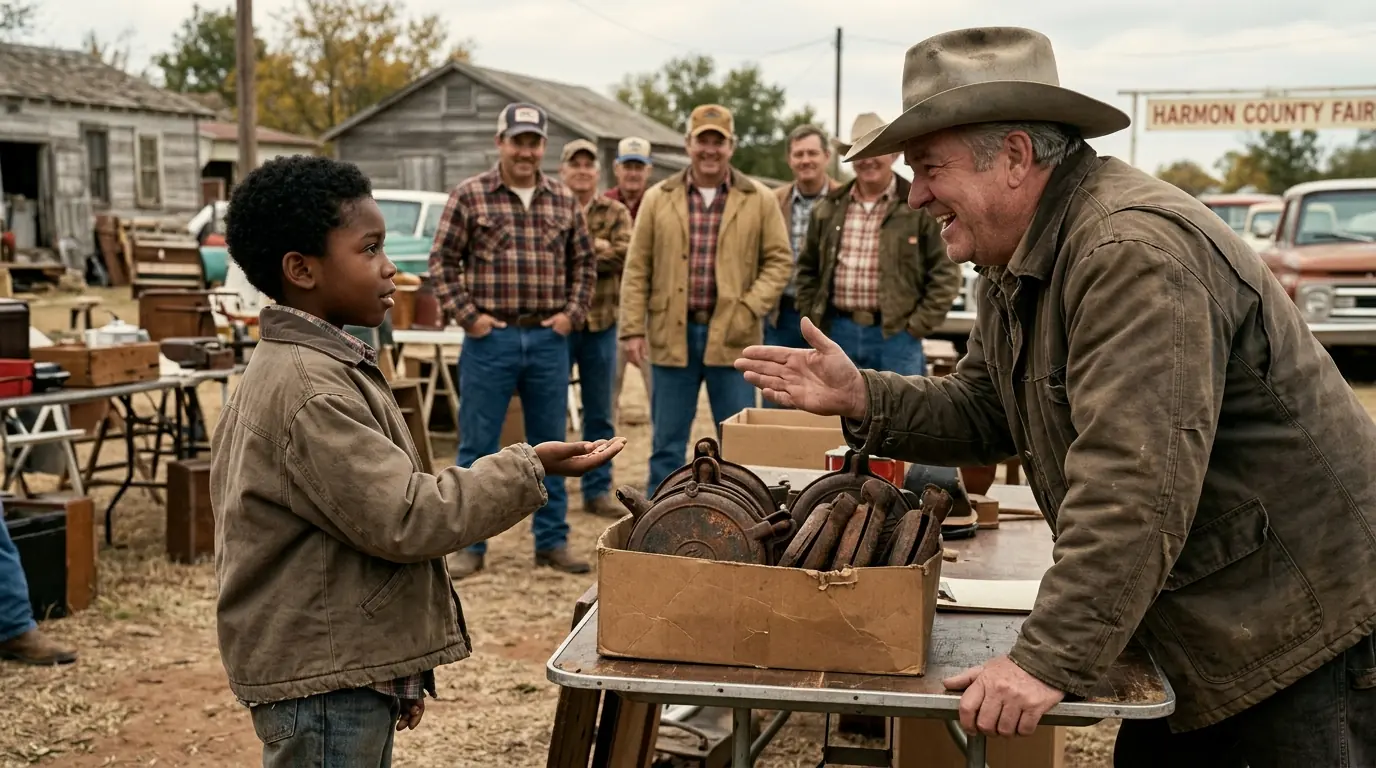
A quarter for the whole lot. Anybody? Nobody moved. Then a small hand went up in the back.
You got a quarter, son? The boy opened his palm. One penny. A penny, huh?
That boy wants to buy garbage. The crowd roared. Fine, sold. And don't you dare bring that junk back here.
Nine years later, a state fair judge froze in front of that same boy's booth. Wait. You restored all of these? Yourself?
Every single one, ma'am. I can prove it. Her voice shook. Call the other judges right now. What had a 1-cent box of rust become?
Elias Turner was 9 years old in the fall of 1971, and he lived with his parents on 160 acres of mixed grass and old cropland on the south side of Beckham County, Oklahoma, about 9 miles outside the town of Erick. The Turners were one of very few black families farming in that part of western Oklahoma. The laws that had once kept them out of certain schools and certain counters had been struck down years before. The habits had not been struck down with them. People were polite, mostly.
They were also watchful, and Elias had learned early that watchful was something you could feel without anyone saying a word. His father, Amos Turner, ran a small cow-calf operation, put up hay on the creek bottom ground, and did custom cutting for two neighbors when the season allowed. The house was a frame house built in 1938 and added on to twice with a covered porch that faced east. Behind it stood a shop building Amos had put up board by board over three winters. It had a wood stove, a long workbench, and a set of shelves along the east wall where Amos kept things he had not yet figured out a use for.
He called it the thinking shelf. He said everything on it was there because it had more left in it than people thought, and the only question was what that thing was. Amos had been buying broken things at sales since before Elias was born. He fixed what he could fix and sold what he fixed to families who needed it and could not afford new. He knew small appliances the way he knew which fence posts were still sound and which had gone hollow at the ground by handling them, by reading what the surface told him about what was underneath.
He had never studied it. He just knew. He kept a ledger for it, a brown composition book with a red spine. In it he wrote the date, the item, what he paid, what he spent on it, and what he got. The winter Elias turned seven, Amos showed him the ledger and told him to read it like a story because it was one.