By the time the eight-hundredth oak barrel was dumped behind Dela Voss’s farm, nearly everyone in Sycamore Valley had decided the same thing.
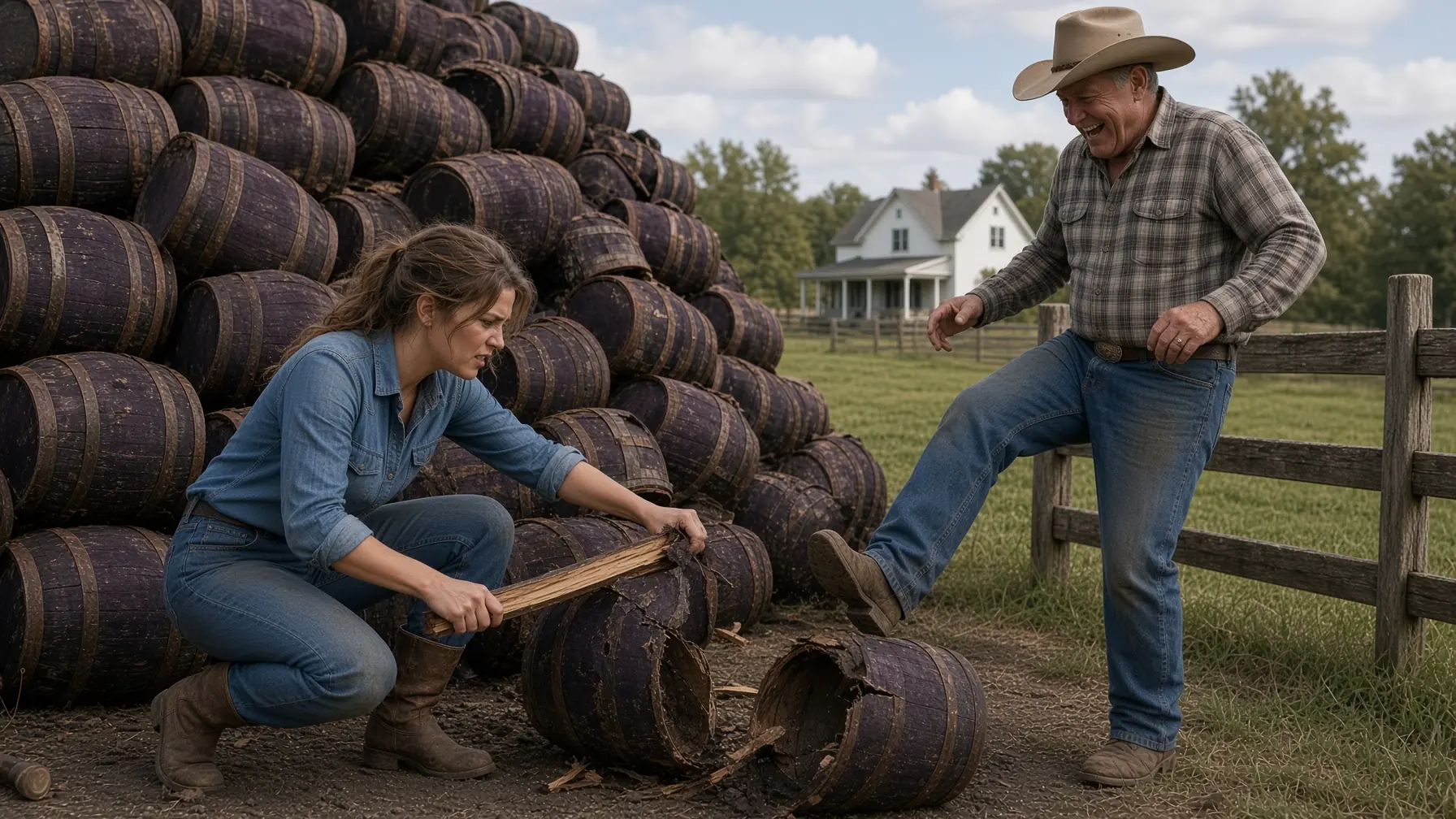
Ernst Voss’s granddaughter was not going to last.
Some people said it with sympathy. Others enjoyed saying it. Henderson Pike, the cattleman whose western fence bordered the Voss property, simply stopped his pickup beside her mailbox one afternoon, stared at the mountain of barrels rising near the fir trees, and said, “Your grandfather spent forty years keeping this place from looking like a junkyard. Took you three months.”
Dela rested both arms across the fence. She was twenty-five, sunburned across the nose, wearing her grandfather’s old work shirt with the sleeves rolled above her elbows. “They’re paying me to take them.”
Henderson looked toward the barrels again. Hundreds of warped oak casks lay on their sides or stood crooked against one another, some blackened by weather, some leaking the last sour traces of wine into the grass. Rusted hoops had already begun falling loose. The clearing smelled of vinegar, oak, mold, and old red wine.
“People get paid to haul garbage too,” he said.
“That doesn’t make the truck a landfill.”
“No. But eight hundred barrels behind a barn comes close.”
Dela did not argue.
That was partly because Henderson was not entirely wrong.
When Blackwood Ridge Vineyards first approached her in August of 1977, she had seen only money. Not much money, but enough to matter. The winery offered fifty cents per barrel plus hauling, provided Dela accepted responsibility once the barrels were unloaded. Blackwood Ridge had expanded quickly during the previous five years and was replacing older cooperage that no longer contributed enough oak character to its premium wines. The barrels were not rotten in the way ordinary firewood was rotten. Most were simply exhausted for winemaking. But to Blackwood Ridge they occupied warehouse space, required handling, and cost money to dispose of.
To Dela, four hundred dollars represented almost half the cost of repairing the farmhouse roof.
That was enough.
Her grandfather Ernst had died in May after a stroke. He left her sixty acres of mixed pasture, orchard, timber edge, and tired outbuildings on the east side of the valley. There was no mortgage, which sounded like wealth to people who did not understand farms. There were property taxes, fencing, veterinary bills, irrigation repairs, an orchard sprayer with a cracked pump housing, a Ford tractor that needed persuasion before every cold start, and a farmhouse roof that leaked into two upstairs rooms whenever the rain came from the west.
Ernst also left six thousand three hundred dollars in savings.
By September, Dela had less than half of it.
The valley watched.
Some neighbors expected her to sell to Blackwood Ridge. The winery had already purchased three nearby parcels and wanted more land for future vineyard expansion. Mr. Albright, the winery’s operations manager, had mentioned that fact the first time he came to Dela’s porch.
“You could make this much easier on yourself,” he told her.
Dela had been repairing a torn screen door.
“How?”
“Sell us the lower forty. Keep the house, barn, orchard. You’d still have twenty acres and enough capital to make them comfortable.”
“My grandfather didn’t leave me comfortable.”
Albright smiled.
“No. Apparently not.”
That was the first time she disliked him.
The barrel arrangement came a month later.
He found her kneeling in Ernst’s vegetable garden, trying to repair an irrigation line.
“We have a disposal issue,” he said.
“That sounds unfortunate.”
“You have unused ground.”
“That sounds like my business.”
Albright smiled as though she were a clever child.
“Hear me out.”
He explained the barrels. Several hundred immediately, with more perhaps later. Blackwood Ridge would transport them. Dela would sign a release accepting the wood as discarded material and assuming responsibility after delivery. The winery would pay enough to make the inconvenience worth her time.
Dela asked the question Ernst had taught her to ask whenever somebody wanted a signature.
“What exactly becomes mine?”
Albright looked surprised.
“The barrels.”
“Permanently?”
“We certainly don’t want them back.”
“Put that in writing.”
He laughed.
“They’re trash, Miss Voss.”
“Then you won’t mind writing it.”
Two days later, Albright returned with a one-page disposal agreement prepared by the winery office. It described the barrels as used cooperage of no continuing commercial value to Blackwood Ridge Vineyards and stated that title, possession, and responsibility transfer permanently to Voss Farm upon unloading.
Dela signed.
Albright signed.
She put her copy inside Ernst’s metal filing cabinet.
Then truck after truck arrived.
The first fifty barrels amused people.
Two hundred caused gossip.
At five hundred, Dela herself wondered whether she had made a serious mistake.
At eight hundred, there was no pretending anymore.
The barrels occupied nearly half an acre.
For three weeks she refused to walk among them.
She collected her payments, bought shingles, patched the worst section of roof, repaired three hundred feet of fence, and concentrated on everything that felt like real farming.
But every time she crossed the yard, she could see the pile.
Something about it embarrassed her.
Not because the neighbors mocked it.
Because she suspected they might be right.
Then, one September evening, a rusted hoop slipped from a barrel near the edge of the stack.
Three staves sprang outward.
One separated completely and landed in the weeds.
Dela picked it up.
The outside looked terrible.
Gray weathering.
Dark stains.
A patch of mildew near one end.
She almost threw it back.
Instead she ran one thumb across the inside surface.
The wood beneath the wine stain was hard.
Dense.
Tight-grained.
She carried it to Ernst’s workshop.
Her grandfather had not been a furniture maker by profession, but there was almost nothing on the farm he refused to build himself. Shelves, gates, tool handles, orchard ladders, chicken houses, hay racks, cabinets. He distrusted anything sold with the phrase assembly required because, in his opinion, it meant somebody had manufactured a problem and charged extra for the privilege of solving it.
His tools still hung where he left them.
Dela placed the stave across the bench.
She took down a hand plane.
The first pass removed gray surface fibers.
The second exposed pale oak.
The third revealed something she had not expected.
A dark burgundy line ran through the inner face of the wood, not as paint or surface dirt but as color absorbed unevenly into the grain. It faded from nearly black-purple at the wine side toward honey-colored oak deeper inside.
Dela stopped.
She turned the stave under the workshop light.
Beautiful.
Not clean beautiful.
Not furniture-store beautiful.
It looked old.
Used.
Like the wood had already lived somewhere before arriving in her hands.
Ernst had once told her, “Never ask what a thing used to be before you ask what it can still become.”
At the time he had been talking about a broken orchard ladder.
Dela looked toward the clearing.
Eight hundred barrels.
She went back outside with a hammer.
Before midnight, she had dismantled three.
It was harder than she expected. Hoops had rusted tight around some sections and fallen loose around others. Several staves split when released. Barrel heads varied in condition. Some pieces were too warped, too rotten, or too deeply cracked to use.
But enough were sound.
A standard barrel gave her more than two dozen curved oak staves, plus the head pieces. Not every barrel was identical. Some were American white oak, wider-grained and more strongly stained. Others had finer grain that Albright later told her came from French cooperages. Cooper marks had been burned into many heads. Some dates went back nearly a decade.
Dela worked until her hands blistered.
The next morning she dragged one complete barrel into the shop.
By evening, she had made a stool.
It was ugly.
The seat leaned.
One leg rocked.
The curved stave braces looked as though they had been attached by somebody angry at geometry.
Dela put it beside the door and stared.
Then she made another.
Better.
The third did not rock.
She used portions of the barrel heads for round seats, preserving the wine-dark side underneath and planing the upper surface smooth. She used shortened curved staves as legs and braces, working with the shape instead of trying to flatten it.
On Saturday, Henderson wandered over.
He found Dela sanding the fourth stool.
“What’s that?”
“A stool.”
“I recognize furniture.”
“Congratulations.”
He ran one finger across the grain.
“This came from the barrels?”
“Yes.”
He turned it over.
The underside showed deep red staining.
“Huh.”
That single sound mattered more to Dela than she wanted to admit.
“You want one?”
“No.”
“Good.”
Henderson sat on it.
Dela stared.
He shifted his weight.
The stool remained steady.
“How much?”
“You just said you didn’t want one.”
“I changed my mind.”
“Why?”
“My wife will like it.”
Dela smiled.
“Eight dollars.”
Henderson looked offended.
“For garbage?”
“Ten.”
“You said eight.”
“Then stop insulting the inventory.”
He paid eight.
The following week his wife ordered two more.
That was how it began.
Not with a miracle contract.
Not with a wealthy collector discovering a hidden fortune.
Three stools.
Then a small table.
Then four plant stands.
Then a set of shelves for a tavern twenty miles away whose owner liked that the wood still smelled faintly of wine when cut.
Dela learned quickly.
Some barrel parts were far more useful than others. She could not flatten a full stave without removing too much material or risking splits, so she stopped trying. She designed around the curve. Chair backs. Rockers. Cradle sides. Arched shelf supports. Wine racks.
The flat barrel heads became table tops, cabinet doors, trays, and signs.
Short damaged sections became handles or small decorative pieces.
Only the truly rotten pieces became firewood.
Even the hoops had uses.
She heated and reshaped them into brackets, handles, and circular frames.
Most importantly, she kept records.
Ernst had taught her that if something took three hours and sold for the cost of one hour, it was not a business simply because people admired it.
Dela made a ledger.
Barrel 17: 22 usable staves. 5 partial. Head sound.
Time dismantling: 38 minutes.
Stool: 1.4 hours.
Sale: $8.
Not enough.
She changed the design.
Built jigs.
Made repeat cuts.
Grouped tasks instead of completing one item at a time.
By November, she could dismantle a good barrel in under twenty minutes without splitting most of the usable staves.
By December, the shop looked less like Ernst’s workshop and more like a small manufacturing room.
That was when Marianne Vale walked into Henderson’s house.
Marianne was thirty-six and worked for a Portland architectural firm specializing in restaurant and hotel renovations. She had driven into the valley to visit her sister, Henderson’s wife.
She saw the stools.
Then a small side table Dela had made from a barrel head.
Marianne turned it over.
The underside was nearly purple.
“Where did this come from?”
Henderson’s wife pointed across the pasture.
“The junkyard.”
Marianne drove to Dela’s farm the next morning.
Dela was replacing a belt on the orchard sprayer.
“You make furniture?”
“Sometimes.”
Marianne looked toward the workshop.
“May I see?”
Dela wiped her hands.
“What are you looking for?”
“Wood.”
“I have some.”
That was an understatement.
Marianne walked into the workshop and stopped.
Against one wall, Dela had sorted staves by length, curve, condition, grain, and color. The best pieces stood upright in racks. Barrel heads lay stacked flat with spacers between them. Several finished chairs waited beside the bench.
Marianne picked up a stave.
“Do you know what people are paying for character wood in Portland right now?”
“No.”
“Neither do most people because nobody calls it that yet.”
Dela frowned.