When twenty-three-year-old Marie Fontenot inherited fifty acres of cracked, exhausted land outside Breaux Bridge, Louisiana, nearly everyone gave her the same advice.
Sell it quickly.
Sell it cheaply if necessary.
And leave before the farm swallowed the best years of her life.
The property had belonged to her grandfather, Lucien Fontenot, a quiet man who spent forty-six years growing rice, raising a few cattle, and repairing machinery that should have been replaced long before Marie was born.
By the time Lucien died, the farm no longer looked like something worth inheriting.
The fields were uneven and pale.
Years of repeated cropping had left the soil thin and compacted. Deep cracks opened during hot weather, while the lowest sections turned into sticky mud after heavy rain. The irrigation pump had not worked properly in three seasons. Rust covered the gates. The tin roof on the equipment shed lifted whenever storms came from the south.
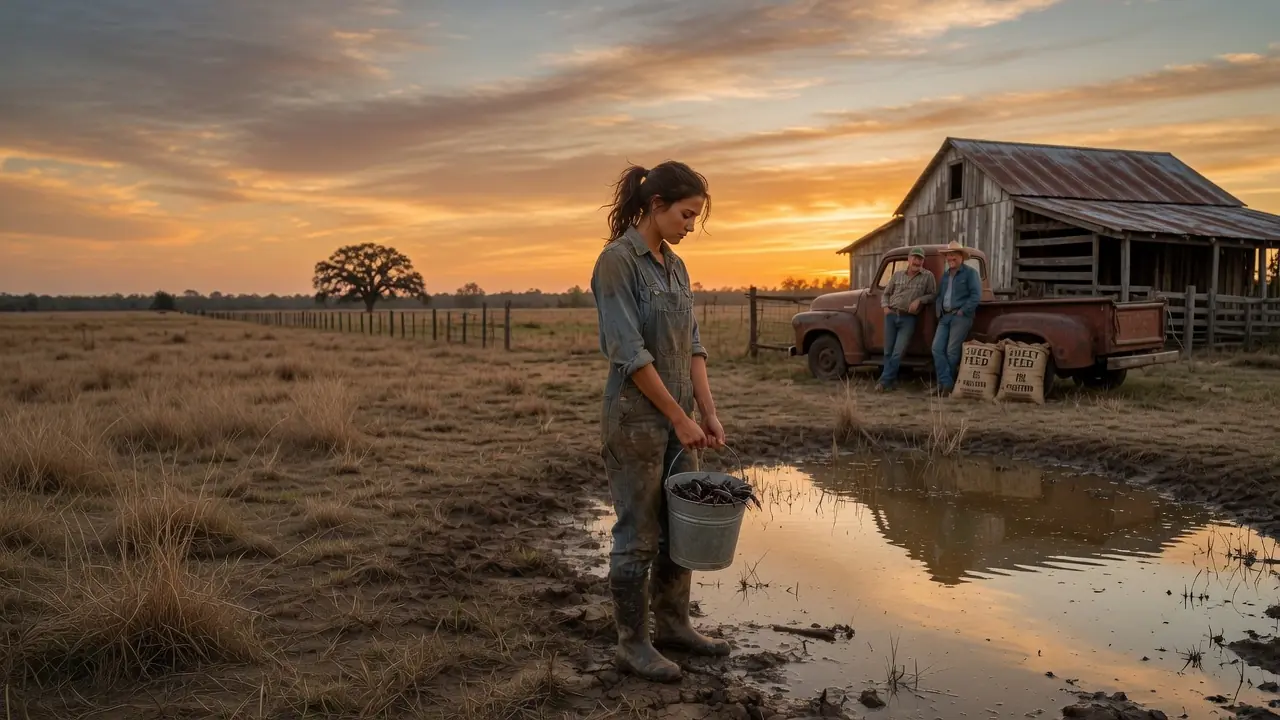
At the center of the farm sat a six-acre pond that had not held water in nearly a decade.
The levee had broken along the northern edge.
Willows grew through the old spillway.
Dry weeds covered the pond floor, and sun-bleached turtle shells lay among the cracked clay.
To Marie’s neighbors, the pond represented everything wrong with the property.
It took up good ground.
It collected mosquitoes when rain temporarily filled the low spots.
And restoring it would cost more money than any sensible person would spend on a farm already losing value.
Marie saw it differently.
She saw water waiting for a reason to return.
The morning after the funeral, she walked the property alone.
Lucien’s old rubber boots were too large for her, but she wore them anyway. They had been standing beside the farmhouse door since the last time he entered the kitchen.
She followed the fence line, passed the broken pump, and stopped at the dry pond.
Her grandfather had brought her there when she was eight.
Back then, the pond held water year-round. Blue herons stood near the bank. Frogs sang after sunset. Lucien raised a small crop of crawfish beneath a shallow rice rotation, mostly for the family and a few local buyers.
Marie remembered dropping bait into wire traps while her grandfather laughed at her fear of being pinched.
“Crawfish don’t chase people,” he told her. “People make themselves important in every story.”
Then disease struck the rice.
Two bad hurricanes damaged the levees.
Fuel prices climbed.
Lucien stopped flooding the pond because the diesel pump cost too much to operate.
The water disappeared.
The crawfish disappeared with it.
By the time Marie entered high school, the pond had become a dry scar surrounded by weeds.
She stood there after the funeral and pressed the toe of Lucien’s boot against the cracked soil.
Something about the place bothered her.
Not only its emptiness.
Its waste.
Every nearby farm fought the same problem.
Too much water when storms came.
Not enough during summer heat.
The Fontenot property had a pond designed to hold water, drainage channels leading into it, and heavy clay soil that sealed naturally when flooded.
Yet everyone described it as useless because it had stopped doing the job for which it was built.
Marie returned to the farmhouse and opened Lucien’s desk.
Inside were tax records, seed invoices, machinery manuals, and small notebooks filled with years of observations.
He recorded rain.
Water depth.
Planting dates.
Crawfish catches.
Feed costs.
The notebooks did not contain a perfect plan.
But they contained enough to show that the pond had once earned money.
Not much.
Some years barely enough to cover fuel.
But Lucien’s best seasons came when rice prices were poor and crawfish demand was strong.
One page from 1989 had been underlined twice.
Water earns twice when managed right.
Marie read it several times.
Then she called the bank.
The loan officer’s name was Curtis Landry.
He had known her family for years and spoke to Marie with the careful tone adults used when trying to appear respectful toward someone they considered inexperienced.
“The land is paid off,” Curtis said. “That gives you options.”
“What options?”
“You could sell the eastern section separately. A developer has already asked about it.”
“A developer?”
“Small residential lots. The road access is good.”
“My grandfather wanted it farmed.”
Curtis sighed.
“I understand the emotional connection.”
“It is not only emotional.”
“Marie, the property lost money for four consecutive years.”
“My grandfather was sick during two of those years.”
“The numbers remain the numbers.”
“What would the whole farm bring?”
Curtis gave her an estimate.
It was enough to place a down payment on a small house in Lafayette and leave the problems behind.
Many people would have accepted.
Marie asked another question.
“How much would the bank lend me against it?”
Curtis became quiet.
“For what?”
“To repair the levee, replace the pump, and flood the pond.”
“Why?”
“Crawfish.”
There was another pause.
“Marie, are you planning to raise crawfish in the abandoned pond?”
“Yes.”
“That pond has been dry for years.”
“I know.”
“Have you ever operated a crawfish farm?”
“I helped my grandfather.”
“As a child.”
“I also studied agricultural business for two years.”
“You left school.”
“To take care of him.”
Curtis softened slightly.
“I know.”
“Then you know why I came home.”
“Yes.”
“So will the bank lend against the land?”
“It depends on the plan.”
“I can bring one.”
“Bring a realistic one.”
Marie spent the next week building it.
She calculated levee repair costs.
Pump capacity.
Fuel.
Bait.
Traps.
Seed crawfish.
Water loss.
Expected yield.
Wholesale prices.
She visited three crawfish producers in neighboring parishes. Two refused to discuss their operations with her. The third, a sixty-six-year-old farmer named Raymond Thibodeaux, allowed her to follow him through his ponds for an afternoon.
Raymond had thick hands, a sun-darkened face, and no patience for exaggerated confidence.
“What do you know?” he asked.
“Enough to know I don’t know enough.”
“That’s better than most.”
He showed her how water depth affected temperature.
How crawfish burrowed during dry periods.
Why oxygen levels mattered.
How poor levee design could trap fish that ate juvenile crawfish.
He explained that crawfish farming was not simply filling a pond and waiting.
It required water management, forage, timing, labor, and constant observation.
“People see the sacks at harvest,” Raymond said. “They don’t see six months of decisions under muddy water.”
Marie wrote everything down.
Before she left, Raymond asked how much money she had.
“Fourteen thousand dollars.”
“For the whole project?”
“Yes.”
He laughed once.
“That won’t get far.”
“I know.”
“How much is the bank lending?”
“They haven’t agreed.”
“What happens if they refuse?”
“I start smaller.”
Raymond looked toward her.
“You planning to prove something?”
“Yes.”
“To who?”
Marie thought of Curtis.
The neighbors.
The developer.
Then she shook her head.
“To the farm.”
Raymond nodded slowly.
“That answer might keep you from getting stupid.”
The bank approved a limited operating loan.
Not because Curtis believed in the crawfish plan.
Because the land provided enough collateral to protect the bank.
The agreement gave Marie eighteen months to begin repayment.
If the operation failed, the eastern section could be sold.
Curtis explained every clause twice.
“You understand that the farm secures the debt?”
“Yes.”
“And you understand crawfish income is seasonal?”
“Yes.”
“And unpredictable?”
“Yes.”
He slid the papers toward her.
“I hope you know what you are doing.”
Marie signed.
“So do I.”
The first machine she hired was an excavator.
For three days, it reshaped the broken levee and cleared the spillway. The operator pulled old tree roots from the bank, compacted new clay, and repaired the worst erosion.
Neighbors slowed along the road to watch.
By the second day, trucks began stopping.
“What are you building?” asked Wayne Boudreaux, who farmed soybeans across the canal.
“Repairing the pond.”
“For cattle?”
“Crawfish.”
Wayne stared at the dry basin.
“You’re filling that with water?”
“Yes.”
“In August?”
“As soon as the pump is ready.”
He looked toward the cracked pond floor.
“That thing will drink money faster than it holds water.”
Marie returned to checking the levee grade.
Wayne waited for an argument.
She gave him none.
At the feed store, the story spread.
Lucien Fontenot’s granddaughter was borrowing against paid land to flood a dead pond.
She had abandoned college.
She had never managed a commercial crop.
She was spending thousands to raise “mudbugs” on land that had already defeated a farmer with forty years of experience.
An older man named Floyd Hebert laughed loudly when Marie entered for fittings.
“You know crawfish need water, chère?”
Marie placed a length of pipe on the counter.
“That’s why I’m buying a pump fitting.”
“They also need something to eat.”
“I’m planting rice and sorghum.”
“In a pond?”
“That is usually where aquatic forage goes.”
Several men laughed.
Floyd leaned against the counter.
“Your grandfather tried that.”
“My grandfather farmed crawfish before the levee broke.”
“And stopped.”
“Because he could not afford to replace the pump.”
“He stopped because there wasn’t money in it.”
Marie looked at him.
“Then you should not be worried about competition.”
The laughter ended.
She paid for the fitting and left.
The replacement pump was not new.
Marie found a used diesel unit at an auction near Crowley. It needed seals, bearings, and a rebuilt fuel system.
A new pump would have consumed nearly all her remaining cash.
So she bought the broken one.
Raymond helped inspect it.
“You sure?”
“No.”
“That’s honest.”
Together, they rebuilt it inside Lucien’s equipment shed.
Marie cleaned the housing.
Replaced the shaft seal.
Installed new bearings.
Repaired wiring.
Rebuilt the injector pump with parts salvaged from another engine.
The work took eleven days.
On the twelfth morning, the diesel started.
Black smoke filled the shed.
The engine knocked twice, then settled.
Raymond listened.
“Not pretty.”
“It runs.”
“For now.”
“That is enough for today.”
They moved it beside the canal and connected the discharge pipe to the pond.
Marie opened the intake valve.
The pump drew water.
At first, only muddy air and a thin stream came through.
Then the pipe shook.
A heavy rush of canal water poured into the dry basin.
Marie stood on the levee and watched it spread.
Water moved through the cracks.
Covered dead grass.
Collected in low places.
The old pond began returning one inch at a time.
Wayne stopped his truck beside the road.
“You really did it.”
“It is not full yet.”
“How long will that take?”
“Several days.”
“How much fuel?”
“Too much.”
Wayne shook his head.
“You are going to regret this.”
Marie looked at the water advancing across the clay.
“Maybe.”
That answer confused him more than confidence would have.
The pond took six days to reach working depth.
Water disappeared into cracks at first, but the heavy clay swelled and began sealing. Marie checked the levee morning and evening. She marked water levels on old fence posts and recorded the decline overnight.
Then she planted forage.
Not a commercial rice crop.
Enough rice and sorghum to create organic material and provide food after flooding.
She added seed crawfish purchased from Raymond and another grower.
Thousands of them disappeared into the muddy water.
Nothing dramatic happened.
No immediate harvest.
No visible proof.
Only rings on the surface and occasional movement near the banks.
For weeks, Marie fed, measured, checked, and waited.
Then the first major problem arrived.
The pond began losing water faster than expected.
Marie inspected the levee.
No obvious breach appeared.
She walked the entire perimeter twice.
The loss continued.
Fuel costs climbed as the pump worked longer.
Curtis visited from the bank and saw the diesel running.
“How many hours a day?”
“Eight to ten.”
“That was not in the plan.”
“I know.”
“Fuel expense?”
Marie gave him the number.
His expression tightened.
“This cannot continue.”
“I’m finding the leak.”
“What if there isn’t one?”
“Water doesn’t disappear because it feels like leaving.”
Curtis looked across the pond.
“Evaporation.”
“Not this much.”
“What will you do?”
“Find it.”
After he left, Marie waded along the pond’s northern edge.
Water reached above her knees.
She pushed a metal rod into the levee, testing for soft areas.
Near an old willow stump, the rod sank nearly to the handle.
Marie dug with a shovel.
Water began moving through the hole.
A decayed root channel ran beneath the repaired bank, carrying water into the drainage ditch.
The excavator crew had removed the visible tree but left a buried root system.
Marie lowered the pond level.
Dug out the channel.
Packed the cavity with clay.
Then compacted the levee by driving Lucien’s old tractor back and forth across it.
The loss slowed.
Fuel use returned closer to her estimate.
Wayne watched from the road.
“You fixed it?”
“For now.”
“How’d you find it?”
“I measured what disappeared.”
He nodded reluctantly.
The second problem came from the sky.
A tropical storm moved inland in October.
Three days of rain threatened to overtop the levee.
Marie opened the spillway early.
Neighbors thought she was wasting the water she had paid to pump.
Floyd Hebert stopped near the gate.
“You’re draining the pond before a storm?”
“I’m lowering it eight inches.”
“You spent fuel to put that water there.”
“I’m making room for the water coming.”
“What if the storm turns?”
“Then I pump again.”
He laughed.
“You young people love doing work twice.”
The storm did not turn.
Rain fell harder than predicted.
Ponds across the parish overflowed. One nearby crawfish farmer lost part of a levee. Another watched fish enter through an uncontrolled spillway.
Marie’s pond rose to within three inches of the top.
The bank held.
The lower water level had created enough capacity.
Floyd stopped laughing.
Winter came.
The forage broke down beneath the water.
Crawfish fed and grew.
Marie set test traps in December.
The first traps contained only a few small crawfish.
The second week was slightly better.
By January, the catch remained below what she needed.
Raymond studied the crawfish.
“Too small.”
“Why?”
“Could be temperature. Could be forage timing. Could be too many predators.”
Marie looked toward the pond.
“What predators?”
“Fish. Frogs. Birds. Anything that eats small crawfish.”
She began checking.
A cast net pulled up small wild fish that had entered from the canal.
Sunfish.
Catfish.
A few gar.
Enough to reduce the juvenile population.
Marie installed finer screens at the intake.
Then she trapped and removed fish.
The work took weeks.
Harvest was approaching.
The bank balance was shrinking.
At night, Marie sat at Lucien’s kitchen table with spreadsheets and notebooks spread around her.
Some evenings, she considered selling.
Not the entire farm.
Only the eastern section.
Enough to clear the operating note and give herself time.
But every time she looked at the developer’s offer, she thought about the pond.
The water.
The repaired levee.
The months of work still hidden below the surface.
Selling would not only end the experiment.
It would divide the farm permanently.
She placed the offer back in the drawer.
In February, the traps changed.
One morning, Marie lifted a wire trap and felt weight.
Inside were dozens of mature red crawfish.
Not record size.
Not yet.
But marketable.
She emptied them into a sorting table.
The next trap held more.
By the end of the row, she had filled two sacks.
Raymond arrived that afternoon.
He examined the catch.
“They’re coming.”
“How many per trap do I need?”
“Depends on price.”
“I need enough to pay the loan.”
“Then stop thinking in crawfish.”
“What should I think in?”
“Pounds per acre, labor per pound, fuel per acre, and which buyers pay on time.”
Marie looked at him.
“You waited until now to tell me?”
“You needed crawfish before you needed accounting.”
Harvest began in earnest three weeks later.
Marie woke at three thirty each morning.
She loaded bait.
Launched a flat-bottomed boat.
Checked hundreds of traps.
Sorted the catch by size.
Washed mud from the sacks.
Then delivered them to a buyer in Breaux Bridge before noon.
At first, the numbers remained modest.
Then Lent began.
Demand increased.
Restaurants called.
A wholesaler from Lafayette offered a better price for consistent volume.
Marie negotiated weekly instead of accepting the first offer.
By midseason, the pond produced far more than the neighbors expected.
Trucks began entering the Fontenot property before sunrise.
People who had called the pond useless stood near the road counting sacks.
Floyd Hebert stopped pretending not to watch.
“How many today?”
Marie kept loading.
“Enough.”
“That’s not a number.”
“It is the number I’m giving you.”
Wayne laughed from his truck.
For the first time, he was laughing with her.
Not at her.
The crawfish season ended with a strong harvest.
After fuel, bait, seed crawfish, repairs, labor, and loan payments, Marie made a profit.
Not enough to become rich.
Enough to keep the farm.
Enough to reject the developer.
Enough to begin again.
Curtis visited with the annual loan statement.
“You met the payment.”
“Yes.”
“Earlier than required.”
“Yes.”
He looked toward the pond.
“I was skeptical.”
“I know.”
“You understand why.”
“The bank wanted collateral.”
“The bank wanted certainty.”
Marie looked at him.
“Farming and certainty rarely meet.”
Curtis folded the papers.
“What are you doing next year?”
“Expanding.”
His eyes widened.
“How much?”
“Not the pond.”
“What then?”
“The fields.”
Marie had learned something during the first crawfish season.
The pond produced more than crawfish.
Each harvest left nutrient-rich water and organic material.
When she lowered the pond, the exposed bottom held soft mud far darker than the surrounding farm soil.
Lucien’s notes mentioned using pond sediment in the vegetable garden.
Marie decided to test it on a larger scale.
She pumped shallow water into the lowest field and spread some of the settled organic matter across five exhausted acres.
Then she planted rice.
Not high-input rice over the whole farm.
A small rotation integrated with crawfish production.
The neighbors began laughing again.
“You got lucky with one pond,” Floyd said. “Now you’re going to turn the whole place into a swamp.”
Marie adjusted the water gate.
“That’s not the plan.”
“What is?”
“Use water more than once.”
She flooded a rice field shallowly.
Grew forage.
Allowed crawfish to use the stubble after harvest.
Then drained and rotated sections to break disease cycles and restore the soil.
The system required careful timing.
Too much water hurt the crop.
Too little reduced crawfish habitat.
Late drainage risked delaying planting.
Early drainage reduced yields.
Marie made mistakes.
A gate failed and drained one field overnight.
A rice variety lodged during a storm.
One year, warm winter weather reduced crawfish growth.
Another year, low market prices cut profits despite a good harvest.
The farm did not become successful because every season worked.
It became successful because Marie learned enough from each failure to keep one season from ending the operation.
She repaired gates before they broke.
Built a backup pump from salvaged equipment.
Installed intake screens.
Added deeper refuge channels so crawfish survived heat.
Used rice stubble as forage.
Rotated pond sections to reduce disease and predation.
The dry, cracked fields began changing.
Water softened the heavy soil.
Organic material increased.
Crop residue remained instead of being burned or removed.
Earthworms appeared in the drained fields.
The topsoil darkened.
Where rain once ran over hard ground, it began entering.
Marie recorded everything.
Pump hours.
Fuel use.
Water depth.
Crawfish weight.
Rice yield.
Market price.
Labor.
Weather.
Her notebooks became more valuable than any single machine on the farm.
By the fourth year, the operation was no longer a strange experiment.
It was a functioning integrated farm.
Crawfish produced spring income.
Rice followed.
A small cattle herd grazed higher ground.
The pond stored stormwater that once flooded the southern field.
Water used for crawfish supported forage and later irrigated crops.
The same acre earned money in more than one season.
Neighbors began asking questions.
Wayne came first.
He stood beside the pond one afternoon.
“I have fifteen low acres that never produce soybeans worth harvesting.”
Marie waited.
“What would it cost to turn them into crawfish ground?”
“I don’t know.”
“You did it here.”
“This is heavy clay with an existing levee.”
“My soil is similar.”
“Do you have reliable water?”
“Canal access.”
“What about drainage?”
“We can build it.”
Marie looked at him.
“Why do you want to do it?”
“Money.”
“That is not enough.”
Wayne laughed.
“Money is why farms exist.”
“No. Money is how they survive.”
“What’s the difference?”
“If you only see the sacks at harvest, you’ll quit the first year the price drops.”
Wayne became serious.
“What should I see?”
“Water management. Soil. Forage. Labor. Risk.”
Marie helped him create a five-acre trial.
Floyd Hebert came the following year.
He did not apologize for laughing.
He brought a soil map.
“My back forty holds water all spring and burns up by July.”
Marie spread the map across the table.
“That may be useful.”
Floyd looked embarrassed.
“You said the same thing about that dead pond.”
“No.”
“What did you say?”
“I said it was built to hold water.”
The farm began attracting attention beyond the parish.
An extension agent visited.
Then a university specialist.
Then a reporter from an agricultural magazine.
They called Marie innovative.
She disliked the word.
Most of what she did had been practiced in Louisiana for generations.
Her grandfather had done a smaller version decades earlier.
Marie’s advantage was not invention.
It was integration.
She treated water, crawfish, rice, soil, and drainage as one system instead of separate enterprises.
At a regional agricultural conference, a speaker introduced her as the young woman who turned a useless pond into a profitable farm.
Marie corrected him before beginning.
“The pond was never useless.”
The audience became quiet.
“It was neglected.”
She showed photographs of the dry basin.
The broken levee.
The first water entering.
The early small crawfish.
Then the mature farm.
“People often confuse something being unprofitable under one system with being worthless under every system.”
She explained the financial realities.
The first year required borrowed money.
The first harvest could have failed.
Fuel almost destroyed the budget.
Predatory fish reduced survival.
The farm remained vulnerable to storms, market prices, and disease.
“This was not a miracle,” she said. “It was an expensive set of lessons that eventually began paying for itself.”
Afterward, a young farmer approached her.
“My family has thirty acres of low ground no one wants.”
“What kind of soil?”
“Clay.”
“Water source?”
“A bayou.”
“What grows there now?”
“Weeds.”
Marie smiled.
“Weeds are already telling you something.”
“What?”
“That the land isn’t empty. You just haven’t decided what job fits it.”
By the time Marie turned thirty-five, the Fontenot farm covered eighty acres.
She purchased only neighboring parcels with similar water and soil conditions.
She refused large loans for rapid expansion.
Crawfish prices could collapse.
Storms could destroy levees.
One disease outbreak could change everything.
She preferred growth slow enough to survive mistakes.
The farm employed six seasonal workers and two full-time employees.
One was a young woman named Camille whose family had lost land after repeated soybean failures.
Marie taught her trap management, pump repair, grading, marketing, and recordkeeping.
Camille expected to spend her first week catching crawfish.
Marie handed her a notebook instead.
“What do I write?”
“Everything.”
“That’s not very specific.”
“Then start with water depth, temperature, bait, and catch.”
“When do I get in the boat?”
“When your numbers mean something.”
Camille eventually managed the eastern ponds.
Years later, she started her own small operation.
Marie loaned her traps and helped negotiate the first buyer contract.
When someone asked why she helped create competition, Marie answered, “Bad farmers are not competition for long. Good farmers strengthen the market.”
Lucien’s farmhouse remained modest.
Marie repaired the roof, replaced the wiring, and kept his desk exactly where it had been.
His notebooks occupied the top drawer.
Her own filled two cabinets beside them.
On the wall hung a photograph of Lucien standing beside the pond when it still held water.
Marie was eight years old, wearing rubber boots and holding a crawfish trap with both hands.
Beneath the photograph, she placed his sentence.
WATER EARNS TWICE WHEN MANAGED RIGHT.
By then, Marie understood that he had underestimated it.
On her farm, water earned repeatedly.
It raised crawfish.
Supported rice.
Stored storm runoff.
Softened soil.
Moved nutrients.
Created habitat.
Protected crops during dry periods.
The important part was not the water alone.
It was control.
Knowing when to hold it.
When to release it.
When to move it.
And when to leave land dry.
One August, a hurricane moved across southern Louisiana.
Forecasts changed rapidly.
Rainfall estimates climbed.
Marie lowered every pond several days early.
Some neighbors delayed because their crawfish habitat was valuable and their pumps had already consumed fuel filling it.
The storm arrived stronger than expected.
Water rose across the parish.
Levees failed.
Roads disappeared beneath brown water.
The Fontenot ponds filled nearly to the top but remained contained.
They absorbed runoff that would otherwise have entered the farmhouse and equipment shed.
The farm lost some fencing and one roof panel.
The main levees held.
After the storm, Wayne stood beside Marie looking across the ponds.
“These saved the farm.”
“They helped.”
“You built them for crawfish.”
“I rebuilt them for water.”
He nodded slowly.
“That’s not what people said at the beginning.”
“No.”
“What did they say?”
“That I was filling a hole with money.”
Wayne smiled.
“They weren’t entirely wrong.”
Marie laughed.
The farm had consumed money.
Labor.
Sleep.
Confidence.
And years.
It gave back only after Marie learned how to make every part support another.
When Curtis Landry retired from the bank, he visited the farm one final time.
He carried a folder containing the original loan application.
“You wrote that the pond would become the economic center of the farm.”
“It did.”
“I marked that sentence as unrealistic.”
“I know.”
“You saw my notes?”
“The copy you gave me had carbon marks.”
Curtis looked embarrassed.
“I nearly denied the loan.”
“Why didn’t you?”
“The land covered the risk.”
“So the bank believed in the collateral.”
“Not the plan.”
Marie nodded.
“That sounds more accurate.”
Curtis looked across the crawfish boats moving between trap lines.
“I was wrong about one thing.”
“Which thing?”
“I thought your age was part of the risk.”
“It was.”
He looked at her.
“I expected you to argue.”
“I made decisions at twenty-three that I would not make now.”
“Then how did it work?”
Marie considered the question.
“Some mistakes were small enough to survive.”
“And the large ones?”
“I asked for help before making most of them.”
She looked toward Raymond, now in his eighties, sitting beneath a shed near the sorting tables.
He still visited during peak season.
He criticized bait use.
Complained about trap spacing.
And noticed changes in water before anyone else.
Marie never called him an employee.
He never accepted payment beyond coffee, lunch, and fuel money.
Raymond watched the operation grow with quiet satisfaction.
One afternoon, he sat beside Marie near the original pond.
“You remember when you asked me if fourteen thousand dollars was enough?”
“Yes.”
“It wasn’t.”
“No.”
“You did it anyway.”
“I borrowed more.”
“That’s not what I mean.”
Marie looked toward him.
Raymond pointed at the water.
“This didn’t take money first.”
“What did it take?”
“The ability to look foolish longer than most people can tolerate.”
She smiled.
“That sounds like something you’ve been waiting years to say.”
“It is.”
Raymond became serious.
“People think success makes the laughing stop.”
“It usually changes direction.”
“Now they say you were lucky.”
“I was.”
“You were also prepared.”
“Sometimes luck needs plumbing.”
He laughed until he began coughing.
Raymond died the following winter.
Marie named the new sorting shed after him.
His family gave her his old water gauge, a simple wooden board marked in inches.
She mounted it at the original pond.
Modern electronic sensors now recorded depth and temperature.
The wooden gauge remained.
It did not need batteries.
When Marie turned fifty, the farm hosted an annual field day.
Young farmers, university students, lenders, and conservation specialists walked the levees.
They studied integrated rice-crawfish rotation, soil structure, water storage, habitat design, and low-cost pump modifications.
The original dry-pond photographs were displayed inside the equipment shed.
Visitors often found them difficult to believe.
The pond floor looked dead.
The farmhouse roof sagged.
Weeds reached the old spillway.
One student asked, “How did you know this would work?”
Marie looked at the photograph.
“I didn’t.”
“But you borrowed against the farm.”
“Yes.”
“That sounds reckless.”
“It was risky.”
“What’s the difference?”
“Reckless means refusing to see what can go wrong.”
She pointed toward the notebooks.
“Risk means seeing it, measuring it, and deciding the chance is still worth taking.”
The student looked toward the successful ponds.
“Would you do the same thing again?”
“No.”
He seemed surprised.
“Why not?”
“I would repair the intake screen before adding the crawfish. I would test the levee root channels. I would build the spillway wider. I would negotiate buyers before harvest.”
Marie smiled.
“But I would flood the pond.”
By then, the Fontenot farm had become one of the most studied small integrated operations in the region.
Not the largest.
Not the richest.
The most copied.
Farmers with low, difficult acreage began looking again at land they had treated as a burden.
Some built crawfish ponds.
Others restored wetlands, planted rice, raised fish, or created flood-storage systems.
Not every experiment succeeded.
Marie warned people not to copy the visible surface of her farm without understanding its conditions.
Heavy clay made the ponds possible.
Reliable canal access mattered.
Local crawfish markets mattered.
Experience mattered.
“Copy the questions,” she told them. “Not the pond.”
What job does this land perform naturally?
What resource already arrives here?
What problem can become part of another enterprise?
What fails first?
What must be measured?
What can the farm survive losing?
Those questions traveled farther than her crawfish system.
Near the end of her life, Marie returned to the original pond at sunset.
She walked more slowly then.
A young manager drove the harvesting boat.
Camille’s daughter supervised the sorting tables.
The farm no longer depended on Marie’s hands every hour.
That had taken longer to build than any levee.
She stopped beside Lucien’s wooden depth gauge.
Water reflected the evening sky.
Crawfish traps formed straight lines across the pond.
A blue heron stood near the far bank.
For a moment, Marie saw the place as it had been when she was twenty-three.
Dry.
Cracked.
Mocked.
A developer ready to divide it into house lots.
A banker waiting to see whether she would fail.
Neighbors laughing as the first water crossed the dead grass.
They believed she was filling a useless hole.
In truth, she was discovering what the farm had been designed to do.
Hold water.
Grow life beneath it.
Use one season to prepare the next.
The first harvest changed the county’s opinion.
But the sacks of crawfish were never the greatest success.
The greatest success was that the land stopped being exhausted by every crop it produced.
Water returned organic matter.
Rice created forage.
Crawfish created income.
The ponds absorbed storms.
Rotations restored soil.
Each part gave something back.
That was why the farm endured.
Not because Marie found one valuable product.
Because she stopped demanding that every acre perform only one job.
People still told the story as though a young woman filled a dry pond with crawfish and became successful overnight.
Marie corrected them whenever she heard it.
The pond did not create the farm’s success in one season.
It leaked.
It flooded.
It filled with predatory fish.
It consumed fuel.
The first test traps were disappointing.
The market shifted.
Storms came.
Every year added another problem.
The farm took off only after Marie learned how those problems connected.
The dry pond became useful because she rebuilt the levee.
The crawfish became profitable because rice provided forage.
The fields improved because water and residue returned organic matter.
The business survived because she kept records and refused to expand faster than a bad season could punish.
The neighbors laughed at what they could see.
A young woman.
An empty pond.
A borrowed pump.
Thousands of crawfish disappearing into muddy water.
They could not see the system yet.
Neither could Marie.
Not completely.
She built it one failure at a time.
Years later, farmers stood along the same levee with notebooks in their hands, asking how to recreate what they once called foolish.
Marie always began with the same warning.
“Don’t start with crawfish.”
They would look confused.
“What do we start with?”
She pointed toward the land.
“Start by asking what everyone else has decided is useless.”
Then she would look across the water, where the abandoned pond had become the heart of the farm.
Because the future of the Fontenot land had never been buried beneath the cracked soil.
It had been waiting for someone willing to let the water back in.