“Look at her,” Curtis Malloy called from the fence line. “She really thinks she’s going to stop a river with firewood.”
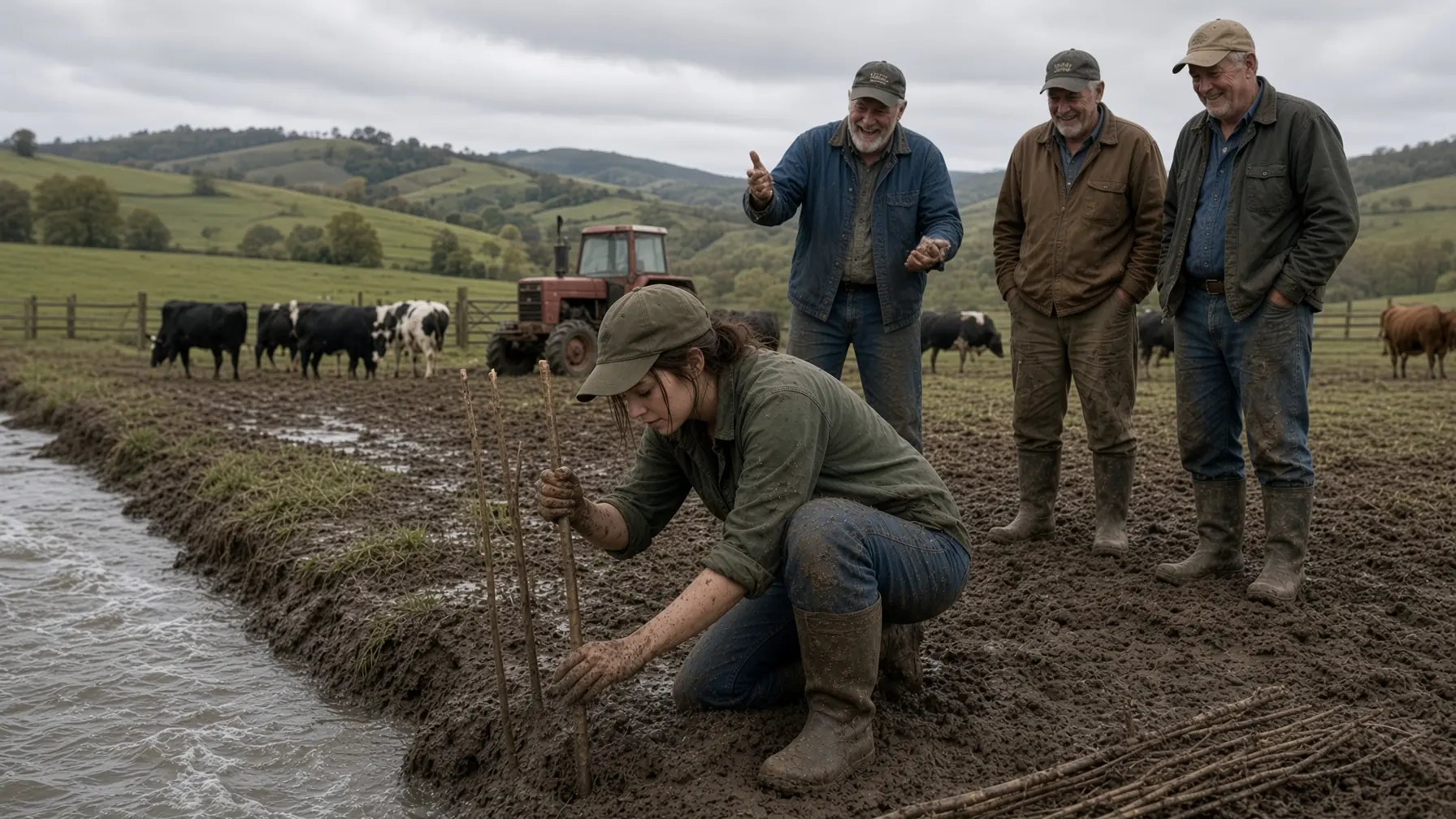
The men beside him laughed.
Fifteen-year-old Emily Cole heard every word, but she did not turn around. She stood ankle-deep in cold March mud along Millstone Creek, holding a three-foot willow cutting in one hand and a steel planting bar in the other. The cutting had no leaves, no visible roots, and nothing about it looked alive. To Curtis and the other farmers watching from the pasture, it was exactly what they called it—a stick.
Emily pushed the planting bar deep into the soft streambank, twisted it to open a narrow hole, then slid the willow cutting down until almost two-thirds of its length disappeared beneath the soil. She pressed the mud firmly around it with her boot and moved three feet downstream.
Earl Bishop laughed again. “How many of those things you planning to stab into the ground?”
“About four hundred.”
That made Curtis nearly choke.
“Four hundred?”
Emily nodded.
Mack Turner leaned against the fence. “Girl, if four hundred sticks could stop Millstone Creek, every farmer in Harmon Valley would’ve done it fifty years ago.”
Emily pushed another cutting into the bank.
“I’m not trying to stop the creek.”
Curtis grinned. “Could’ve fooled me.”
“I’m trying to keep the bank from leaving with it.”
The laughter weakened slightly, but only because nobody was entirely sure what she meant.
Emily’s father, Thomas Cole, stood eighty yards away repairing a gate. He had heard the conversation from the beginning. A year earlier, he might have told Emily to ignore the men or, worse, told the men she was just experimenting. Now he said nothing. He had learned that defending Emily too quickly made people assume she needed defending because her idea was weak.
She did not.
At least, not yet.
What she needed was time.
Harmon Valley lay between two long wooded ridges in southern Missouri, where Millstone Creek twisted through cattle pasture, hay ground, and patches of bottomland before joining the Blackwater River twelve miles downstream. In August, Millstone could shrink until children crossed it on exposed gravel. In spring, it became something else entirely. Rainwater came off the ridges, filled every drainage, and turned the creek brown and restless.
Everyone in the valley considered erosion part of farming.
Banks collapsed.
Fence posts disappeared.
Cattle trails became gullies.
After big storms, farmers simply moved fences farther back.
Thomas Cole had done it.
His father had done it.
His grandfather had done it.
Emily was the first person in the family who asked how much land they were actually moving.
The question began when she was thirteen.
She had been walking Millstone Creek looking for a lost calf when she noticed an old cottonwood root hanging over empty air. Emily remembered sitting on that root as a child. Back then, the tree had stood several feet from the water.
Now half its root system was exposed.
She went home, found a tape measure, two pieces of rebar, and a notebook.
The first measurement showed twenty-three feet four inches from the reference stake to the upper edge of the streambank.
Three months later, after two heavy thunderstorms, it measured twenty-two feet eight inches.
Eight inches gone.
By autumn, the distance was twenty-two feet three inches.
Thirteen inches of pasture had disappeared from that one location in less than a year.
Emily showed her father.
Thomas looked at the notebook, then at his daughter.
“You sure you put the stake in the same place?”
“That’s why I hammered it almost two feet down.”
“You sure you measured straight?”
“I marked the angle.”
He looked again.
Emily had drawn a crude diagram.
Thomas sighed.
“You’ve been doing this instead of homework?”
“I finished my homework.”
“Barn chores?”
“Finished.”
“Chicken water?”
“Yes.”
He seemed disappointed that none of his usual arguments were available.
“What are you trying to prove?”
Emily closed the notebook.
“That we’re losing more ground than you think.”
Thomas glanced toward the creek.
“Streams move.”
“I know.”
“Always have.”
“I know.”
“Then?”
Emily looked at him.
“How much are we willing to lose before we stop calling it normal?”
That question stayed with him.
A week later father and daughter walked nearly a mile of Millstone Creek together. Emily showed him steep bare banks where cattle had repeatedly climbed in and out of the water. She showed him hoof prints punched deep into wet soil, patches where grass had disappeared entirely, and narrow cattle trails that pointed directly downhill toward the creek.
Thomas knew every one of those places.
He simply had never connected them.
“The cows need water,” he said.
“We can give them water somewhere else.”
“With what money?”
Emily had already expected that.
She pulled another sheet from the notebook.
Thomas groaned.
“You made a budget?”
“Sort of.”
“What thirteen-year-old makes a livestock-water budget?”
“One whose father complains about water bills.”
She had priced temporary electric fencing, plastic water line, a used stock tank, and a small solar energizer. It was not cheap. But it was less expensive than Thomas expected, especially if they started with only one section of stream.
Thomas looked at the figures.
“This doesn’t include labor.”
“We are the labor.”
“That is suspiciously convenient.”
Emily smiled.
The next question was what to do with the bank after cattle were removed.
Emily called the county extension office.
She expected a brochure.
Instead, Dr. Laura Bennett answered.
Laura worked in soil conservation and riparian restoration, and she treated Emily’s questions seriously enough that the girl nearly forgot she was talking to an adult.
“First thing,” Laura said during her first visit to the Cole farm, “do not assume planting something fixes everything.”
Emily frowned.
“I thought roots stabilize banks.”
“They can.”
“Then why—”
“Because the stream decides where the energy is. Some bends receive so much direct force that vegetation alone won’t hold them. Some banks are unstable because cattle are destroying the surface. Some are unstable because the channel is naturally migrating. If you treat every problem with the same answer, you’re not restoring anything. You’re decorating mistakes.”
Emily loved that sentence.
Thomas less so.
“Sounds expensive.”
Laura laughed. “The cheapest treatment is usually to stop causing the damage first.”
She pointed toward three cows standing fetlock-deep in Millstone Creek.
“Start there.”
They fenced two hundred fifty yards of creek.
The temporary electric line sat twenty to thirty feet back from the upper bank, depending on the ground. Thomas installed a water tank uphill and ran a line from the farm well. They left one controlled crossing where cattle could move between paddocks without tearing multiple paths into the creek.
Then Emily planted.
Willow stakes were only part of the plan.
Laura showed her how to collect dormant cuttings from healthy native willow growing elsewhere on the property. The cuttings needed to be long enough to reach consistently moist soil. They had to be installed with the correct end up, during dormancy, and deep enough that they would not dry out before roots formed.
Emily also protected existing sedges, grasses, young sycamores, buttonbush, dogwood, and other plants already colonizing the bank.
In several places, she planted nothing.
That confused Curtis Malloy more than the willow stakes.
“You forgot that section.”
“No.”
“There’s nothing there.”
“There are sedges.”
Curtis looked down.
“Those weeds?”
“Yes.”
“You paid somebody at the government office to tell you weeds are useful?”
“No. She gets paid whether I listen or not.”
Earl Bishop laughed.
Curtis did not.
The jokes followed Emily for months.
At Miller Feed & Supply, somebody left a bundle of fireplace kindling beside the register with a note:
EMILY’S FLOOD CONTROL SYSTEM
She took the kindling home and burned it.
At school, two boys began calling her Willow Girl.
One teacher asked her to explain the project during science class. That made things worse for about two weeks.
Emily learned to ignore most of it.
What she could not ignore was failure.
Of the first two hundred twelve willow stakes she planted, fifty-three never leafed out.
Some had been damaged during installation.
Some dried.
Some were pulled loose by deer.
A few disappeared during a spring rise before they developed enough roots.
Emily marked every failure.
Laura returned in May.
Emily showed her the dead stakes.
“Twenty-five percent.”
Laura crouched.
“Sounds plausible.”
“That’s terrible.”
“No.”
“One out of four died.”
“Yes.”
Emily waited.
Laura looked up.
“Did someone promise you one hundred percent survival?”
“No.”
“Then why are you grading yourself against an imaginary number?”
Emily hated how often adults made good points at inconvenient moments.
She replaced some stakes.
Left others.
Watched.
By late summer, the surviving willows had produced shoots two and three feet tall. Their visible growth impressed Emily less than what she imagined beneath the soil.
She had read about adventitious rooting in willows. When dormant stems were placed into wet soil, roots could emerge from buried portions of the stem, spreading through sediment and around stones.
That was the entire idea.
The stick aboveground was almost irrelevant.
The work was happening below.
Curtis could not see it.
Neither could Emily.
That made the first two years difficult.
The fenced creekside strip became taller and rougher while adjacent pasture stayed clipped by cattle. Goldenrod appeared. Sedges thickened. Young trees emerged. Grass grew waist-high in places.
To Curtis, it looked abandoned.
“You’re paying taxes on pasture you refuse to graze.”
Thomas leaned against the fence.
“Twenty feet of it.”
“Twenty feet times a mile adds up.”
Thomas nodded.
“It does.”
“And you’re letting weeds use it.”
Thomas glanced toward Emily.
She was fifteen now, checking willow survival farther downstream.
“Apparently we’re farming roots.”
Curtis laughed.
Thomas did too.
That worried Curtis.
“What?”
“Nothing.”
“You used to think this was stupid.”
“I still think parts of it look stupid.”
“Then why keep doing it?”
Thomas looked toward Millstone Creek.
“Because the bank stopped moving in two of the test sections.”
Curtis’s smile faded.
“Stopped?”
“Slowed.”
That correction came from Emily.
She had walked up behind them.
Thomas nodded.
“Right. Slowed.”
Curtis looked at her.
“How much?”
Emily opened the notebook.
That was when he regretted asking.
At the original measurement site, annual bank retreat had decreased from thirteen inches to roughly four inches after cattle exclusion and vegetation recovery. Another section changed almost none. A third still eroded badly.
Curtis pointed.
“So it didn’t work there.”