"Put those crawfish in that ditch, boy, and you'll lose every acre your family ever fought to keep." The warning traveled across a barbed-wire fence in the dry heat of a Mississippi evening, carried by the voice of a farmer who had spent forty years watching other men fail. Sixteen-year-old Elijah Carter stood knee-deep in brown water with a damp burlap sack against his hip. Beyond him stretched three hundred acres of tired cotton ground, pale and cracked beneath a sky that had not delivered meaningful rain in six weeks. He looked at the sack, at the ditch, and then at the neighbor who had stopped his tractor to witness what he considered a foolishness beyond recovery. "Maybe," Elijah said, and tipped the first crawfish into the water.
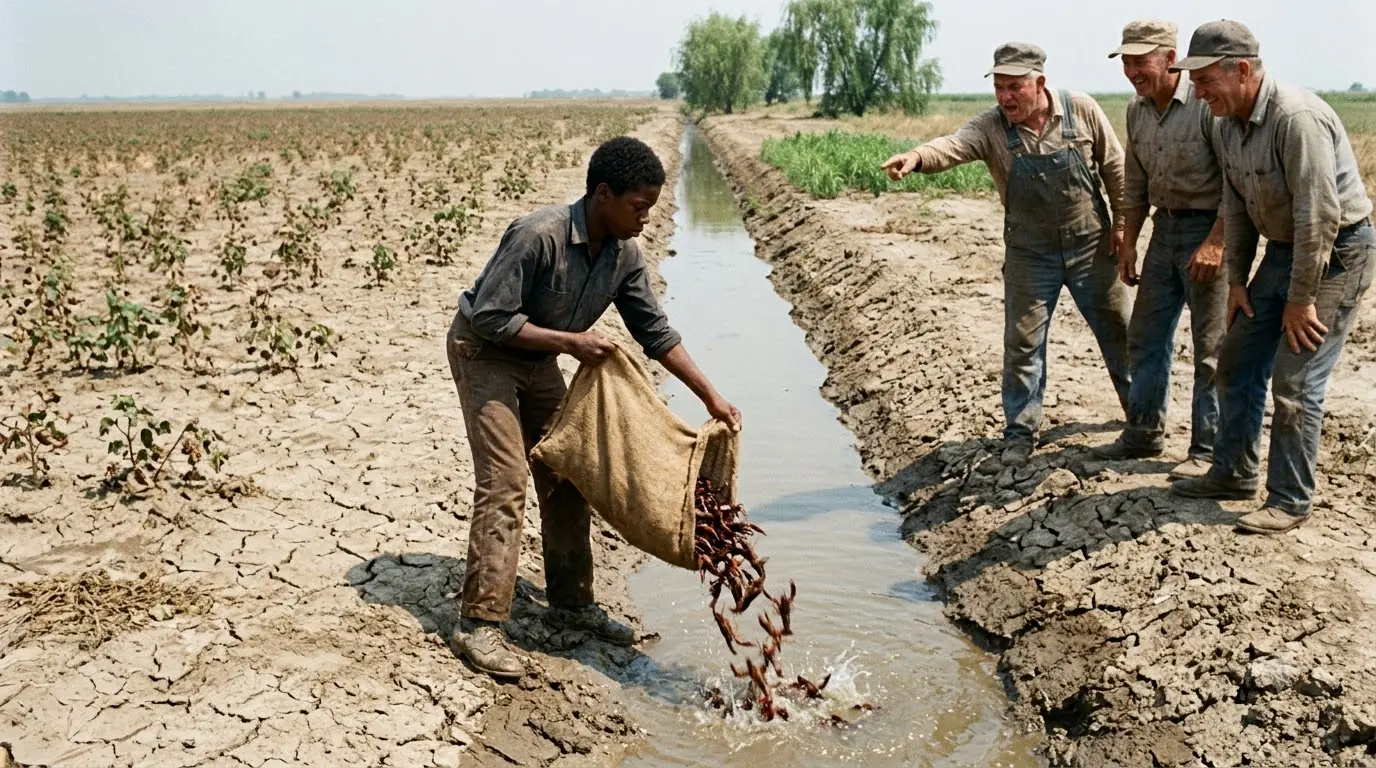
The neighbor, Calvin Sloane, was a broad-shouldered man with a pale scar across his chin and a reputation for paying his bills promptly. He had known Elijah's grandfather since both men were young enough to work from dawn to dark without discussing their backs. Calvin was not trying to be cruel that evening; he believed himself to be the last sensible voice within hearing distance of a grieving child. He had watched the Carter farm diminish for years while the other growers bought stronger fertilizer, larger tractors, and irrigation equipment on seasonal notes. Now the grandson was emptying a sack of living creatures into a drainage channel as though a supper could replace a crop plan. "I'm telling your grandmother what you've done," Calvin said, and drove away before Elijah could answer.
Elijah remained in the water until the last creature vanished beneath the surface. The mud moved around his boots with the slow resistance of something that had not been disturbed in a long time. He collected the emptied sacks and walked to a rusting headgate, where the wooden posts had been repaired so often that little of the original wood remained. That ditch had been cut by his great-grandfather, widened by his grandfather, and nearly abandoned by the time Elijah was old enough to drive the family's worn-out Massey Ferguson. He did not believe crawfish alone could save a farm. What he believed was that the small green corner near the willow trees was trying to tell him something, and he had finally decided to listen.
Three weeks earlier, he had stood beside a grave with his grandmother's hand around his wrist. The minister spoke about faithful labor and the patience of the righteous, but Elijah heard very little after the first shovel of earth struck the casket. His grandfather Nathaniel Carter had been the person who taught him to distinguish rain moving through sycamore leaves from wind moving through a cotton field. Nathaniel knew which county roads flooded first and why a tractor sounded different before a bearing failed. He had raised Elijah since the boy's parents died in a highway accident outside Memphis when Elijah was four. At the funeral, everything the old man had taught him seemed suddenly smaller than everything he had left unfinished.