The courtroom froze when the young man in the oversized gray hoodie walked through the doors.
Richard Sterling noticed him immediately.
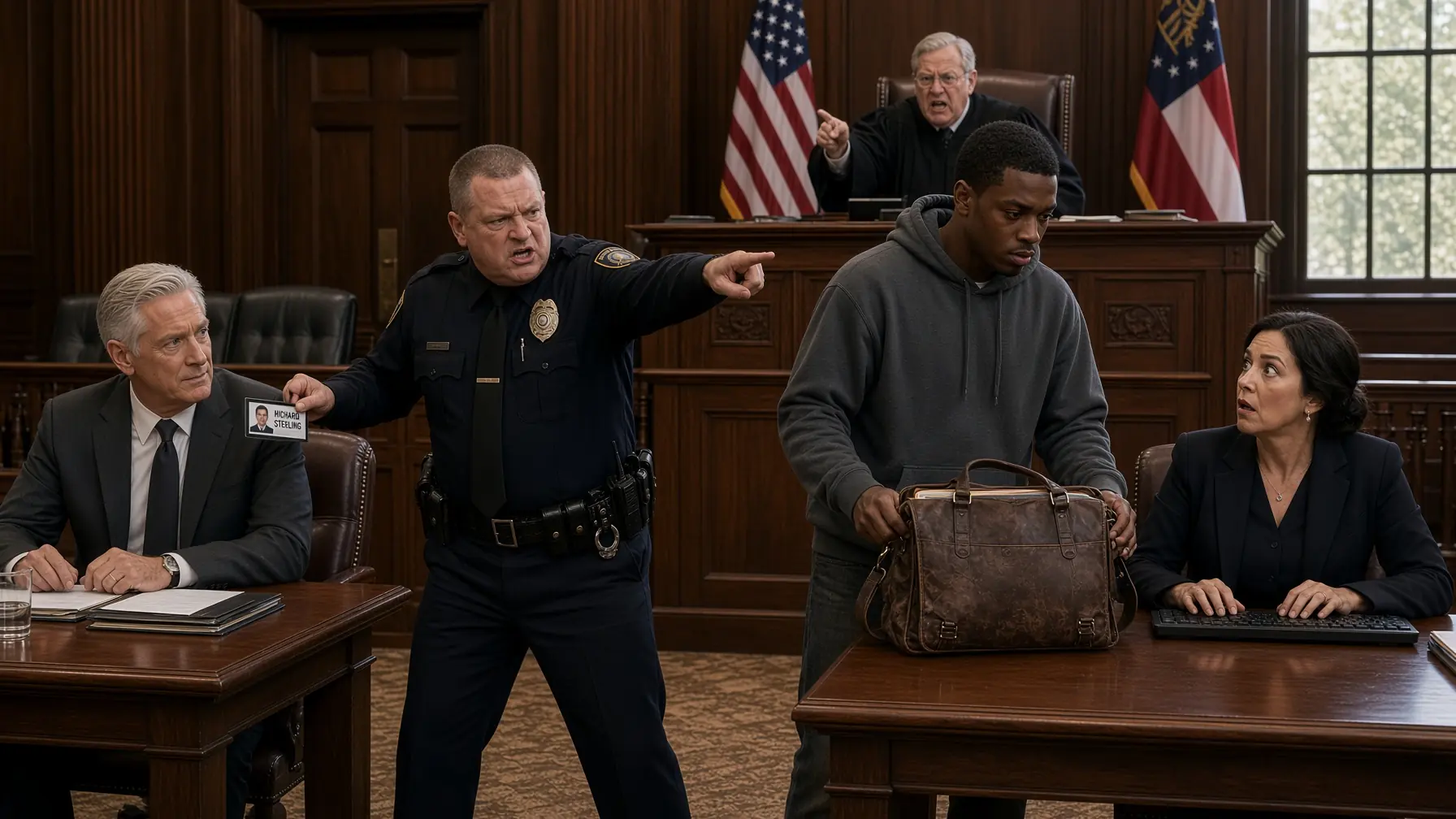
Everybody did.
Courtroom 4B of the Fulton County Superior Court was filled with dark suits, polished shoes, leather portfolios, and the quiet confidence of people who had spent years learning how to look expensive.
The newcomer looked like he had walked into the wrong building.
Faded jeans.
Scuffed Timberland boots.
Charcoal hoodie.
A battered leather satchel hanging from one shoulder.
Richard looked him over once and dismissed him.
Lost defendant.
Courier.
Maybe some relative of the old woman they were evicting.
Certainly not anyone who belonged at counsel table.
The bailiff stepped into the aisle.
“Wrong courtroom, son. Criminal arraignments are downstairs.”
The young man stopped.
Slowly pulled his hands from the hoodie pockets.
No weapon.
Only a thick rubber-banded stack of files.
“I’m not here for arraignment.”
Judge Frederick Halloway looked up from the bench.
He was already irritated.
The hearing had been moved to eight that morning after Richard’s firm filed an emergency request the previous afternoon, and Halloway clearly wanted the matter finished before lunch.
“Young man,” the judge said sharply, “remove the hood and tell me why you’re interrupting this court.”
The stranger pulled it down.
Short black hair.
Tired eyes.
Maybe twenty-six.
Twenty-seven at most.
“I apologize for the clothes, Your Honor.”
He moved around the bailiff and placed the satchel on the empty defense table.
“My suit is still at the cleaners. I wasn’t expecting opposing counsel to move the hearing forward two hours on less than a day’s notice.”
Richard laughed.
Actually laughed.
“Excuse me?”
The young man turned.
His posture changed.
Not dramatically.
Just enough.
Shoulders straight.
Chin level.
Voice steady.
“My name is Julian Banks.”
He rested one hand on the defense table.
“I represent Lucille Banks.”
Silence.
Richard Sterling’s smile widened.
“The defendant’s grandson?”
“Yes.”
“And you’re representing her?”
“Yes.”
Richard glanced toward the gallery.
A few junior associates from his firm were already smiling.
“Your Honor, surely we’re not going to entertain this.”
Judge Halloway leaned forward.
“Mr. Banks, are you a licensed attorney?”
Julian reached into his satchel.
“Georgia Bar number 99401.”
The clerk typed.
Waited.
Then looked at the judge.
“Active. Good standing.”
The laughter stopped.
Richard stared at Julian again.
This time more carefully.
Still young.
Still dressed like he should be carrying boxes instead of motions.
But something in his eyes bothered Richard now.
There was no embarrassment.
No nervousness.
No eagerness to prove himself.
Just patience.
Judge Halloway frowned.
“Passing the bar does not excuse appearing before this court dressed like that.”
Julian nodded.
“I understand.”
“Then explain it.”
“The plaintiff filed an emergency motion at 4:52 yesterday afternoon asking that this hearing be moved from ten o’clock to eight. I received notice shortly after five.”
He glanced toward Richard.
“If the court prefers, I’m happy to request a continuance until I can dress appropriately.”
Richard’s face tightened.
He needed the hearing today.
The entire development schedule depended on clearing Lucille Banks’s property before the end of the month.
Judge Halloway knew it too.
“Continuance denied.”
Julian nodded once.
“Then I’m ready.”
He sat.
Richard walked to the podium.
Now he wanted to embarrass him.
Quickly.
Decisively.
The case was supposed to be easy.
Apex Horizon Development Group had acquired almost every property on one historic West End block for a luxury condominium project.
Almost every property.
Lucille Banks, eighty years old, had refused every offer.
She lived in a narrow Victorian house that had belonged to her husband’s family for generations.
The developers called it deteriorated.
Lucille called it home.
Apex’s lawyers claimed the title history revealed that the Banks family had lost valid ownership decades earlier through an old municipal transfer.
According to their filing, the city had reclaimed the parcel and lawfully sold it to Apex.
Lucille, therefore, was not a homeowner.
She was an occupant without title.
Richard intended to have her removed.
“Your Honor,” he began, “there is very little to dispute here.”
He lifted a bound title report.
“The plaintiff has established a break in the defendant’s chain of title. The city obtained ownership and subsequently conveyed the parcel to Apex Horizon.”
He turned slightly toward Julian.
“Despite several opportunities, the defendant has not filed competent evidence contradicting the recorded transfer.”
Julian remained still.
Richard continued.
“In fact, I see no affidavit in opposition to summary judgment.”
Judge Halloway looked toward the clerk.
She checked the electronic file.
Then shook her head.
The judge looked at Julian.
“Mr. Banks?”
“I did not file one.”
Richard smiled.
There it was.
The rookie mistake.
“Then the material facts are effectively undisputed.”
Judge Halloway reached for his pen.
“Mr. Sterling, prepare—”
“Before the court rules,” Julian said quietly, “I need to address the document on which the plaintiff’s entire title theory depends.”
Halloway looked annoyed.
“You just admitted you filed no counter-affidavit.”
“I said I filed no counter-affidavit.”
Julian stood.
“I did not say the plaintiff’s deed was valid.”
Richard rolled his eyes.
“Your Honor—”
Julian lifted one document from his stack.
“The deed conveying this property from the city to Apex Horizon was executed two months ago by a supposed deputy land registrar named Marcus Thorne.”
Richard’s smile faded slightly.
Julian continued.
“There is no Marcus Thorne employed by the City of Atlanta land records office.”
Richard frowned.
“What?”
Julian walked toward the clerk.
“I have a certified employment verification from the city clerk, along with an affidavit from the current land records director.”
The clerk accepted the papers.
Richard stood.
“Objection. We have not had an opportunity to authenticate—”
“You filed the deed,” Julian said.
Richard turned toward him.
Julian’s voice stayed calm.
“I’m asking you to identify the public official who supposedly signed it.”
Richard looked toward the associate beside him.
Sarah had already opened her laptop.
Her fingers moved quickly.
Julian continued.
“The employee number beneath the signature belongs to a woman who retired four years ago.”
Judge Halloway stopped writing.
Richard’s stomach tightened.
Julian placed another document on the clerk’s desk.
“The notarization is also defective. The notary listed on the deed surrendered his commission eighteen months before the supposed execution date.”
Now the courtroom was silent.
Richard walked toward Julian.
“Are you accusing my client of forgery?”
“I’m saying the deed you relied on cannot presently be authenticated as a lawful conveyance.”
Richard gave a short laugh.
“Semantics.”
“No.”
Julian looked directly at him.
“That’s title.”
Judge Halloway removed his glasses.
“Mr. Sterling.”