By the time Willow Ridge stopped laughing at Eleanor Ashcroft’s sunflower wall, her cabin had disappeared beneath the snow. From Gideon Mercer’s ridge a quarter mile away, there was no roof, no porch, no eastern window, and no sign of the small woodpile Eleanor and her daughter had spent all autumn stacking beneath a lean-to. There was only a monstrous white drift curled against the hillside where the Ashcroft cabin should have been, with the upper end of the stone chimney occasionally appearing through blowing snow before vanishing again. Inside that buried house, Eleanor suddenly pressed one trembling palm against the eastern wall and realized the logs felt nothing like they were supposed to feel.
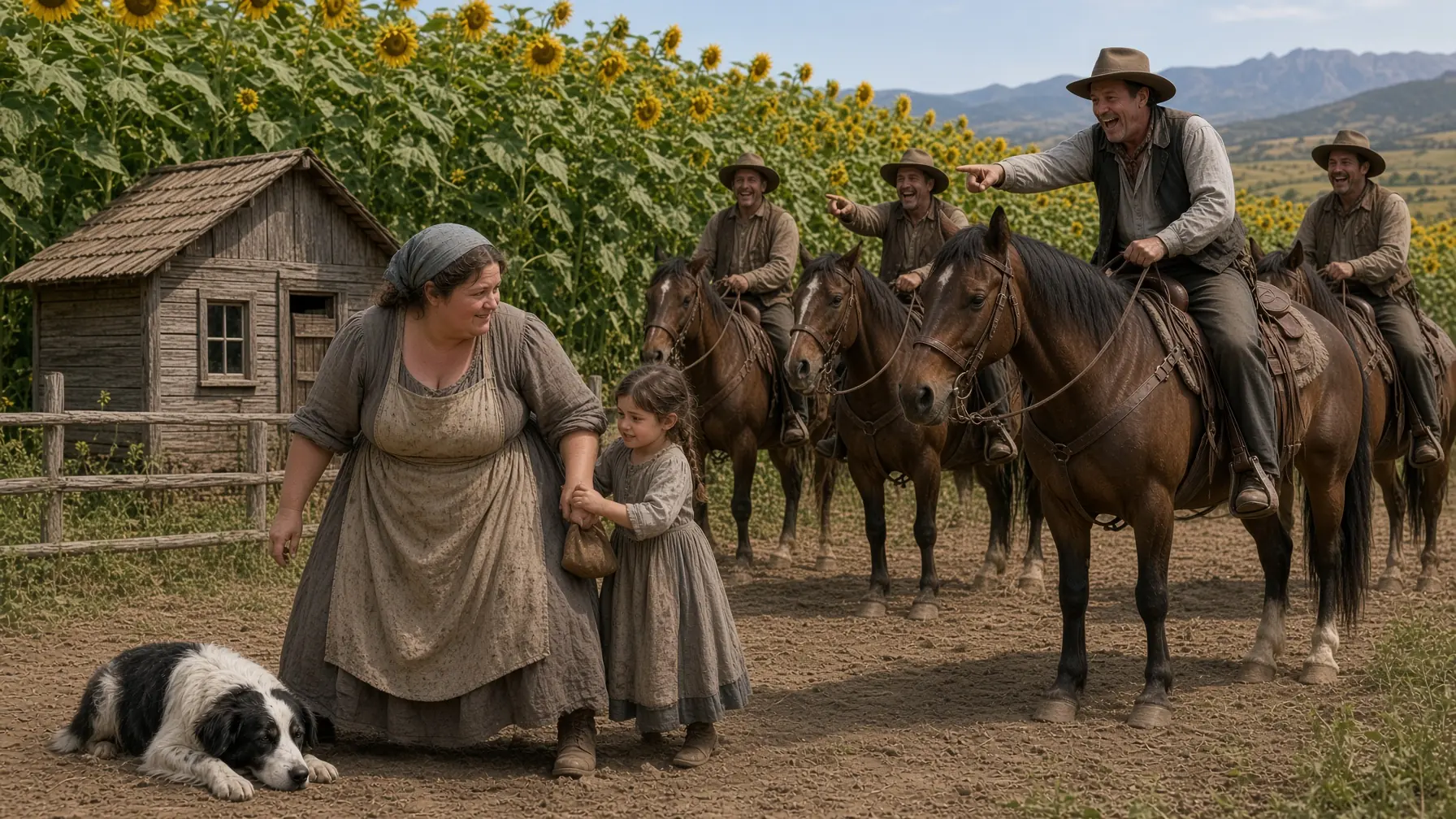
Eight-year-old Rosalie sat beneath three quilts near the stove, hugging her knees while the wind screamed somewhere beyond the walls. Their aging sheepdog Bruno had been asleep beside her until a few moments earlier, but now the black-and-white dog stood rigid with his ears forward, staring toward the eastern wall as if someone were moving outside. Eleanor crossed the room, expecting to feel freezing air leaking between the logs or perhaps moisture pushing through the chinking as the snow packed tighter around the cabin. Instead she touched the wood, frowned, and moved her palm slowly across three logs.
“Rosalie,” she whispered.
Her daughter looked up. “What?”
Eleanor did not answer immediately. She pressed harder, then touched the wall beside the window frame, where frost normally formed first whenever winter wind struck the house hard enough.
There was no frost.
Months earlier, that would have meant nothing to anyone in Willow Ridge except Eleanor Ashcroft.
In April of 1884, the people of Willow Ridge had been far more interested in deciding whether grief had damaged the young widow’s judgment. Eleanor was thirty-four, her husband Thomas had been dead barely five months, and nearly everyone who came to “check on her” seemed to arrive with advice about what she should sell, abandon, lease, or stop attempting by herself. Thomas had died after pneumonia followed a late-autumn accident in which his horse threw him into an icy creek, leaving Eleanor with a weathered cabin, twenty-eight acres of rough Montana Territory ground, two milk cows, six hens, an aging sheepdog, an eight-year-old daughter, and approximately enough cash to survive one bad decision.
Eleanor discovered quickly that widowhood changed the way people explained her own property to her. Men who had once asked Thomas before crossing a pasture now walked through Eleanor’s gate and told her which fence posts needed replacing, which cow should be sold, and how impossible it would be for a woman with a child to keep the Ashcroft place through another serious winter. Carpenter Abraham Holt suggested she sell before the cabin “became more house than she could manage,” while trader Silas Dean offered to buy the eastern acreage for a price Eleanor knew was insulting even before she checked Thomas’s old records. Gideon Mercer, who lived closest, was kinder than most, but even Gideon occasionally spoke with the careful patience people use when they have already decided the person listening needs protection from herself.
Eleanor rejected every offer. She repaired the chicken enclosure, hired a teenager for one afternoon to help replace three fence posts she could not safely lift alone, and traded eggs for enough seed to enlarge the kitchen garden. Then she did the thing that convinced half the settlement she had finally surrendered to grief.
She planted sunflowers.
Not six beside the doorway. Not a cheerful strip near the garden.
Hundreds.
Eleanor started before the last patches of snow had completely disappeared from the northern side of the cabin. She drove small stakes into the ground, tied string between them, and marked wide lines that circled the house at varying distances, with the thickest planting on the northwestern and western sides. Rosalie followed carrying a cloth bag of seeds, dropping them into shallow holes while Bruno investigated every third one and received increasingly stern instructions to stop assisting.
“What are we making?” Rosalie asked on the second morning.
“A wall.”
The girl looked at the empty soil. “Out of flowers?”
“Yes.”
Rosalie considered that with the serious expression children reserve for adult ideas they have not yet decided to trust. “Why?”
Eleanor pressed soil over another seed. “Because wood costs money.”
That answer did not explain anything, but Rosalie had inherited her mother’s patience and continued planting.
The first neighbor to ask directly was Gideon Mercer. He stopped his horse beside the fence in May, removed his hat, and stared at the rows of young sunflower plants emerging around the cabin. Gideon was forty-seven, broad-shouldered, recently remarried, and considered reliable enough that people frequently asked him to settle disputes involving livestock, water, or property lines.
“You starting a seed business?” he asked.
“No.”
“Feed?”
“Some.”
Gideon pointed toward the ring surrounding the cabin. “That’s more sunflowers than three families could feed chickens.”
Eleanor smiled. “Then I suppose the chickens will be disappointed.”
Gideon studied her. “Eleanor, what are you doing?”
She brushed soil from her skirt. “Preparing for winter.”
His eyes moved from her face to the seedlings.
“With flowers.”
“With what grows.”
Gideon almost laughed. He managed not to.
That courtesy lasted until the story reached the trading post.
By June, Willow Ridge had acquired a new nickname for Eleanor. Men began referring to her as the Sunflower Widow, sometimes affectionately and sometimes not, though nobody seemed concerned whether Eleanor wanted a nickname at all. One ranch hand suggested Thomas must have left instructions to turn the cabin into a churchyard, while another wondered aloud whether Eleanor planned to convince January to become summer by surrounding herself with enough yellow petals.
Abraham Holt was less playful. He stopped beside Eleanor’s fence one afternoon and watched her place additional stakes among the growing stalks.
“You know those won’t stop weather.”
Eleanor tied another strip of cloth.
“I know.”
“Might stop a rabbit if the rabbit’s polite.”
“I’m not building a fence.”
Abraham frowned. “Gideon says you told him it’s a wall.”
“Gideon talks too much.”
Abraham looked toward the cabin. “If you’re worried about winter, I can add another layer of boards along the north side.”
“How much?”
He named a figure.
Eleanor almost smiled. “Then the sunflowers are cheaper.”
“You’ll spend more fixing what they damage.”
“What damage?”
“Moisture. Rot. Mice. Insects.”
Eleanor nodded. “Those are things worth watching.”
Abraham seemed irritated that she had not argued. “I’m trying to help you.”
“I know.”
“Then listen.”
Eleanor looked directly at him. “Listening and obeying are different things, Abraham.”
He rode away convinced grief had made her stubborn.
In reality, the idea had begun before Thomas died.
His grandfather, Caleb Ashcroft, had settled farther east decades earlier and possessed the kind of practical knowledge that rarely appeared in books because men passed it through stories until somebody forgot to repeat one. Caleb had built cattle windbreaks from woven willow, stacked cornstalks against drafty barns, banked houses with earth before hard freezes, and understood that winter did not need to enter a building through an open door if it could steal heat through every surface instead.
Thomas repeated one of Caleb’s sayings often enough that Eleanor remembered it nearly word for word.
The cold always hunts for the weakest wall. Give it something else to fight first.
For most of their marriage, Eleanor had interpreted it as another old farmer’s proverb.
Then Thomas died.
That winter, every practical weakness of the cabin became impossible to ignore because Eleanor was suddenly the person splitting firewood, measuring the pile, carrying ash, sealing drafts, waking before dawn to revive the stove, and deciding whether one more log belonged in the fire now or might matter more in February. She discovered that the western wall grew painfully cold whenever the wind came down from the mountains, that frost gathered first around two windows, and that one corner of Rosalie’s room remained colder than the rest even after Abraham re-chinked the logs.
Most people responded to cold by burning more wood.
Eleanor had wood.
What she lacked was enough certainty that the pile would last through a severe winter.
So she began measuring.
Thomas had owned a small wall thermometer with a cracked brass frame, and Eleanor moved it around the cabin during the winter after his death. She recorded temperatures in an old leather notebook, along with wind direction, number of stove logs burned, whether frost appeared inside, and how quickly each room lost warmth after the fire dropped.
Nobody knew she was doing that.
Nobody would have cared.
By spring, Eleanor knew exactly which walls consumed the most firewood.
The sunflowers were an experiment.
Summer made them difficult to ignore.
By July, the largest plants towered above Rosalie and reached past the lower edge of the cabin roof. Thick green stalks formed irregular rows around the house, leaves broad enough to shade the ground beneath them, while hundreds of golden heads turned slowly through the day.
The Ashcroft cabin almost disappeared inside them.
Children loved it.
Adults found it ridiculous.
One Sunday afternoon several families returning from church stopped their wagons on the road because Rosalie had created a narrow path through the sunflowers and was leading three children inside what she called “the golden fort.” Eleanor heard laughter from the road, saw Abraham Holt pointing toward the cabin, and returned to tying one bent stalk against a support.
Gideon Mercer visited again.
This time he dismounted.
“I’ll admit they’re impressive.”
Eleanor looked up.
“You thought they wouldn’t grow?”
“I thought half would.”
“More did.”
“What are they protecting the house from right now?”
“Wind.”
Gideon glanced at leaves moving in the afternoon breeze.
“That’s not winter wind.”
“No.”
“Then how does this tell you anything?”
Eleanor pointed toward several strips of faded cloth tied to stakes at different heights. Some moved violently.
Others barely stirred.
Gideon followed the pattern.
“You’re measuring it.”
“Watching it.”
“Same thing?”
“Sometimes.”
Eleanor had discovered that the thickest rows changed how wind reached the cabin. Dust behaved differently near the western wall, laundry hung closer to the sunflowers moved less, and summer thunderstorms pushed hard against the outside rows while the ground nearest the house remained surprisingly calm.
That did not prove anything about winter.
She knew that.
It only gave her a reason to keep going.
“You really think flowers are going to save firewood?”
Gideon asked it gently.
Eleanor looked toward the cabin. “I think still air costs nothing.”
That answer followed Gideon back to the trading post.
By evening it had become, “Eleanor Ashcroft says she’s storing air for winter.”
The laughter lasted a week.
Eleanor planted a second, shorter row.
By August, the sunflowers began producing enough seed to attract birds. Rosalie spent mornings chasing blackbirds until Eleanor explained that a few stolen seeds were cheaper than losing an entire afternoon to war.
They harvested carefully.
Some heads became chicken feed.
Some were dried for food.
Several hundred of the strongest seeds went into labeled jars for the following spring.
The stalks remained.
That was when Eleanor’s strange project became stranger.
She cut the first mature stalks close to the ground and laid them beneath the shed roof to dry. The thickest were nearly as wide as Rosalie’s wrist, light for their size once dry, with pale pith running through the center.
Eleanor split several lengthwise.
She pressed the pith between her fingers.
Then added another note to the leather journal.
In September she built shallow wooden frames along the cabin’s most exposed walls, using scrap rails and boards Thomas had saved. The frames stood a handspan away from the logs and several inches above the ground so air and moisture could move beneath them.
Into those frames Eleanor stacked dried sunflower stalks.
Horizontal.
Then vertical.
Then another crossing layer.
She tied the bundles with twine and packed smaller pieces into obvious gaps without blocking the windows, door, or anything near the chimney.
Abraham Holt nearly lost patience when he saw it.
“You’re wrapping your house in kindling.”
“Not near the stove.”
“Fire travels.”
“I know.”