Nobody in Holden County paid much attention the first few times Ruth Alderman appeared at a farm auction in Walt’s old pickup truck and bought whatever everyone else had already decided was worthless. She was sixty-eight, recently widowed, small enough that some of the heavier auction pieces looked almost ridiculous beside her, and she always carried cash folded inside an old leather wallet rather than a checkbook. Broken plows, bent hay rakes, rusted cultivators, hand-crank shellers, cracked wooden presses, and tools so old younger farmers could not even name them somehow ended up in the bed of her truck. The men at those sales usually watched her leave with the quiet amusement people reserved for someone they believed grief had made a little strange.
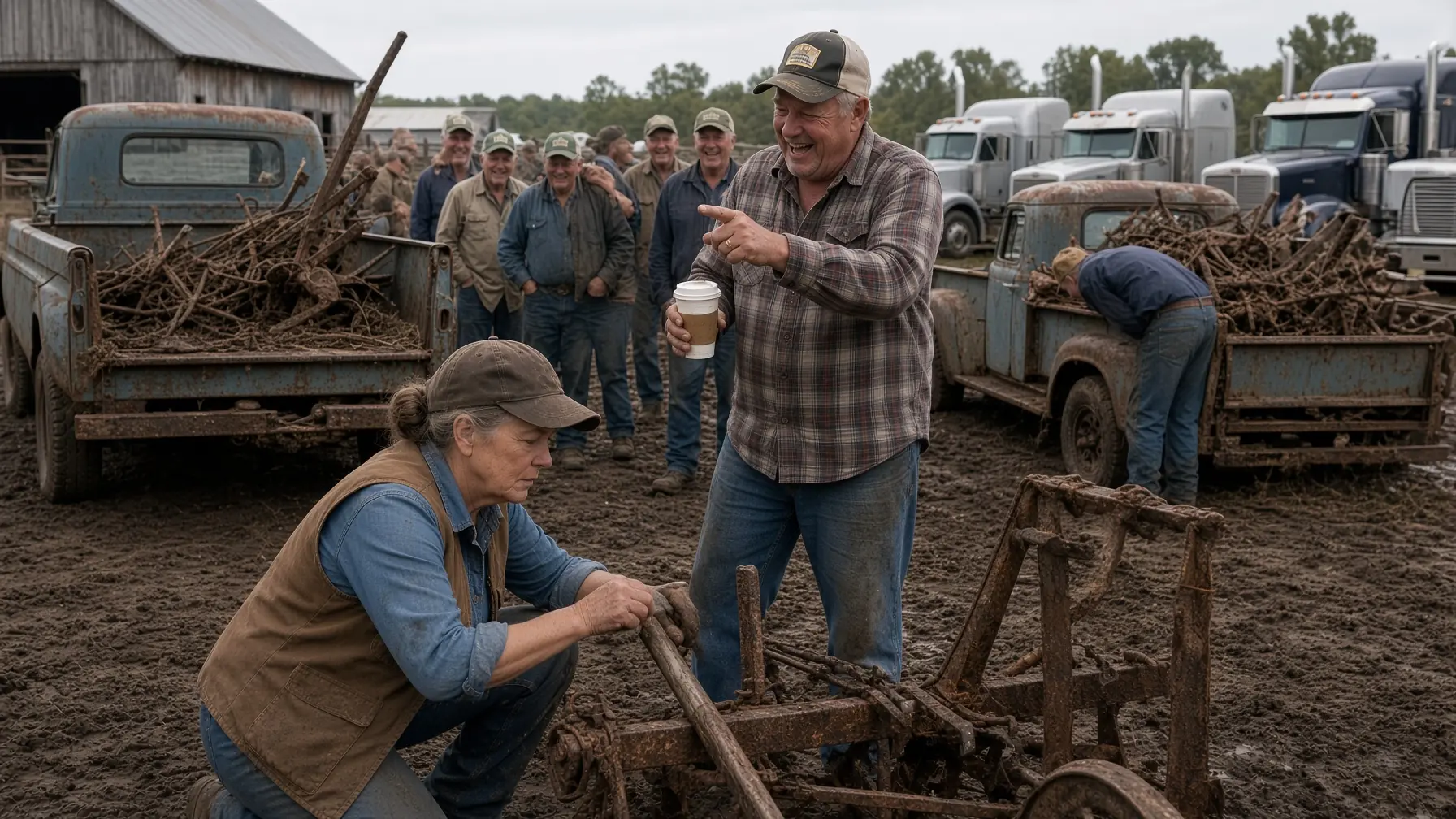
Del Osgood was less quiet about it. He had farmed in Holden County for forty-one years, owned more than eight hundred acres at his peak, and believed four decades of surviving weather and markets had earned him the right to diagnose almost anything within sight. At the Rutledge dispersal sale one April morning, Del watched Ruth pay eighteen dollars for a rusted horse-drawn cultivator with one rotten handle and leaned toward the men beside him. “Woman’s filling Walt’s barn with junk because she doesn’t know what else to do with herself,” he said.
A few people laughed. Ruth heard him. She tightened the chain around the cultivator and continued loading it.
Del walked closer. “Ruth, you know they make tractors now.”
She looked over the side of the pickup. “I’ve heard rumors.”
That got another laugh. Del smiled as if Ruth had joined the joke.
“You planning to farm with that thing?” He pointed toward the cultivator. Ruth looked at it.
“Planning to take it home.”
“That wasn’t what I asked.”
Ruth closed the tailgate. “Then I suppose you’ll have to live with the disappointment.”
She climbed into Walt’s truck and drove away. The laughter followed her onto the county road.
Three years earlier, nobody would have spoken to Ruth that way. Not because she was intimidating, but because Walt Alderman would have been standing beside her, and there were men in Holden County who respected a widow only after first respecting her husband.
Walt had farmed beside Ruth for forty-three years. They owned 110 acres, ran a small herd of Dexter cattle, grew hay, kept an enormous garden, and made enough from a combination of farming, repair work, eggs, and stubborn frugality to live without ever becoming impressive on paper.
Then Walt developed heart trouble. Six weeks after the diagnosis, Ruth was sitting beside a hospital bed holding the hand of a man who had expected to work until eighty.
Three weeks after the funeral, someone asked when she planned to sell the farm. Ruth said she did not.
Two months later, another neighbor asked whether she wanted help finding somebody to lease the fields. Ruth said she did not.
By spring, people had started speaking about Ruth’s property in the future tense as though she had already left it. That was when the auction purchases began.
The first was a walking plow a neighbor had planned to throw into a scrap pile. Ruth brought it home, placed it inside the old dairy barn, and spent two evenings cleaning rust from the steel share.
She replaced one bolt. Sanded the handles. Rubbed linseed oil into wood that had not been touched carefully in decades.
When she finished, she stood inside the quiet barn holding handles polished smooth by somebody else’s hands long before she was born. It was the first evening since Walt died that she had worked for three hours without checking the clock.
The following month she bought an old grain cradle for six dollars. Then a broken cider press.
Then a sorghum mill missing part of its gearing. Then two drawknives, an auger, several hoes, and a hand-crank corn sheller whose gears were frozen with rust.
She never told anyone why. At first, Ruth herself might not have been able to explain it.
She only knew she hated seeing tools thrown into scrap trailers because nobody remembered how they worked. She hated estate-sale tables where fifty years of somebody’s knowledge could be purchased for less than a restaurant dinner.
Most of all, she hated hearing people call old things useless simply because newer things were faster. Walt had never thought that way.
“New is useful,” he used to say. “Old is useful too, if you remember what problem it was built to solve.”
Ruth remembered. So she kept buying.
By the second year, people noticed. Her truck appeared at almost every estate auction within forty miles.
The pattern became entertaining. If something had a motor, good hydraulics, fresh paint, or enough horsepower to attract serious farmers, Ruth usually ignored it.
If auctioneers could not get a bid, she became interested.
“Here comes Ruth,” somebody would say when an old piece was dragged forward. “She’ll buy it.”
Sometimes she did. Sometimes she did not.
That distinction confused Del Osgood. He believed Ruth was collecting randomly until one auction when he watched her reject a decorative antique plow in nearly perfect condition, then pay thirty-five dollars for a much uglier one missing a wheel.
He walked over afterward. “Now explain that to me.”
Ruth counted bills. “Explain what?”
“That pretty one was worth more.” Ruth handed money to the clerk.
“To decorate a restaurant, maybe.”
Del pointed toward the broken plow she had purchased. “And that one?”
Ruth shrugged. “That one can work.”
Del laughed. “Not like that.”
“No.” Ruth looked at him.
“Not like that.”
She went home.
What happened inside the dairy barn remained largely invisible. Ruth kept the doors closed most evenings because winter wind came hard across the north pasture, and no one had much reason to visit.
She learned slowly. Library books came home with her.
So did photocopies from old agricultural manuals. A county historical society located extension pamphlets printed before Ruth was born.
She called men and women in their eighties when she needed to understand a tool nobody else could identify. Occasionally one drove to the farm and showed her something their father had taught them seventy years earlier.
Ruth listened. She took notes.
She did not consider herself preserving history. That sounded too grand.
She simply did not want to be the person who watched something disappear because saving it required effort.
The county interpretation remained less generous. Walt had died.
Ruth was lonely. Ruth collected junk.
Grief did strange things. Best leave her alone.
Del repeated that story more often than most. It allowed him to feel sympathetic while still feeling superior.
At one estate sale, Ruth bid twelve dollars on a hand-crank seed cleaner. Del called across the crowd, “Ruth, if you keep buying all this, someday we’re going to have to hold an auction just to sell your auction junk.”
Several men laughed. Ruth did too.
“Then you’d better save your twelve dollars.”
Del raised his coffee cup. “I’ll wait until it’s scrap price.”
Ruth loaded the cleaner and left.
By the third year, almost nobody asked questions. Her behavior had become part of the county’s scenery.
Then the drought came.
It did not arrive as one terrible season. Holden County had endured dry years before.
This one built gradually. Spring rains came late, then disappeared early.
Pastures that normally stayed green into July turned pale by June. Creeks narrowed.
Ponds pulled away from their banks. Hay yields dropped.
People began feeding stored hay weeks before they normally would.
Then the next year was worse. Seed went into dry ground.
Cattlemen started culling. Hay prices climbed.
Diesel rose with almost everything else, while interest rates turned equipment loans that once seemed manageable into monthly reminders of how little room existed between modern efficiency and modern debt.
Ruth suffered too. Her farm was not protected by nostalgia.
She sold six cows because her pasture could not support them. Her lower garden struggled.
The pond dropped almost three feet. One hay cutting failed badly enough that Ruth bought bales from forty miles away.
People noticed only that she kept attending auctions. Even during drought, perhaps especially during drought, farms failed or downsized.
More equipment appeared for sale. Ruth kept buying the things nobody wanted.
That offended Del in a way he could not fully explain. His own operation was under pressure, and watching a widow spend money on obsolete equipment felt irresponsible.
He confronted her after a September auction. Ruth had just purchased an old seed drill built for horse or mule traction.
“You know what your problem is?” Del asked.
Ruth tied the drill to her trailer. “I suspect you’re going to tell me.”
“You’re living backward.”
She stopped. Del pointed toward the machinery.
“This stuff belongs in museums.”
“Maybe.”
“Farming moved on.”
Ruth looked at him. “From what?”
Del frowned. “From all this.”
He gestured toward the drill. “Nobody can make a living with hand tools and mule equipment anymore.”
Ruth tightened the strap. “Did I say they could?”
“You don’t have to.”
Del lowered his voice, almost trying to sound kind. “Walt’s gone, Ruth. You don’t have to keep the farm looking like it did when your daddy was alive.”
That landed differently. Ruth became very still.
“My father died thirty-two years ago.”
“I know.”
“And Walt died three years ago.”
“I know that too.”
“Then perhaps stop explaining my life to me like I wasn’t present for either one.”
Del opened his mouth. Ruth climbed into the pickup before he could answer.
That winter nearly broke him.
Del’s acreage was much larger than Ruth’s and his equipment much newer. That had always been his advantage.
Now it was also the problem.
A combine payment came due after a year when yields collapsed. His operating note had grown.
Diesel, fertilizer, chemicals, seed, parts, and interest were all costs that existed before Del harvested one profitable bushel.
He had always believed scale protected farmers. For decades, it had.
Then two bad years arrived together.
By March, Del had begun negotiating with his lender. By May, negotiation became surrender.
The equipment dealer collected his combine on a gray Thursday morning.
Del stood beside the machine while another man climbed into the cab. He had owned it six years.
It left his farm on a trailer.
His daughter Emily found him sitting alone in the machine shed afterward. She asked whether he wanted coffee.
Del said no.
She sat anyway. “Dad, you’re going to have to change something.”
“I know.”
“Maybe lease out the west ground.”
“No.”
“Sell more cattle.”
“I already did.”
Emily hesitated. “What about Ruth?”
Del looked at her. “What about Ruth?”
“She’s helping people.”
He laughed once. “Doing what?”
“Showing them things.”
“What things?”
Emily had heard about it from a young couple named Jesse and Anna Wade who rented twelve acres outside the county seat. They could not afford a tractor, so Ruth had apparently helped them repair several old implements and showed them methods for cultivating a large garden, saving seed, and managing small plots without expensive machinery.
Del shook his head. “That’s gardening.”
“Maybe.”
“I farm eight hundred acres.”
“Seven hundred and twelve now.”