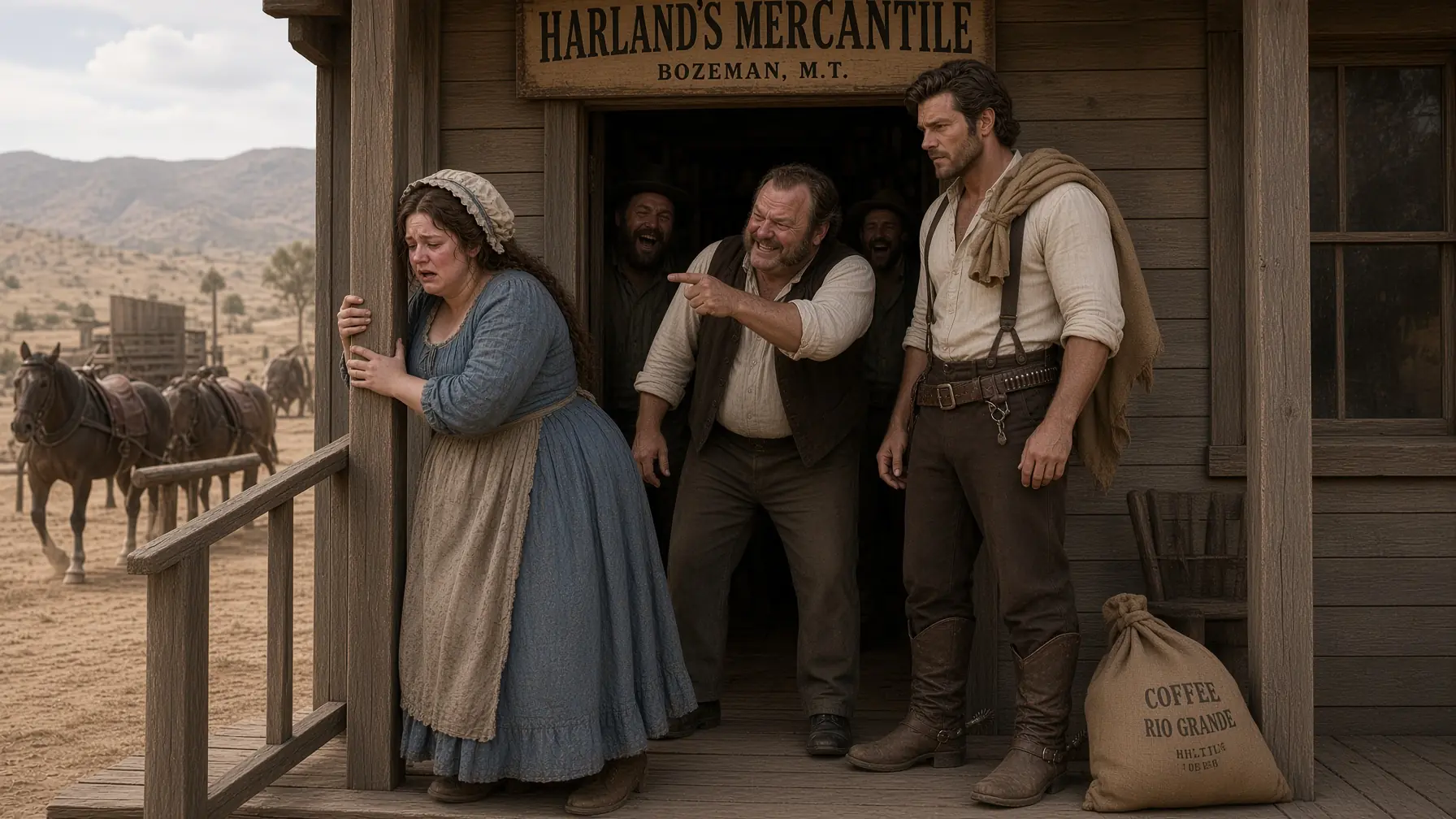
The morning Martha Higgins finally walked into Harland’s Mercantile, she had not eaten a proper meal in four days. Bozeman shimmered beneath the August heat of 1883, dust lifting from wagon wheels and settling over porch rails, hitching posts, boots, and the hems of dresses as though the whole town had been powdered with ash. Martha stood outside the store gripping a support post because black spots were drifting across her vision and her knees had begun trembling whenever she remained upright too long. She was thirty-nine years old, recently widowed, homeless except for a hayloft above the livery stable, and frightened that if she sat down on the boardwalk she might not possess enough strength to stand again.
Only three months earlier, her life had been small but respectable. She and her husband Arthur rented a two-room house near the eastern edge of town, kept a vegetable patch behind the kitchen, owned two chairs that matched, and had almost eighty dollars in a savings account Arthur joked was their retirement fortune. Arthur worked underground at the Silver Crown Mine, where wages were good enough to keep them comfortable if nothing went wrong and dangerous enough that Martha prayed every morning before he left. Then one Tuesday in May, something went wrong.
A support section failed deep in the western shaft shortly after noon. Timber cracked under shifting rock, part of the tunnel collapsed, and seven men were trapped before the warning bell had finished ringing. Four were eventually pulled out alive, two died before rescuers reached them, and Arthur Higgins was found beneath enough stone that the mine superintendent advised Martha not to look at his body. She ignored him and looked anyway because Arthur had never been afraid of seeing difficult things clearly, and she believed he deserved the same courage from her.
Arthur’s younger brother Samuel arrived before the funeral. He was twenty-nine, handsome in the loose easy way that had carried him through card games, unpaid boardinghouse bills, failed business schemes, and more second chances than Martha believed any man ought to receive. Samuel hugged her, cried convincingly beside Arthur’s coffin, and spent the evening telling anyone who listened that he would make certain his brother’s widow was protected. Three days later he asked Martha where Arthur kept the bankbook.
She did not understand the question at first. Samuel explained that Arthur owed him money, not a little money but nearly all the savings Martha believed belonged to her, because according to Samuel his brother had secretly borrowed against several gambling debts. Martha laughed because Arthur hated cards and considered poker a reliable method for transferring wages from foolish men to patient ones. Samuel produced three handwritten notes carrying what appeared to be Arthur’s signature.
Martha read them twice. The handwriting resembled her husband’s, though several letters looked wrong, and Samuel insisted Arthur had hidden his gambling because he was ashamed. Martha demanded time to investigate, but Samuel went to the bank before she understood that grief did not automatically make people honorable. By the end of the week, the account had been emptied under a claim that Arthur’s notes represented debts already acknowledged between brothers.
The bank president told Martha the matter was regrettable but private. Samuel had documentation, Arthur was dead, and Martha possessed no attorney, no independent copy of the account agreement, and no money to begin a fight. Samuel promised to return some funds after settling what he called Arthur’s obligations, then disappeared west with a gambler named Everett Cole. Martha never saw a dollar.
The mine paid for Arthur’s funeral. Beyond that, Martha was told the company was still reviewing compensation related to the collapse and that surviving families would be contacted when liability had been determined. Weeks passed without payment. Rent came due, groceries stopped appearing in the cupboard, and the landlord eventually offered what he described as generosity by allowing Martha ten additional days before changing the lock.
She sold Arthur’s good coat. Then she sold her wedding silver, two quilts, the walnut dresser her mother had given her, and almost every tool that belonged to him. Each sale bought another handful of days. When the furniture was gone, the landlord rented the house to a railroad clerk with three children, and Martha carried what remained of her life to the livery stable in one carpetbag.
The stable owner, Mr. Jensen, gave her a corner of the hayloft without charge. He was not wealthy, and his wife had already complained that kindness did not pay feed bills, but Jensen remembered Arthur repairing a broken wagon axle for him during a snowstorm and could not bring himself to put Martha directly into the street. He allowed her to sleep above the horses in exchange for mending harness straps, washing saddle blankets, and keeping the loft clean. Martha thanked him so often that eventually he told her to stop because gratitude did not improve anyone’s sleep.
She tried to find work. Bozeman had laundresses, cooks, seamstresses, hotel maids, boardinghouse women, and widows already competing for every respectable position, and Martha’s size became part of almost every conversation whether employers said it directly or not. At more than two hundred and fifty pounds, she was described as slow before anybody watched her work, unhealthy before anybody asked how she felt, and unsuitable for jobs requiring stamina by people who had never seen her carry a fifty-pound flour sack.
Martha had always been large. Her mother was large, two of her sisters were large, and Arthur had once told a drunk miner who mocked her that marrying a woman built like a sparrow had never been one of his ambitions. Martha’s body had never prevented her from splitting kindling, hauling laundry, tending a garden, kneading bread, carrying water, or working beside Arthur through lean winters. Losing access to food did not make her immediately thin, which convinced foolish people that she could not possibly be starving.
By August, starvation had begun changing things people could not see from the street. Martha’s joints hurt, headaches arrived each afternoon, her hands sometimes trembled while threading needles, and she tired so quickly that climbing into the hayloft required several pauses. She learned to drink large quantities of water because an empty stomach felt temporarily different when filled with anything. On the fourth morning without a real meal, she decided pride had become more dangerous than embarrassment.
Harland’s Mercantile extended credit to half the town. Caleb Harland carried accounts for ranch hands between paydays, miners waiting on wages, farmers between harvest and sale, and respectable families whose debts could remain politely invisible for months. Martha had bought flour, coffee, lamp oil, and cloth there for eleven years without once leaving a balance unpaid. She believed that history might be worth a sack of flour.
Caleb stood behind the counter speaking with two cattle buyers when Martha entered. He was fifty, narrow-faced, permanently irritated, and had developed the habit of treating financial success as proof of personal wisdom. Martha waited until the buyers finished before asking whether he could extend her a small amount of credit until she found regular sewing work. She requested flour, beans, salt, and perhaps a little bacon if he was willing.
Caleb looked at her long enough for people nearby to begin listening. “Credit?” he repeated, making the word unnecessarily loud. Martha said she would repay every cent. Caleb’s eyes traveled openly over her body before he smiled.
“Look at you, Martha,” he said. “You’ve got enough stored up to survive a famine.”
The first laugh came from a freight driver beside the pickle barrel. A second followed near the stove, then another by the front window, because cruelty becomes easier when somebody else begins it. Caleb looked pleased with himself and added that extending food credit to someone who clearly had plenty “in reserve” would be poor business judgment. Martha stood completely still.
She had been insulted before. Women had whispered about her dresses, men had made comments when Arthur was not nearby, children occasionally asked questions their mothers answered with embarrassed shushing. None of those moments felt like this one because hunger had stripped away the protective distance between mockery and physical danger. Martha realized that everyone laughing was looking directly at a starving woman and congratulating themselves for not seeing starvation.
She left without saying anything. Outside, the heat struck her hard enough that she reached for the support post beside the mercantile door and nearly missed it. Her knees bent. Martha locked both hands around the wood and concentrated on remaining upright because falling in front of the same people who had laughed would give them a final entertainment she refused to provide.
Then a sack of coffee hit the boardwalk behind her. The impact was heavy enough to make several people turn. Martha heard spurs, boots, and a man’s voice saying, “You there.”
She closed her eyes. She knew the voice even though the man had never spoken directly to her before. Hezekiah Caldwell owned the Broken Spur Ranch northwest of Bozeman, ran more cattle than Martha could count, employed nearly forty people at peak season, and was famous for paying wages on time while firing anyone who mistook reliability for weakness. She prepared herself for another joke.
“Yes, Mr. Caldwell?” Martha said.
Hezekiah stepped in front of her. He was forty-seven, well over six feet, broad across the shoulders, weathered by years outdoors, and wearing a black hat whose brim cast his gray eyes into deeper shadow. His beard had gone silver along the jaw, one old scar crossed his right hand, and everything about him suggested a man accustomed to being obeyed without raising his voice. He did not look at Martha’s body the way Caleb Harland had.
He looked at her hands. Then her face. Then the way she leaned more heavily against the post when she thought nobody noticed. “When did you last eat?” he asked.
The question humiliated her more than the laughter had. Martha looked toward the road. “I’m all right.”
“No.”
She looked at him.
“That wasn’t the question.”
Martha swallowed. “I had an apple yesterday.”
Hezekiah’s expression changed almost imperceptibly. “And before that?”
She did not answer.
He turned toward the mercantile door. Half the people inside were still watching. Caleb Harland appeared behind the screen door with an expression suggesting he expected Hezekiah to share the joke.
Hezekiah looked back at Martha. “Arthur Higgins’ widow?”
“Yes.”
“I knew him some.”
Martha nodded.
“My ranch cook disappeared this morning,” Hezekiah said. “Took whiskey, twenty-three dollars from the kitchen cashbox, and enough bacon to make leaving inconvenient.”
Martha stared at him.
“I’ve got thirty-one men, six seasonal hands arriving tomorrow, and a ranch house that currently smells like somebody boiled a boot.”
She almost smiled despite herself.
Hezekiah folded his arms. “Twenty dollars a month, room and board.”
Martha thought she had misheard him.
“You need a cook?”
“I need somebody who can run a kitchen.”
“I can cook.”
“That isn’t what I asked.”
Martha straightened as much as her weak legs allowed. “I can run a kitchen.”
Hezekiah glanced toward the mercantile. “Can you feed thirty hungry men before sunrise?”
“Yes.”
“Can you keep accounts?”
“Yes.”
“Can you order stores without letting suppliers rob me?”
“Yes.”
“Can you work hard?”
Martha looked directly at him.
“I worked harder before breakfast than most of those men laughing inside have worked all week.”
Several people near the door heard her.
Hezekiah’s mouth moved slightly. It was not quite a smile.
“That’ll do.”
He reached down and lifted the coffee sack. “My wagon leaves in ten minutes.”
Martha looked toward the stable three blocks away. Everything she owned fit inside one carpetbag, but ten minutes still felt too short for a life to change direction. “Mr. Caldwell, I should tell you I have almost nothing.”
“I’m hiring your hands, your judgment, and whatever you know about feeding people.”
He looked at the store.
“Not your furniture.”
Martha breathed once slowly. “Twenty dollars?”
“Monthly.”
“Room included?”
“Yes.”
“Meals?”
“If you’re cooking them, I’d be concerned if you didn’t eat.”
That sentence almost broke her.
Martha nodded. “I’ll be ready.”
Hezekiah picked up the coffee sack and stepped back inside Harland’s Mercantile. The room became quiet before he said a word. Caleb Harland adjusted his vest.
“I need flour,” Hezekiah said.
Caleb moved quickly. “Certainly.”
“Fifty pounds.”
Caleb reached for the ledger.
“Cash.”
Hezekiah laid coins on the counter. Then he added beans, salt pork, onions, coffee, sugar, dried apples, lard, yeast, and several spices the previous cook apparently considered unnecessary.
Caleb attempted a joke. “Planning to feed half Montana?”
Hezekiah looked at him.
“Planning to feed people who work for me.”
Caleb’s smile weakened.
Hezekiah waited until the goods were packed. Then he pointed toward the flour. “And another twenty-five pounds.”
“For the ranch?”
“No.”
Caleb looked confused.
Hezekiah nodded toward the door where Martha was walking toward the stable.
“For the woman you decided had enough stored up.”
Caleb’s face reddened.
“I was only teasing.”
Hezekiah lifted the sack of flour.
“Then next time be funnier.”
He left.
Martha heard about that conversation months later. Hezekiah never mentioned it. That was the first thing she eventually learned about his kindness: he rarely performed it for the person receiving it.
Ten minutes became seventeen. Martha returned carrying one carpetbag, Arthur’s old Bible, a sewing box, and the rolled quilt Jensen’s wife had insisted she take. Hezekiah had already loaded supplies into a broad ranch wagon pulled by two chestnut geldings.
Mr. Jensen followed Martha outside. “You’ve got a place?”
“Broken Spur.”
He looked at Hezekiah.
“That good?”
Martha nodded.
Jensen lowered his voice. “He’s hard.”
“So is hunger.”
Jensen’s face tightened.
He hugged her awkwardly.
“Arthur would be glad.”
Martha looked toward the wagon because tears had become inconvenient.
“I hope so.”
Hezekiah waited without pretending not to notice.
The ride to Broken Spur took nearly three hours. Bozeman fell behind them while the road climbed through open grassland toward distant mountain foothills, the Bridger Range blue against a sky too bright to stare at comfortably. Martha sat beside Hezekiah with her carpetbag at her feet and felt each mile place something physical between herself and the mercantile.
Hezekiah did not ask about Arthur at first. He talked about the ranch. Broken Spur covered several thousand acres of deeded and leased grazing ground, maintained a cattle herd large enough to require separate winter and summer operations, and housed thirty-one regular hands during the busiest months.
The ranch kitchen occupied part of the main house. Hezekiah explained that the previous cook, Wesley Trapp, had been adequate when sober and increasingly unreliable after discovering a preference for drinking from the cooking whiskey. That morning Wesley had left before dawn with cash, food, and one of Hezekiah’s better mules.
“You’ll report the theft?” Martha asked.
“I already sent a rider to town.”
“Sheriff?”
“Yes.”
Martha looked back toward Bozeman.
“Good luck.”
Hezekiah glanced at her.
“That sounded personal.”
Martha folded her hands.
“Not yet.”
He did not ask more.
An hour into the ride, Martha’s vision blurred. She gripped the seat, hoping Hezekiah would not notice. He noticed.
He stopped the wagon beneath a cottonwood. Without asking permission, he opened one supply crate and removed bread, cheese, and dried apples. He placed them beside Martha.
“I can wait until the ranch,” she said.
“No.”
“I’m not helpless.”
“I didn’t say you were.”
Hezekiah cut the cheese with a pocketknife.
“You’re hungry.”
Martha felt anger rise because hunger had become the most visible proof of everything she had lost. “I don’t want charity.”
“Good.”
He handed her bread.
“I’m deducting this from the thirty meals you’re going to overfeed me during the next month.”
She almost laughed.
Then she ate.
Hezekiah looked away while she did.
Martha ate slowly because hunger wanted her to swallow everything at once. The first bites made her stomach hurt. Hezekiah gave her water and said nothing until color returned to her face.
When they resumed driving, he asked, “How long have you been sleeping at Jensen’s?”
“Six weeks.”
“Arthur left debts?”
Martha looked toward him.
“Why?”
“Because somebody told me his brother claimed them.”
She remained quiet.
Hezekiah added, “Arthur bought horses from me twice. Paid early both times.”
“That doesn’t mean he couldn’t gamble.”
“No.”
He held the reins loosely.
“But I played poker with him once.”
Martha turned.
“He lost twelve cents and complained for three years.”
A laugh escaped her before she could stop it.
Hezekiah looked satisfied.
“That sounds like Arthur.”
“Yes.”
Martha’s smile disappeared slowly. “Samuel had notes.”
“Maybe.”
“You think they were false?”
“I think paper can lie when people make it.”
Martha stared at the mountains.
“So can grief.”
Hezekiah nodded once.
He did not tell her what to believe.
Broken Spur appeared after another hour, first as a line of fence posts, then cattle, then a cluster of buildings arranged around a broad yard beside a creek. The main ranch house was larger than Martha expected, two stories of weathered timber with a deep porch, stone chimney, and windows facing the mountains. Beyond it stood bunkhouses, barns, corrals, a blacksmith shed, smokehouse, icehouse, chicken yard, and enough activity to resemble a small settlement.
Cowboys noticed the wagon immediately. One shouted that Hezekiah had returned with reinforcements. Another leaned against a corral rail and asked whether the new cook had brought food or prayers.
Hezekiah stopped the wagon.
“This is Mrs. Higgins.”
The men quieted.
“She runs the kitchen now.”
A young hand with red hair asked, “Can she cook?”
Martha climbed carefully down.
Hezekiah looked toward her.
Martha answered for herself. “If you can chew.”
The yard erupted in laughter.
This laughter felt different.
Nobody was laughing at her.
The red-haired man grinned.
“Yes, ma’am.”
“Then we’ll probably manage.”
Hezekiah carried her carpetbag toward the house. Martha attempted to take it.
“You’re employed as cook.”
“I can carry my own bag.”
“I’m aware.”
“Then give it to me.”
He did.
That was the second thing she eventually learned about him.
Hezekiah Caldwell could be overbearing.
He could also be corrected.
The ranch kitchen was a disaster. Burned hardtack sat inside one pan, beans had crusted to the bottom of another, flour covered the preparation table, and a strip of bacon had somehow landed beneath the stove. Martha stood in the doorway staring.
Hezekiah set supplies behind her.
“Wesley’s final contribution.”
Martha looked at him.
“When did thirty men last eat?”
“Breakfast.”
“What?”
He hesitated.
“Coffee.”
“That isn’t breakfast.”
Hezekiah leaned against the doorframe.
“I had gathered.”
Martha removed her coat.
“How long until supper?”
“Usually six.”
She looked at the clock.
Three twenty.
“Get out.”
Hezekiah raised an eyebrow.
“Mrs. Higgins—”
“You hired me to run the kitchen.”
“Yes.”
“Then you’re standing where I need to work.”
He smiled.
“There she is.”
“Who?”
“The woman from the mercantile who said she could outwork everybody.”
Martha pointed toward the hallway.
“Out.”
He left.
She surveyed what she had inherited. Two wood stoves, one large worktable, cupboards, a pantry, root cellar access, three sinks supplied by hand pumps and carried water, heavy iron cookware, baking tins, serving platters, and enough ingredients to produce real food if somebody imposed order. Her weakness remained, but anger could sometimes imitate strength for an hour.
Martha began with beans. She added salt pork, onion, molasses, mustard, and enough water to recover what had not burned. She mixed biscuits while a kettle heated, started potatoes, cut cabbage, and discovered dried peaches in the pantry.
The first cowboy entered at five forty. Martha chased him out.
At five fifty-two, six more gathered outside the door pretending not to gather.
At six ten, Hezekiah appeared.
“Are they always this badly trained?” Martha asked.
“They’re afraid you’ll run out.”
“Of what?”
“Food.”
Martha opened the dining-room door.
“Sit.”
Thirty-one men obeyed.
They filled two long tables. Martha served beans, potatoes fried with onions, cabbage cooked with bacon, biscuits, gravy, and stewed peaches sweetened with brown sugar. The room became silent after the first bites.
Martha remained standing near the kitchen doorway.
The red-haired cowboy looked up.
“Mrs. Higgins?”
“Yes?”
“If you leave, I’ll help chase you.”
Several men laughed.
Hezekiah ate another biscuit.
“Name’s Tommy Leach,” the cowboy added.
“I didn’t ask.”
“Yes, ma’am.”
He grinned.
Martha almost smiled.
She returned to the kitchen.
She did not eat until the men finished because old habits of serving others were difficult to break. Hezekiah found her standing beside the stove afterward holding one biscuit and a spoonful of beans.
“That your supper?”
“I’ve been tasting all afternoon.”
“That’s not supper.”
Martha sighed.
“Mr. Caldwell—”
“Hezekiah.”
She looked at him.
“My employees call me Hezekiah when they aren’t angry.”
“What when they are?”
He considered it.
“Not usually where I can hear.”
Martha laughed.
He pointed toward the table.
“Sit.”
This time she did.
He filled a plate for her.
Martha ate slowly.
Hezekiah sat across from her drinking coffee.
Neither mentioned how quickly she finished.
The room assigned to Martha was upstairs at the rear of the house. It contained a proper bed, washstand, wardrobe, rug, and small window overlooking the kitchen garden. Martha placed Arthur’s Bible on the bedside table and stood looking at the mattress.
For six weeks she had slept on hay. Before that she had slept beside Arthur.
A bed had become complicated.
Martha touched the quilt Jensen’s wife had given her.
Then she sat down.
She cried quietly for almost an hour.
Nobody knocked.
In the morning, Martha woke before four thirty. She had slept deeply enough that the first moment of consciousness confused her, and for several seconds she thought she was back in the house with Arthur. Then she smelled pine, heard a cow bawling somewhere beyond the window, and remembered.
The ranch required breakfast before dawn. Martha dressed, pinned her hair, descended to the kitchen, and found a lantern already burning. Beside it sat a cup of coffee and two boiled eggs.
There was no note.
She knew who had left them.
Martha ate both.
At five forty-five she served oatmeal with cream, fried potatoes, eggs, biscuits, bacon, and coffee. The men ate with reverence. Tommy Leach asked whether she intended to kill them with food before winter.
“If it works, I’ll ask for a raise.”
Hezekiah heard that.
“So will they.”
Martha looked toward the men.
“Then eat less.”
Nobody did.
Her first week at Broken Spur became a blur of work. She inventoried the pantry, reorganized storage, discovered three sacks of beans spoiled by dampness, found mice entering through a gap behind the flour bins, and learned that the ranch spent almost thirty percent more on food than Arthur and she had spent feeding themselves even after accounting for the number of men. Something was wrong with the purchasing.
Martha asked Hezekiah for invoices.
He brought a wooden box.
She stared.
“That’s your bookkeeping?”
“No.”
He pointed toward the office.
“The real books are there.”
“Then why give me this?”
“Kitchen receipts.”
The box contained crumpled paper from six suppliers.
Martha looked at him.
“Wesley did not keep accounts?”
“He said he did.”
“He lied.”
“I’m beginning to suspect that.”
Martha sorted receipts after supper. Flour purchases varied strangely, bacon appeared billed twice on several dates, and Harland’s Mercantile charged Broken Spur substantially more for sugar than another supplier charged for comparable shipments. She marked discrepancies.
The following morning she presented them to Hezekiah.
“You’re being robbed.”
He looked at the papers.
“How much?”
“I don’t know yet.”
“By whom?”
“Possibly your former cook.”
“Harland?”
“Possibly.”
“Both?”
“Likely.”
Hezekiah looked toward her.
“You’ve been here six days.”
“You hired me to run the kitchen.”
He smiled.
“So you keep reminding me.”
Martha requested authority to change suppliers.
Granted.
She requested a weekly food budget.
Granted.
She requested that ranch hands stop entering the pantry whenever they wanted dried fruit.
Hezekiah looked toward Tommy.