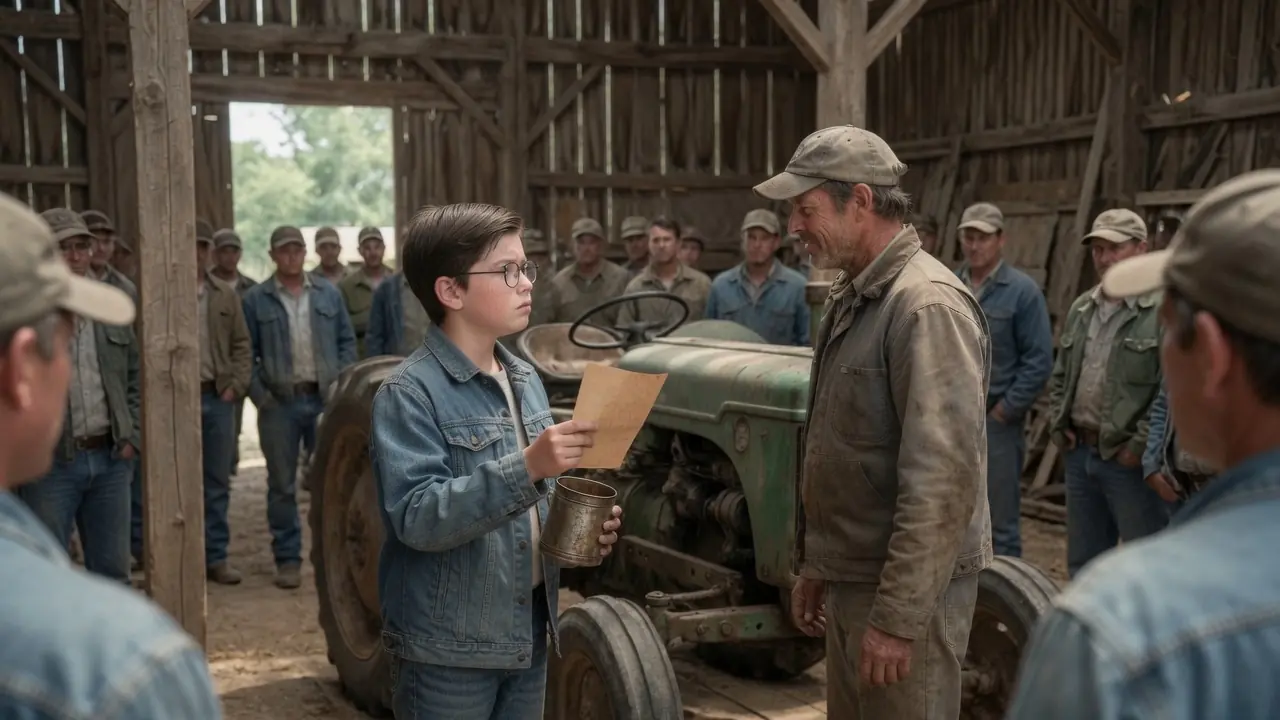
Danny Pruitt stood in the middle of the Siebert Sale Barn with a dented coffee tin held tight against his chest and one hand raised toward the auctioneer.
Around him, grown men in dusty caps and work jackets watched with the kind of amused patience people reserve for children who do not understand they are embarrassing themselves. The old green Oliver 88 tractor sat beside him with faded paint, a missing rear fender, and a front side tilted just enough to make every experienced buyer in the barn shake his head. Ray Denton, the most respected used-equipment dealer in Colby County, stood across from Danny near the tractor’s front wheel, smiling like he had already seen the ending.
The auction barn smelled of dust, diesel, old oil, and coffee poured from thermoses before sunrise.
Rows of farmers stood behind the tractor, shoulder to shoulder, their boots planted on the plank floor, their eyes shifting between Danny and the machine. A few folding chairs sat near the wall, mostly empty, because men at farm auctions preferred standing where they could move fast when something worth buying came up. A big light hung from the rafters, throwing a pale glow over the tractor’s worn hood and the boy who seemed far too serious for his age.
Danny was sixteen, though he looked younger when he stood among men who had been buying and selling equipment since before he was born.
His brown hair fell across his forehead, his denim jacket was too large in the shoulders, and his boots still carried mud from the fourteen-mile bicycle ride he had taken that morning. He had arrived before registration opened, locked his bicycle to a fence post outside, and walked straight into the preview area as if he had every right to be there. The laughter started almost immediately, low at first, then spreading whenever someone saw him crouch with a flashlight and notebook.
Ray Denton had watched him longer than anyone.
Ray had run a used equipment dealership in Colby for fourteen years, and he knew how to read a machine with one look. He had seen beginners mistake rust for age, bent frames for easy repairs, and dead engines for sleeping ones. So when he saw Danny measuring the front axle of the Oliver 88 with a folding ruler, he grinned and said to the men beside him, “Somebody’s boy is playing farmer today.”
Danny heard it.
He did not answer.
He had learned from his grandfather that a man who answered every insult wasted breath better saved for work. So he kept checking the tractor. He checked the oil, the compression, the transmission cover, the hydraulic fittings, and the angle of the front axle from below. Every number went into the little notebook in his pocket, written in careful block letters.
The Oliver 88 was lot 14 on the auction sheet.
Most buyers had walked past it quickly because the problem seemed obvious. The front axle looked bent, the tractor sat wrong, and the catalog described it as damaged, sold as is. A damaged axle meant expensive repair, and expensive repair meant the tractor was worth little more than parts to most people in that barn.
But Danny knew something they did not.
He knew because his grandfather, Roy Pruitt, had kept binders of service bulletins in the equipment shed for decades. He knew because after Roy died, Danny had spent winter nights reading those bulletins by a workbench lamp, one manufacturer at a time, one model year at a time. He knew because the 1952 and 1953 Oliver 88 row crop tractors had a known front kingpin bushing wear pattern that could make the axle look bent when it was not. And when Danny measured the tilt that morning, the number matched the old bulletin almost exactly.
The axle was not broken.
The kingpin bushing was worn.
That was the difference between a ruined tractor and a hidden bargain.
At nine o’clock, the auction began.
The auctioneer moved fast, his voice rolling through the barn while bidders lifted cards and lowered them without ceremony. A grain auger sold for $180, a post hole digger for $55, and a rough John Deere B went to a man who knew he was buying an engine rebuild. Danny stood near the Oliver, coffee tin in one hand, bidder paper in the other, waiting through thirteen lots without shifting his feet.
Ray noticed that too.
When lot 14 came up, the auctioneer stepped beside the Oliver and read from the catalog sheet. “Nineteen fifty-three Oliver 88 row crop, engine runs, visible front axle damage, sold as is. We’ll open at one hundred fifty.” He looked across the crowd. “One hundred fifty. Who gives me one fifty?”
Nobody moved.
The auctioneer dropped his opening bid. “One hundred, then.”
Still nothing.
“Seventy-five?”
A parts dealer near the back lifted his card.
The auctioneer nodded. “Seventy-five. Do I hear eighty?”
Danny raised his bidder paper.
A ripple of laughter moved through the barn.
The auctioneer saw him and paused for only half a beat before continuing. “Eighty from the young man. Do I hear ninety?”
The parts dealer lifted his card again.
“Ninety. One hundred?”
Danny raised his paper.
The laughter thinned.
Not because anyone believed in him yet, but because the boy did not look embarrassed. His face was still, his jaw set, his eyes on the auctioneer, not on the men laughing behind him. Ray Denton’s smile faded a little as he watched. A fool usually looked nervous when spending money he could not afford to lose.
Danny looked like a man following a plan.
The parts dealer went to $110.
Danny went to $120.
The parts dealer lifted his card for $130, then looked at the Oliver again. He was calculating the resale value of engine parts, transmission parts, rear tires, and scrap iron. At $130, there was still money to be made, but not much if the machine fought him. Danny lifted his paper for $140.
The parts dealer lowered his card.
The auctioneer looked around the barn. “One forty. Do I hear one fifty?”
Silence.
“One forty going once.”
Ray Denton folded his arms.
“One forty going twice.”
Danny’s hand stayed up.
“Sold to the young man for one hundred forty dollars.”
The gavel struck, and just like that, Danny Pruitt owned the tractor every adult in the barn had dismissed.
The crowd relaxed into laughter again.
Some men shook their heads. Someone muttered that the boy had just bought himself a lesson. Another man said $140 was not too high a price to learn not to bring coffee money to a real auction. Danny lowered his bidder paper and looked at the Oliver as if he had not heard any of it.
Ray Denton stepped toward him.
“Son,” he said, loud enough for several men nearby to hear, “that front axle is bent. You know that, right?”
Danny turned slowly.
“The axle’s not bent.”
That stopped the closest laughter.
Ray blinked once. “Excuse me?”
“The axle isn’t bent,” Danny repeated. “The kingpin bushing is worn. It looks the same from the outside, but it’s a different problem.”
Ray’s half-smile returned, but it was sharper now. “And you know that how?”
Danny shifted the coffee tin under his arm and pulled his notebook from his jacket pocket. His hands did not tremble. “Oliver issued a service bulletin in 1956 about the 1952 and 1953 models. It describes this exact front-end tilt. The lateral cant is four and a quarter inches at the wheel flange. The bulletin says four to four and a half usually indicates bushing wear, not impact damage.”
The men nearest him went still.
Specific knowledge has a sound when it enters a room.
It is not loud, but it changes the air.
Ray Denton looked at the tractor, then at Danny, then back at the tractor. He had expected a guess, a childish defense, or maybe something his grandfather had told him once while half-asleep in a shed. Instead, he had heard measurements, model years, a technical bulletin, and a diagnosis too precise to be invented on the spot.
“How much to fix it?” Ray asked.
Danny opened his notebook. “Eleven dollars and forty cents if the supply shop still has the bushing in Colby. Maybe twelve if the price went up. Three hours of work if I take my time.”
No one laughed.
The auction continued behind them, but a small crowd had gathered around Danny and Ray, leaving the next lot half-forgotten. Men who had ignored the Oliver all morning stepped closer and looked at the front axle again. They saw the same tilt, the same faded paint, the same rough tractor, but now the machine looked different. Not because the tractor had changed, but because their understanding of it had.
Ray crouched near the front wheel.
He did not touch anything.
He only looked.
Danny waited.
The waiting mattered.
A boy desperate to prove himself would have talked too much. Danny did not. He had said what he knew, and now he let Ray Denton catch up to it in his own time. His grandfather had taught him that truth did not need decoration if the measurements were right.
Ray stood again.
“Where did you learn that?”
“My grandfather,” Danny said. “Roy Pruitt out of Thomas County. He kept every bulletin Oliver ever sent him.”
Ray’s expression shifted. “I knew Roy.”
Danny nodded. “Yes, sir.”
“He was a good man.”
“Yes, sir.”
Ray looked at the tractor one more time. Then he held out his hand.
For Danny, that handshake meant more than the sale.
Ray Denton was not an easy man to impress. Everyone in that barn knew it. He did not apologize with many words, and he did not hand respect to people just because they wanted it. But when his weathered hand closed around Danny’s, the whole barn understood what had happened.
The boy had not gotten lucky.
The boy had known.
And the men had not.
After the sale, Danny stayed long enough to settle his paperwork.
His coffee tin had held $340 that morning, saved over two years from repairs, odd jobs, fence work, and a little money his mother had tried to make him keep for school clothes. Now $140 of it was gone, and in his pocket was a receipt for a tractor most people thought was nearly useless. He folded the receipt carefully and placed it inside his notebook.
Outside, his bicycle leaned against the fence post.
He did not have a way to haul the tractor home that day. He had already planned for that. Mr. Hanley, a neighbor two farms over, had agreed to lend a flatbed trailer on Saturday if Danny managed to buy anything worth hauling. Danny had not told him he expected to buy an Oliver 88.
As Danny unlocked his bicycle, Ray Denton came out of the barn.
“You riding all the way back to Oakley?”
“Yes, sir.”
“Fourteen miles?”
“Yes, sir.”
Ray looked at the coffee tin tied into Danny’s saddlebag. “You always this stubborn?”
Danny thought about his grandfather’s tool chest in the shed, the empty chair at the workbench, and the months after Roy’s death when adults had told him to put away the tools and be a boy. “Not always,” he said. “Only when I’m sure.”
Ray laughed once, quietly.
Not at him.
With him.
That Saturday, Danny brought the Oliver home.
The tractor arrived on the flatbed trailer after noon, rocking gently over the ruts that led to the Pruitt equipment shed. His mother stood on the porch with her arms folded, not angry but worried in the way mothers are when they want to believe and fear the world will punish belief. Danny backed the trailer with Mr. Hanley’s help, unloaded the tractor, and rolled it into the shed that had once belonged fully to Roy.
The shed smelled like old oil and wood shavings.
Roy’s tools were exactly where Danny kept them, organized in the chest his grandfather had built by hand. The service bulletin binder lay on the bench, already open to the Oliver section. Danny ran his fingers once across the page, then set to work. He did not speak much for the next three hours.
The old bushing came out stubborn but clean.
The new one cost $11.40 at the implement supply, exactly as Danny had hoped. He replaced it, checked the alignment, greased the assembly, and tightened everything according to the manual. By late afternoon, the tilt was gone.
Danny stood back and looked at the Oliver.
For the first time, his mother smiled.
“You were right,” she said.
Danny wiped his hands on a rag. “Grandpa was right first.”
On Sunday afternoon, he drove the Oliver down the county road and back.
The engine ran steady, the front axle tracked straight, and the tractor moved like a machine grateful to be understood instead of condemned. Danny listened to every sound, one hand on the wheel, his face serious beneath the sun. When he returned to the shed, he shut the engine off and sat there for a moment before climbing down.
He wished Roy could have heard it.
The story moved faster than Danny did.
By Monday morning, men at the feed store had already heard about the boy at the auction, the coffee tin, the service bulletin, and Ray Denton’s handshake. By the end of the week, the story had reached Oakley, Colby, and half the farms in between. Some versions made Danny sound like a genius. Some made Ray sound foolish. Neither version interested Danny much.
He cared more about the tractor.
In September, a farmer two miles north came to look at it.
The man needed a second tractor for his son and could not afford anything newer. Danny showed him the repair, explained the bushing replacement, showed the compression numbers, and started the engine. The farmer listened, asked two careful questions, then paid $480 without bargaining.
Danny’s $140 auction purchase had become $480 in six weeks.
After parts, he had made $328.60.
At sixteen, that felt like a fortune.
But what mattered more was what came next.
Farmers began stopping by the Pruitt shed with small problems first. A carburetor that would not hold tune. A hydraulic line that behaved strangely. A tractor that coughed only after warming up. Danny fixed what he could, refused what he did not know, and wrote down everything he learned.
Ray Denton came by in October.
He arrived in a pickup with a flatbed trailer and a 1948 Farmall M that had been sitting too long. The block had a crack everyone assumed made it worthless. Ray climbed out, leaned against the truck, and looked toward Danny with the same measuring eyes from the auction.
“I heard you’ve been busy,” Ray said.
“A little.”
“I’ve got something you might want to look at.”
Danny walked around the Farmall slowly.
He checked the crack, the oil, the head, and the casting marks. Ray did not interrupt. After thirty minutes, Danny looked up and said, “It can be saved, but not the way most people would try.”
Ray grinned. “That’s why I brought it.”
They made a deal.
Danny would repair it, Ray would sell it, and they would split the profit. It took longer than the Oliver, but the Farmall sold for $390, and Danny’s share was $155. More important, Ray Denton told three other dealers that the Pruitt boy was worth calling when old equipment had a problem nobody wanted to touch.
By spring, the shed had three machines waiting.
By graduation, Danny had repaired and resold nine pieces of equipment through arrangements with Ray and other farmers. He saved $1,840 before he turned eighteen. He did not buy a new car, new boots, or anything that would have made boys at school notice him. He bought tools, manuals, and more service bulletins whenever he found them.
The more he learned, the quieter he became.
People mistook that for shyness.
It was not shyness.
Danny had learned that the machine always told the truth if a person was patient enough to listen. People talked over each other, guessed, laughed, bragged, and rushed. Engines did not. A worn bearing, a bad bushing, a weak cylinder, a clogged jet, each had its own language.
Roy had taught him the alphabet.
Danny spent the rest of his life reading fluently.
In 1983, at twenty-two, Danny opened Pruitt Agricultural Services.
The sign was plain, painted white with black letters, hanging over the same shed where Roy’s tools still rested. He had no fancy office, no showroom, no sales pitch. Just a workbench, binders, tools, a gravel lot, and a reputation that had started the day a sixteen-year-old boy raised his bidder paper in a barn full of men who thought he was foolish.
Within five years, Danny’s shop was the most trusted independent equipment service in the county.
Within ten, farmers from four counties were hauling machines to him.
He never advertised.
He did not need to.
In rural Kansas, word of a man who could fix what the dealership would not touch was worth more than any newspaper ad. Men came with tractors older than their marriages, combines with strange sounds, planters that skipped rows, and engines everybody else had declared finished. Danny did not promise miracles. He promised to look carefully.
Sometimes the answer was expensive.
Sometimes the machine truly was too far gone.
But sometimes, hidden under rust, bad assumptions, and years of neglect, there was a simple fix everyone else had missed. Those were the jobs Danny loved most, though he never said so. They reminded him of the Oliver.
Ray Denton retired in 1994.
On his last working day, he drove to Danny’s shop and found him standing beside a disassembled transmission. Ray was older, slower, but still sharp-eyed. He carried no part, no problem, no business proposition. He only came to shake Danny’s hand.
“I almost didn’t do it that day,” Ray said.
Danny looked up. “Do what?”
“Shake your hand at the auction.”
Danny smiled faintly. “You thought I got lucky.”
“I did,” Ray admitted. “For about two minutes. Then I realized luck doesn’t quote service bulletins.”
They both laughed.
Ray looked around the shop at the binders stacked above the bench, now far more than Roy had ever owned. “Your grandfather taught you well.”
“He started it.”
Ray nodded. “No. He handed you the door. You walked through it.”
Danny did not answer.
He went back to the transmission because that was easier than receiving praise.
Years passed.
The Oliver 88 story became something men told at diners and feed stores whenever a young person was being underestimated. Some told it with extra details that were not true, like Danny standing on a chair to outbid a rich dealer, or the whole crowd cheering when he explained the bushing. Danny never corrected every version. The heart of it stayed true enough.
A boy had been laughed at.
A machine had been misjudged.
Knowledge had changed the price of both.
One summer afternoon, decades after the auction, a teenager came into Danny’s shop carrying a notebook.
He was nervous, skinny, and too careful with his questions. He said his grandfather had told him Danny might know where to find service information for an old Allis-Chalmers. Danny saw the way the boy looked at the tools, not with boredom, but hunger. He remembered himself at sixteen, standing in a barn with a coffee tin while men laughed.
Danny reached up and pulled down a binder.
“What have you checked so far?” he asked.
The boy blinked. “You want to know?”
Danny placed the binder on the bench. “If you bothered to come here with a notebook, I expect you bothered to check something.”
The boy opened his notebook.
Danny listened.
Outside, the Kansas wind moved dust across the gravel lot. Inside, under the same kind of shop light Roy had once worked beneath, another young person began learning that knowledge could become dignity if carried carefully enough. Danny did not make a speech. Roy would not have either.
He simply handed the boy a flashlight.
“Start at the front,” Danny said. “And don’t assume the obvious thing is true just because everyone agrees on it.”
That was the real lesson of the Oliver 88.
Not that old men could be wrong.
Not that young boys were always right.
The lesson was that general experience could miss what specific knowledge revealed. A whole auction yard of farmers had looked at the same tractor and seen a bent axle. Danny had looked deeper and seen a worn bushing.
The difference was not confidence.
It was preparation.
When people asked Danny years later if he remembered the laughter, he always said yes.
He remembered Ray’s half-smile. He remembered the parts dealer dropping out. He remembered the sound of the gavel, the weight of the coffee tin, and the strange silence after he mentioned the 1956 bulletin. He remembered Ray’s handshake most of all, because that was the moment the barn changed its mind.
But he never hated the men for laughing.
They had looked at him and seen a boy.
They had looked at the tractor and seen damage.
In both cases, they had stopped looking too soon.
Danny Pruitt built his life on the habit of looking longer.
That habit bought him his first tractor, built his business, carried his grandfather’s lessons into another generation, and turned a summer auction in 1977 into a story people still told when someone was underestimated. The dented coffee tin eventually disappeared, though Danny suspected his mother had kept it somewhere. Roy’s tool chest stayed in the shop, worn smooth at the handles from decades of use.
Above the workbench, the Oliver service bulletin still sat in its binder.
The page was yellowed now, the corners soft from being turned and studied. Danny no longer needed to read it. He knew every line by heart. But he kept it there anyway, because some pieces of paper are more than information.
They are proof.
Proof that the thing everyone laughs at may hold value.
Proof that the quiet person in the room may know the missing truth.
Proof that a boy with $340, a coffee tin, and the right knowledge can make an entire auction barn fall silent.