When Claire Boudreaux flooded the old pond, the whole town laughed.
Not quietly.
Not politely.
They laughed the way small towns laugh when they believe someone young has made a mistake too big to hide.
By noon, half of Pine Hollow County had heard about it.
By sunset, every booth at Miller’s Diner had an opinion.
“She inherited fifty-eight acres and decided to turn them into mud.”
“Poor girl doesn’t know farming from fishing.”
“Her daddy couldn’t make that land pay, and now she thinks crawfish will save it?”
Claire heard most of it.
She just kept working.
At twenty-four, she had inherited the Boudreaux farm after her grandfather passed away. The land sat at the edge of Pine Hollow, Mississippi, where the soil had been worked too hard for too long. Cotton had drained it. Soybeans had barely survived it. Corn had failed twice in five years.
Everyone called it worn out.
Claire called it unfinished.
Her grandfather, Louis Boudreaux, had left her more than land. He left her a farmhouse with a leaking porch roof, an old pickup that started only when it felt generous, and a stack of notebooks filled with thirty years of observations.
Not profits.
Not plans.
Observations.
Water levels.
Soil texture.
Bird patterns.
Rainfall.
Grass growth.
And one sentence underlined three times:
The pond is the only part of this farm that still wants to live.
The pond sat behind the south pasture, though nobody in Pine Hollow had called it a pond in years. It was a cracked, weed-choked depression where cattle sometimes wandered for shade. During dry months, dust lifted from the bottom. During storms, water gathered for a few days and disappeared.
Frank Delaney, Claire’s neighbor, said it best one morning at the feed store.
“That ain’t a pond. That’s a hole with memories.”
Frank owned nearly eight hundred acres, two new combines, and the kind of confidence that came from owing the bank more money than he would ever admit.
He liked Claire well enough.
He just didn’t think she belonged on a farm.
“You’re young,” he told her after the funeral. “Sell while people still feel sentimental. Don’t let that place ruin your life.”
Claire thanked him.
Then went home and read her grandfather’s notebooks again.
One page changed everything.
Louis had sketched the old pond, marking natural drainage lines and low spots where water held longest. At the bottom he had written:
If someone ever brings water back, don’t waste it fighting the land. Raise crawfish. Let the wet ground earn its keep.
Claire had never raised crawfish in her life.
So she learned.
She drove two counties over to talk with an old aquaculture farmer named Vernon Tate. Vernon was seventy-six, patient, and unimpressed by excitement.
“You think you can just flood a hole and get rich?” he asked.
“No,” Claire said. “I think I can learn.”
Vernon looked at her for a long time.
Then handed her a pair of rubber boots.
“Good. Start by cleaning traps.”
For six weeks, Claire worked beside him before sunrise. She learned water depth, bait timing, oxygen levels, predator control, drainage gates, and the difference between mud that held life and mud that only held water.
When she returned to Pine Hollow, she didn’t announce a plan.
She rented equipment.
Rebuilt the pond banks.
Cleared brush.
Installed a pump.
Repaired the old drainage ditch her grandfather had marked in pencil thirty years earlier.
That was when the laughter really started.
Trucks slowed on the road.
Men leaned against fence posts.
Frank Delaney stopped by one afternoon and watched water spread across the pond bottom.
“Claire,” he called, shaking his head, “you know crops don’t grow underwater.”
She wiped sweat from her face.
“I’m not growing crops.”
“That’s what worries me.”
When the crawfish arrived in white delivery crates, people acted like a circus had come to town.
Children pointed.
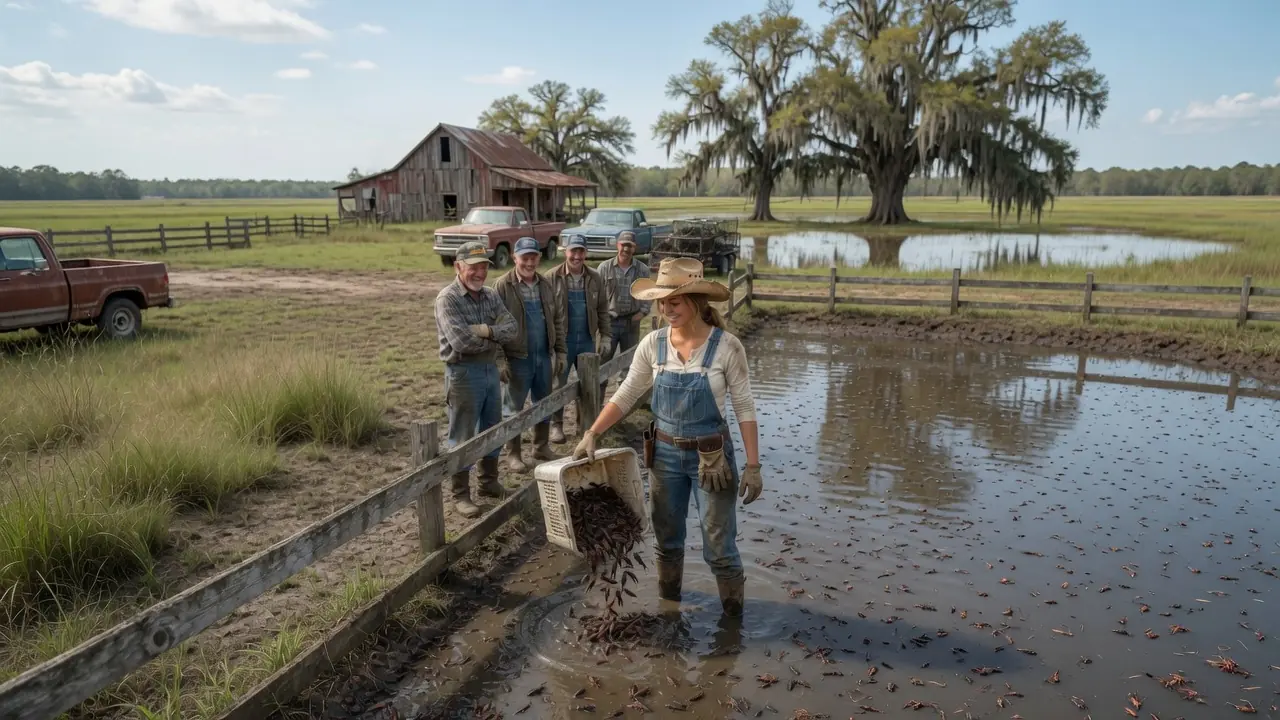
Farmers laughed.
Someone joked that Claire was stocking the county’s most expensive ditch.
She released the crawfish anyway.
Then came the waiting.
That was the hardest part.
Nothing looked successful while it was becoming successful.
The pond sat quiet.
The fields around it looked empty.
Claire woke before daylight, checked water levels, tested oxygen, inspected the banks, repaired leaks, and wrote everything down in a notebook just like her grandfather had.
At night, she sat at the kitchen table adding numbers.
Fuel.
Feed.
Trap wire.
Pump repairs.
Loan payments.
The math scared her.
The silence scared her more.
Some evenings, she wondered if everyone else had been right.
Maybe love for land wasn’t enough.
Maybe her grandfather had seen hope where there was only mud.
Then one morning, she pulled up a test trap and found six crawfish inside.
Not many.
But alive.
Healthy.
Red as embers.
Claire stood there holding the trap and laughed so hard she cried.
Two weeks later, every trap came up heavy.
By harvest season, the old pond that everyone mocked was producing more than anyone expected.
The first seafood buyer opened one crate, reached inside, and smiled.
“These are clean.”
Claire tried not to sound nervous.
“Is that good?”
He laughed.
“That’s excellent. How much can you bring me tomorrow?”
“Tomorrow?”
“I’ll take everything you’ve got.”
Within a month, refrigerated trucks were turning down the same road where neighbors had once slowed to laugh.
Frank Delaney stopped laughing first.
Then he started asking questions.
“How deep did you flood it?”
“What bait are you using?”
“How often do you pull traps?”
Claire answered him honestly.
That surprised him.
“I figured you’d tell me to go to hell.”
She smiled.
“I thought about it.”
He laughed, embarrassed.
“I deserved that.”
“You did.”
Frank removed his cap.
“I was wrong about you.”
Claire looked past him toward the pond, where water shimmered beneath the late afternoon sun.
“No,” she said softly. “You were wrong about the land.”
The story spread beyond Pine Hollow.
First came local farmers.
Then the county extension office.
Then a reporter from Jackson.
By the next spring, agriculture students visited the Boudreaux farm to study how Claire had turned failed cropland into a working crawfish pond with careful water management and old notes everyone else had ignored.
A professor asked her during one visit, “What made you see value here when nobody else did?”
Claire opened her grandfather’s notebook and touched the underlined sentence.
“I didn’t see it first,” she said. “He did.”
The professor smiled.
“And what did he teach you?”
Claire looked across the pond.
“He taught me that land isn’t stubborn. People are. We keep trying to force it to become what we want.”
She paused.
“But sometimes the land is already telling us what it can be.”
Five years later, the Boudreaux farm had changed completely.
The farmhouse roof no longer leaked.
The old pickup still sat beside the barn, though Claire now drove a newer truck for deliveries.
The pond had been expanded carefully, never faster than the land could handle.
She hired three local workers during harvest season.
Then five.
Then eight.
The same people who once called the pond a mistake now brought their sons and daughters to learn from her.
At the entrance to the farm, Claire placed a small wooden sign.
It didn’t mention profit.
It didn’t mention success.
It carried only one line from Louis Boudreaux’s notebook:
Don’t waste good water trying to grow the wrong thing.
Visitors often stopped to photograph it.
Claire always smiled when they did.
Because the sign was not really about crawfish.
It was about patience.
About listening.
About refusing to let other people’s certainty become your future.
The entire county had laughed when she filled a dry pond with crawfish.
Then harvest came.
And suddenly, the farm everyone thought was finished became the one nobody could stop talking about.