The drilling rig sank into the northern pasture at 9:17 on a Tuesday morning, and by the time the shouting began, the woman who owned the land had already made up her mind about what she would not do. She would not sign a document she had not read. She would not let strangers tear apart a drainage system her father had spent ten years building. And she would not apologize for standing on ground her family had worked for three generations, even when the man in the polished boots told her that resisting him would cost more than she could afford.
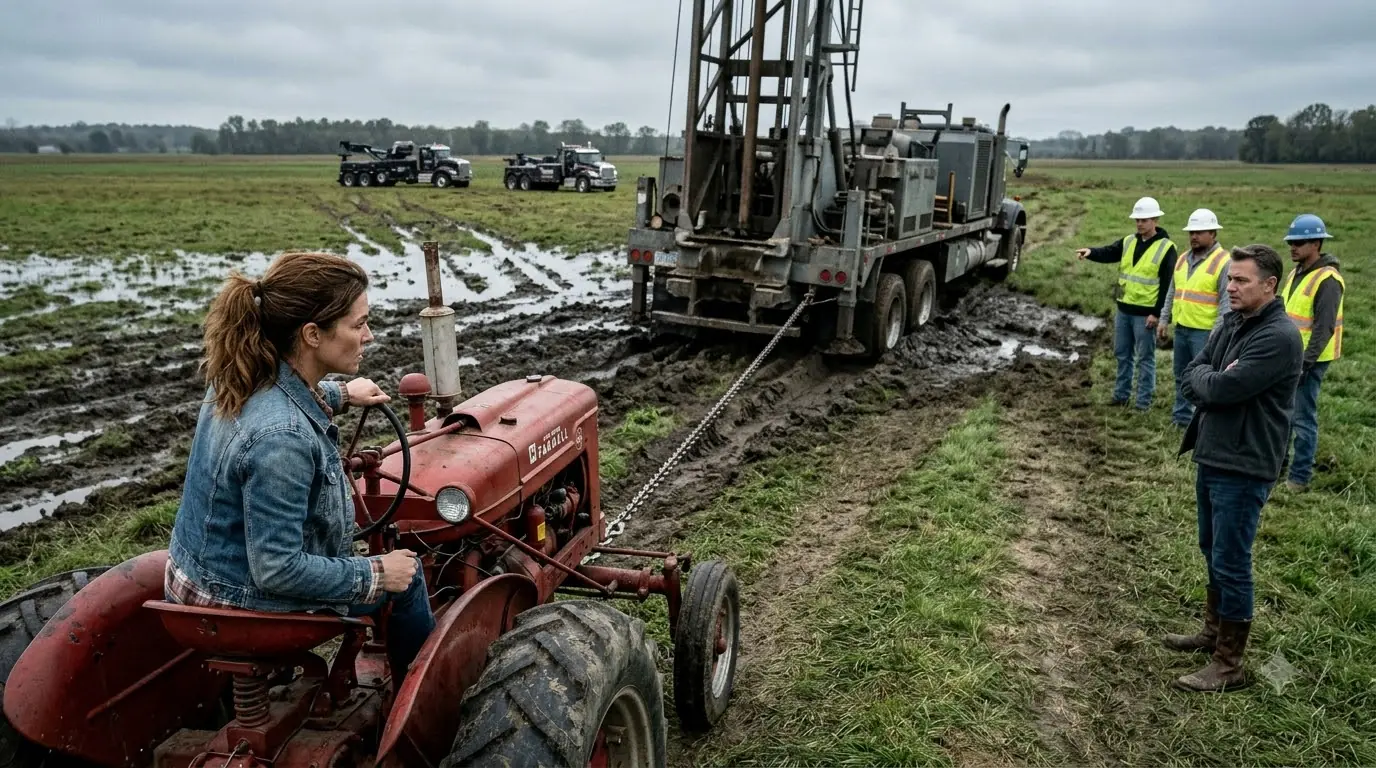
The man was Preston Vale, regional director for Meridian Pipeline, and he had arrived with a laminated map, two attorneys on standby, and a convoy that made the county road look like a construction yard. He had a manner that suggested every disagreement was merely a delay before his eventual victory. When the old farmer's daughter had asked him to stop, he had smiled without warmth, lifted his radio, and told the operator to proceed. Now seventy-six thousand pounds of drilling equipment sat crooked in the wet earth, its rear axles buried nearly to their housings, while Preston stared at the field as though the field had personally deceived him.
At the edge of the crowd, a laborer named Eddie Ruiz glanced toward an open barn and laughed. Inside stood a faded red Farmall tractor older than nearly everyone working on the project. “Maybe she can drag it out with that museum piece,” he said. Three men chuckled, and Preston gave the weary smile of an executive trying to maintain control of an embarrassing situation. The woman heard them, but she did not look up. She was studying the tire marks and the way water shimmered in the troughs where the heavy tires had cut the ground.
She had learned to read a field before she could read a map. Her father had taught her that soil remembered every mistake made upon it, though she had not understood until much later that people could be the same. A tire mark could tell you where a truck entered, where its driver changed his mind, and where the weight shifted. As she crouched beside the first set of tracks, she saw something that had nothing to do with the rig being stuck. Whoever had directed this machine had sent it deliberately across the wrong part of her farm.
Eight weeks earlier, at forty-two, Emily Harper had returned to Clay County, Minnesota, for her father's funeral with one black dress, a borrowed suitcase, and a plan to stay no longer than twelve days. She worked in Minneapolis as an operations manager for a regional agricultural equipment supplier, a position that gave her a reliable paycheck and the privilege of being tired for reasons she could identify. Her father, Walter Harper, had died in his own bed before dawn on a cold March morning. The neighbor who found him said the kitchen light was on and a cup of coffee sat untouched beside the sink. He had apparently risen, decided he was tired, and gone back upstairs without telling anyone.