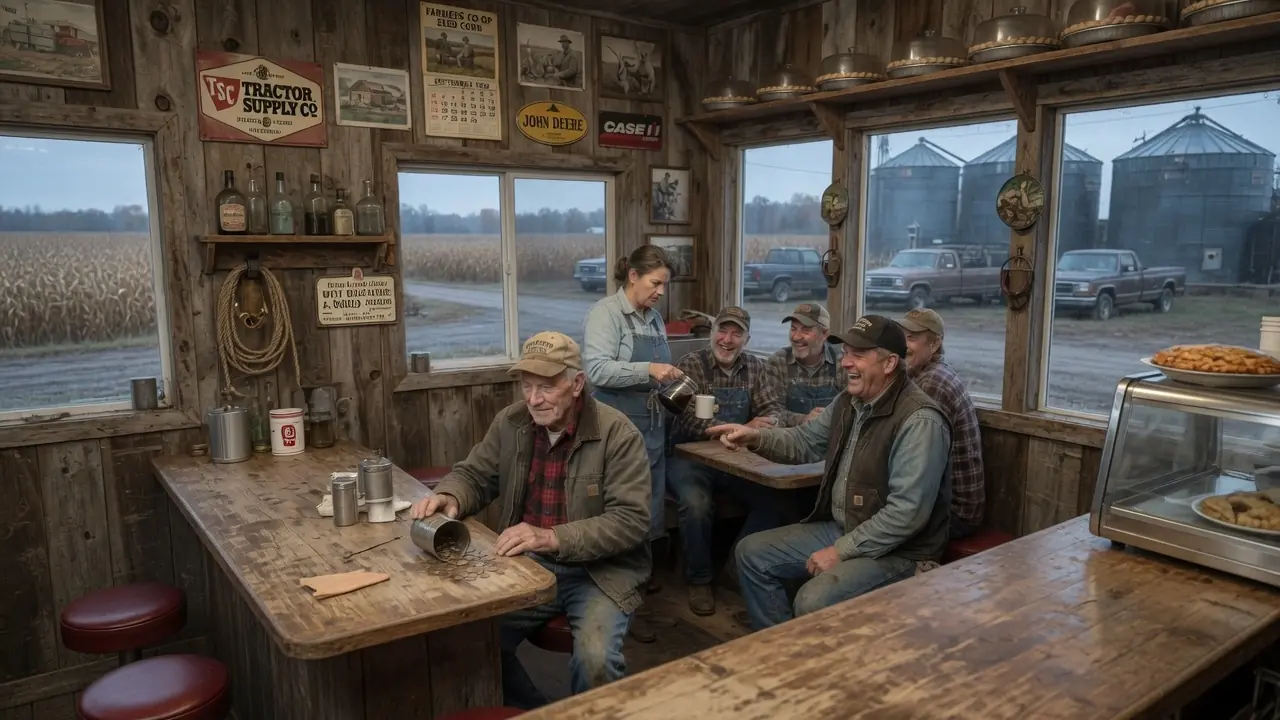
Every morning at six-thirty, Henry Whitaker walked into Mae’s Diner with the same old canvas jacket, the same faded cap, and the same coffee can full of coins.
Pennies.
Nickels.
Dimes.
Sometimes quarters, if the week had been good.
He always sat at the last stool near the window, the one with a small crack in the vinyl cushion, and waited until Mary came over with the coffee pot.
“Morning, Henry.”
“Morning, Mary.”
“Same breakfast?”
“Same breakfast.”
Two eggs.
Dry toast.
Black coffee.
No bacon.
No sausage.
No hash browns.
Henry could afford none of those things, or at least that was what everyone in Mason Ridge believed.
He would finish eating slowly, wipe the corner of his mouth with one napkin, then take out the coffee can and begin counting.
One coin at a time.
No hurry.
No embarrassment.
Just the soft little clink of metal against the counter while everyone else pretended not to watch.
Some people felt sorry for him.
Others enjoyed it.
Especially Dale Mercer.
Dale owned the newest combine in the county, drove a glossy black pickup that had never seen real mud, and liked reminding people that farming was a business now, not a place for old men with rusted equipment and stubborn habits.
One morning, as Henry counted out dimes beside his empty plate, Dale laughed from the big booth near the register.
“Henry, you know they invented paper money a while back.”
A few men chuckled.
Henry didn’t look up.
Mary did.
She shot Dale a look sharp enough to cut pie crust.
But Dale kept going.
“You keep paying in coins like that, folks are gonna start thinking you buried your wallet during the Depression.”
Henry placed another nickel on the counter.
Then another.
His hands were old, but steady.
When he finally had enough, he pushed the coins toward Mary.
“There you go.”
Mary softened.
“You know you can just pay me tomorrow if you’re short.”
Henry looked up then.
His blue eyes were pale, clear, and surprisingly calm.
“I’m not short.”
Dale laughed again.
“Could’ve fooled us.”
Henry stood, tucked the empty coffee can under his arm, and left without answering.
Outside, his 1971 Ford truck waited near the road.
The paint had faded from green to something close to gray.
The passenger door didn’t match.
The engine took three tries to start and complained every time.
People watched him drive away the way they watched old barns in a storm, wondering how much longer the whole thing would hold together.
Across Mason Ridge, farmers were expanding.
Borrowing.
Upgrading.
New irrigation.
New machines.
New land bought with bank money and hope.
Henry did none of that.
His farm looked almost abandoned.
No shiny equipment.
No big grain bins.
No fresh fences except where they truly needed fixing.
He wore the same jacket for fifteen winters.
Drove the same truck for twenty years.
Paid for breakfast with coins.
And because people saw only what he spent, they assumed they knew what he had.
They were wrong.
Henry Whitaker was not poor.
He was patient.
The habit had begun when he was twelve years old, the year his father placed three jars on the kitchen table.
One jar for spending.
One jar for saving.
One jar for land.
“Land?” young Henry had asked.
His father nodded.
“Money disappears if you let it sit too close to wanting. Land stays where you put it.”
Henry never forgot that.
After his father died, Henry kept the jars.
Then the jars became envelopes.
The envelopes became ledgers.
The ledgers became bank accounts no one in town knew existed.
He did not believe in showing money.
He believed in moving it quietly.
The first piece of land came in 1968.
Eleven acres of dry pasture nobody wanted.
Too far from the highway.
Too rocky for corn.
Too small for anyone ambitious.
Henry bought it for almost nothing.
No announcement.
No celebration.
Just one deed folded neatly into a metal box beneath his bed.
Five years later, he bought another piece.
Then another.
A narrow strip by the creek.
A forgotten hay field behind the old Miller place.
Twenty acres of scrubland when the Jenkins brothers moved to Arizona.
None of it looked important alone.
That was the point.
People noticed big moves.
They ignored small ones.
For thirty-seven years, Henry bought the land everyone else overlooked.
He never outbid anyone loudly.
Never showed up in a new suit.
Never acted eager.
He simply waited until somebody needed cash, then made a fair offer.
Sometimes he paid with a cashier’s check.
Sometimes with savings bonds his father had bought decades earlier.
Sometimes with money earned from renting out land nobody even realized he owned.
Each purchase looked small.
Scattered.
Almost random.
But Henry had a map pinned to the wall inside his farmhouse pantry.
Every parcel he owned was marked in red pencil.
At first, the red marks looked like freckles.
Then they became lines.
Then corridors.
Then something larger.
A shape no one else could see.
All except one piece.
The Barlow tract.
Four hundred and eighty acres of rich bottomland stretching between Henry’s old farm and the creek.
The best soil in the county.
The last missing piece.
For decades, it belonged to the Barlow family, and Henry never once asked to buy it.
He knew better.
Land like that did not become available because someone wanted to sell.
It became available when life cornered them.
And life finally did.
By autumn, the Barrows were drowning in debt.
Two bad seasons.
One failed expansion.
A loan called in by the bank.
The auction signs appeared on a Tuesday morning.
By noon, the whole county knew.
Dale Mercer walked into Mae’s Diner that day smiling like harvest had come early.
“Barlow land’s going up,” he announced, loud enough for everyone to hear.
“That bottom ground is mine.”
One farmer asked, “You sure?”
Dale leaned back.
“Bank already likes me. I’ve got the equipment, the operation, the credit. Nobody else can handle that much land.”
Henry sat at the counter, stirring his coffee.
Dale noticed and grinned.
“Unless Henry here wants to buy it with pennies.”
The diner burst into laughter.
Mary didn’t.
Henry only placed his spoon beside the cup.
Then he took out three dimes and two pennies for the tip, stood up, and left.
The auction happened three weeks later on a cold, bright morning.
Nearly the entire county showed up.
Men with bank approvals.
Men with borrowed confidence.
Men wearing boots polished for the occasion.
Dale Mercer arrived in his black pickup with two bankers beside him and a smile already prepared for victory.
Henry arrived alone in the old Ford.
No one paid much attention.
He stood near the back fence with both hands in his jacket pockets.
The auctioneer began at two hundred thousand.
The number rose fast.
Three hundred.
Four.
Five.
Men dropped out one by one.
Some shook their heads.
Some cursed under their breath.
Dale kept bidding.
So did a farming corporation from two counties over.
The price climbed past what most people expected.
Seven hundred thousand.
Eight.
Nine.
The crowd murmured.
Dale’s smile tightened.
At nine hundred and fifty thousand, the corporation dropped out.
The auctioneer looked across the field.
“Nine-fifty going once.”
Dale lifted his chin.
The county seemed to accept the outcome before the hammer fell.
“Nine-fifty going twice.”
Then Henry raised one hand.
“One million.”
No one moved.
Not even the auctioneer.
Dale slowly turned around.
“What did he say?”
Henry spoke clearly.
“One million dollars.”
Someone laughed, thinking it was a joke.
The auctioneer didn’t.
He looked at Henry.
“Mr. Whitaker, I’ll need proof of funds before accepting that bid.”
Henry nodded.
He walked forward slowly, reached inside his jacket, and handed him a sealed bank envelope.
The auctioneer opened it.
Read the letter.
Then read it again.
His expression changed.
“Bid accepted.”
The crowd went silent.
Dale’s face turned red.
“That’s impossible.”
The auctioneer looked at him.
“Do you bid one million fifty?”
Dale turned toward his bankers.
They whispered urgently.
One shook his head.
Dale looked back at Henry.
For the first time in his life, he had no joke ready.
“One million going once.”
The wind moved through the dry grass.
“One million going twice.”
Henry stood perfectly still.
“Sold.”
The hammer fell.
To the man who paid for breakfast in coins.
The silence after that hammer was louder than any laughter Henry had ever endured.
People stared as though he had taken off a mask.
Dale marched toward him.
“Where did you get that kind of money?”
Henry looked at him calmly.
“Same place everyone gets money.”
Dale frowned.
“Where?”
“From not spending all of it.”
Then Henry signed the papers and drove home.
But the questions did not stop.
By evening, someone pulled county records.
Then someone else pulled more.
Different parcels.
Different years.
Different sellers.
Same name.
Henry Whitaker.
The dry pasture near the ridge.
Henry Whitaker.
The creek strip.
Henry Whitaker.
The old Jenkins field.
Henry Whitaker.
The Miller back acres.
Henry Whitaker.
One by one, the pieces began to speak.
What looked scattered became connected.
What looked small became massive.
For nearly four decades, Henry had been quietly assembling the largest continuous block of farmland in Mason Ridge County.
The Barlow tract had not made him rich.
It had completed the shape.
By the following week, maps of Henry’s land were being passed around the diner like scandal.
Dale sat silent in his booth, staring at one of them.
Mary looked over his shoulder.
All that red pencil formed one enormous stretch of property from the ridge to the creek.
Nearly three thousand acres.
Paid for.
No bank liens.
No partners.
No loans.
Henry walked in at six-thirty the next morning like nothing had happened.
Same jacket.
Same cap.
Same coffee can.
Mary poured his coffee.
“You could’ve told me.”
Henry smiled.
“About what?”
She gave him a look.
He chuckled softly.
“Mary, people hear what they’re ready to hear.”
Dale stood from his booth.
The whole diner tensed.
For once, he didn’t laugh.
He walked to the counter and removed his cap.
“I was wrong about you.”
Henry looked up.
“Yes.”
Dale swallowed.
“I’m sorry.”
Henry studied him for a moment.
Then nodded.
“Sit down, Dale.”
Dale blinked.
“What?”
“Sit down. Coffee’s better before it gets cold.”
Slowly, awkwardly, Dale sat two stools away.
Mary poured him a cup.
For several minutes, nobody said anything.
Then Dale asked the question everyone wanted answered.
“Why the coins?”
Henry looked down at the little pile beside his plate.
“My father taught me to count what leaves my hand.”
Dale frowned.
“You don’t trust banks?”
“I trust banks fine.”
Henry picked up a penny.
“I don’t trust habits.”
The diner grew quiet.
Henry continued.
“Big losses don’t always start big. Sometimes they start with one small thing you stop paying attention to.”
He placed the penny on the counter.
“This makes me pay attention.”
After that day, Mason Ridge never laughed at Henry’s coins again.
But Henry didn’t change.
No new truck.
No new house.
No expensive watch.
No grand speech about success.
He still repaired fence posts himself.
Still drank black coffee.
Still counted coins after breakfast.
Only now, people watched differently.
Not with pity.
With curiosity.
A few younger farmers even started asking him for advice.
Henry rarely gave much.
When he did, it was simple.
“Buy what lasts.”
“Borrow less than they offer.”
“Don’t confuse looking successful with being free.”
Years later, after Henry passed, his will created the Whitaker Land Trust.
The farmland would never be sold to developers.
Young farmers could lease pieces of it at fair rates.
Local families could keep working soil that might otherwise have disappeared beneath subdivisions and parking lots.
At the dedication ceremony, Mary—older now, with silver in her hair—stood beside the same auctioneer who had once asked Henry for proof of funds.
A small bronze plaque was placed at the entrance to the land trust office.
It read:
Henry Whitaker paid in coins, lived with patience, and bought the future one quiet acre at a time.
People smiled when they read it.
Some remembered the old coffee can.
Some remembered the laughter.
A few remembered being the ones who laughed.
But everyone understood eventually.
Henry had never been trying to look wealthy.
He had been trying to stay free.
And freedom, he knew, was not built in one lucky moment.
It was built quietly.
In habits.
In restraint.
In decisions no one applauds.
And in the patience to buy tomorrow while everyone else is busy showing off today.